
Introduction to Data Structures
Data structures are a very basic and important element of computer programming and software engineering. As soon as a program has to store, organize, retrieve, or manipulate info it requires a good way to present that info in memory. A data structure provides a systematized approach to do all of that. As opposed to looking at data as a set of unconnected values, programmers put info into structures which in turn make certain operations easier and more efficient. For example a program may have to put in a list of student names, run tasks which are in a queue, present how people are related to each other, or very quickly find info using a unique key. We have different data structures for different purposes which is why it is so important for any programmer to study them. Whether you are developing a small app or a large scale software development project, knowing how data is put together helps you write programs that are easier to understand, maintain, and improve.
At base, a data structure is a method of organization and storage of data for computer programs to use it well. Data may be numbers, characters, text, objects, records, or more complex sets of info. While just putting data away is a start, it is not enough as programs are always performing actions on that data. They may be looking for certain values, adding in new info, deleting old info, updating records, sorting items out, or getting to info at exact positions. Also, what data structure is used plays a large role in how well those functions go. For starters it is useful to think of data structures as different kinds of containers. As a bookshelf, filing cabinet, queue, and toolbox are designed to organize physical things in different ways, we have arrays, linked lists, stacks, queues, trees, graphs, hash tables, and heaps which organize digital info by different rules.
Importance of Data Structures
Data structures are basic to programming which almost never work with single bits of info at a time. A simple app may have to manage thousands or millions of values and the way they are organized plays a great role in the performance of the program, memory use, and overall behavior. Think of an app that has to store info on thousands of customers. If the program uses an improper data structure for that task, finding or updating a record may require a great deal of extra work. With the right data structure the same task can be performed much more efficiently. This is especially true as apps grow. A method that works fine with 10 items may break down with 10 million. Thus data structures are a tool which programmers have to design programs that scale with increasing amounts of info while keeping performance and results predictable.
Another issue which puts forth the value of learning data structures is that they are the base for algorithmic knowledge. An algorithm is a step by step set of procedures to solve a problem, and a data structure is what we use to store the info that the algorithm will use. These concepts are very much related. For example a search algorithm may perform differently as a function of what type of storage the info is put in in an array, a linked list, or a tree. Also an algorithm for breaking out tasks may be much easier to put together when the tasks are in a queue. By studying data structures we get the terms and mental models to see why some algorithms do so well. Also it helps developers look at different options instead of just writing out code which produces the right results.
How Data Structures Organize Data
A computer uses memory which has locations that programs access. We have data structures which give the rules for how data elements relate to each other. Some structures put elements in a sequence which means one item comes after another. Others present a hierarchy in which an element may have many children. Also some structures are based on the relationship between elements instead of a simple sequence. The structure of the data determines how a program may access and manipulate the info. For example an array puts elements in a linear structure which typically may be accessed by index, while a tree puts elements in a parent/child relationship. For beginners it is more valuable to grasp which structure best represents the data’s relationship than to memorize the complex implementation details. Also to note is that the main idea is recognition of what type of relationship the data has and which structure best puts that relationship forward.
In most cases there is not a single data structure which will suit all situations. Programmers select structures based on the issue at hand.
Common Types of Data Structures
Arrays
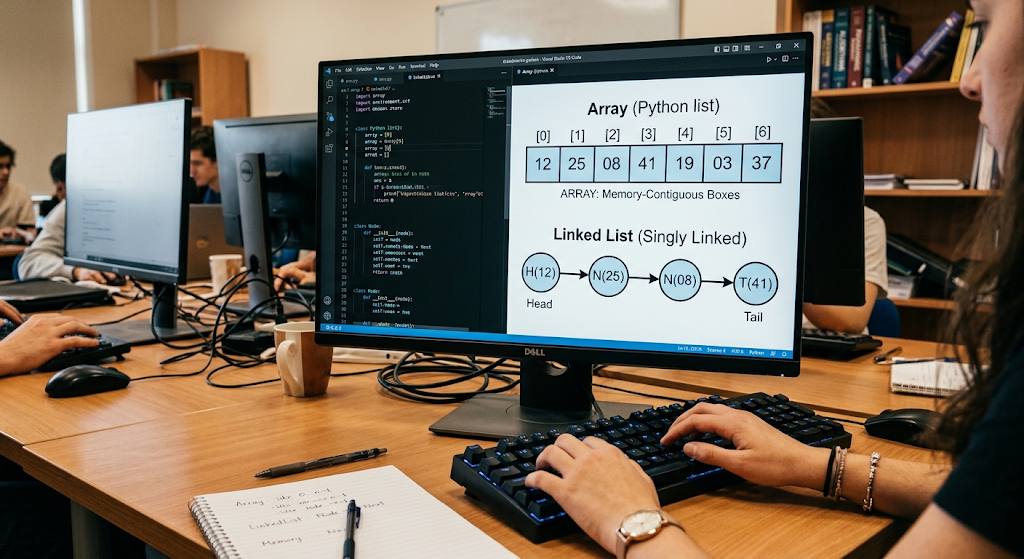
An array is a very basic and very common type of data structure. It puts many elements into a sequence which has a position for each element we call that position an index. For instance an array may hold the weather report for a week, which for our purpose is each day. Also among arrays’ great features is that you can go right to an element when you know its index. That makes them very useful in programs which are constantly looking up info by location. We see wide use of arrays in programming because they are easy to grasp and present a simple way to handle groups of related values. Also in some programming languages arrays may have a set size which does not change but in other languages they are used in structures which grow as you add more elements in.
The best structure is one that which a program’s main operations use. If a program is mostly accessing elements by index, an array may very well be the right choice. But if it is constantly inserting and removing elements at various positions, other structures may present a better solution.
Linked Lists
A linked list which is a method of organizing data does so in a sequence of nodes instead of in a single continuous block as arrays do. Each node has some data and a reference or link to another node. In a singly linked list each node points to the next node, but in a doubly linked list we also have the ability for a node to point to the previous node as well. This structure is also a part of what allows the list to grow or shrink as elements are added or removed without the same type of element shifting that is present in arrays. Also linked lists are used as a way to present how references connect separate pieces of info and they are that which also introduce us to dynamic data organization.
In many cases what we see is that while linked lists do not usually offer the same which element is at what exact position like in arrays. For instance instead of going straight to the item at hand in a particular location, a program must begin at the start and trace through each element using the links which go from one node to the next until it gets to the required place. Also this can be a large time consumer if what you are looking for is at the end of the list. At the same time that is a pro which linked lists put forward when what you are doing very often includes adding or removing items and when you value the ability to have a very flexible structure which can grow or shrink easily more so than the speed of access to a given spot. Also in the learning stage of programming linked lists’ use is very pedagogical as they introduce basic but very important ideas of pointers, references, nodes, dynamic memory and the interconnection between data elements which we see again in more complex structures.
Stacks
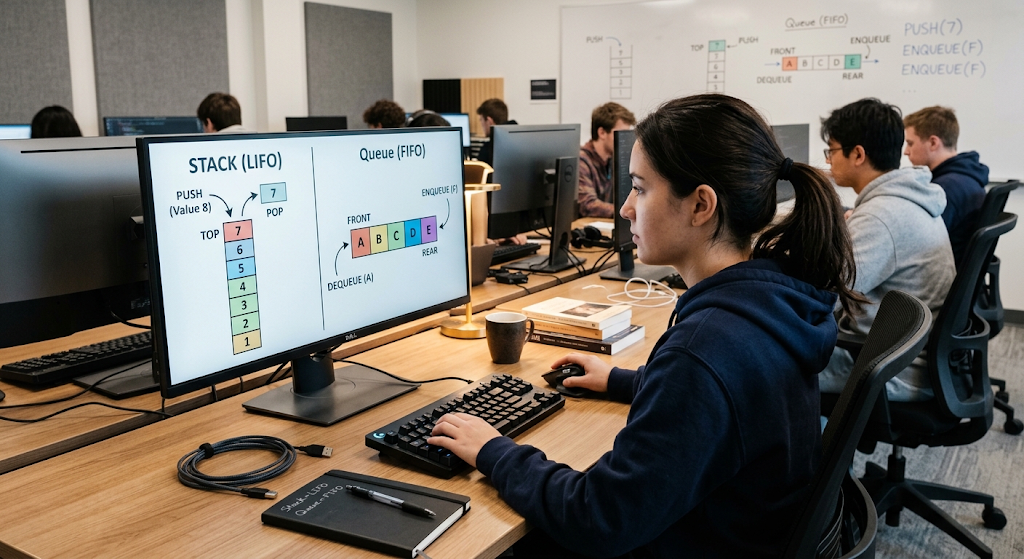
If in a series of books placed on top of each other the last one that goes on is the first one to come off, in programming we see that a stack which usually performs a action to add an item (which we call push) and an action to remove the most recent addition (which we call pop). Also in stacks you can see a function which views the top element without removing it. They are put to use in situations where the information that was most recently added needs to be looked at or used before that which is older.
Stacks are a very practical feature in computer science. In programming languages and runtime systems we see stack based tools for function call and local info management and also apps which use stacks for things like undo actions, expression evaluation, and some problem types. For instance as a user does a series of edit actions and then hits undo the application puts those actions into a stack and steps back from the most recent action which is at the top of the stack. Also in the study of stacks we see the idea that the order of data processing is a function of a defined rule which is a fundamental concept. This same base concept plays out in the study of algorithms, recursion, parsing and other programming fields.
Queues
A queue also is a linear data structure but for the most part it follows the First In First Out (FIFO) principle. This means that the first item put in the queue is also the first one out. A good example is a queue of people waiting for a service. The first person in line is the first to be served, then the next in line. In computing queues are put to use any time tasks or requests have to be handled in a specific order. A program may put in incoming tasks to a queue and then go through them one at a time. Also common are queue operations which we call enqueue for adding an element and dequeue for removing an element.
Queues play a large role in operating systems, networking, printing and also within customer service settings and task processing systems. Also, we see instances in a multi user setting where printers feed off a queue of print jobs which then runs through in a serial process. Also queues are very present when looking at which nodes to access in data structures such as trees and graphs. While stacks follow the LIFO principle, queues follow the FIFO this may at first look like a small thing, but in reality the decision between the 2 has great impact on the functioning of the application. In fact it is out of this that we see a strong base for how one goes about ordered processes. Also, we see the basic principles of the two structures used as a basis for more complex designs of systems that do ordered processing.
Trees
A tree is a hierarchical structure of elements which are put in a parent and child relationship. Also unlike a simple list which is linear, a tree can branch out in many directions. At the top of the tree is the root element which has all other elements reported to it, below that are the nodes which may also have nodes reporting to them. A node which does not have any of its own is a leaf. We see trees used to present info that has a natural hierarchy. For example on a computer we have files in folders which are in other folders, in organizations we have a report structure, we use categories which have sub categories. Also we use certain types of trees which are designed for specific purposes which in turn allow for certain actions to be performed more so than others.
One of which is the binary tree where each node has at most two children. In a binary search tree we apply order rules which in turn make the search, insert and delete operations very efficient when the tree is properly structured. Also we see other specialized trees in databases, file systems, compilers and many other computing fields. It isn’t that a beginner has to memorize all types of trees at once. What is key is that trees present a hierarchy. Once that concept is grasped, more complex ideas like tree traversal, binary search trees, balanced trees and priority structures fall into place.
Graphs
Graph theory provides us with structures which we may use to present relationships or connections between entities. A graph has vertices which are also referred to as nodes, and edges which are the connections between these nodes. Also unlike a tree, a graph does not have to have a single root or a strict parent child structure. Connections may go in any direction and may form very complex networks. This feature makes graphs very useful for modeling real world systems like social networks, transport networks, communication networks, computer networks, and the relationship between web pages. In a social network for example we may put people at the nodes and the relationships between them at the edges.
Graphs present a structure which may be directed or undirected based on the presence of a set direction for connections. Also they may be weighted in which case an edge may represent info like distance, cost or time. Such features which graphs present enable them to model very complex systems. We have algorithms which run on graphs which in turn help us solve issues like route finding, out which connected components are present, network exploration or to determine what is the relationship between entities. Also learning graphs is of great value in that many real world issues play out in a connected context rather than with simple sets of values. They also serve as a base for study of advanced algorithms.
Hash Tables
A hash table is a data structure which we use to put data away very quickly at the same time we are also able to look up that data instantly. As opposed to going through all saved items one by one a hash function is used to convert a key into a place or index which the related info is put in or retrieved from. For instance a program may use a person’s username as a key which is then associated with info related to the user’s account. When the username is given again the hash table uses the key to find out the related info very efficiently.
Hash tables are used in dictionaries, caches, databases, symbol tables, and in any application that requires frequent key based lookups. An issue we see is that at times the same location is put to use by different keys which is what we call a collision. In terms of implementation we see that hash tables use a variety of methods to handle these collisions and at the same time maintain performance. What is very basic to know is that hash tables in fact trade off some memory and also implementation complexity for that efficiency in key based access. They also prove that which organization method you choose may greatly impact how a program does in terms of info retrieval.

Heaps
A heap is a type of tree based data structure that is mostly used in a program that requires constant access to the highest or the lowest priority element. In a min-heap the smallest value is at the top as per its order rule, and in a max-heap the largest value is at the top. Heaps are very useful for implementing priority queues in which elements are processed based on priority instead of the order in which they arrived. For example a system may require to process critical issues before non critical ones which were reported in earlier.
Heaps are also present in many algorithms which include heap sort and some graph related algorithms. While it is true that heap structures can be represented as trees, they are in fact best put into practice using arrays. This is a great reason for beginners to study the basic principles of data structures which in turn will make it easier to see through the implementation of the concept. A heap gives you a framework to maintain priority info and to very efficiently produce the next element which should be processed.
Choosing the Right Data Structure

Choosing what data structure to use is based on the problem at hand and the actions the program must do most often. No single data structure can be used for all applications; it is not automatic that one is best for all. Array is a good choice for when you need quick access of items by their index; also for that which you do a lot of insertions and deletions a linked list will be better. Stack does well for when the last item put in is the first out and queue does for the opposite to that first in first out. Trees are used for hierarchical info, graphs for very complex sets of relationships, hash tables for looking up by key, and heaps for priority based processing. Programmers look at speed, memory use, data set size, how the data is accessed, and what the requirements are for the program’s structure before they make their choice.
The issue of data structure performance is usually put in terms of time and space complexity. Time complexity is how the amount of work done by an operation changes as we add more data, and space complexity is what it’s going to use out of memory. We put this forward in terms of Big O notation for example O(1), O(log n), O(n), or O(n^2). While it isn’t necessary for beginners to get into math right away, what they should get out of it is that some operations perform better than others as scale increases. A program which does well with a small set may break down when you have large sets. By understanding this isotope which data structures to use for which tasks.
Data Structures and Algorithms
Data structures and algorithms which are very much related fields in computer science. A data structure puts info in a certain organization and an algorithm details out what the problem is to be solved or how info is to be processed. For example a program will put values into an array and then use a search or sort algorithm to go over that info. Also a graph may be used with an algorithm that finds paths or which explores relationships. A queue which is a type of data structure supports an algorithm which goes through items in a certain order and a heap which is another data structure supports a priority based algorithm. What also plays a large role in how well an algorithm does is the data structure it is used with. This is why programmers study both together instead of looking at them as very separate topics.
Hierarchical data often presents itself in a tree structure, for interrelated data a graph may be used, in case of key based retrieval a hash table is a great option, also for ordered processing queues or stacks work well. These associations make complex programming concepts more approachable.
Conclusion
Data structures are the tools which programmers use to put together, put away, access and work with info. We have arrays, linked lists, stacks, queues, trees, graphs, hash tables, and heaps which each solve different organization issues and present different benefits and tradeoffs. It is not just about memorizing what they are; it is about how the structure of info in these data structures plays into the function of the program. What we are after is that you understand data structures well enough to look at a problem, determine the relationships and actions which are involved, and choose an appropriate way to present the info. As programs grow in size and must process more and more data efficiently this becomes especially important.
For starters the best way to get into data structures is to balance out your theoretical study with practical coding. Begin with basic structures like arrays, stacks, and queues which you can then build up to more complex ones such as linked lists, trees, graphs, hash tables, and heaps. Practice implementation of each structure, add and remove elements, search for values in them and see how various operations play out. As you get more comfortable with the material, move on to algorithms and complexity analysis. At first data structures may appear very abstract computer science topics but in reality they are very practical tools for solving programming problems. By building a strong base in them you’ll have an easier time with algorithms, writing better organized code and in turn will be better prepared to take on more complex software projects with more confidence.