Introduction
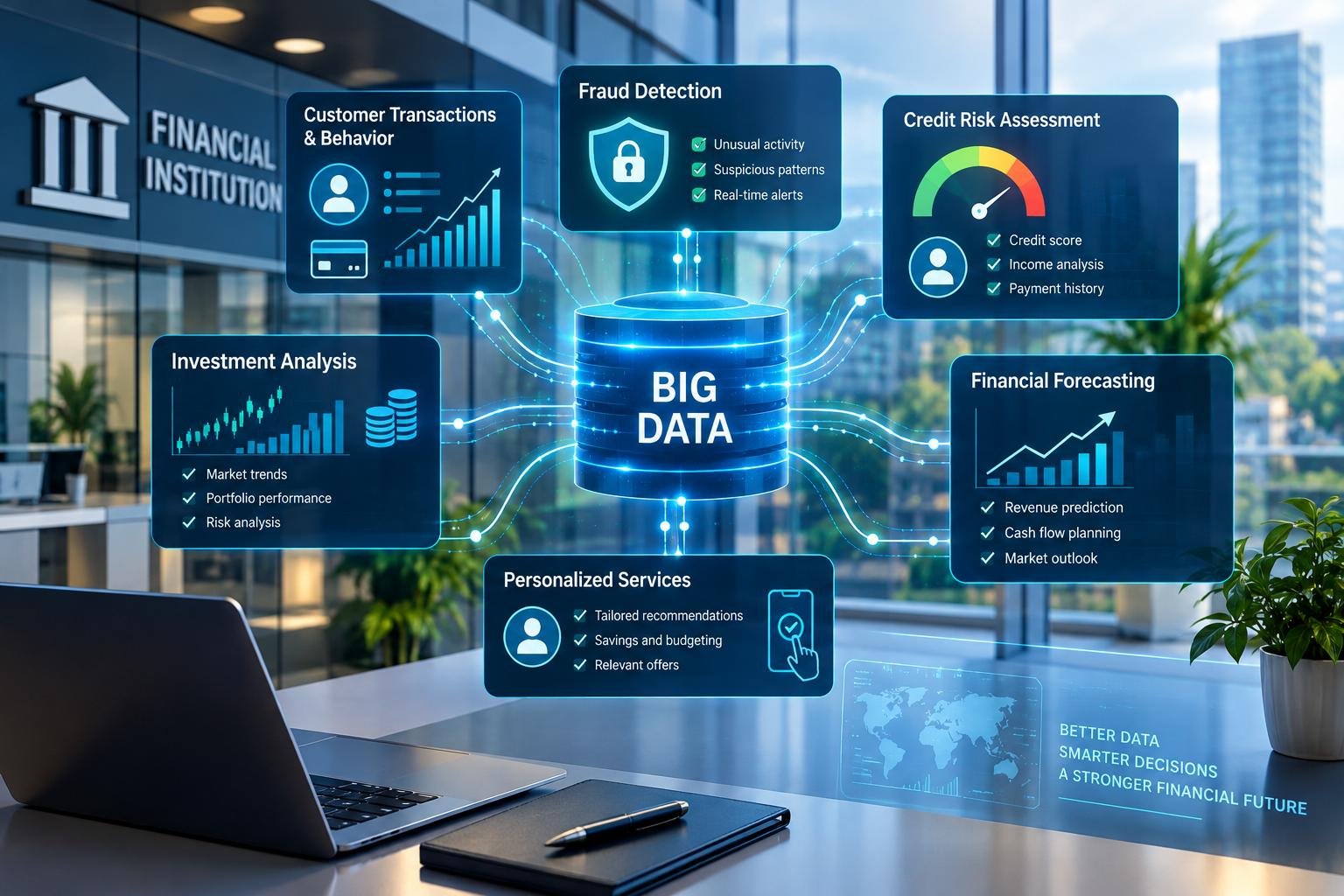
Banks, investment firms, insurance companies, fintech businesses and other financial institutions have started generating and collecting massive amounts of data daily, making Big Data one of the most valuable resources in a Financial Institution today. Useful data can be generated from each transaction, mobile banking session, loan application, card payment, investment, customer interaction and digital communication. If this data is well gathered, properly processed and studied, it can be a significant factor in the financial institution’s decision making process. For instance, by analyzing customer behavior, banks can enhance their understanding of customers and make more informed decisions on service offerings and credit risk evaluations. For example, banks can utilize their customer data to offer better customer behavior analysis, improve credit risk assessment, uncover suspicious transactions, predict trends in financial activity, and provide more customized services. Financial institutions can leverage analytical tools and AI to uncover patterns that might not be apparent from historical reports or human insight, by using massive datasets and sophisticated analysis. This evolution is altering the perception of customers, risk management, resource allocation and the reaction to market changes by financial institutions.
What is Big Data in Financial Services?
Big data is very large data sets that are often complex and difficult to process using traditional data-processing techniques. It may be sourced from a variety of sources in financial services, such as banks, credit card accounts, ATMs, mobile apps, websites, customer service platforms, investment platforms, payment systems, social media, economic indicators, and external market databases. The significance of big data isn’t just that there’s a lot of it, it’s also that it can be used to gain useful insights. These datasets are organized and interpreted using various technologies, including cloud computing, artificial intelligence, machine learning, data warehouses, and advanced analytics, in financial institutions. As opposed to analyzing individual records, institutions can analyze millions of transactions and customer activities simultaneously. Decision-makers can spot trends, spot unusual behavior, know what customer needs are changing and act in response to an opportunity or risk to the financial resources with greater efficiency.
Methods Financial Institutions use for Data Collection
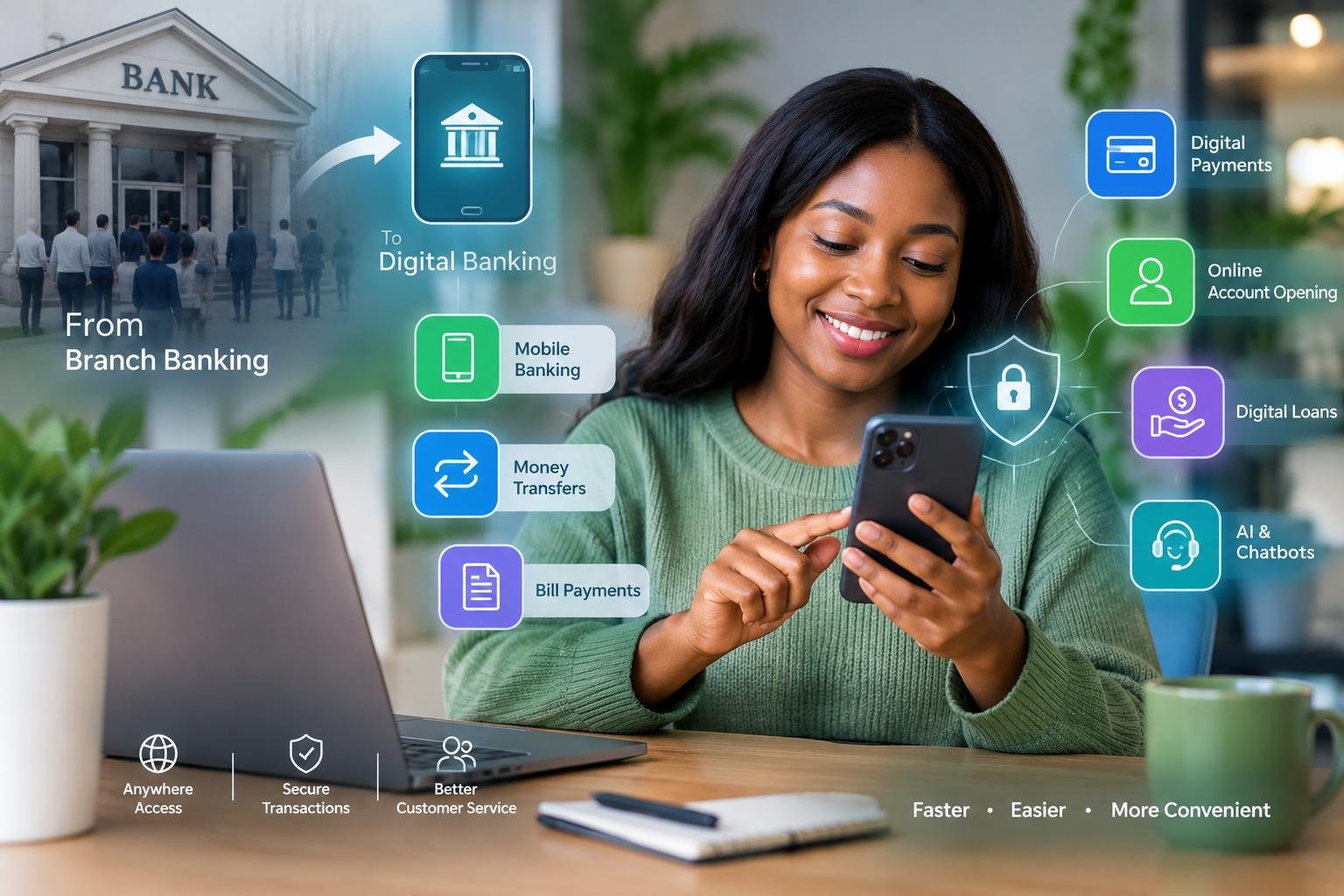
Both conventional and online methods are used to gather information from financial institutions and other institutions. Information about an activity such as an account opening, loan application, payment, funds transfer and contact with the customer support can be incorporated into an institution’s wider data environment when a customer opens an account, applies for a loan, makes a payment, transfers funds, or contacts customer support. The amount and diversity of this information has grown with the rise of digital banking, as customers are growing more reliant on mobile apps, online banking portals, digital wallets and contactless payment methods. Credit bureaus, financial markets, government data, economic reports and other authorized external sources may also provide relevant data to financial institutions. These various sources can then be integrated into modern systems, enabling businesses to create a holistic view of their customers and operations. But data collection doesn’t provide value on its own. The information should be accurate, well organized, secure and processed in accordance with relevant privacy, security and financial legislation.
Understand how Customers Behave and Improve Decision-Making.
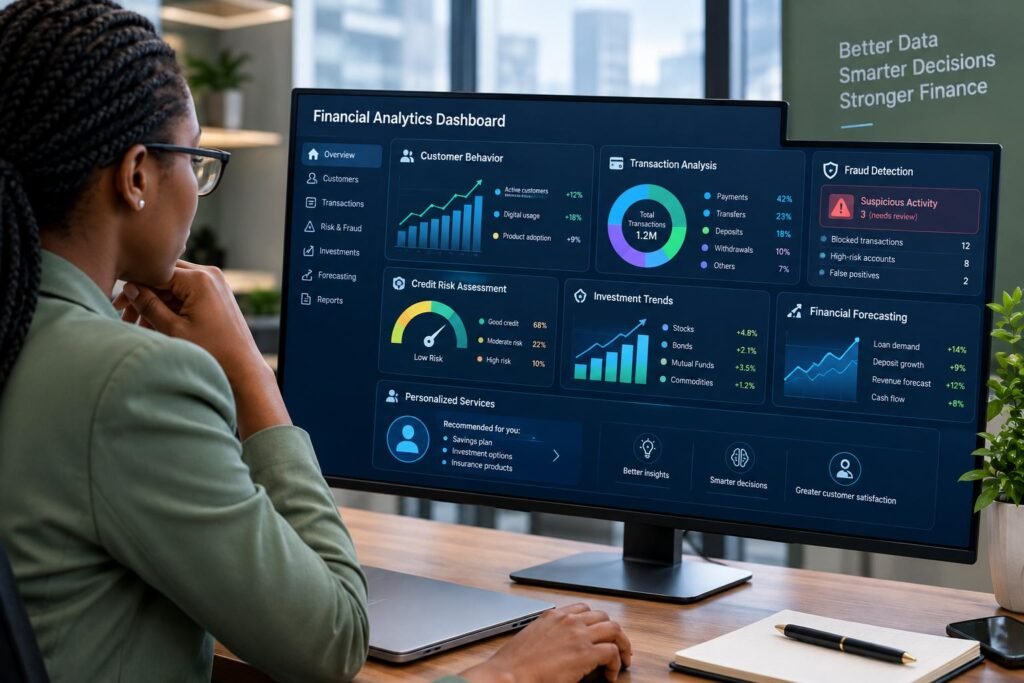
The understanding of customer behavior is one of the most important use cases of big data. By understanding the patterns of transactions, spending, account activity, product usage, and interactions with digital platforms, financial institutions can gain insights into customer needs and their changing financial behaviors. For instance, a bank could find that a customer deposits funds regularly into a savings account, but has never tapped into one of the bank’s investment products. One customer may often be utilizing global payment solutions, which could indicate a curiosity for items targeted at global transactions. These trends can be studied within the banks’ large customer base to uncover shared trends and preferences. This information helps to inform product development, marketing, customer retention and service delivery decisions. Rather than offering a one-size-fits-all service, institutions can leverage data to gain a better understanding of the various customer segments and tailor their services to better align with their needs and behaviors.
Enhance Credit Risk Evaluation
Big data is also transforming financial institutions’ borrower appraisals. Historical lending criteria might be based on credit scores, earnings details, job history and customary markers. These are still significant but big data can yield further information that can aid lenders in gaining a more comprehensive view of prospective borrowers. Financial data can be used to create patterns that lenders can then recognize in large collections to indicate whether a person is likely to pay his or her loan, is financially stable, or is in danger of defaulting on a loan. Machine learning can be used to sift through data and has the potential to model the relationship between many factors, and to predict the probability of loan repayment for an institution. This can help to ensure consistency in the lending process and help to better identify high-risk and creditworthy applicants. Meanwhile, the institutions need to be mindful of the quality and fairness of the data they rely on. The quality of the information and/or models used can influence the outcomes in ways that are not desirable, so responsible data governance is paramount when leveraging big data for lending decisions.
The Use of Big Data and Fraud Detection
Another area in which big data has definitely helped with financial decision making is fraud detection. Financial institutions make significant amounts of transactions, and it is hard for the human employees to review all the transactions. Data Analytics and Machine Learning enable the systems to keep a continuous watch on transactions and detect any irregularities that could be a sign of fraud. A transaction can be considered suspicious if it is located, timed, or amounts to a suspicious amount, occurs at an unusual frequency, or is related to a suspicious previous account transaction. If, for instance, an account that typically makes local purchases suddenly starts a series of several big transactions from different places, an automated system can alert the staff to investigate the activity. These can be used to evaluate fresh transactions in addition to the old data and enable financial institutions to detect potential hazards earlier. Fraud methods are constantly changing, and institutions can also keep their analytical models up to date to catch new fraud patterns, which help them to safeguard customers and minimize unwanted burden on legitimate transactions.
Supporting Investment Decisions
Big data is also opening up new opportunities for investment firms, asset managers, banks and individual investors to make better investment decisions. The financial markets provide a vast amount of information, such as the price of stocks and shares, the number of shares traded the reports of the companies, the economic indicators, interest rates, currency fluctuations, and news headlines. These datasets can be analyzed much quicker with advanced analytical systems than by humans. The insights gained from this analysis can help investment professionals spot market trends, assess potential investment opportunities, track investments, and analyze new risks. Algorithmic trading systems can also be programmed to make trades at specific times when certain market conditions are met. The uncertainty in investment will not be gone from big data as the financial markets are still subject to unforeseen events, investor sentiment, economic changes and other random factors! Rather, it is useful for helping investors to handle more information efficiently and to make decisions using a wider array of information.
Enables Users to Develop Financial Forecasting and Planning Skills
The traditional basis for financial forecasting is the past, economic expectations and professional judgment. This process is growing bigger, with the help of big data, which lets institutions use much more extensive and varied data sets when making their predictions. Banks can look back at the past to see the trends in interest rates, the economy, customer activity, and more to predict outcomes. For instance, a financial institution could employ data models to predict such things as loan requests, deposit growth, cash needs, income, or even losses. Advanced analytics also can assist institutions detect changes in customer actions that may influence future financial performance. It is especially important to have forecasting models that will enable decision makers to think through various options instead of focusing on a single outcome. Institutions can move their models when there are changes in the economy and consider the impact of such changes on their operations. This aids planning and enables organizations to anticipate uncertainty, before it turns into a financial issue.
Personalized Financial Services
Financial institutions are also shifting towards a more individualistic customer experience by using big data. Banks will not be selling and servicing the same products and services to all customers, but rather can look at customer data to identify which products might be suitable for some customers or groups of customers. For instance, what you see in the transactions that your customer has could point to a product that they need to help them budget, invest, save for something, or get insured for. Personalized recommendations are also possible in mobile banking applications, for instance, if the customer is shown an overview of their expenditure, savings tips, financial alerts or reminders depending on his or her activities. This can also lead to more convenient financial services, as customers can also receive information that is more in line with their needs. But there needs to be a balance between personalization and respect for privacy. The customer must be aware of what their information is used for, and financial institutions must have robust controls on data access, data security, data consent and responsible data processing.
Big Data Challenges in Finance
While the advantages of big data are great, the challenges it poses to financial institutions must be handled carefully. Financial institutions deal with a lot of private information related to users and businesses and data privacy is one of the most crucial concerns. If there’s a security breach, this could compromise personal, financial or transactional data and have a negative effect on customer trust. However, data quality is a challenge too. Analytical models may generate unreliable results if information is incomplete, outdated, duplicated and/or inaccurate. Skilled professionals with knowledge in data science, finance, cybersecurity, and regulatory/compliance frameworks are also essential to financial institutions. In addition, AI and machine learning algorithms can also result in biased or opaque decision-making. It is especially critical if data is leveraged for a decision that impacts the customer, such as loan approval, fraud prevention, or other business-related decisions. Thus, in good governance, institutions must have clear guidelines regarding data collection, storage, access, security, model tests and accountability.
The Future of Data-Driven Financial Decision-Making: A Slow, Steady Trendsetter.
With the ongoing proliferation of digital transactions, AI, cloud computing and connected financial services, big data will undoubtedly play an even larger part in financial institutions. Financial systems of tomorrow will be able to analyze more and more data sources and provide real-time insights. For banks, predictive analytics can help signal early signs of trouble in the financial sphere; for investment firms, it can be increasingly sophisticated models to analyze market conditions. Customer service may be more proactive in that customer need may be sensed and responded to before the customer requests it. Meanwhile, financial institutions will have to concentrate on responsible innovation. The utility of big data is as much about the amount of information that an institution has as it is about the accuracy, security, fairness and ethical treatment of that information. As financial institutions become more data-informed, it will therefore be vital for them to have strong governance, clear decision-making, proper cybersecurity, and human oversight.
Conclusion
From gaining a deeper and faster understanding of data, to using it to inform decisions that drive business, big data is reshaping the way financial decision making is done. The vast amounts of data can enable banks and other financial institutions to analyze customer behavior, assess risk for lending, identify fraud, assist in making investment choices, customize their financial offerings and enhance forecasting capabilities. These applications can help to enhance the efficiency of operations, and support financial decision makers with additional evidence. But with data comes the responsibility as well. Financial institutions need to safeguard sensitive data, uphold data quality, minimize bias, adhere to regulatory requirements, and responsibly incorporate automation into their operations. Future of finance is not just about information, it’s about information that can be converted to trusted and usable knowledge. Advanced analytics, when coupled with good governance and human judgment, will enable organizations to make better decisions in today’s highly complex financial setting.
Get more well researched information about Big Data in Financial Institutions here.