Introduction
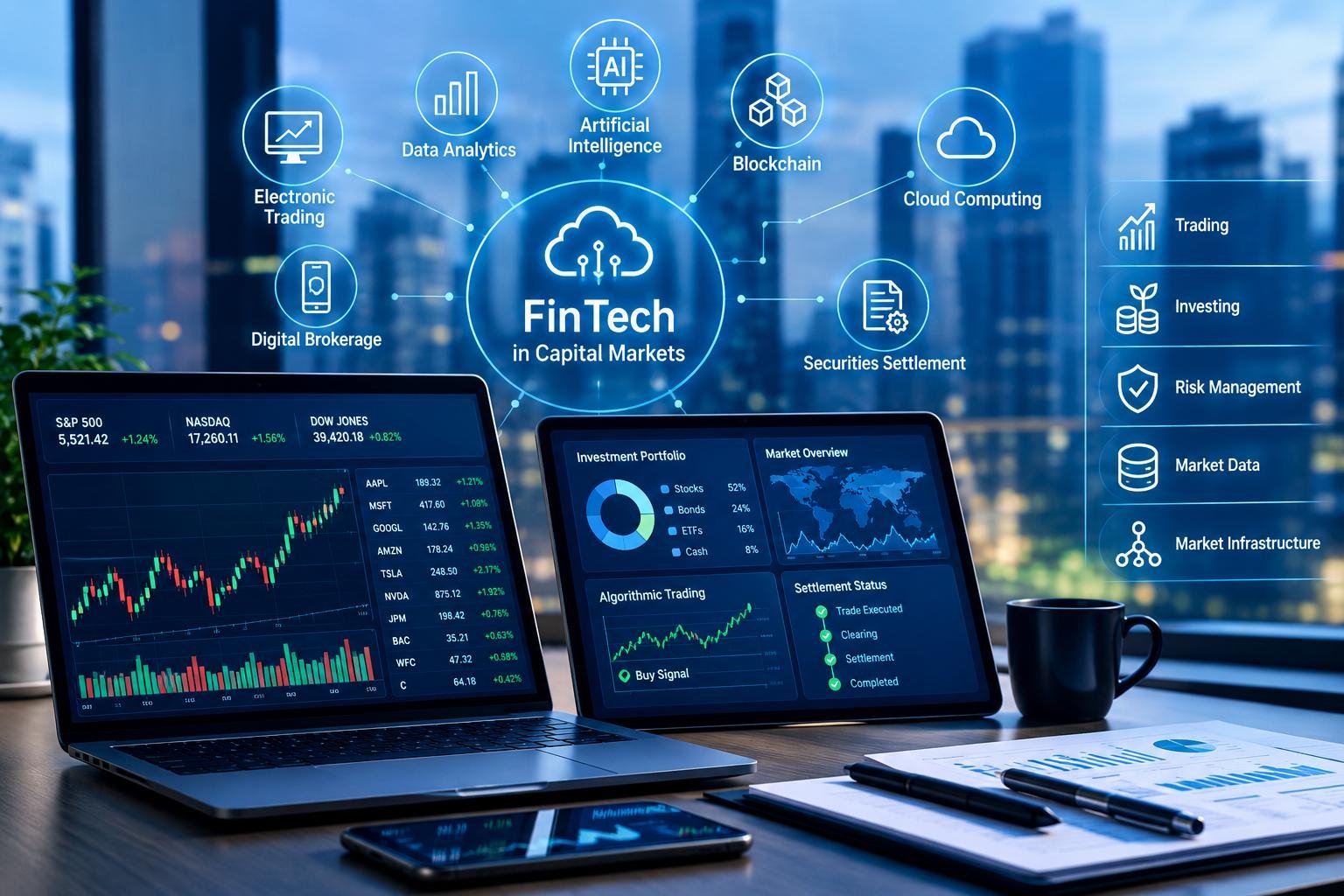
Financial technology, or FinTech, is changing the way securities are traded, investments are managed, financial information is delivered and transactions completed in capital markets. Historically, the capital markets relied on a complex web of exchanges, brokers, banks, clearing houses, custodians, asset managers and other financial institutions. Nowadays, technologies like software, cloud computing, artificial intelligence, automation, blockchain, application programming interfaces (APIs), and advanced data analytics are transforming the ways these players are connecting. Technology has accelerated the pace of many of the processes in the market, connected them together, and increasingly made them data-driven, whether through electronic trading systems or automated investment systems. Financial institutions are adopting new methods to speed up settlement, lower operational costs, and minimize the risk of settlements, even for the most basic of activities like securities settlement. With the continuous evolution of these technologies, the FinTech infrastructure is also becoming a key element in linking investors, companies, intermediaries and financial markets together.
Overview of FinTech in Capital Markets
In the context of capital markets, FinTech is technology that enhances or reinvents financial market activities that involve capital raising, security trading, investment management, transaction processing and dissemination of market information. Although FinTech typically comes to mind when it comes to mobile banking and digital payments, the impact of FinTech does not stop at that. Activities like order execution, portfolio construction, risk analysis, market surveillance, securities processing, financial reporting and investor communication are now supplemented by technology. It’s not just a matter of swapping out the old financial institutions for online platforms. Rather, most FinTech solutions operate alongside, and complement, traditional exchanges, banks, brokerages, asset managers, and exchanges infrastructure providers to enhance their services. This is especially relevant since the speed, accuracy, transparency, and automation that are needed in the capital markets are enormous, allowing for even minor changes to have substantial impacts on market participants.
The Impact of Technology on Stock Exchanges
The stock exchanges are definitely one of the sectors that has changed capital markets with the help of technology. Old fashioned trading floors are now mostly given way to more sophisticated electronic trading systems that can match the buy and sell order in seconds at the most. Powerful computing infrastructure provides the ability to handle a vast amount of transactions with orderly markets and a watchful eye to trading. The market participants use electronic order books to place orders electronically and matching engines are used to match orders on the basis of predetermined rules of the market. Technology also allows exchanges to offer investors and financial institutions real-time prices, trading data, market alerts, and analytical data. Furthermore, automated surveillance systems can analyze market activity for any unusual patterns that might suggest market manipulation, or other improper practices. These functions enable exchanges to function on a scale and at a speed that would be hard to do with manual processes.
Electronic and Algorithmic Trading
Algorithmic trading has also brought about a shift in the way that securities are traded. Algorithms can, however, act based on a set of instructions, including volume, price, market conditions, time and more, without having to wait for human traders to decide when and how to execute the order. These systems are often employed by institutional investors to place large trades as they try to reduce market impact and transaction costs. High-frequency trading is a more technologically advanced strategy, with dedicated systems picking up on market data to make decisions in a matter of milliseconds. AI and machine learning are also trying to be used to spot patterns, execute trades smartly, and process vast amounts of data from markets. Automated trading has the potential to enhance efficiency and liquidity in various situations, but it also poses challenges. Unexpected market conditions, system failure or poorly designed algorithms could cause volatility to be compounded and thus good control, testing, monitoring and risk management are vital.
The Rise of FinTech and Digital Brokerage Platforms
Digital technology has made brokerage services a lot more available. Online and mobile brokerage platforms enable investors to open accounts, research securities, place orders, track portfolios and get market information without relying on a complete reliance on traditional in-person interaction. This has reduced some apprehensions for the entry into the market and has made it more convenient for individual investors. Digital brokers can also make automated administrative processes like account verification, transaction alerts, document delivery and portfolio reporting. Professional investors can benefit from the electronic brokerage infrastructure by having a direct link to several markets and advanced features to manage and execute orders. Furthermore, financial applications or institutions can tap into financial data via APD via brokerage platforms, enabling the incorporation of market data, trading capabilities, portfolio data and analytics into wider financial applications. Consequently, brokerage is becoming more of an operational service, with technology playing an increasingly important role in the process, instead of being merely a middleman between an exchange and investors.
The Role of Technology in Investment Management
The investment management sector is another key industry undergoing transformation from FinTech. Technology is applied to the analysis of markets, security evaluation, portfolio construction, risk monitoring and client communication by asset managers, wealth managers and institutional investors. An automated investment platform can take into account factors like investment goals, risk tolerance, the amount of time invested, and the available investment capital, and then use algorithms to make recommendations or implement investment portfolios. At the institutional level, portfolio management systems can integrate information from various sources, and deliver investment professionals a single consolidated perspective of assets and exposures. Artificial intelligence can help in analyzing financial documents, identifying patterns in company data, sentiment analysis of the market, and creating investment insights. While technology won’t replace the need for professional judgment, it can provide investment professionals with tools that aid in making professional judgments. This blend of human insight and automated analysis can enhance the speed and scope of investment analysis.
Data-Driven Investment Decisions
Financial information is one of the most important assets in today’s financial markets. Investors can access market prices, company financial statements, economic indicators, alternative data, news, transaction information and other data that can impact investment decisions. In comparison to traditional manual processes, FinTech systems can more effectively gather, organize, clean and analyze these datasets in a much quicker time. Machine learning algorithms can uncover patterns in complex, large data sets that might not be known to humans, and visualization can make data like financial information appear as dashboards and interactive reports. But as financial data becomes increasingly important, it is not without its problems of quality, privacy, security, ownership and interpretation. The results of the model can be misleading if the data entered into it is inaccurate or the model is poorly designed. Financial institutions must therefore employ advanced analytics while using robust data governance for technology to be adopted.
Modernization of Securities Settlement and Post-Trade Infrastructure
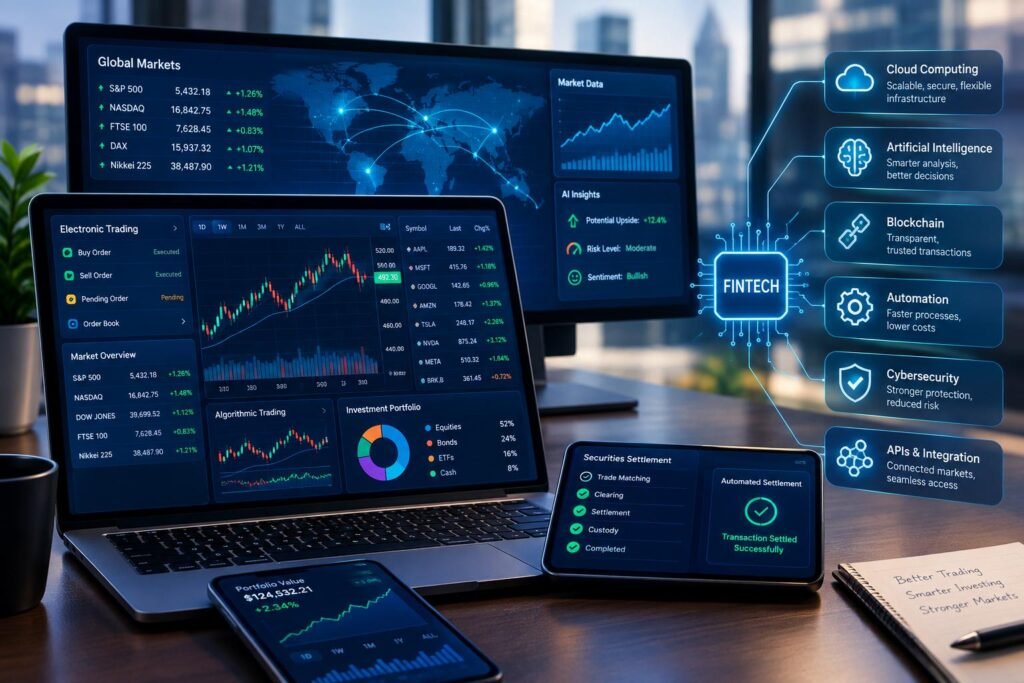
Capital markets activity is a much longer process than the trading of a security. Once the transaction has been carried out, the financial system has to guarantee that the purchaser gets the security and the seller gets the proper payment. All the post-trade activities like clearing, settlement, reconciliation, custody, record keeping and other post trade activities. Financial institutions are leveraging technology to create the automation and decrease manual actions. For instance, Distributed ledger technology has garnered attention as it may enable that transaction records can be shared with multiple authorized participants while eliminating some of the reconciliation procedures. Digital workflows can also automatically compare records, create alerts for differences and trigger corrective actions. Quick and precise post-trade processing can lower the operational risk and enhance efficiency, especially when a vast amount of transactions need to be processed in various institutions and jurisdictions.
The Faster Settlement’s Potential.
Modernization of settlement is also relevant as it may leave market participants vulnerable to operational and financial risks while a trade is being executed and until it is settled. To achieve quicker settlement cycles, financial institutions need to invest in their technology, processes and communications to ensure that transactions can be settled faster with speedy verification and processing of transaction information. Some ways automation can assist include minimizing data entry, enabling institutions to share information in a uniform representation, and so on. There has also been research into the feasibility of using smart contracts and distributed ledger technologies to create a more automated part of settlement when certain conditions are met. However, settling faster is no easy task of just introducing new software. It involves a level of coordination between exchanges, brokers, banks, clearinghouses, custodians, regulators and investors. The infrastructure should continue to be reliable, secure, interoperable and be able to respond to exceptional situations.
Financial Data and Market Intelligence
One of the biggest impacts made by FinTech has been in the field of financial information and market intelligence. The modern capital markets produce vast quantities of data – price data, orders, company announcements, economic data, transaction data etc. – every second. This information can be processed by the institutions using technology on a scale, which would be impossible through the conventional manual analysis. Data platforms can provide real-time data to traders and investment professionals, and analytical tools can help to identify trends and potential risks. NLP can also enable systems to analyze vast amounts of financial news, research reports, earnings announcements and other financial documents. This can streamline the research process and enable professionals to find pertinent information quickly. Meanwhile, a lot of data doesn’t necessarily lead to improved investing choices. Market participants need to distinguish between credible information and ‘noise’ and comprehend how the conclusions of the analytical models are reached.
Improving Workflow with Automation and Improving Operational Efficiency.
In capital markets, automated processes are gradually gaining significance due to the multiplicity of repetitive processes that are capable of being rationalized in financial institutions. Each of these activities can benefit from RPA and intelligent workflow systems. These are just some of the activities that can be supported with RPA and intelligent workflow systems. These can be automated, minimizing repetitive tasks for employees and allowing them to spend more time on analysis, client relations, risk management and strategic tasks. Cloud computing can play a role in helping this shift, by offering scalable access to computing systems and applications, while not relying on a single system being based purely on traditional physical hardware. But there are risks involved in automation, too. The institutions need to track automated processes and put in place proper controls, as well as contingency plans in case of a malfunction. To successfully implement FinTech, both technological capability and good governance of the operations are required.
Information Security and Risk Management
Technology is becoming a mainstay of financial infrastructure and cybersecurity is becoming an integral part of the process. Financial firms, such as exchanges, brokerages, banks, asset managers, and technology service providers, have important financial data and systems that could impact the markets and investors. This can result in serious consequences of cyberattacks, unauthorized access, ransomware, data breaches, and system disruptions. To safeguard their systems, FinTech firms are focusing on a range of security measures such as encryption, identity management, multi-factor authentication, real-time monitoring, threat detection, and automated security solutions. Artificial intelligence can also be used to detect any unusual network or transaction activity that could be a security risk. Risk management technology can be applied to more than just the cyber risks and protects a financial institution from market exposure, liquidity, credit risk, operational risk, and more. Given the increased connectivity brought by technology, it is crucial to establish strong controls to ensure that there are no additional vulnerabilities and opportunities for efficiency.
Challenges of Fintech Adoption in Capital Markets
While there is an upside to FinTech, there are also some hurdles to its adoption by the capital market players. The complexity of incorporating the new technology with existing systems that many financial institutions are still using is one big problem. There can be significant costs and complexity in replacing legacy infrastructure, especially if it is used to enable vital market operations. Regulatory requirements also pose challenges, as financial institutions will need to make sure that new technologies meet the requirements for transparency, investor protection, data management, protection against cyber risks and the stability of markets. AI raises further questions regarding the accuracy, explainability, bias and accountability of the models. Also, when a number of financial institutions are dependent on a few technology providers or cloud platforms there is a risk of concentration. These scenarios suggest that existing infrastructure and technologies must be carefully planned for successful modernization, and that this cannot be done by taking the latest technologies out on the market.
The Future of FinTech in Capital Markets
Emerging trends in the future of FinTech in capital markets will see an increased pairing between AI, automation, cloud computing, advanced analytics, distributed ledgers and digital financial systems. There might be a greater tendency to become more adaptive in trading systems, more personalized analytical assistance on investment platforms, and more automated and connected post-trade processes. Another area that is being garnering interest is tokenization, as digital representations of financial or real-world assets have the potential to enable new ways to issue, transfer and manage investments. Meanwhile, traditional financial institutions will continue to play a crucial role as technology needs to fit into existing regulatory, legal and economic frameworks. Some of the most successful companies are likely to be those that are technologically innovative and have strong financial capabilities, governance, cybersecurity and risk management capabilities. FinTech is unlikely to be a substitute for current capital markets, but will rather step in to modernize the working of capital markets over time.
Conclusion
From the instant an investor is provided with financial data to when a transaction is executed, cleared, settled, held in custody, and reported, capital markets are being affected by FinTech in virtually every aspect. Technologies have rapidly advanced trading platforms, made digital brokerage more accessible, enhanced investment technology tools for analysis and automation has streamlined many investment processes. On the infrastructure front, advances in data management, cloud technology, distributed ledgers, and AI are opening up novel avenues for bringing market participants together and transacting. Modernization, however, does not come without cyber security, regulatory compliance and operational resilience, data quality, and good risk management. The impact of FinTech is not just about making finance faster, however. It is about constructing capital market infrastructure that is reliable, transparent, secure and accessible to institutions and investors and can handle the growing volume of information and transactions.
Get more well researched information about FinTech in capital markets here.