Introduction
Forex market, also known as foreign exchange or FX market, is one of the most active and biggest financial markets in the world. Forex trading is not conducted on a single, fixed physical or electronic trading floor and is not limited to specific trading times as is a traditional stock exchange. Forex trading is conducted through a worldwide network of financial institutions, banks, brokers, technology providers and individual traders. These participants are linked by technology, and currencies can be traded 24/7, 365 days a year from Monday to Friday. Today’s forex trading platforms provide traders with currency rates, charts, analysis tools, order management and more via computer and mobile device. But beneath these well-recognized user-facing platforms lie a complex technological architecture that includes electronic communication networks, automated systems, algorithms, artificial intelligence, real-time data feeds and risk-management technologies.
The Role of Technology in the Global Forex Market
The modern forex market relies on technology for its operation as it is important to coordinate currency transactions among participants located in different parts of the world. Financial institutions may have their headquarters in London, New York, Tokyo, Singapore, Frankfurt and other financial centres, but they must share currency data and conduct transactions in seconds. This is achieved by electronic systems which communicate price quotations, trades, confirmations, and market information via the network of interconnected systems. Most of the forex trades are conducted electronically instead of by telephone or paper. Buy and sell prices are continuously accessible from banks and other liquidity providers, and can be made available to the customer by brokers and trading platforms. Information circulates smoothly between servers, data centres, communication networks, and specific financial software. Information flows rapidly and precisely between servers, data centres, communication networks, and specialized financial software. This structure of technology is one of the principal reasons why the Forex market is able to function properly and efficiently across borders.
Electronic Communication Networks in Forex
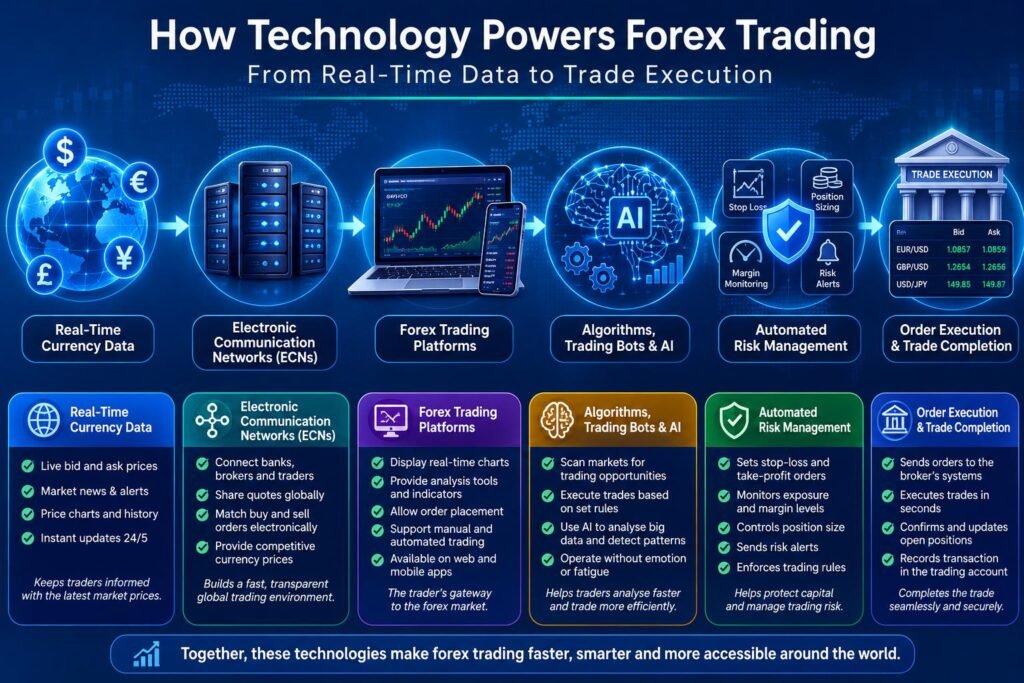
An electronic communication network (ECN) is a significant component of electronic financial markets that assists in the dissemination of information on the market to other participants and match buy and sell orders. In the forex trading, electronic systems can gather quotes from different banks, liquidity providers, brokers and more, which assists traders to get competitive currency quotes. An ECN is not quite a retail trading platform. Instead, it is a part of the infrastructure around which orders and prices can flow among the various parties. An order is entered by a trader into an electronic system, which acts on the order and sees how it can be carried out based upon the prices and conditions available in the market. Electronic networks have speeded up communication and minimized reliance on manual processes. It has also contributed to the development of an integrated global trading environment that allows information to be transferred quickly between financial systems and trading systems.
Forex Trading Platforms and Their Part
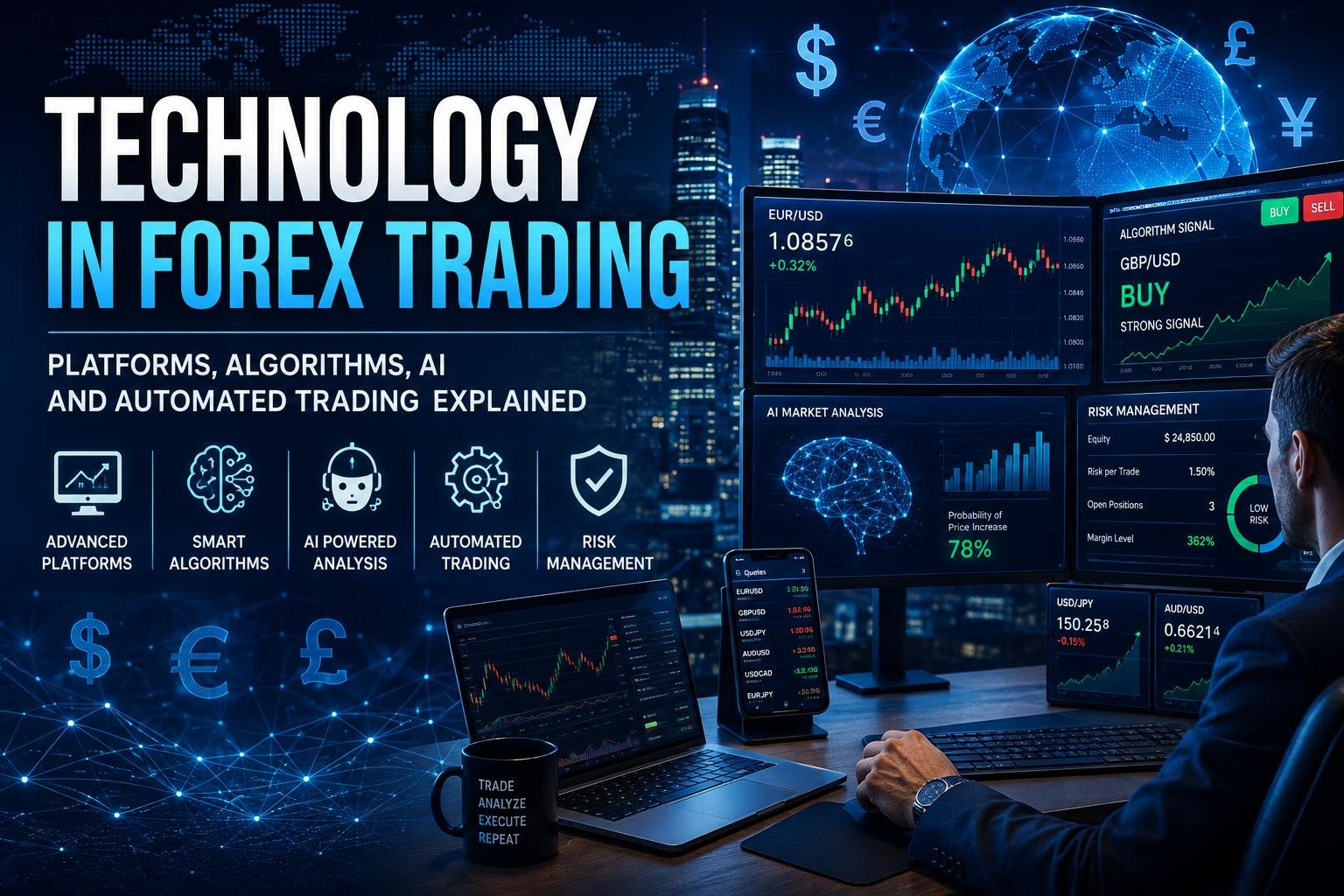
A Forex trading platform is the software application which is utilized by the traders for interacting with the Foreign exchange marketplace. The platform to the novice can seem to be just a display of currency charts, prices, buttons and account details. But it does several significant technological tasks. It connects to the market, shows the price of currencies, enables traders to analyze charts, and transfers orders to the trader’s broker’s execution system. A lot of platforms also feature a wide range of technical indicators, economic calendars, drawing tools, alerts, account-management tools, and various order types. Some platforms are made for manual trading, some are created for automated techniques and algorithmic trading systems. A good trading platform can impact traders’ ability to track the markets and manage trades, especially during periods of rapid price movements. Trading also takes place on modern platforms via web browser pages and mobile apps, which means that traders can access their accounts as long as they have an internet connection, without having to be permanently connected to a desktop computer.
Real-Time Currency Data and Real-Time Market Information
Another vital part of Forex Technology is real-time data as currency prices can fluctuate rapidly depending on various economic announcements, interest-rates expectations, geopolitical news, market sentiment and supply and demand dynamics. Trading systems get streams of information including currency prices, and other market information, that can be shown on a traders platform. The information can range from bid and ask prices, trading volume indicators, historical prices, charts, and market alerts. This is especially significant for traders who employ short-term strategies who want to know the price as quickly as possible, as it may be different when the order is placed. Financial institutions and professional trading firms are therefore, investing a lot in data infrastructure, high-speed connections, servers, and reliable data providers. Real-time data enables ordinary traders to track the market and make informed decisions based on up-to-date market information as opposed to stale data.
Algorithmic Trading in the Forex Market
Algorithmic trading refers to the practice of using computer programs to adhere to specific rules in researching the markets or when making trades. If an algorithm is programmed to scan for certain conditions, then when those conditions are triggered, an algorithm can attempt to act on the currency rather than having to watch the price all the time, which a person has to do. Examples include the system noticing a specific price pattern, a moving average or the system taking action when a currency crosses a specified threshold. There are markets where the situation may move quickly and algorithms can process information quicker than a person taking the time to individually evaluate each price movement, making them useful. But not all algorithm trading strategies are guaranteed to be profitable. The computer will execute its instructions without fail; an unsuccessful strategy will lead to unsuccessful results, as will a successful one. It is therefore important that algorithms be well-designed, tested, monitored and well-controlled before being used with real money.
Trading Bots and Automated Forex Systems
Bots for trading are software programs that can automate particular trading tasks. They are basically computer systems which track markets and analyze specific circumstances and then execute and/or control trades on the basis of a set of rules. The functionality of a simple trading bot could range anywhere from technical indicators to a more advanced system that combines more than one data source, statistical models, or machine-learning techniques. The benefit of the trading bots is they can do it without getting tired, distracted or emotionally affected by winning and losing streaks in their trading. They are also capable of performing repetitive instructions in a constant manner. However, the risks associated with finances are not eliminated with the use of automation. Market fluctuations, technical glitches, connectivity issues, wrong settings, or strategy bugs are possibilities that a bot can face. An inadequate designed automated system could even because the loss as it can execute the instructions fast. Therefore, automated trading should be considered a tool that needs to be monitored rather than an alternative to instinctive trading.
Artificial Intelligence in Forex Trading
Financial technology is extending the ability of Artificial Intelligence to uncover patterns and relationships from a massive amount of data. AI can be applied in various aspects of forex trading, including market analysis, pattern recognition, sentiment analysis, forecasting models, detecting anomalies, and automated decision support. Machine Learning systems can analyze the past data and uncover patterns that might not be obvious on a manual basis. A few systems also have the ability to take into consideration substitutions data, including financial news and market sentiment, to produce extra insights. Yet, the predictions made by AI should not be taken as definite. The currency markets are affected by unexpected developments like political events, economic surprises, central-bank decisions and unforeseen shifts in investor sentiment. A model that has worked well in the past might not work in the future when there are changes in market behavior. AI can thus be best seen as a tool that can help in analysis and automation rather than as a technology that can remove uncertainty from forex trading.
Automated Risk Management
Technology also becomes a key in managing risks of currency trading. When the trader is active in the market, automated risk-management systems can track the trader’s positions, account balances, exposure levels and preset limits. Automated controls can assist in executing stop-loss orders, stop orders, position sizing, monitoring the margin, and triggering alerts when specific limits are breached, depending on the platform or strategy used. The ability of these functions to be useful in fast-paced markets, where manual effort may be delayed by stress, distraction or lack of attention, can be particularly useful. Risk-management technology can also serve to allow traders to adhere to the same rules, without letting their emotions take the place of decisions made after a trade. Automated controls are not totally safe, however. For instance, a stop-loss order does not always mean that the position will be closed at precisely the stop loss price as market conditions and liquidity may affect the order’s execution. Technology can help with responsible risk management, but cannot eliminate market risk.
Mobile Apps and Forex Trading
Forex trading has become much easier due to the use of mobile technology, which has made it easier for traders to keep track of markets and engage in trading activities using their mobile device. Mobile trading applications can offer real-time currency pricing, engaging charts, trading orders, account details, alerts and news immediately on a portable device. This means that traders will no longer need to stay at their desktop workstation and watch their trades or get market information. Mobile apps use secure connections among the app, the broker’s systems and the financial infrastructure to send information and trading orders. While mobile apps are convenient, they shouldn’t be used to make hasty trades. Too much information on too small a screen can make it more difficult to assess complex charts and market information, and having information at your fingertips can help people to become emotionally attached to price fluctuations. The most useful application of mobile technology is in the context of a clearly defined trading and risk management process, not in lieu of careful analysis.
How Different Technologies Work in the Global Forex Market
Forex trading technologies are not standalone solutions. They are a seamless process which starts from getting market information and culminates in the execution of trade, monitoring and risk management. The currency prices are created or published by liquidity providers and financial institutions via electronic networks. These data are conveyed by data providers and market infrastructures to brokers and trading platforms. The trader will then be able to access the data on a desktop, web or mobile platform. In the event the trader employs an algorithm or perhaps an automated trading guide, software can examine the data offered and develop an instruction based on a set of rules. The broker’s systems then execute the order and go to the appropriate execution infrastructure. Once a trade is made open, monitoring systems are able to monitor its location and use risk-management rules. The data, networks, software, automation and human decision making gives rise to this technological landscape that enables the forex market to operate at high speeds across multiple time zones with ease.
Advantages and Disadvantages of Forex Trading Technology
Forex market trading has undergone a lot of technological advancements that have brought some benefits to the traders. Electronic systems have boosted the pace of communication, enhanced access to information on the market and simplified trade, and even allowed currency trading via a computer and a smartphone. Automation can also eliminate repetitive manual tasks and enable pre-defined strategies to work without human variability. Institutional use of advanced computing systems can handle vast amounts of data and provide for complex risk-management operations. But with more technology there are challenges, too. Various system disturbances, cyber security issues, invalid information, software bugs, network issues, and algorithm failures can disrupt trading operations. Another downside to automation is that it can lull inexperienced traders into a false sense of security, making them believe that an automated strategy is guaranteed to be safe and profitable. While technology enhances the instruments traders have, it doesn’t alter the reality that forex trading can be uncertain and risky.
Technical Aspects needed by Forex Novices
Although the skill set of software engineer may not be required for the forex trader to grasp the technology behind trading, the fundamental understanding of the relationship between platforms, data, execution, automation, and risk management is important. A trading platform is the point on which the user gets market information and place orders; electronic networks assist in linking the participants and the prices and transactions. While algorithms and trading bots make decisions based on a set of rules, AI can offer more sophisticated data analysis and pattern recognition capabilities. Real-time data can be used to monitor market conditions and automated risk management tools can be used to ensure that the predetermined controls are adhered to. If you know these factors, you can make a realistic assessment of whether or not it is a viable trading business, and you can spare yourself from the false hope that cutting edge technology is bound to make things money. However, beginning traders need to as well learn spreads, leverage, margin, order execution, security and the dangers of trading currency prior to opening a live account. While good technology helps inform good decisions, knowledge, and disciplined risk management are still necessary.
Conclusion
For the most part, the forex market was a business entity that depended on a relationship between traders. Now it is an electronic market that can process information and transactions in a matter of seconds. All market participants are linked via electronic communication networks, prices and execution tools are available on market platforms, and real-time data helps keep traders up to date on market conditions. Algorithms and trading bots can take care of repetitive strategies, and artificial intelligence can help to analyse large and complex data sets. More recently, mobile apps have enabled access to markets from mobile devices, and automated risk-management systems offer the tools to manage risk. All of these technologies form the foundation of the infrastructure needed to enable trading of global currencies all week long. However, the use of technology is no assurance of success. Knowing how these systems work can make forex trading more realistic for beginners, help them to consider automated solutions carefully, and give them a better understanding of the opportunities and risks they present in the increasingly digital financial market.
Get more well researched information about Technology in Forex Trading here.