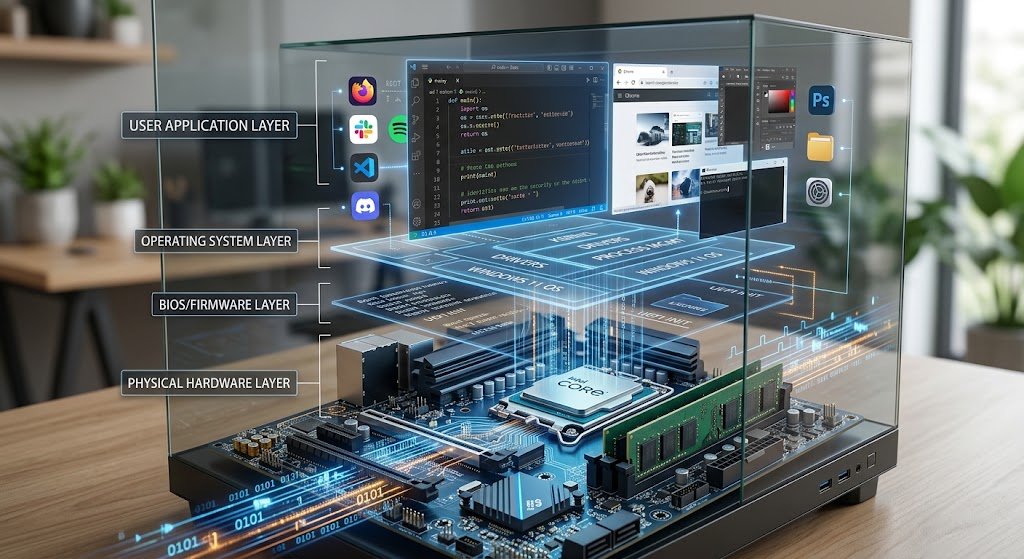
Introduction: Understanding Computers Through Layers
The computer is a machine that seems to be one machine when we click on buttons, launch applications or run programs, but when it comes down to the nitty-gritty, a computer is a very organized system with many levels working together. Under the concept of structured computer organization a computer can be viewed as a set of layered virtual machines, and each layer supplies services for the layer on top of it, obscuring irrelevant technical details. The concept was popularly explained by computer scientist Andrew S. Tanenbaum, who called computer systems made of different levels of abstraction. Each layer defines a simpler environment, removing the need for programmers or users to understand all electronic signals and hardware operations, to make interaction with the computer easier and more efficient.
The layered approach is critical because modern computers are very complex. A programmer who writes a software program for a mobile device doesn’t require to know how each transistor could flip electrical signals within the processor. For instance, if the program runs on a computer, the operating system developer doesn’t have to manage each electrical component manually. Each layer interfaces and communicates with the layer below by using pre-defined rules. This organisation provides hardware designers, software designers and users to work with computers at various levels of complexity. The study of structured computer organization develops an increased understanding of how hardware and software interact to produce machine actions from human instructions.
The notion of computer layers is also responsible for the fact that there are different types of specialization in computing. Hardware engineers specialize in digital circuits and processor design, system programmers are concerned with operating systems and instruction sets, and application developers use programming languages to program software. Each group operates primarily at one particular layer, and makes use of the functionality of layers below. This division of labour, or separation of responsibility, has facilitated computer system design, development and maintenance over many decades.
Concept of Layered Virtual Machines in Computer Organization
In a structured computer organization, a virtual machine is not necessarily software running an operating system, e.g., a virtual computer running inside a physical computer. Rather, Tanenbaum defined it as an abstraction layer that gives a “simplified view of the computer”. They resemble virtual machines since each layer provides a set of operations to the user or programmer without having to know how the lower layers implement the operations.
A person working with a word processor would, for instance, manipulate menus and buttons and use text formatting tools. There is no direct communication between the user and the processor’s instruction set or electrical circuits. The lower-level instructions are provided by the operating system, which is used by the application software to communicate with the hardware. Similarly, the operating system doesn’t have to manage each logic gate itself, because the processor offers a down-level operating environment for commands.
The layered model establishes a sequence of dependency on one another for each layer, in which each layer relies on the services provided by the layer below it. The higher levels are more about human interaction, the lower levels are more about the physical hardware operations. This arrangement allows for computers to be more comprehendible, since complex processes can be examined individually, instead of as a giant system.
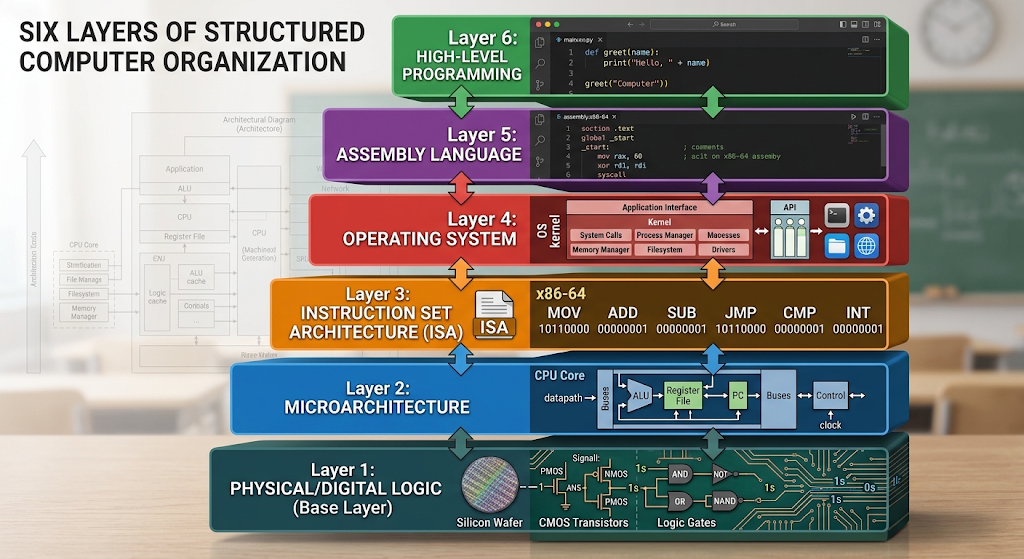
Simplified Diagram of Tanenbaum’s Computer Layers
Layer 5: High-Level Language (Java, Python, C++, etc.)
↑
Layer 4: Assembly Language (Human-readable machine instructions)
↑
Layer 3: Operating System (The ability to manage resources and provide system services)
↑
Layer 2: Instruction Set Architecture (ISA) (Instructions to the computer)
↑
Layer 1: Microarchitecture (Design and operation of CPU)
↑
Layer 0: Digital Logic (Logic gates, circuits and electronic signals)
There are multiple levels of abstraction within each layer. The layers are closer to the physical machine in the lower layers and closer to human communication and problem solving in the upper layers.
In this article, we will describe the six layers of Structured Computer Organization.
Six Layers of Structured Computer Organization
Layer 0: Digital Logic Level
All computer systems are based on the digital logic level. Computers at this level use electronic components which are either on or off, or 0 or 1, to represent information. Each of these values represents a different electrical state (such as low voltage or high voltage signals). While users work with complicated software and graphical interfaces, each and every action is nonetheless a result of billions of small electronic operations taking place inside the computer chips.
The digital logic layer consists of basic digital components like transistors, logic gates, circuits, memory cells and basic electronic structures. Logic gates are simple devices that take binary inputs and output binary signals, such as AND gates, OR gates and NOT gates. These gates are used to build memory systems and processors consisting of millions or billions of such gates that can carry out complex calculations.
In this stage, the computer doesn’t know words, pictures, applications, or programming languages. It only works with electrical signals following very specific rules. The main function of the digital logic layer is to provide a physical base for higher layers to build on. If there were no electronic circuits, the processor could not carry out instructions, store information, etc.
An understanding of this layer will help explain the need for computer hardware design. All software actions, such as opening a Web site or playing a video, are eventually a series of electrical changes in a digital circuit.
Layer 1: Microarchitecture Level
Microarchitecture is the internal structure of a processor for performing instructions. The digital logic layer deals with the fundamental electronic devices, while the microarchitecture integrates these devices into functional units which create the central processing unit (CPU). This layer is responsible for executing instructions and controlling internal operations of the processor.
At the microarchitecture level, a CPU has certain components that are essential to its operation such as registers, ALUs, control units, and data pathways. The ALU is used for performing arithmetic and logical operations, and the registers are used for temporary storage of data that the processor needs to use in its computations. The control unit monitors the activities and determines what activities to perform and when to perform them.
The same instruction set and different microarchitectures can be found in different processors. For instance, two processors could have the same commands, but process them differently, depending on their design goals—such as speed, energy efficiency, or performance. This is why it’s possible for processor generations to improve without software compatibility changes.
The microarchitecture layer is used to bridge the gap between electronic circuits and software instruction. Converts abstract processor instructions into specific internal operations in order to perform tasks efficiently in the computer.
Layer 2: Instruction Set Architecture (ISA) Level
ISA, also known as the Instruction Set Architecture, specifies the instructions that a processor can interpret and perform. It serves as a contract between hardware and software, defining the relationship between programs and CPU. The ISA defines instructions that are available, data formats, methods for accessing memory, and the way in which various operations are performed.
Programmers don’t typically design instructions to the ISA since most of this work is done for him by higher-level programming languages and tools. Eventually, however, all programs are converted to a sequence of machine instructions that are based on the processor’s ISA. Architectures such as x86, ARM and RISC-V are examples of instruction sets.
The ISA layer is very significant because it enables software to execute upon the hardware without knowing the inner workings of the processor design. A program for a particular ISA may run on several processors with different microarchitectures and the same instruction rules.
The point of this layer is to emphasize the importance of abstraction in computer design. Programmers can write software without knowing anything about the individual transistors within a CPU because the ISA offers a common technique for transmitting information from programs to hardware and from hardware to programs.
Layer 3: Operating System Level
The usage of the operating system layer makes computer hardware more user-friendly. Resources that are managed in an operating system include memory, storage devices, processors, and input and output equipment, such as Windows, Linux, macOS, and Android. Rather than having to deal directly with the hardware, the operating system offers convenient services and manages access to the system resources.
The operating system is the mediator between applications and hardware below. The operating system handles everything that a user does, like opening a file, running a program, or plugging in a device. It schedules processor time, deals with files, safeguards data, and regulates communication between software and hardware.
This layer provides another virtual machine by making the computer appear as it is in its simplest form to applications. A programmer can request memory, store files or display information on a screen without being forced to know precise commands of the hardware. The operating system converts the requests into instructions which can be understood by the lower layers.
If there was no operating system layer, computers would be much more difficult to use, as each application would have to know much more about the operation of the hardware. The operating system offers the convenience and organization to work in today’s computers.
Layer 4: Assembly Language Level
The assembly language is an intermediate level where the instructions of the computer are more comprehensible to humans, but are still closely related to the operation of the machine. Unlike the high level languages, assembly language is a symbolic language that represents the processor command exactly as it is. Programmers can write commands that are more readable and correspond to specific machine operations, rather than binary numbers.
For instance, an assembly instruction can instruct the processor to move data around between storage locations, do calculations, or compare values. These human-readable instructions are then translated into machine code by an assembler program, which can be executed by the processor.
In certain applications like embedded systems, device drivers, firmware development and performance-critical applications, direct control of hardware is essential, and still, assembly language is being used. While most contemporary programmers build software with higher-level programming tools, knowledge of assembly can give them insight into how software works with hardware.
The assembly layer illustrates the relationship between the processor’s native language and the instructions created by people. It offers more control than higher level programming languages, but is not quite as easy to read as machine code.
Layer 5: High-Level Language Level
Tanenbaum’s structured computer organization model has the High-Level Language at the top. Most of today’s software development occurs in this layer as programmers can write applications in instructions more similar to human language than to machine operations. Developers can use high-level languages like Python, Java, C++ and JavaScript to concentrate on solving problems rather than managing specific instructions of the processor. A High-Level Language is a language that is designed to be easier, faster and more accessible to program, and is more abstract from the computer hardware.
High-level programming languages have a variety of features that make software development easier, including variables, functions, objects, and libraries. A programmer, who is developing a banking application, a website or a mobile application, doesn’t have to bother about managing the memory locations or processor registers. Rather, the language tools and operating system deal with lots of technical specifics in the background. This separation helps developers to construct complex software systems with efficiency.
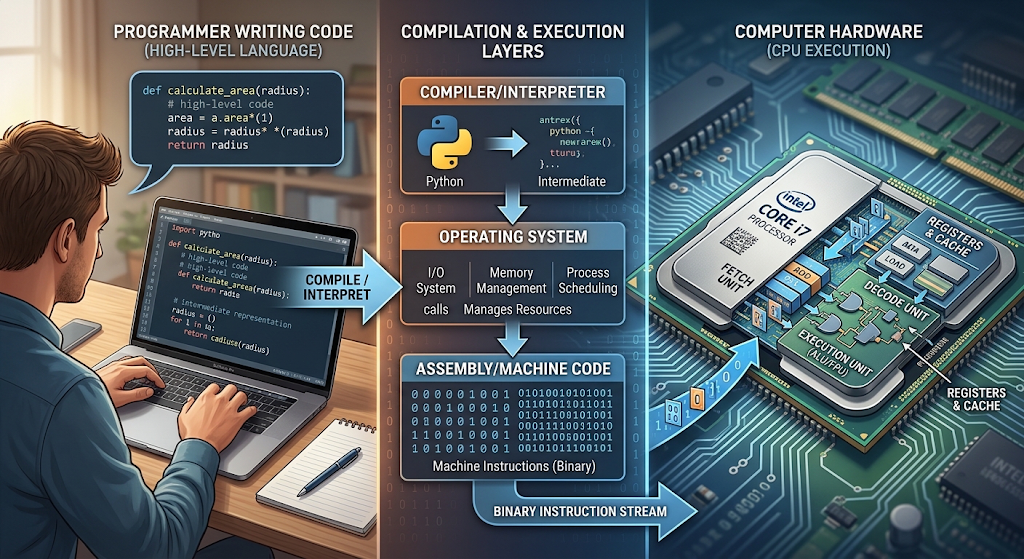
High level programming and low computer layers are important because all instructions that a developer writes in code have to be converted to instructions the processor understands. Compilers and interpreters provide the ability to translate high-level programs to low-level instructions that a computer can follow. The definition of High-Level Language provides more information about this concept.
Compiler is a language that is optimized for human use, but it is also used by computers. They enable humans to develop software programs without having to understand the complexities of the electronic operations in computers.
Importance of Structured Computer Organization
Making the Understanding of Complex Systems Easier
Structured computer organization is of great value because it makes a very complex system into manageable parts. Most people can’t see all the components in a modern computer, and can’t see all the operations it performs, especially when it performs millions of operations per second. The layered approach enables students, engineers and developers to learn one level at a time and to know how each level relates to the others.
This organization also accounts for the ability of improvements to take place at different levels separately. Faster processors can be designed by hardware engineers and software developers can continue to code in their preferred languages. Hardware engineers can design faster processors, and software engineers can still write code in their preferred languages. By changing the architecture of the processor, operating systems can make security and performance improvements without informing users of changes occurring within the processor. Each layer offers stability and innovation on the bottom layer.
Teaching Computer Design in the Modern Way
The layered model has had an impact on the design of modern computing systems, and has helped to promote the clear division of responsibilities between hardware and software. Existing interfaces link between the various layers to guarantee compatibility with previous programs, permitting engineers to create new technologies with compatibility.
For instance, when the manufacturer of processors improves, the performance can be increased without the necessity for the programmer to have to rewrite all the programs. Likewise, it is possible to design new programming languages that offer improved application development tools that can be built on top of existing hardware foundations. The flexibility is one of the reasons that computers are still evolving over the decades.
Conclusion: Virtual Machines as Layers of Computers
Structured computer organisation gives a strong understanding of how computers work from the smallest electronic components to complex software applications. Tanenbaum’s model is a multi-layered view of a computer, which can be thought of as a stack of virtual machines. Every layer masks complexity from the layer above and offers helpful methods and services that enable computing to be executed.
Digital Logic, Microarchitecture, Instruction Set Architecture, Operating System, Assembly Language and High-Level Language are six levels of interaction with a computer system. The lower layers are concerned with operations of hardware, whereas the higher layers are concerned with human friendly programming or applications. These layers together make up the total computing experience which billions of people experience every day.
This knowledge is important for students and professionals to recognise the relationship between hardware and software. It describes how basic electronic signals can over time be transformed into complex programs, websites, games and artificial intelligence systems. As computers become virtual machines, we get a better understanding of the technology that runs the modern world.