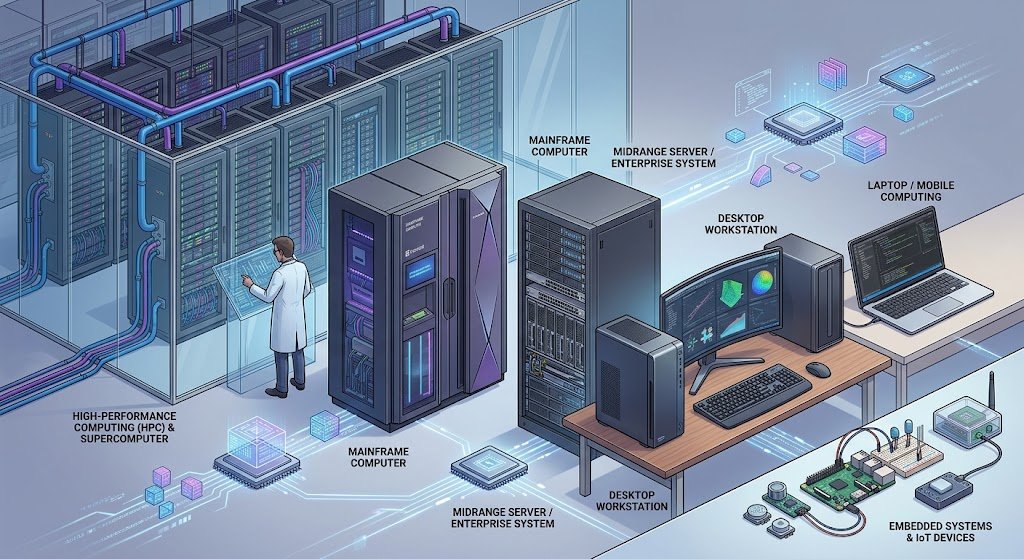
Introduction to Computer Classification
From scientific studies to everyday tasks, computer systems have become integral components of today’s infrastructure. The digital landscape is traditionally broken down into computing machines according to their processing power, architecture, size, and application.
Computer science teachers, IT professionals and computer science students require a solid background in the various types of computers to use when assessing computational resources. This is a guide to the major hardware categories of the modern day, discussing the technical characteristics, distinctive operating properties and practical application of the hardware in different industries.
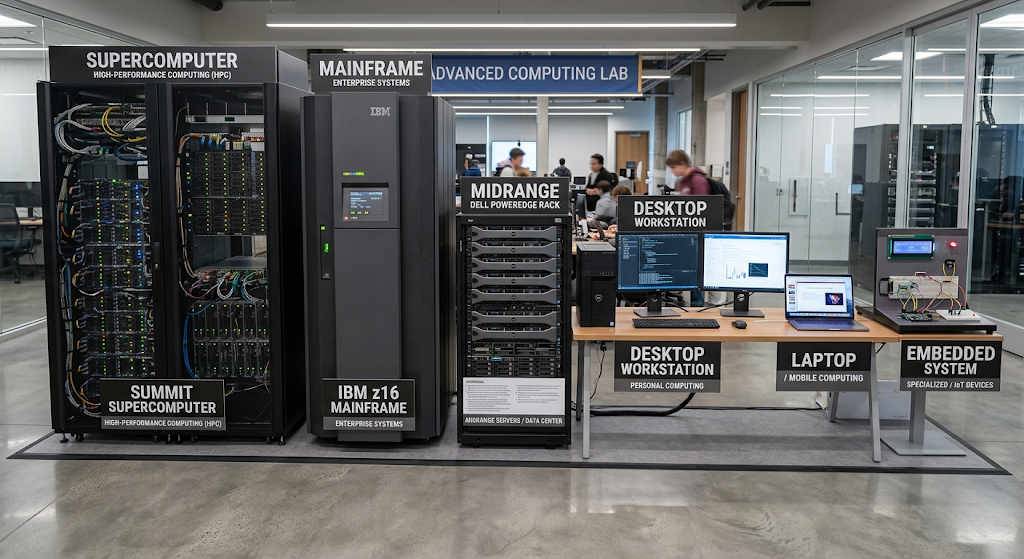
Supercomputers: High Performance Computing at Scale
Supercomputers are the ultimate in computer speeds, power and parallel hardware design. Supercomputers are not for general purposes but are built to perform a specific task that requires trillions of calculations per second and has a lot of data to process. Performance is measured in FLOPS (Floating Point Operations Per Second), and today’s high-end systems can perform in the exaFLOPS range (more than 1018 operations per second).
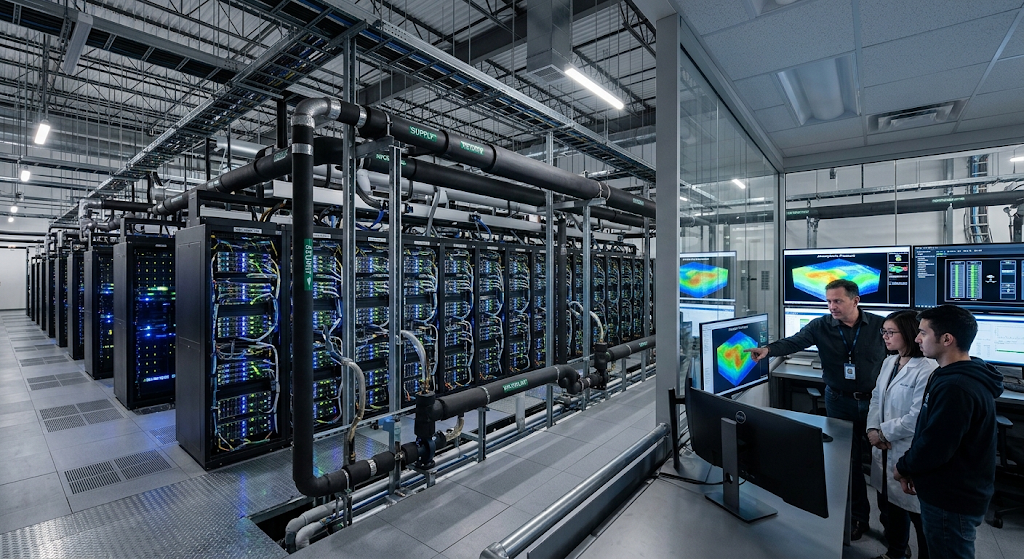
These systems feature architectures of massively parallel processing (MPP), which include hundreds of thousands of highly specialized CPU and GPU cores that are interconnected by high bandwidth, ultra-low-latency networks.
Technical Infrastructure and Cooling Constraints
The technical infrastructure and cooling constraints. The supercomputer has so many hardware parts that it requires a lot of energy and produces a lot of heat. Therefore, these installations need to be designed with custom-developed power delivery systems and liquid-cooling or direct-to-chip cooling systems. The software stack is also very specialized, with customized Linux kernels and distributed programming models, like MPI (Message Passing Interface) and OpenMP, that divide and conquer large computing tasks into thousands of independent nodes working concurrently.
Primary Use Cases and Academic Applications
Due to the high cost of the investment and the high cost of maintenance, supercomputers are mainly used in important international consortiums, research universities, and government laboratories. The problem of climate and weather prediction involves processing huge amounts of physical equations over high-resolution spatial grids, which in turn simulate the dynamics of the Earth’s atmosphere, ocean and the climatic state of the past.
Molecular Dynamics and Drug Discovery: Computational simulation of the 3D folding structure of complex proteins, testing chemical compound binding to molecular targets, and the computational identification of therapeutic chemical compounds before experimental testing in laboratory. Astrophysical Simulations: Multi-body, complex, gravitational calculations of galaxy formation, stellar nucleosynthesis and distribution of dark matter over cosmological timescales. Computational Fluid Dynamics (CFD) testing of hypersonic airframes, advanced cryptographic analysis, and nuclear stockpile stewardship.
Mainframe Computers: The Backbone of Enterprise Operations
Supercomputers are used for performing specific problems at high speed, whereas mainframe computers are best suited for high volume input/output (I/O) throughput, enterprise data security and transaction processing. The mainframe is built to handle many transactions at once at the same time, around the clock and all day long with no downtime. They are known for their absolute reliability, available redundancy, and backwards software compatibility, and are used for critical operations for decades at a time.
Hardware Comparison: Supercomputer vs Mainframe Computer
| Hardware Metric | Supercomputer | Mainframe Computer |
| Primary Metric | Raw Mathematical speed (FLOPS) | Transaction Volume & Reliability (MIPS / TPS) |
| Architecture | Massively Parallel Cores | Specialized I/O Processors & Redundant Bus |
| Workload Type | A single compute job that is large in size.Large compute job. | Each time a small transaction is performed, many millions of transactions are taking place concurrently. |
| Downtime Tolerance | Low to moderate (Job level) | Zero Tolerance (Fault-tolerant high availability) |
Enterprise Architecture & Reliability (RAS)
The mainframe systems use the Reliability, Availability, and Serviceability (RAS) principles. Built-in redundancy is provided for hardware components such as memory channels, power and main central processors. The cryptography, virtualization, and disk I/O are all handled by microcode and special co-processors, which leave the primary processors to just business logic. A single physical mainframe chassis can be used to power thousands of virtualized instances running on operating systems such as IBM z/OS, which can be considered as an entire enterprise datacenter.
The number of commercial and institutional applications is small.Commercial and institutional applications are limited. Mainframe architecture still plays an important role in global commerce and in the foundation layer of core infrastructures in critical private and public industries.
Global Applications of Mainframe Computers
Global Banking and Financial Networks: Processing millions of transactions each day with credit card transactions, clearing wire transfers across borders, and keeping the core account ledgers with strict atomic transaction consistency.
Airline and Logistics Reservation Systems: Processing real-time passenger reservations, seat reservations, and queries to the global distribution system (GDS), as well as inventory management for global logistics chains.
Government and Social Infrastructure: Working with national tax systems, processing public healthcare claims, maintaining social security systems, securely handling motor vehicle records.
Minicomputers: Midrange Computing Systems and Distributed Servers
Evolution of Minicomputers
Minicomputers have, historically, appeared in the 60s with the availability of a machine that was smaller and less expensive than large mainframes, but was still able to offer multi-user processing to medium sized organizations. In the contemporary architectural lexicon, the word “minicomputer” now more or less refers to midrange servers, distributed enterprise servers and departmental compute nodes. They connect the single user microcomputers to the large central mainframe systems and offer flexible multi-user compute capacity to certain operational units.
System Scaling and Multi-User Support
The ability of the system to scale and support multiple users.System Scaling and Multi-User Support. Midrange servers are built with multi-socket processor configurations, high density RAM modules and scalable rack-mount form factors. These systems run on enterprise Unix, Linux and specific server platforms (including IBM i) and efficiently support multiple concurrent connections from dozens to thousands of thin clients or local network endpoints. They are also modular which means they can be expanded by memory boards, storage array channels or network cards as the need arises.
Real-World Operational Scenarios
Midrange server systems offer dedicated computers which do not require the significant capital investment that is associated with full scale mainframe hardware.
Manufacturing and Industrial Automation: Managing local factory assembly lines, controlling Computer Integrated Manufacturing (CIM) and coordinating real-time quality assurance data on the shop floor.
Hospital Information Systems: Electronic Health Record (EHR) databases, Medical imaging storage systems (PACS) and administrative workflows within local hospital departments.
Academic and Departmental Research Nodes: Providing a dedicated cluster management system for University Department labs, internal web application hosting, and special local database queries.
Microcomputers: Platforms for Personal and Workplace Computing
Introduction to Microcomputer Systems
Microcomputers are single user computer systems that use a microcompatible processor with a CPU, cache memory and control bus all built on a single integrated circuit. Microcomputers were first introduced in the 1970s, a time of the microelectronics revolution, and are the most widespread type of computer in the world. This is a general term that includes traditional desktop workstations, along with laptops, tablets, smartphones, and workstation-grade PCs, which are used for daily productivity, creative work and direct human-computer interaction.
Architectural Composition and Hardware Evolution
Architectural Composition and Hardware Evolution discusses the process of evolving architectural components and hardware. A microcomputer’s hardware architecture has a central focus on the x86-64 (Intel/AMD) or ARM processor architecture, along with system RAM, high-speed solid-state disks (NVMe PCIe SSDs), and graphics processing units (GPUs) that are linked together by common bus interfaces. Operating systems like Windows, macOS, Linux, Android and iOS control hardware abstraction and offer graphical user interfaces (GUIs) that are optimized for simple multi-tasking and interaction.
Sub-Categories and Diverse Deployments
The hardware of microcomputing has evolved into various sizes and shapes adapted for different applications:
Desktop Workstations: High performance desktop configurations designed for software engineering, 3D CAD modelling, video production and scientific visualization.
Laptop Computers and Mobile Devices: Ultra portable form factors with built-in displays, extended battery life and wireless chipsets for remote working and education, and communications.
Single-Board Computer (SBC): Small microcomputers such as the Raspberry Pi that have input/output ports, RAM and the system CPU on the same circuit board, which are extensively used in educational labs, home media servers, and fast hardware prototypes.
Embedded Systems: Specialized Microprocessors in Everyday Hardware
An embedded system is a specialised microcomputer embedded in a non-computing artefact to carry out specific control roles, real-time monitoring or specific processing operations. Embedded systems are also different from general purpose microcomputers because the software programs (firmware) are permanently programmed and cannot be changed by the user, and the systems are expected to be energy efficient, have very few time constraints, and be deterministic, which means predictable.
Embedded System Architecture and Real-Time Control
The embedded system is usually based on a microcontroller, which is an integrated circuit that integrates a processor core, memory modules (RAM and flash), and programmable input/output peripherals onto a single silicon die. Embedded systems may also be programmed with a Real-Time Operating System (RTOS) or bare-metal code loops which ensure that critical tasks can be executed at a known speed for safety reasons.
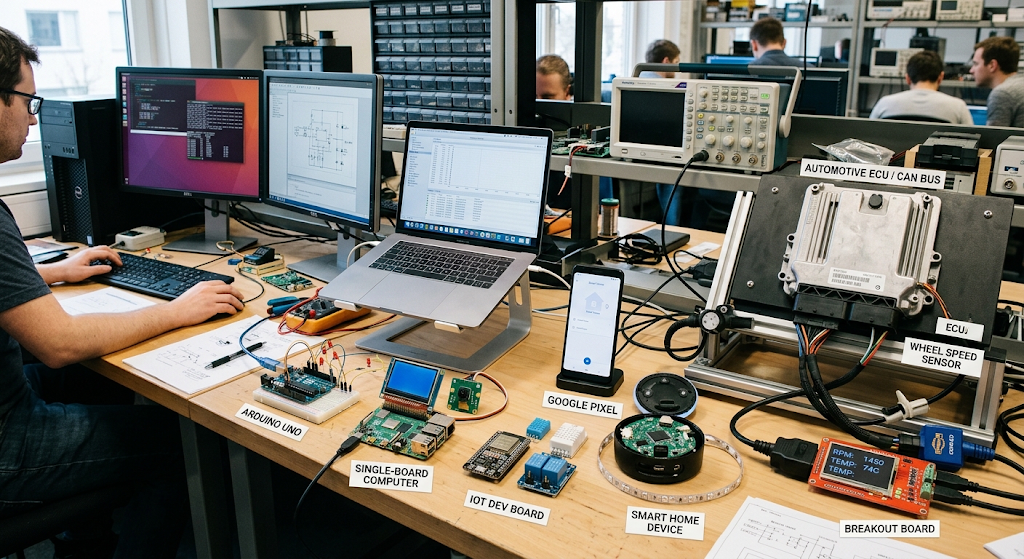
Ubiquitous Deployment Examples
Embedded computers are trillions of times more numerous than general purpose personal computers and are used to manage and control important parts of the technical world today.
Automotive Control Units (ECUs): Control electronic fuel injection, anti-lock brakes (ABS), advanced driver-assistance systems (ADAS) and battery management for electric vehicles.
Medical Diagnostic Devices: Regulating automated insulin pumps, cardiac pacemakers, digital patient monitors and handheld point-of-care diagnostic devices.
Consumer Electronics and Smart Home Devices: Powering smart thermostats, robot vacuums, smart TVs, and connected IoT sensors.
Industrial Control Systems (ICS): These power Programmable Logic Controllers (PLCs) used to control physical valves, conveyor belts and robotic arms in today’s automation environment.
Comparative Architectural Overview of Computer Categories
These categories can be combined into a spectrum for computing systems, which ranges from processing ability, primary architecture, target user capacity, to size.
| Category | Typical Processor Scale | Primary OS Environment | Physical Scale | Primary Purpose |
| Supercomputer | 105-106 Parallel Cores | Customized Linux (Distributed) | Multi-rack / Warehouse | The process of creating a model using scientific methods.The act of modeling using numerical simulation. |
| Mainframe | Specialized Redundant CPU/IO | z/OS, Linux for Z | Multi-chassis cabinets | High Throughput Enterprise Transaction Processing |
| Minicomputer | 8-128 Multicore Sockets | Enterprise Linux, Unix, IBM i | Single/Multi-rack cabinets | Data is stored in departmental databases or on mid-tier servers. |
| Microcomputer | 2-24 Core Microprocessors | Available for PC, Mac, Linux, iOS | Desktop, Laptop, Handheld | Personal productivity, content creation, personal client nodes. |
| Embedded System | Single-core Microcontroller | RTOS, Bare-Metal Firmware | Integrated Component | Hardware control with real-time automation. |
Conclusion
An academic, research or enterprise IT hardware solution requires knowledge of the structural classification of computer hardware. Every level of computing, from the supercomputer at the highest end of the spectrum to the tiny embedded controllers at the lowest end, has different engineering challenges with respect to system power usage, computational capacity, reliability, and system costs.
These classifications serve as essential guidelines for structuring and comprehending the contemporary digital landscape, as hardware evolution continues with each passing day, fueled by advancements in semiconductor manufacturing, high-bandwidth memory integration, and specialized AI accelerator silicon.