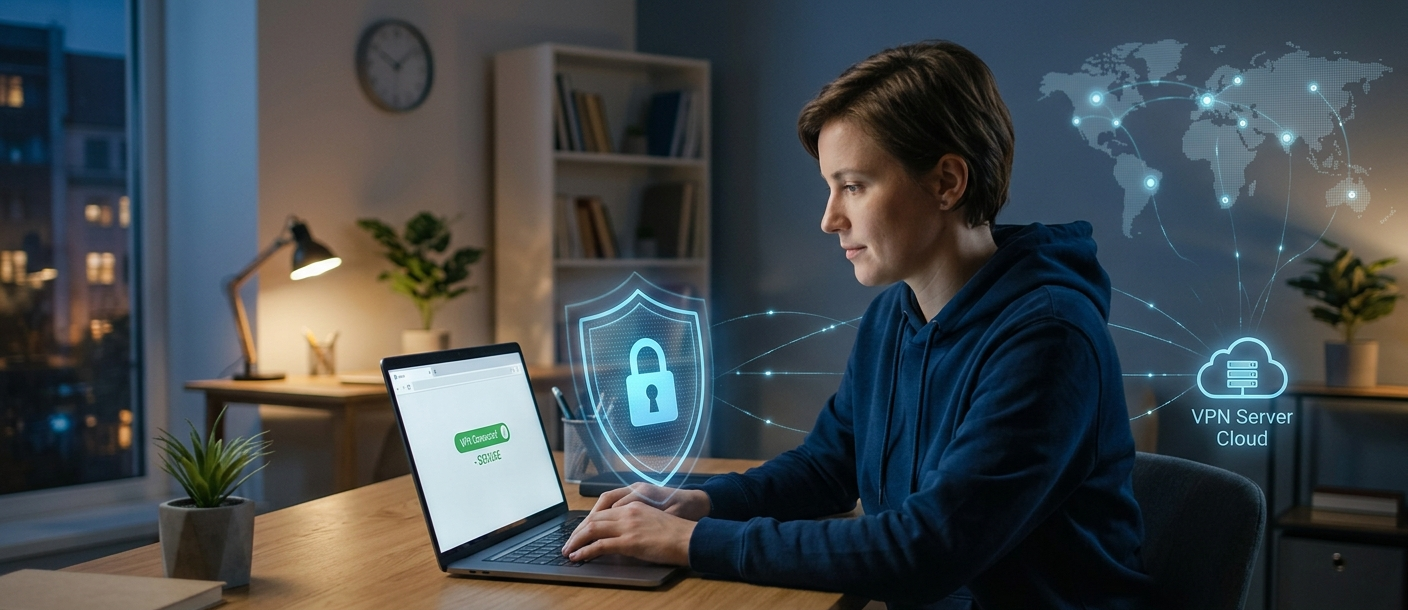
Today the Internet is an integral part of people’s lives and offers them a way to communicate, work, shop, study, watch entertainment and get information from virtually anywhere. But all online activities leave digital footprints, such as information about the websites that people visit, the services used, and the networks through which they connect. This has raised concerns regarding online privacy and security, particularly in light of the ongoing rise in cyber threats, data tracking, and unauthorized access.
Also known as a Virtual Private Network, or VPN, is a technology created to offer users a more secure and private connection while using the web. VPNs are not only easy to use but also can be considered a simple solution for anyone as well, despite its sounding like a complicated tool which is used just by cyber security experts. By grasping the essence of a VPN, how it secures data, and its scenarios of usefulness, beginners can make smarter choices concerning their online safety measures.
What Is a VPN?
Virtual Private Network (VPN) is a service that enables a private and secure link between a user’s device and the Internet. A VPN encrypts internet traffic and routes it through a secure VPN server instead of connecting directly to the websites and online services via an internet service provider (ISP). This gives a further level of security as other people outside of the network, such as hackers, third parties, or network administrators, cannot easily see or intercept the information being exchanged. VPN is not a way to become invisible on the Internet, but it can certainly enhance your privacy; you can hide your sensitive information without revealing as much as possible when you’re on the Internet.
It’s important to appreciate the importance of using a VPN by picturing how the normal internet connection works. Without a VPN, the website a user visits will have direct communication with the user’s internet provider. The link may contain data like the device’s IP address, network information and its approximate location. An Internet Protocol (IP) address is a sort of digital address for a device on the Internet. This information may be used on a website or online service to know from where a user is connecting from and sometimes track their online activity. A VPN can reverse this flow and provide a safeguard for the user’s identity and Internet activity.
Why do people use a VPN?
There are various reasons why people use VPNs, but the top two are privacy and security. A major benefit of having a VPN is that it safeguards personal data when customers are linked to networks which aren’t completely secure. For instance, an airport, hotel, or restaurant public wi-fi can provide a convenient Wi-Fi network but the shared network may present a security issue as many people use it. If not protected, attackers could try to observe network activity, or possibly access confidential information. A VPN minimizes these dangers by encrypting data prior to it getting across the web, making it difficult for unofficial people to comprehend or misuse the information.
Another widespread use of VPNs is to gain more privacy when surfing online. ISPs, Web sites and advertisers can gather information about Web activity for analysis or for use in personalizing and advertising. There’s some tracking that goes along with Internet use, but many people want to reduce the amount of information they share. A VPN can mask the IP address of the user and present a fake IP, which will make it tougher for the websites to figure out the actual location of the user. This feature is particularly helpful for those seeking greater privacy and control over their online presence.
How Does a VPN Work?
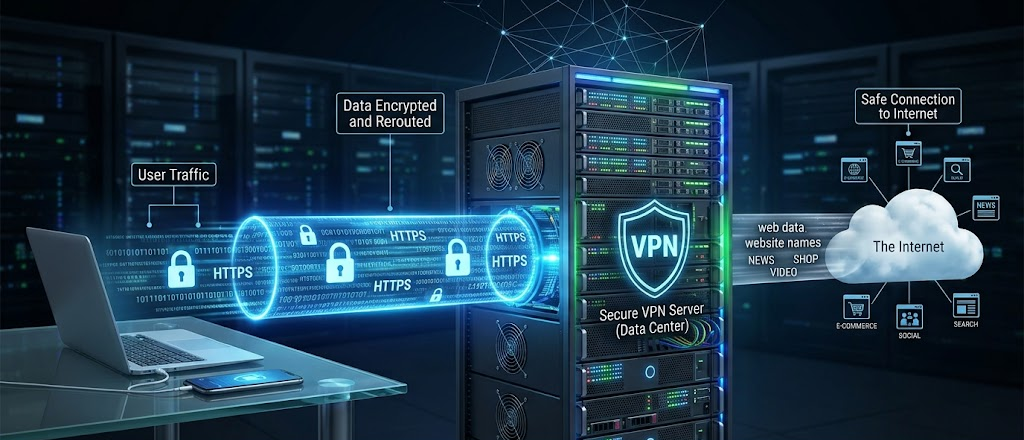
The way a VPN works is by establishing a secure connection, known as a tunnel, between the user’s device and the VPN server. This tunnel is used for securing information when it is making its way across the internet. Once a user launches the VPN, the VPN software makes a connection to a VPN server that the user selected and starts to tunnel all Internet traffic through the VPN server. The data is encrypted, and sent from the device to the websites, rather than directly to the websites. The VPN server then acts as the user’s proxy in communicating with the Internet, bringing information back and forth through the protected tunnel between the Internet and the VPN server.
There are a number of important technologies involved, such as VPN protocols, tunnels, and encryption. Encryption is a method of scrambling text, or plaintext, into a format that is not readable by others, called ciphertext. The information can only be translated back into readable data by authorized systems that have the proper decryption technique. This way, criminals or people gaining access to the information without authorization cannot understand what it says. The power and efficacy of a VPN relies on the encryption procedures and security technologies supplied by the VPN service.
If you’re a beginner who wants to learn what happens behind the scenes of the technical aspect of VPN protection, then you’ll learn how a VPN encrypts traffic to understand how encryption helps to protect information by converting it into a secure format as it travels between a device and a VPN server. One of the primary reasons for the popularity of VPNs and their use in encrypting online data communications, particularly when dealing with personal information like passwords, financial data, business documents and personal messages.
How VPN encryption secures data
One of the most vital features of a VPN is encryption, which helps to stop unauthorized users from being able to easily read internet traffic. If not secured, information sent over the internet can be compromised at various stages between the user’s machine and the server’s machine. A VPN encrypts this information before it leaves the device so that anyone who does get the data will see a string of unreadable characters, not meaningful information. This is especially helpful when users are on networks they don’t necessarily trust, such as public wiFi networks.
Today’s VPN services employ high-end encryption methods that can securely transport massive amounts of data at a fast pace with minimal impact on the normal Internet experience. You can protect activities like email, access work systems remotely, make online payments, and communicate with private applications using encryption. While VPN encryption is not foolproof against all online threats, it does provide a solid security layer that makes the majority of online activities more challenging.
Another key feature of VPN security is that it encrypts data transmitted between locations. It is not the same as security that guards information that is stored on a device or server. A VPN is primarily designed to secure the data as it is being transferred, so that communications between the user and the internet are kept private. This is particularly advantageous when information needs to pass through other networks that are controlled by other organizations or by other people.
How a VPN Hides Your IP Address
One of the most significant benefits of using a VPN is to conceal the actual IP address of a user. IP Address is a number used to identify a device by uniquely associating it with the Internet. Identifies Internet traffic sources for websites, online services and networks. An IP address is not used to give out all information about a person, but it can be used to obtain some information about the location and internet provider of a person. The VPN service hides the user’s IP address from websites, meaning that when the VPN is used, the user’s machine won’t utilize the website’s standard IP address. Instead, the IP address of the VPN server is displayed on the webpage, which makes it more difficult to know the IP address of the user and the location or track the user’s connection directly.
The reason that this works is that the VPN server is situated between the user and the internet. If for instance, someone logs into a VPN server in a different city or different country, the websites will view the location of the VPN server as opposed to the user’s actual location. This can help to enhance the level of privacy by minimising the amount of identification provided throughout online interactions. It is worth noting, however, that the VPN is not an absolute solution to conceal a person’s digital identity. There are other pieces of information that can still be used to find out information about a user such as logins to an account, browser settings, cookies, and online behavior. A VPN is thus a privacy instrument which minimizes exposure, not total anonymity.
Understanding VPN Tunneling
VPN tunneling is yet another important concept that helps to explain how VPNs establish secure connections. The term tunnel refers to the protected tunnel which a VPN facilitates for data to pass through the public internet safely. When there’s a VPN tunnel between a device and a normal internet connection, data flows straight by way of the tunnel. A VPN securely encrypts the data before sending it out. This tunnel ensures that the data cannot be easily accessed or modified by unauthorized parties while it is being transmitted from the device to the VPN server.
The wrapping of data within other layers of data is sometimes referred to as encapsulation, and is the tunneling process. This enables the VPN to securely route Internet traffic over networks that are not necessarily trusted. When encrypted data is received at the VPN server, it is decrypted and forwarded to the final destination. If information is sent back to the user, it will be encrypted again by the VPN server and transmitted through the secure tunnel. This ongoing process occurs rapidly in the background so that users are allowed to browse, stream, communicate and work online without having to manually safeguard every piece of information.
VPN tunneling is particularly critical for businesses or organizations, where workers may require secure access to company resources from various locations. A VPN can help keep important business information secure and private while remote employees are accessing internal systems from their homes, hotels, or other workplaces. Organizations can opt for using the VPN technology to enable the establishment of secure connections between employees and company systems instead of using potentially unsafe networks.
VPN Protocols: What Are They?
VPN protocols are the rules and technologies that govern how a VPN establishes connections, moves data and safeguards security. Each VPN protocol has a different approach to distributing speed, reliability and security. A VPN service’s protocol impacts on the effectiveness with which data can flow and the power of their security features. You don’t need to be familiar with all the technical aspects of each VPN protocol, but it’s helpful to understand what they do to evaluate why various VPN services work differently.
OpenVPN is one of the most popular VPN protocols, known for its robust security and flexibility. It is a secure, open source protocol that can run on a variety of operating systems and has been tested by security experts. WireGuard is another protocol of the modern times, created to deliver the quickest speed with sufficient security. WireGuard is generally faster to establish connections than the more traditional protocols due to its simpler design. Other protocols, like IKEv2/IPSec, are proven to be reliable and can be very helpful on mobile devices as they are able to reconnect quickly when users move from one network to another.
Some older protocols may still be in use, but many have fallen out of favor due to the improvements in technology that make some of these protocols less secure. A secure VPN service provider will automatically choose a secure protocol or offer the user the choice of which to use. For beginners, the most crucial factor is selecting a reputable VPN provider that updates its security protocols regularly, instead of having to tweak technical settings.
Different Types of VPNs
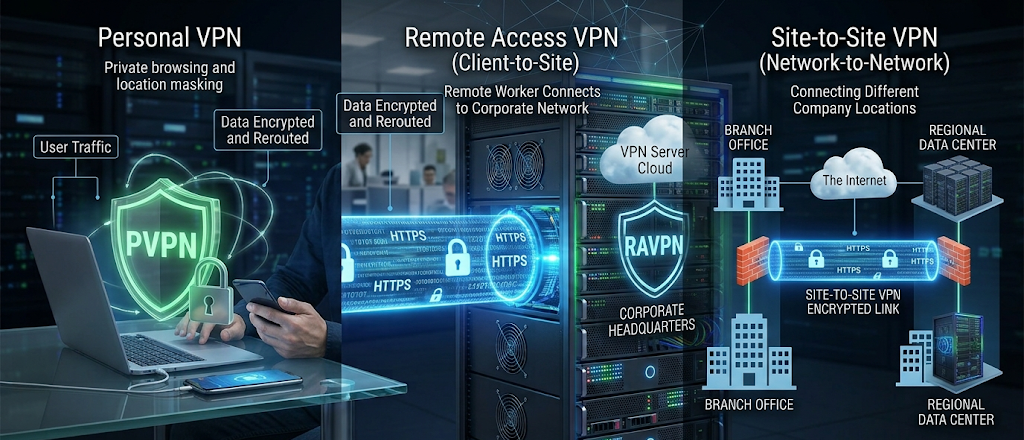
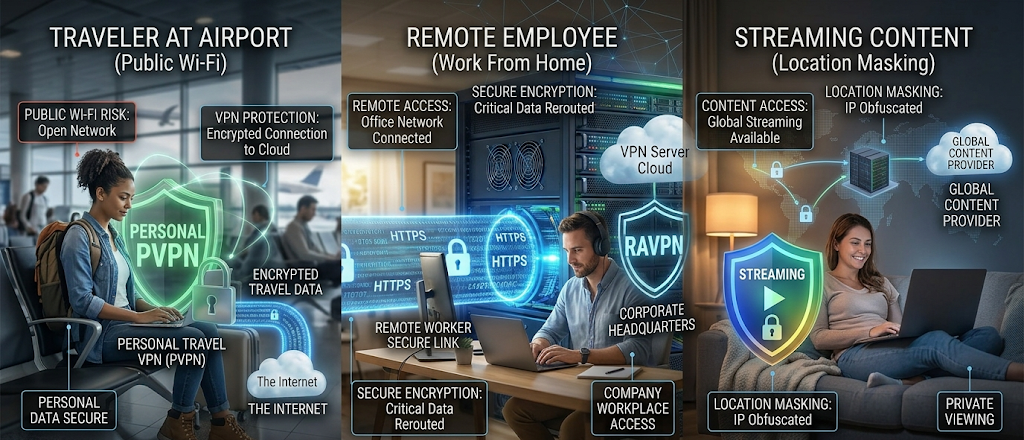
Many people believe VPNs are instruments of personal privacy, however there are several kinds of VPNs, each with its own unique functions. There are three categories of VPNs: personal, remote access and site to site.
Depending on the objective, they address different issues, whether it’s securing an individual user, linking employees or linking entire networks together.
Personal VPNs
The VPNs that are used by the common users of the internet are called personal VPNs. They are meant to keep individual gadgets like smart phones, laptops, tablet computers and desktop computers safe. Personal VPNs are used for privacy, to get onto public WIFI networks and to limit exposure when surfing the web. These services are typically provided by subscription based applications on which users can install and activate when they need more protection.
Personal VPNs are commonly used by travelers, students, remote workers, and those who use a variety of networks frequently. For instance, an individual in a coffee shop may connect to a VPN before checking out email or accessing on-line accounts. The VPN’s ability to encrypt the connection helps to prevent others on the same network from easily tracking what they are doing.
Remote Access VPNs
Remote access VPNs are typically employed by businesses and groups to enable their staff members to access their office systems safely from the outside. With remote and hybrid working increasing in popularity, businesses require robust measures to safeguard company data when it’s being accessed from various locations. A remote access VPN enables an employee to establish a secure connection to the company network to be able to access files, applications and resources safely.
A work-from-home employee, for instance, might have to retrieve sensitive company information from internal servers. The VPN establishes a secure channel between the employee and the corporate network, bypassing the open Internet. This minimizes security threats and aids in preserving the control of sensitive data in organizations.
Site-to-Site VPNs
Site-to-site VPNs are used to provide secure connection of two or more separate networks. They are widely adopted by big enterprises that have offices in various places. The whole networks are connected with each other via the encrypted link instead of individual users connecting via separate VPN applications.
For instance, a company with offices in several countries can utilize a site-to-site VPN to permit staff in each area to securely access and share resources and also connect with one another. The VPN establishes a secure link between the office networks and enables data to flow securely, even though the offices are physically separated.
When is it advisable to use a VPN?
While VPNs offer valuable security and privacy, they aren’t always essential for each and every online activity.
Knowing when a VPN is needed can make people better utilize the technology. VPN’s are particularly useful when privacy, security or safe access to information is a critical concern.
Connecting to public Wi-Fi via a VPN
One of the most frequent instances where it is recommended to use a VPN is when accessing public Wi-Fi hotspots. Convenient networks are located in airports, hotels, restaurants, libraries and shopping centers, so that people can use the internet while away from home. These networks can, however, be shared, posing an increased level of risk. VPN encrypts data in web traffic, which makes it tougher for anyone on the same network to view private data.
If you’re doing work-related activities on public wireless networks like checking email, opening work accounts, shopping online or logging into important services, it’s possible that sensitive information can be exposed if you don’t take steps to secure your connection. A VPN can provide an extra safeguard by encrypting the interaction between the gadget and the Web.
Setting up a Virtual Private Network (VPN) for Work and Remote Access
As remote working becomes more common, VPNs have become an essential tool for employees and organizations. Numerous companies keep sensitive data on private networks which should not be accessible to any unauthorized users. If employees work from home, on the road or accessing the company network from various locations, they may need a secure method to access company systems without exposing sensitive data. By enabling employees to establish a secure connection between their devices and the company’s networks, a VPN can help organizations keep their networks safe even when their staff are not in the office. This is particularly beneficial for industries that involve private data, such as monetary, health care, education and innovation.
A VPN will help employees connect to the company’s shared files, applications and tools with more security. The VPN, as opposed to sending information directly over the public web, encrypts communication and ensures that only granted users have access to certain resources. Additionally, businesses can integrate VPN with other security features like multi-factor authentication and access controls to provide more robust protection from cyber threats. But a VPN is just a component of a broader cybersecurity strategy. It does not replace robust passwords, software updates, employee training or other security measures that will keep organizations safe from attacks.
Using a VPN for Streaming and Online Content
Many people use a VPN for entertainment, particularly while watching movies, TV shows, sports, and other streaming media. Content libraries vary between streaming platforms and geographic areas, and some will offer a wider selection of content to users in certain countries. Some people use VPN services to circumvent geo-restrictions due to a change in their apparent location with the help of a VPN server located in another region.
VPNs offer greater flexibility with streaming, but it’s important to note that streaming services have their own rules and technologies to uncover unusual access patterns. VPN connections might be limited or blocked on some platforms and using a VPN can occasionally impact web streaming because all web traffic has to go through an additional server before arriving at the ultimate destination. The quality of the experience depends on the locations of the VPN providers’ servers, how fast they transmit data, as well as on the overall performance of the network.
For travelers who may want to continue to use their normal online services while traveling, a VPN can be helpful. For instance, if you’re going to a foreign country, you could choose to use VPN to be able to access websites or even services that rely on your home country. A VPN, however, should primarily be considered as a privacy and security tool, not a certain solution to circumvent all geographical limitations.
Benefits of Using a VPN
VPNs offer a number of benefits, making them useful tools for improving online security and privacy. The most prominent advantage is that it safeguards the information from unprivileged access. Data is encrypted over the internet, making it much more difficult for attackers to understand the data being transferred if they are able to intercept it. It is especially crucial to protect users who are dealing with personal information, financial information, business documents, or private communications online.
Another benefit of VPNs is increased privacy. If there isn’t a VPN, a web site or online service may well view a user’s IP address and collect data about the user’s general area. A VPN hides the user’s IP address and makes certain their real IP address is not exposed by a VPN server. It doesn’t stop all sorts of online tracking, but it provides consumers with more control over what information they share online while they’re surfing the web.
VPNs can also enhance the security of users when they use unfamiliar networks. Many people use internet networks that are not in their house and the level of security protection that they present can vary. By using a VPN, users can get a secure connection that is encrypted, ensuring their protection from some network-based threats. This is a very convenient add-on for travelers, students, remote workers and those who use the internet often.
Limitations of VPNs
VPNs offer numerous security and privacy benefits, but they are not the best solution for all online threats. A common misconception is that using a VPN makes someone totally anonymous on the Internet. In fact, a VPN will only cover some of a user’s internet traffic. Even though websites may use a different method to identify users, such as account information, browser settings, cookies, or other tracking technologies. A VPN can make your online presence more private but it cannot eliminate all the ways you can be identified online.
One drawback is VPNs can occasionally slow down the internet. There may be a slight delay compared to a direct Internet connection as data will pass through an extra server and be encrypted and decrypted along the way. This depends on the VPN service quality, distance between the VPN selected server and the user’s initial internet speed. A good VPN will typically have a high number of fast and robust servers to reduce the effects.
Other factors to consider are cost and trust. There are plenty of free VPN services available, but some may be restricted in their number of servers, their speed or the level of privacy they provide, may include advertising or may have a less transparent privacy policy. VPN providers may be capable of taking care of customers’ web traffic, so it is essential that you select a reputable company with a transparent policy. Before choosing a VPN service, users should be well informed about the providers they are considering, and know how their data is being used.
The Most Common VPN Misconceptions Explained
Myth #1: A VPN Will Make You Completely Invisible Online
The myth of the VPN is that it makes users invisible online. A VPN is able to mask the user’s IP address and encrypt data between the device and the VPN server, but it cannot stop all tracking.
There are other ways of obtaining information, such as account activity, browser identification and cookies, that websites can use, even if cookies are not allowed. The easiest way to think of VPN is to consider it a privacy enhancing tool, not an invisibility device.
Myth #2: VPNs Are Only for Experts
Also, another misconception is that VPNs are complex instruments and can only be used by cybersecurity experts. Modern VPN applications are designed for common users and generally are easy to set up and need just a few steps. Most services enable users to install an application, select a location for a server to operate from and enable protection by clicking a single button.
Grasping the fundamentals of VPNs will enable users to make informed decisions, but they do not necessarily have to be tech-savvy to use the technology.
Myth #3: A VPN Can Shield You From All Internet Threats
While a VPN offers enhanced security, it is not a solution that ensures absolute protection from all online threats. VPNs are unable to prevent users from using weak passwords, clicking on malicious links, downloading malicious files, or divulging their personal information to unsuspecting sites, among other things.
Internet safety must be multi-layered and involve using strong passwords, keeping software up-to-date, being cautious when surfing the Internet, and knowing about common cyber threats.
How to Choose the Right VPN
There are a number of factors to take into account when selecting a VPN, such as security features, performance, privacy policies, and reliability. The best VPN service will employ strong encryption, have a secure protocol, and have a transparent policy on user information. One important detail to consider when choosing which VPN service to trust is transparency. VPN companies may be able to see certain internet usage, so it is crucial to choose a transparent one.
The number of available servers, and where these servers are found, are also things to take into account. A bigger server network can offer you with a more extensive range of connections and it may also enhance performance, particularly for those people who are traveling much more often. Speed is also a crucial consideration, as a VPN that drastically slows down connection may make everyday tasks like surfing, video calls, and streaming a hassle.
Compatibility is also very important. The ideal VPN should be compatible with the devices that an individual uses on a frequent basis, such as computers, smart phones, and tablets. Some providers offer simultaneous multi-device connections, making it easy for households or multiple device owners to connect to their provider. The ideal VPN service is one that offers a combination of security, privacy, speed, and user-friendliness.
Final: So, What Is the Answer? – Should You Use a VPN?
VPN is a potent technology that not only helps to protect Internet users but also facilitates encrypted connections, conceals IP addresses, and secures Internet communication. VPNs can sound complicated, but at the most basic level, they provide a more secure connection between the user and the Internet. VPNs are a great way to enhance privacy during browsing and protect information from unauthorized access through encryption, tunneling and secure protocols.
VPN’s are particularly helpful when using public WiFi, accessing work systems remotely, traveling, or when protecting personal data on the web. But they are not a cure-all for all cybersecurity issues. Responsible practice of using the Internet still involves responsible practices (using strong passwords, staying away from suspicious links, keeping software current).
If you are new to VPNs, it is easier for you to determine when VPN services are necessary. A VPN can be a valuable tool for ensuring a more secure online experience for anyone, whether it’s for privacy reasons, better security, or safer business communications. With the increasing usage of the internet, technologies such as VPNs will continue to play an important role in ensuring internet security and privacy.