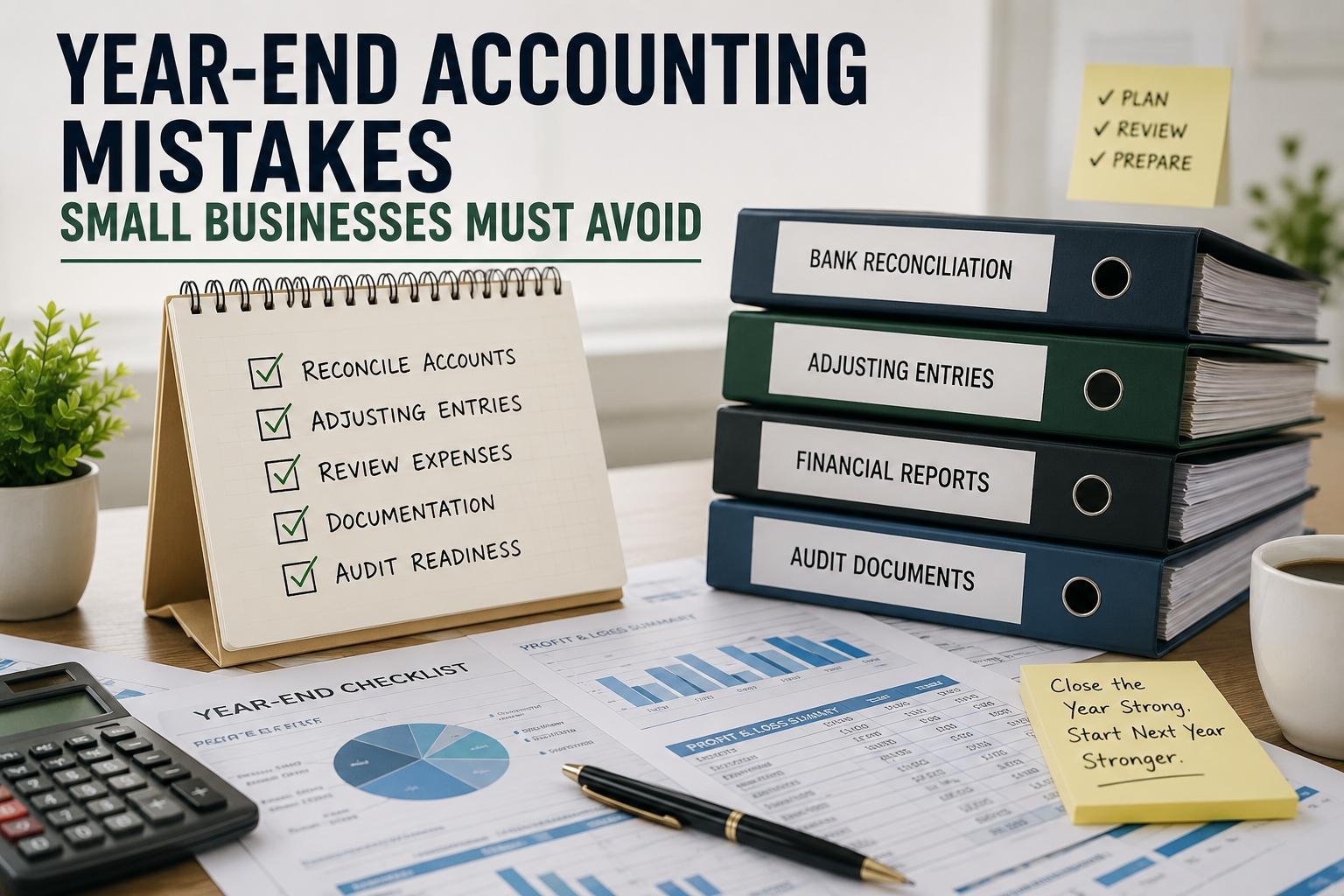
Introduction
The end of the financial year is a more than just a bookkeeping event for small businesses. It underpins the accurate reporting of taxes, making informed business decisions, and financial compliance. The year-end accounts are compiled at the end of the year from all the transactions recorded during the year and therefore are an important time of year for the business owner, bookkeeper and accountant. Unfortunately however, many businesses rush through the closing process or neglect to complete critical accounting duties and miss out on financial accuracy, tax concerns, compliance troubles and avoidable penalties. Sometimes a little error can mean a big trouble when it comes to taxable income, financial reporting or audit readiness.
Avoiding common year end accounting errors should be a priority for any business, whether it has a small team of employees in-house to complete the year-end accounting task or they outsource accounting services. If the financial statements are prepared properly, they provide a true and fair picture of the company’s performance; the tax returns will be filed on time and in proper form and management will have the peace of mind to make strategic decisions for the upcoming year. Identifying the most common year end mistakes of small businesses enables them to set up effective accounting measures and ensure that they comply with financial protocols.
The Relevance of Year End Accounting
Year-end accounting is the process of performing the review, adjustment and finalization of financial records in preparation for annual financial statements and tax filing. During this time, companies check account balances, bank statements, match accrued income and expenses, and determine the values of assets and all financial transactions have been recorded correctly. The objective is to provide accurate financial information that is reliable.
Proper accounting at the end of the year is advantageous for companies in a number of ways. These benefits include better budgeting and forecasting, easier tax filing, better loan applications, higher investor confidence and lower risk of government audits. Most importantly, it provides business owners with the assurance that the financial details employed in making business decisions are comprehensive and correct. Failure to take the necessary steps during the year can often result in a lot more time being devoted to correcting errors after tax time than would have been taken to do proper year-end procedures.
Common Consequences of Year-End Accounting Errors
Year-end accounting errors tend not to be standalone errors. Generally, they impact more than one set of financial reports due to the interconnectedness of the financial statements. A mistake in the expense bookkeeping can have an impact on the taxable income, retained earnings, cash flow reporting and management reports simultaneously. This means that small errors can lead to larger issues that will become costly in the long run.
A few of the consequences are the inaccurate tax returns, financial statement misstatements, delayed tax filing, penalties for failure to file, audit risk, cash flow forecasting issues, poor budgeting choices, loss of lender and investor/trustee confidence, and loss of creditor confidence. The first step to avoiding the problem is to be aware of the most common year-end accounting errors.
Failing to Reconcile All Accounts
One of the most serious year end accounting errors may not be reconciling every balance sheet account prior to closing the books. Reconciliation is the process of comparing the accounting records to the paperwork behind the accounts, including bank statements, credit card statements, loan statements, supplier statements, payroll statements and customer statements. This process can be used to detect any missing transactions, duplicate transactions, unauthorized transactions, or erroneous transactions prior to the closing of financial statements.
Many small businesses only look at their main business bank account and forget to also review their savings accounts, credit cards, petty cash, payroll liability accounts, tax accounts, inventory balances and loans. The lack of reconciliation can cause discrepancies in the accounts that are not necessarily apparent, and can ultimately lead to inaccurate financial statements. An understated liability account could lead to an understatement of taxes and unreconciled receivables could lead to an overstatement of business income. All accounts on the balance sheet should be backed up with a proper documentation before the year’s accounting period is officially over.

Best Practices for Account Reconciliation
A consistent monthly process can enhance the accuracy in reconciliation, instead of relying on year-end. Reconcile monthly throughout the year, this is to allow accounting staff to catch discrepancies when the transaction is fresh. Additionally, the accounting software that has automated reconciliation capabilities helps in minimizing manual mistakes and enhancing efficiency. It is important that management review the reconciliation report regularly to ensure that there are no outstanding differences that require investigation as soon as possible and not wait until the tax season.
Forgetting Important Adjusting Entries
Adjusting entries are made to ensure the recognition of revenues and expenses at an appropriate time based on accrual accounting. A lot of small businesses think that they can prepare their financial statements only when they have recorded their payments and invoices. Year-end adjustments, however, record financial transactions that have actually taken place, but not yet been entered into the books of accounts.
Examples of adjusting entries are accrued wages, accrued interest, prepaid expenses, depreciation, bad debt provision, deferred revenue, inventory adjustments, and outstanding utility expenses. If these adjustments are not made, financial statements are not a true and fair view of business performance. These costs could be underestimated, income could be exaggerated, and tax liabilities could be misstated.
Common Adjusting Entries Small Businesses Miss
There are several common year-end closing adjusting entries that are not made. This is because depreciation doesn’t require cash payments but it is actually the slow erosion of a value of an asset over time. Businesses also overlook accrued interest on existing loans, unpaid supplier invoices received after the end of the year for services provided before the end of the year and employee bonuses earned before the end of the year. Another one of the usual items that people will fail to include is prepaid insurance or annual software fees, which are to be spread out over the years in question. These changes have to be recorded correctly as an accurate record will ensure that accounting standards are met and the financial report will be more reliable.
Combining Personal and Business Expenses
Many small business owners make the wrong bookkeeping error and mix business and personal spending. This is a common issue in sole trader companies and family owned companies where owners pay themselves from business bank accounts and/or company credit cards. This can seem innocuous at first, but can cause major accounting issues at year end closing.
Mixed expenses are hard to analyze to find out what your actual business profits are and can be difficult to investigate before you finish your financial statements. They also can lead to excessive deductible expenses, which can lead to tax adjustments or penalties if audited. Keeping business and personal finances separate makes it easier to keep track of your finances all year round and provides a level of transparency.
Expenses Separation and its Role in Enhancing Financial Accuracy
Separate business bank accounts, business credit cards and accounting books ensure there’s a clear audit trail of all transactions. Owners must withdraw funds from the business and/or distribute funds to shareholders as set out in the proper procedure or owner withdrawals, and not pay out of business accounts personally. Clear expense reimbursement policies also help employees to determine what is covered under a company’s expenses and what their personal expense is. The accuracy of the separation increases the internal control and greatly minimizes the amount of year end corrections.
Lack of Adequate Documentation for Audit
Having accurate accounting records are worthless if they are not accompanied by adequate documentation. Receipts, invoices, contracts, payroll records, tax records, supplier statements, customer invoices, loan agreements, inventory records and more all offer proof of financial transactions. Unorganized supporting documents may cause problems for businesses when preparing their taxes or when under review by the government.
The lack of documentation puts more strain on the hours to verify transactions, and can subject a tax auditor to questioning of deductions or income. Lack of receipts could lead to a denial of reimbursed expenses, and payroll records could be incomplete and lead to employment tax problems. Organized records in digital and physical form throughout the year will help to eliminate stress at the end of year and allow accounting information to be easily verified when required.
Building a Strong Audit Documentation
Businesses should have consistent document retention policies and they should be based on local regulations to define the length of time the records are to be retained. Cloud document handling makes it easier to store contracts, receipts and invoices, as well as decrease the chances of lost paperwork. The other advantage of this approach is that it will greatly simplify future audits, and make it easier for the accountant to find supporting documents if there is a question.
Ignoring Inventory Adjustments
Averaging is NOT allowed in businesses that sell products; they must check to see if they have enough products remaining at the end of the year. Proper valuation of inventory is important because it could be one of the biggest items on the balance sheet. If assets are not physically counted, it may lead to overstated assets, cost of goods sold inaccuracies and gross profit inaccuracies. Damages, old or lost inventory should also be noted and adjusted accordingly to not overstate asset value.
There are several reasons for an inventory discrepancy; they could be due to theft, recording errors, supplier problems, or operational errors. A full inventory count can be taken and a comparison made with the accounting records to determine these differences prior to preparing the financial statements. Effective inventory management will enhance not only financial reporting, but purchasing decisions for the coming year as well.
Overlooking Payroll Liabilities
Payroll accounting is not limited to just processing employee payroll. Before closing their books, businesses need to ensure that they’ve properly logged payroll taxes, employee benefits, vacation balances, retirement benefits, bonuses and more. Not accounting for these liabilities leads to incorrect financial statements and could lead to tax compliance problems.
At the end of the year, a review of the payroll should ensure that all Payroll tax filings are accurate, and that employee benefits accrued are reflected in the payroll records. Reconciling the payroll reports to the general ledger balances helps to make sure that payroll expenses and liabilities are complete prior to the issuance of annual financial statements.
Not conducting reviews of Accounts Receivable & Bad Debts
For many businesses, it is a given that all customer invoices that are outstanding will be collected. Sadly, there are some receivables which are not collectible because the client has gone bankrupt, has claimed dispute or has had financial difficulties. Failure to write off questionable accounts results in assets and profits are inflated due to recording income even though there is no likelihood of it being recovered.
Year-end is a great time to check out the aging report and look at invoices for collection or bad debt write-off. An allowance for doubtful accounts will make the financial statements more accurate and give a more realistic view of the cash that will be collected.
Neglecting Accounts Payable
When closing the books at the end of the year, accounts payable should be thoroughly reviewed. Sometimes, the businesses don’t receive supplier invoices for goods or services after the end of the reporting period. Not including these liabilities is a distortion of the expenses and profit.
Receiving statements of suppliers, unmatched purchase orders, receiving reports and unpaid invoices can help to uncover the outstanding liabilities before financial statements are prepared. Payable records are more complete for improved budgeting accuracy and to ensure that tax deductions are taken in the right accounting period.
Too Late To Close the Books
Many companies rush to prepare year-end financial statements as it’s a tax deadline. Although it is important to report on time, it should never be at the expense of accuracy. Failure to close books after reconciling, adjusting, and reviewing books for tax purposes can lead to amended tax returns, financial statement adjustments, and additional tax professional fees.
An organized year-end closing checklist assists accounting team to finish up all the necessary tasks prior to providing final reports. When enough time is provided for the review, management will have time to detect any unusual transactions or discrepancies that should be investigated.
Poor Internal Controls in the Closing Process of the Year
One of the primary reasons why internal controls are crucial during the year-end is that there is a lot of pressure on the finances and workload. Errors and fraud are more likely to go undetected if not properly monitored. Businesses should be careful to ensure that the duties of authorizing, recording and reconciling are not combined in one person.
Financial integrity is reinforced by management reviews, approvals, independent reconciliations, restricted accounting system access and through regular internal audits. Internal controls are robust and minimize risk of human error and enhance confidence in financial reporting at year end.
Establishing an effective Year-End Closing Process
Year End preparation should be done well ahead of the end of the accounting period. These monthly reconciles, the documentation, closing adjusting entries and financial reviews regularly assist to reduce the workload at end of year. Creating a detailed closing checklist helps to make sure that all necessary steps are taken every year.
It’s also a good idea for businesses to reach out to their accountants, tax advisors, payroll services, and financial counselor early enough to address any pending concerns prior to deadline. Today’s accounting software systems can take care of many of the monotonous tasks and remind you about journal entries, document storage, depreciation calculations and even remind you to perform reconciliation tasks on a regular basis. This is because it takes time to prepare and that preparation time will save a lot of time and money during tax season.
Conclusion
One of the most crucial tasks for any small business will be year-end accounting. Some of the more common mistakes include leaving accounts to be reconciled, not capturing adjusting entries, combining personal and business expenses, not maintaining documentation, missing inventory adjustments, not keeping track of payroll liabilities, or closing the books too quickly can have serious, long-term repercussions. Such errors could lead to greater risk of audits and financial penalties, as well as lower financial information reliability for strategic decision making.
Small businesses can use the following tips to ensure that they generate accurate financial statements and that they are confident during tax season: A structured year-end closing process enables financial health, robust regulatory compliance and owners of businesses to have more reliable financial data to help them achieve sustainable growth and future success.
Get more well researched information about Year-End Accounting Mistakes here.