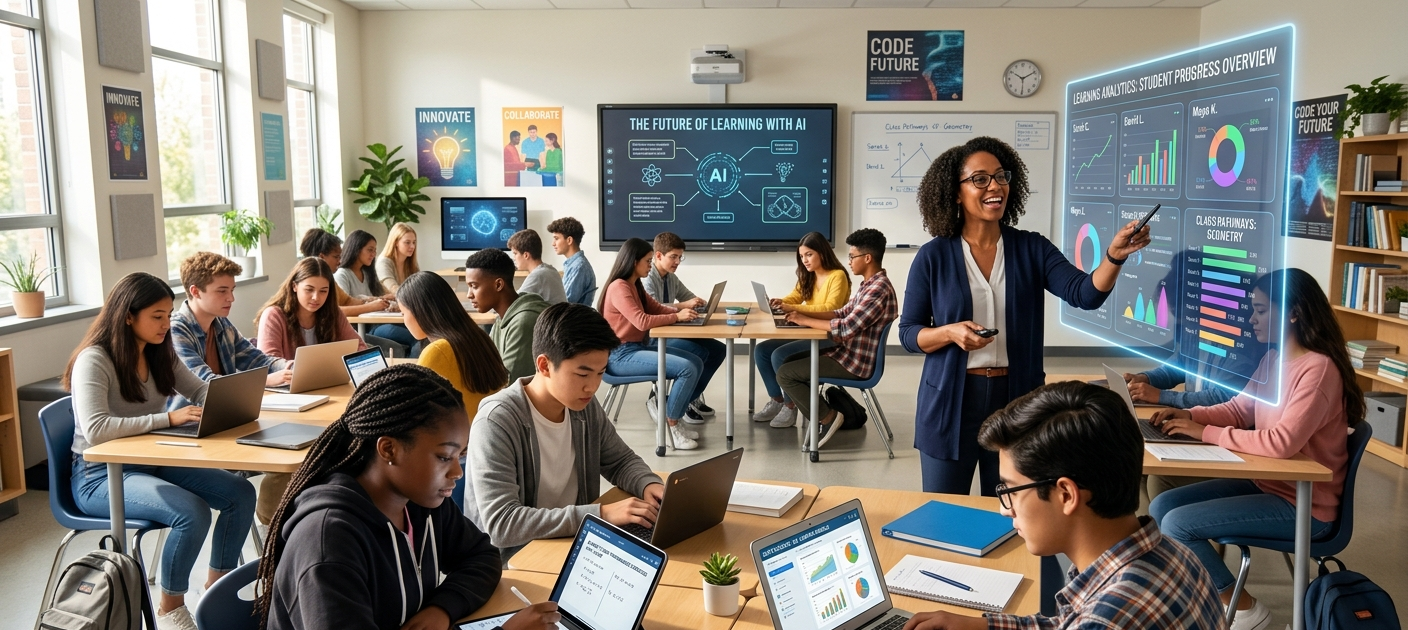
For a long time, the education system was built around a “one-size-fits-all” approach: a single curriculum, a single pace, and uniform evaluation criteria for dozens of students in a classroom. However, the rise of artificial intelligence and adaptive technologies is fundamentally shifting this paradigm.
Today, education is transitioning toward personalized learning pathways, where algorithms analyze a student’s learning speed, strengths, weaknesses, and motivation levels, adjusting the program in real time.
What the World Economic Forum Says: EdTech Trends to 2030
According to research by the World Economic Forum (WEF), the global educational technology market is undergoing a massive transformation. WEF experts highlight several key trends that will shape the industry by 2030:
- The AI Revolution in Learning: The market for AI in education is projected to grow by more than $21 billion by 2028. Algorithms are taking over routine tasks: grading individual assignments, adapting difficulty levels, and providing instant feedback.
- Focus on Measurable Outcomes: The era of simple “textbook digitization” is over. The market demands proven effectiveness—EdTech platforms are evaluated based on how effectively they actually improve students’ knowledge and skills.
- Psychological Comfort and Mental Health: Amid rising academic workloads, creating a supportive environment that reduces stress and the fear of making mistakes has become a critical success factor.
- Continuous Development and Flexibility (Upskilling): The ability to adapt to curriculum changes in real time is becoming a core requirement for educational systems.
How Adaptive Learning Works in Practice
An adaptive platform is not just a library of video lessons; it is a dynamic digital ecosystem. Its operation is built on several key mechanics:
- Real-Time Diagnostics: The algorithm tracks not only the correctness of an answer, but also the time spent thinking, the number of attempts, and the nature of any mistakes.
- Dynamic Difficulty Adjustment: If a child easily completes a task, the platform instantly raises the challenge level. If they encounter difficulty, it offers a micro-explanation or returns to the foundational concept.
- Smart Content and Format Matching: One student might grasp a rule more easily through a visual quest, while another excels through listening exercises or interactive flashcards.
The Core Principle of Adaptivity: The learner is never frustrated by overly difficult tasks, nor bored by overly simple ones. They remain continuously in their “zone of proximal development.”
LearnLink Experts’ Perspective: AI as a Teacher Multiplier, Not a Replacement
At LearnLink, specialists emphasize that despite all the advantages of AI algorithms, the human element remains the cornerstone of successful childhood education.
“AI technologies are incredibly effective at data analysis, gamification, and precisely tuning task difficulty. However, a child doesn’t just learn from an algorithm—they learn from a human being. No matter how smart AI becomes, it cannot replace empathy, emotional support, and timely praise. At LearnLink, we adhere to a hybrid Human-in-the-Loop approach: AI handles the routine, analyzes progress, and matches the ideal tutor to the child’s personality, while the teacher focuses on motivation, live communication, and psychological comfort,” notes the LearnLink academic team.
LearnLink experts highlight three pillars that support effective personalization:
- Smart Matchmaking: The system analyzes not only the child’s academic level, but also their temperament, interests, and learning style. The child gets more than just an instructor—they gain a mentor and friend.
- An Adaptive Gaming Environment: The interactive platform removes the fear of making mistakes. A mistake is treated as a natural gameplay element rather than a “bad grade,” fully aligning with the WEF trend toward protecting student mental health.
- Transparent Progress Analytics: Parents and educators receive objective data on learning dynamics based on real mastery metrics rather than subjective impressions.
Summary: What Education Will Look Like in 2030
The future of the EdTech industry lies at the intersection of high technology and deep human connection. Artificial intelligence and adaptive platforms make learning personal, engaging, and objectively measurable. However, maximum results are achieved where algorithms work in synergy with empathetic educators, creating a safe and inspiring environment for every child’s growth.
Key e-Learning Trends: How Innovations Are Reshaping Modern Education
Digital education is undergoing its most significant transformation in over a decade. Simple digitization of textbooks and watching pre-recorded video lectures have permanently given way to interactive, flexible, and high-tech ecosystems.
According to research from eLearning Industry, the modern e-Learning market is defined by the integration of artificial intelligence, the growth of microlearning, and a strong focus on preserving human connection. An analysis of the industry’s key trends illustrates exactly how technology is changing the approach to educating both children and adults.
1. AI-Driven Personalization and Smart Analytics Systems
Artificial intelligence has become the primary driver of personalized learning. Machine learning models no longer deliver identical assignments; instead, they analyze behavioral patterns, mastery speed, and friction points.
- Increased Engagement: Personalized AI learning pathways can increase student engagement by up to 60%.
- Higher Completion Rates: The use of adaptive analytics boosts course completion rates by 25–40%.
LearnLink Expert Insight:
“The primary value of AI in education lies in its ability to accurately assess a student’s current state and psychological profile. Based on analytics system data, LearnLink implements a Smart Matchmaking algorithm to pair students with teachers who fit not only their academic level but also their temperament. As a result, the algorithm handles routine tracking and analytics, while the educator focuses on building a trusting relationship and a motivating atmosphere.”
2. Microlearning and Adaptive Pacing
Traditional hour-long sessions are increasingly struggling to hold students’ focus, especially among younger generations. According to the eLearning Industry report, the microlearning concept—delivering information in short, highly focused segments—is now utilized by 94% of learning organizations.
- Reduced Cognitive Load: Short modules lasting 15–25 minutes prevent mental fatigue.
- High Concentration: Information is absorbed faster thanks to higher intensity and frequent shifts in activity types.
LearnLink Practice:
LearnLink’s academic department emphasizes that a child’s peak focused attention spans around 20 minutes. That is why the learning process is broken down into dynamic micro-tasks (solving a puzzle -> dialogue -> visual quest). This pacing maintains maximum student engagement throughout the entire lesson without causing exhaustion.
3. Gamification and Interactive Immersion
Gamification is no longer just an entertainment gimmick; today, it is a fully realized methodological tool. Completing a game-based objective boosts intrinsic motivation far more effectively than standard textbook drills.
- Removing Psychological Barriers: In a gamified environment, a mistake is not perceived as a “bad grade,” but rather as another attempt to complete a level.
- A Safe Environment: Interactive platforms foster a comfortable space free from the fear of judgment.
LearnLink Expert Insight:
“In children’s education, the language barrier often stems from a fear of making mistakes. By embedding Edutainment (education through play) directly into our proprietary platform’s interface, we shift how students view the learning process. Children log in to ‘play’ with characters—matching words or solving text-based quests—and naturally begin expressing themselves fluently in English without stress.”
4. Human-Centered AI: Balancing Technology and Human Interaction
One of the most striking conclusions of the eLearning Industry report is the necessity of maintaining a human-centered approach. Despite rising automation, fully autonomous AI systems cannot replace teachers when it comes to empathy, emotional reinforcement, and live conversation.
- A Hybrid Approach: Algorithms optimize learning pathways and verify assignments, while the instructor acts as a mentor, guide, and source of inspiration.
- Emotional Support: Psychological comfort and live praise remain critical success factors, particularly for early learners and school-aged children.
Summary
The e-Learning market is steadily moving toward smart, adaptive, and human-centric technologies. Analytical data from eLearning Industry confirms that the highest effectiveness comes from ecosystems where the technical precision of AI tools blends seamlessly with an educator’s empathy and an inspiring game format. LearnLink’s experience demonstrates that this exact synergy makes the learning process not only measurable and productive, but also genuinely enjoyable for every student.
The Future of EdTech: Synthesizing AI Analytics, Adaptive Microlearning, and Human Empathy
The modern digital education market has evolved far beyond the era of static “digital libraries” and recorded video lectures. Today, the core quality benchmark for EdTech solutions is a platform’s ability to adapt to an individual student’s unique needs, sustain their intrinsic motivation, and deliver measurable outcomes without causing stress or burnout.
An analysis of current data from the World Economic Forum (WEF) and research from eLearning Industry shows that the sector is rapidly shifting toward hybrid technologies, where sophisticated algorithmic intelligence works in synergy with expert pedagogical support.
The Three Pillars of the Modern EdTech Market
Research from leading international institutions highlights the key components driving the effectiveness of contemporary learning systems:
- AI-Driven Personalization (WEF & eLearning Industry)
- The educational AI market is experiencing exponential growth, replacing rigid curricula with dynamic learning pathways.
- AI algorithms analyze mastery speed, error patterns, and student reactions in real time.
- Adaptive scenarios boost student engagement by up to 60%, while course completion rates increase by 25–40%.
- Microlearning and Focused Gamification
- 94% of learning organizations are adopting the Microlearning framework. In childhood education, peak focused attention spans just 15–20 minutes; consequently, lengthy sessions result in a 40–50% drop in material retention.
- A gamified environment alters the psychological context: a mistake is no longer viewed as a “bad grade,” but rather as a natural gameplay mechanic (a retry), drastically reducing language barriers.
- Human-Centered AI
- Despite rising automation, fully autonomous systems fall short compared to hybrid solutions. The leading paradigm is Human-in-the-Loop: the algorithm handles routine tasks, analytics, and difficulty adjustment, allowing the educator to focus on empathy, emotional encouragement, and live communication.
LearnLink’s Practical Experience
In practice, these global trends are effectively realized through hybrid educational models. At the LearnLink online school, personalization begins with a Smart Matchmaking algorithm, which pairs students with instructors based not only on their CEFR level, but also on their personality profile—transforming the teacher into a trusted mentor.
The academic workflow is built on microlearning principles: lessons are structured into concise 25-minute blocks with activity shifts every 3–5 minutes. This approach enables 95% of students to maintain peak focus without fatigue, while story-driven quests on the proprietary platform eliminate the fear of making mistakes and provide transparent tracking of genuine progress.
Summary
The era of standardized education has permanently surrendered to adaptive, hybrid ecosystems. As analytical data and LearnLink’s experience demonstrate, the most effective approach is one where artificial intelligence precisely calibrates task difficulty and learning trajectories, while a human mentor inspires, supports, and unlocks the full potential of every student.