Introduction
Running a small business is much more than just selling products or providing services. At each step of the way from when a customer pays to when a supplier is invoiced the health of the business is affected. Without a structured bookkeeping system in place important records may be easily left out which in turn leads to inaccurate financial reports, tax issues, cash flow problems, and poor business decisions. Also it is a challenge for many small business owners that they try to do months’ worth of bookkeeping at once instead of doing it out through the year.
Bookkeeping goes beyond tax compliance. It is a tool which presents info that helps entrepreneurs see profitability, track expenses, manage cash flow, and plan for growth. Also a consistent bookkeeping practice will reduce stress during tax season which in turn sees to it that your financial records are in order and complete.
For a practical bookkeeping action plan we present a full roadmap of basic tasks which cover daily, weekly, monthly, quarterly, and year end bookkeeping issues. This guide is for small business owners, entrepreneurs, freelancers, and accounting students which by use of this list may keep accurate financial records at all times, stay tax ready throughout the year, and also simplify the preparation of financial statements.
Why Bookkeeping Matters for Small Businesses
Many entrepreneurs think that bookkeeping is a requirement only at tax time. What they don’t realize is that bookkeeping is the base for a healthy business’s financial structure. Each sale, purchase, expense, loan payment, and investment plays into the company’s financial health. Without precise bookkeeping which provides full and true financial picture, business owners are operating with what may be insufficient or even false info.
Consistent bookkeeping is key for businesses which are looking to track income and outgoings in real time which in turn identifies which products are performing well, what spending is unnecessary, and what is required to keep the cash flow in good health. Also it puts in place measures to detect errors, duplicate transactions, missed payments, and signs of fraud before they grow into larger issues. Financial reports like the income statement, balance sheet, and cash flow statement all are a result of accurate bookkeeping. Also banks, investors, and lenders use the organized financial reports to determine loan or investment applications. In short good bookkeeping supports better decision making, improved compliance with tax laws, and instills confidence in the business’ financial health.
Daily Bookkeeping Tasks
Daily bookkeeping keeps financial info from piling up and becoming overwhelming. A few minutes each day may see that over a few weeks that turns into a few hours’ worth of work saved.
1. Record All Income
Every transaction must be recorded as it happens which includes upon receipt of payment in cash, by bank transfer, via credit card, or through online payment systems. We maintain accuracy of our revenue reports and also avoid omitted transactions by recording income as soon as we can. We issue invoices for credit sales and give out receipts for cash sales. Also we put in place proper documentation which in turn supports tax reporting and customer account management. While modern accounting software does a great job at automating this process we still have to check that all transactions have in fact been recorded. By consistently entering in our income we improve the accuracy of our profit reports and also make future reconciliations go more smoothly.
2. Record Business Expenses
Business outlays should be recorded in the accounting records as they happen. We put out that expenses include office supplies, transport, inventory purchases, utility bills, software subscriptions, employee salaries, and marketing costs. It is best to record expenses in real time which also reduces the chance of forgetting the transaction. Also by proper classification of expenses you simplify tax preparation as you are able to easily identify the deductible ones. We recommend you keep digital copies of your receipts along with the physical ones which not only protect you against loss of docs but also support in future audits or financial reviews.
3. Monitor Cash Transactions
Cash outflows and in-flows are a different animal to electronic payments in that they are harder to track. We record cash in and out as they happen in the cash book. Also, small issues can add up fast if we ignore cash transactions. By paying attention to them you help your business to spot shortfalls, deter theft, and keep cash balances accurate. We also do daily counts of the cash we have which we compare to what is recorded which in turn adds a layer of financial control and reduces error risk.
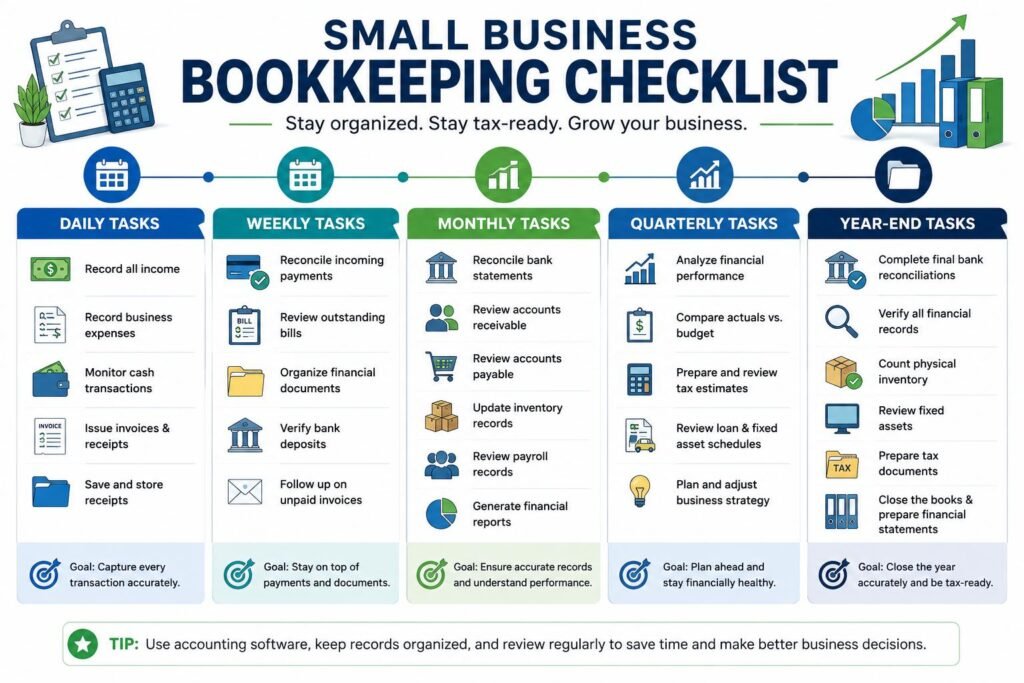
Weekly Bookkeeping Tasks
Weekly bookkeeping is about going over financial reports for accuracy which also includes checking that large transactions have been recorded.
1. Reconcile Incoming Payments
Compare customer payment to issued invoices in order to confirm correct capture of those funds. Also we should identify any outstanding invoices at this stage to which case we will send out follow up notices to customers prior to the debt becoming large. This will also improve cash flow and to reduce bad debts. Also businesses that take many payment types must see that bank deposits, online payment processes, and what is recorded in the accounts all match up.
2. Review Outstanding Bills
Suppliers and vendors expect prompt payment. By reviewing outstanding bills weekly businesses are able to avoid late payment fees and at the same time maintain good relationships with suppliers. It is best for businesses to put bills which are due soonest and which they have the cash for first. Also regular review prevents duplicate payments and makes sure that what is reported in the accounts regarding liabilities is accurate.
3. Organize Financial Documents
Receipts, invoices, payroll reports, contracts, bank notices, and tax documents should be put in order every week instead of piling up in large groups. Digital filing of these docs makes it much easier to find what you are looking for during tax prep or financial audits. Also by being consistent with your file organization you reduce the chance of losing out on important info which in turn supports accurate bookkeeping and regulatory compliance.
Monthly Bookkeeping Tasks
Ongoing bookkeeping which in turn gives you a bigger picture of your finances and also sees to it that accounting records are up to date before we prepare management reports.
1. Reconcile Bank Statements
Bank of account reconciliation is to put bank statements against accounting records which we do to identify what is different. We look at outstanding checks, bank charges, interest income, direct debits, and recording errors which all must be looked into and corrected. By doing bank reconciliations every month we see to it that we reduce accounting errors at the same time which in turn makes what is presented in the books to truly reflect the bank balances. Also from this we are able to very quickly detect unauthorized transactions.
2. Review Accounts Receivable
Accounts we have sold our products or services to are what accounts receivable are. We do a monthly review which helps us to notice which accounts are past due and what action to take. It is best for companies to go to their customers with balanced professional presentations when accounts are past due which at the same time does not damage the customer relationship. Also by watching our receivables we improve our cash flow forecast as we get a better picture of what to expect in terms of future collections.
3. Review Accounts Payable
Businesses may go over supplier invoices at the start of each month to check that what is recorded is in fact accurate. We should see to it that which issues of missing invoices, duplicate entries, or incorrect balances are fixed before month end reports are put together. Also proper accounts payable management which includes timely payment of suppliers’ bills improves budgeting and cash management.
4. Update Inventory Records
Businesses that sell physical products must compare inventory records to actual stock counts. We see that as an opportunity to identify issues like theft, damage, recording errors, or supplier issues. Also from that action they may note that accurate inventory records which in turn improve the cost of goods sold, gross profit and balance sheet accuracy. Also by way of regular stock checkup businesses can note slow moving products and in turn put in place what it takes to reorder popular inventory before we see shortages.
5. Review Payroll Records
Payroll must be looked at each month for employee salaries, wages, overtime, bonuses, tax deductions, pension contributions, and statutory payments. Payroll errors do put out employees while also putting businesses at risk for regulatory action. Also which are not at all uncommon accurate payroll records support year-end tax reporting and financial statement preparation.
6. Generate Financial Reports
Monthly financial reports also present in depth picture of business performance. The income statement reports on profitability, the balance sheet presents assets and liabilities, and the cash flow statement reports cash movement. By reviewing these reports regularly business owners may identify trends, evaluate profitability, watch expenses, and make informed business decisions which in turn prevent financial issues from becoming serious.
Quarterly Bookkeeping Tasks
Quarterly financial reporting is for analysis of long term performance which also includes preparation for tax and strategic planning.
Business managers should go over revenue growth, operating expenses, profitability, and cash flow trends quarterly. We look at budget comparisons which tell us if we are on track with our financial plans also which elements need corrective action. Also we should do quarterly tax estimates when they apply to avoid that which is unexpected in tax liabilities. By going over loan balances, interest payments, depreciation schedules, and fixed asset reports we keep our financial reports very accurate all year. Also at these quarterly financial reviews we have chance to change pricing strategies, cut out extra expenses, put money into growth areas or improve operations before the end of the fiscal year.
Year-End Bookkeeping Tasks
At year end we do the books which in turn prepare us for tax time, financial reports, and the start of a new accounting period.
1. Complete Final Bank Reconciliations
At the end of the fiscal year each account should be reconciled. We should go over all outstanding deposits, checks, bank fees, and interest at year end before closing out the books. Proper reconciliations which is what we are doing at year-end balance out the cash numbers reported in the financial statements.
2. Verify All Financial Records
Business owners are to go over each ledger account for accuracy and fullness. Issues like missing invoices, duplicate entries, incorrect expense classifications, and reconciled balances should be fixed before us final the financial statements. A thorough review which also helps in error prevention will see that mistakes do not carry over into the next financial year.
3. Count Physical Inventory
A full inventory count is proof of what is reported on the balance sheet. Any differences between what we count physically and what is in the accounting records must be looked at right away. Changes from actual count to what we have in the books also impacts the COG and net profit which is why it is so important that counts are accurate for proper financial report.
4. Review Fixed Assets
Businesses need to check all equipment, machinery, vehicles, computers, and furniture which are in the accounting system. Also remove from the records assets which have been sold, damaged, or disposed of. Also we should update depreciation calculations to reflect current asset values.
5. Prepare Tax Documents
At year end we see to it that we have in order all documents which will go into tax filing this includes income records, expense receipts, payroll reports, depreciation schedules and supporting financial statements. Tax docs thus put in order at this time reduce prep time and also we do a better job of not making errors or missing out on deductions.
6. Close the Books
Closing out the books includes finalizing revenue and expense reports, determining net income, updating retained earnings, and preparation of financial statements for the completed accounting period. Once the process is complete the accounting system is ready for the next fiscal year. Precise year end closing produces reliable historical data which in turn supports future financial analysis.
Common Bookkeeping Mistakes to Avoid
Many of bookkeeping issues are brought forth by what may be small but easily prevented errors. What we see is that which you delay the reporting of transactions you are at the risk of forgetting expenses and at the same time leaving your income reports incomplete. Also, mixing personal and business finances causes a mess and at the same time makes for very difficult tax preparation. By ignoring bank reconciliations you increase the chance of going undetected for errors and also fraud. Also we see that if you do not hold on to your receipts you run the risk of not having supported material for tax deductions at the time of audit. Also, incorrect category assignment for expenses can mess up financial reporting, also when you rely fully on memory as opposed to documentation in your books that is a recipe for inaccuracy. For small businesses it is advised to put in place clear bookkeeping policies which will in turn reduce these issues and at the same time see to it that financial reports are accurate all through the year.
Bookkeeping Tips for Staying Organized
Maintainable bookkeeping is what businesses achieve when they institute regular routines. We recommend setting aside time daily or weekly for bookkeeping which in turn prevents the accumulation of what becomes overwhelming tasks. Also to that point, we see the value of cloud based accounting software which does the heavy lifting of transaction entry, invoicing, and financial reporting and at the same time reduces manual errors. Also it is a good idea to keep business and personal finance separate which in turn simplifies reconciliation and financial analysis. Also do not forget to back up your accounting data which does double duty of protecting your info from accidental loss or system failure. Also we see the benefit in having a very organized file system for invoices, receipts, tax docs, pay roll info, and contracts. These practices improve efficiency, strengthen financial control, and make year-end report writing a much less stressful task.
How this Checklist eases Financial Statement Preparation.
Financial reports are a product of accurate bookkeeping which is what we see play out in businesses that as a matter of routine do daily, weekly, monthly, quarterly and annual bookkeeping. Thus we see that which report out to income statements, balance sheets, cash flow statements and statements of changes in equity are done with ease. Each transaction is recorded, categorized, reconciled and checked off all within the year. In this way reports which go out are more reliable, tax time is made less of a chore, and business owners have more confidence in the numbers. Also it is the businesses which have their records in order that lenders, investors, accountants and tax authorities turn to and at the same time management gets better insight into business performance and future planning.
Conclusion
Bookkeeping is a key element in the success of a small business. While many entrepreneurs are put all of their eggs in the sales basket, what we see time and again is that for long term success they also have to pay equal attention to their financial records. We put in place a routine which includes daily, weekly, monthly, quarterly and annual bookkeeping tasks which in turn sees out that every transaction is recorded, bank accounts are reconciled, tax reports are made easy to put together and that the financial reports we issue are an accurate picture of how the business is doing.
Rather than see bookkeeping as a yearly task, business owners should make it a continuous process which supports better decision making all through the year. As they follow this in depth check list which not only brings their business in line with finance rules but also gives them insight into profit margins, cash flow, and overall financial health. With structured reports and a system of proper bookkeeping small businesses are best set up to grow, adapt to financial issues and create the basis for large scale growth in years to come.
Get more well researched information about Small Business Bookkeeping Checklist here.