Introduction
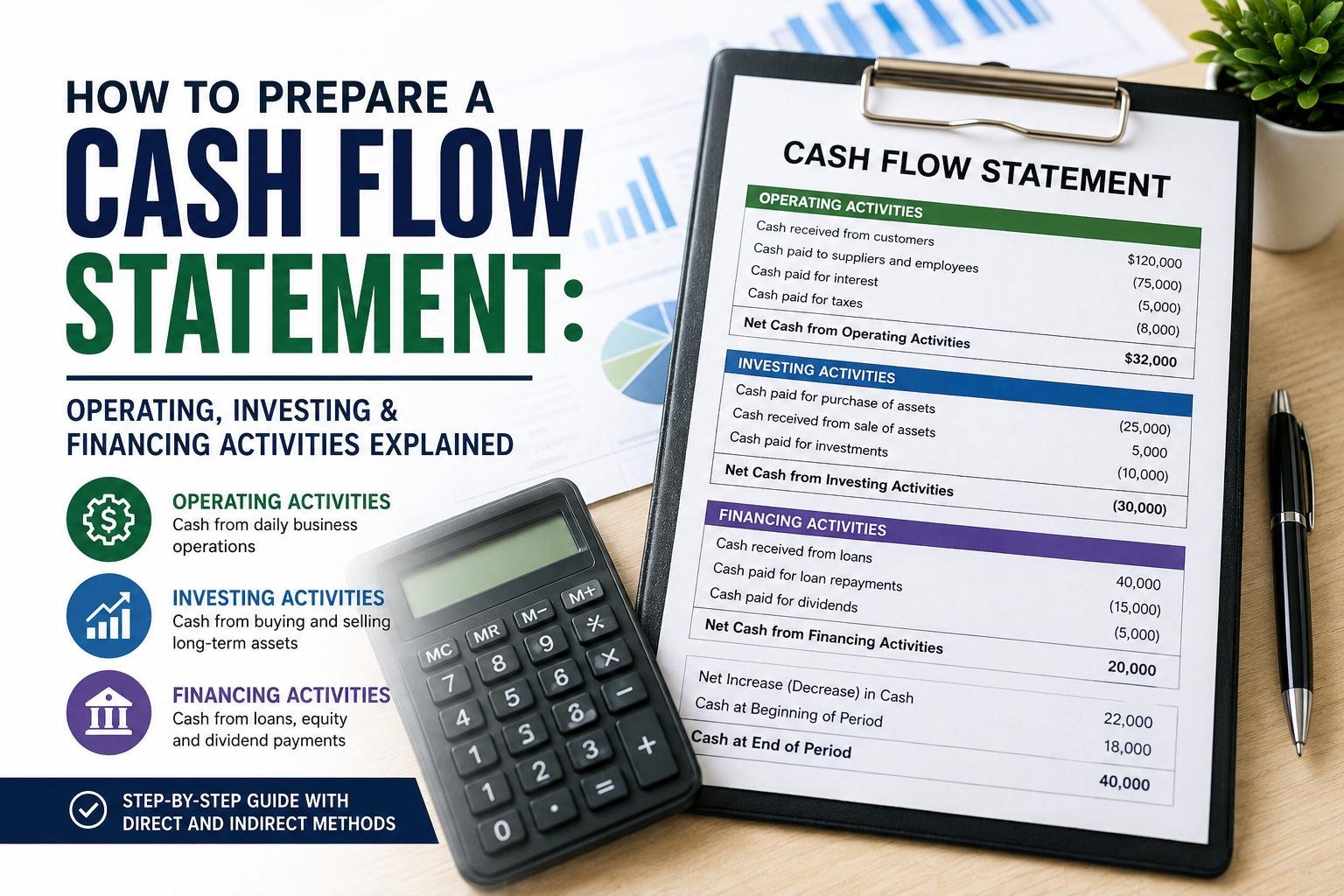
Cash is at the core of what makes businesses tick no matter their size or which industry they are in. A company may report great profit on its income statement but still have issues paying suppliers, employees, or loan repayments if it doesn’t have enough cash. This is which the cash flow statement is one of the most important reports in accounting. It gives a detailed look at which areas cash is going in and out of a business over a given accounting period and also which elements owners, investors, creditors, and managers use to determine the health of the organization’s liquidity, financial flexibility, and overall financial health. As opposed to the income statement which reports on revenues and expenses under the accrual system, the cash flow statement reports only on actual cash which passes in and out of the company making it a very useful tool for seeing how a company does at generating and managing its cash.
Whether you are a small business owner looking to track daily ops, an entrepreneur which is putting together financial reports for investors, or a finance student which is just starting out in accounting, we note that having a grasp of what goes into a cash flow statement is a key skill. This guide we go over the structure of the cash flow statement, look at its three main sections, and put forth how to prepare it via the direct and indirect methods. If you are looking for more in depth technical info on cash flow statements the linked resource also has that.
What Is a Cash Flow Statement?
A cash flow statement is a report which sums up all cash inflows and outflows over a particular accounting period. It reports on how well a business does in generating cash to run operations, fuel growth and pay debts. While the balance sheet gives a picture of the financial position and the income statement reports on profitability, the cash flow statement shows which businesses have the cash to support what they do. We see also that many accounting entries do not include a cash transaction which means that profit does not in itself truly represent a company’s liquidity. What the cash flow statement does is report only on those transactions which impact cash and cash equivalents. It also allows stakeholders to see if the company is able to pay its debts, invest in growth, pay dividends, and weather economic down turns. Due to its use practical use this statement is required by both IFRS and GAAP and is put forth as one of the three primary financial reports used worldwide.
Why do we use Cash Flow Statements?
A cash flow report presents info which is not available in other financial reports. We see that companies may have high profits at the same time as their cash balances drop which can be due to customers paying late, we put away more inventory, or we made large scale investments which used up our cash. By looking at cash flows we are able to see what is really going on with the company’s liquidity before it hits rock bottom. Investors use the report to see if a company is generating enough cash for growth and to pay dividends, also lenders use it to determine if they will give out a loan. Mangers use the report to put together budgets, to predict future cash needs and to make better business decisions. Also the report brings to light how well the company does during a financial crisis without having to turn to external funding. For all of these reasons it is very important to have an accurate cash flow report for good financial health and for the company to do well in the long term.
Three Main Components in a Cash Flow Statement
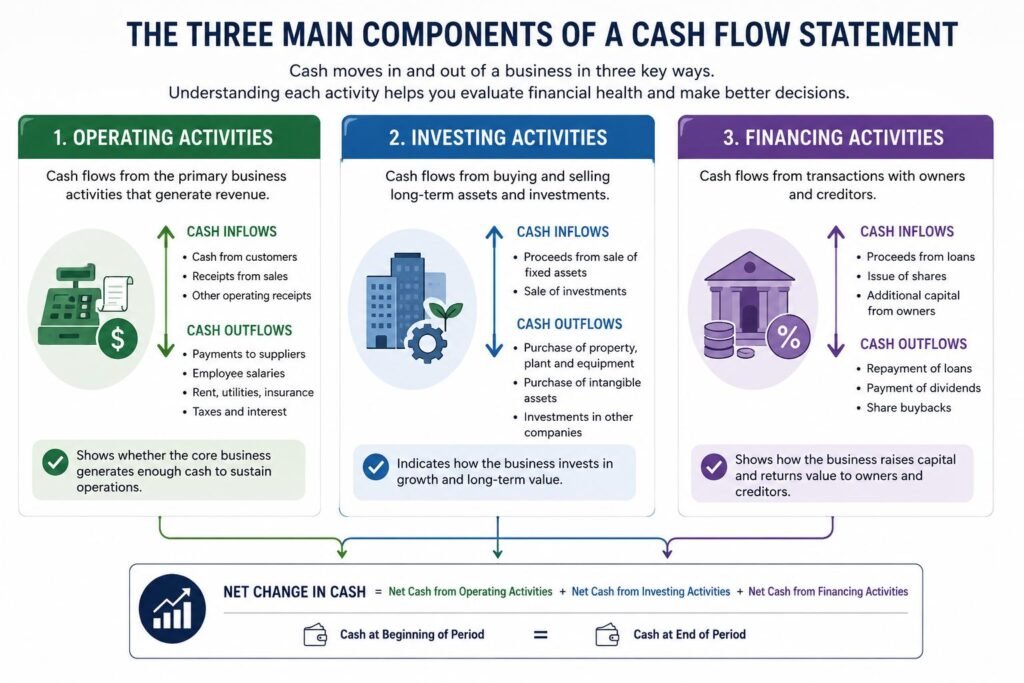
The cash flow statement reports in to three main categories which present different sources and uses of cash. We put activities in these groups which in turn enables users to see where cash comes from and how it is used in the business. Each category represents a different element of financial performance and as a whole they give a complete picture of cash flow.
Operating Activities
Operating activities include the main business processes which produce revenue. This section reports cash in from customers as well as cash out for operating expenses like salaries, rent, utilities, inventory purchase, taxes, insurance, and supplier payments. Operating cash flow is an indicator of whether the company’s primary business functions generate enough cash to run day to day operations without the need for loans or asset sale. Positive operating cash flow is a good sign of a healthy business which is able to generate sufficient cash from its regular activities to pay its bills. At the same time consistent negative operating cash flow may indicate there are issues with the business even if it is reporting profit. As operating activities are tied to the company’s main income producing activities they which is why analysts put great stock in this section of the cash flow statement when they are looking at financial performance and long term viability.
Investing Activities
Investing activities are what we see as cash transactions related to the purchase and sale of long term assets. These assets usually play out in terms of property, plant, machinery, buildings, vehicles, land, patents, software, or long term investments. We see that when a business buys new equipment or increases the size of their facility that which is generally an outflow of cash, that is a result of the business’ push for growth. Also when old equipment is sold off or we see the disposal of investments that is an inflow of cash. While at times large scale investment may cause a negative cash flow they do not in fact point to weak finances. In fact very large investment outlays may be an indicator that the management team is in fact setting the company up for future growth and higher profitability. By looking at investing activities what we are able to do is tell the difference between cash used for growth and cash that is used for poor operating performance which in turn gives a better picture of what the management’s long term plan is.
Financing Activities
Financing activities in a company’s reports are those which deal with the company’s owners and creditors. We see in-flows of cash from issues of shares, securing bank loans, or from raising more capital from investors. Outflows of cash are reported when the company rep repays loan principal, buys back its own shares, or pays dividends to shareholders. This section also reports how the business finances its operations and investments. We see that growing companies report positive financing cash flows as they put out the word that they are looking for external capital to fuel growth. In the case of mature businesses, though they may report negative financing cash flow as they pay down debt and return money to shareholders. By looking at the financing activities along with operating and investing activities report users are able to determine what is being used to fuel business growth internal cash generation or external borrowing.
Information Required for Preparing a Cash Flow Statement.
Preparation of a cash flow statement starts with the collection of accurate financial information from various accounting records. We use the current and past balance sheets, the income statement for the report period and supporting docs which go into detail of asset purchases, loan repayments, dividend payments, depreciation expenses, and other non-cash adjustments. We look at the beginning and ending balance sheet numbers which in turn help us to see what changes in assets, liabilities, and equity which in turn play a role in cash flow. The income statement gives out info on revenue, expenses, and net income and also the supplementary schedules which present info which may not be immediately available in the financial reports. With full and accurate accounting records we are able to put each cash transaction in its right category of operating, investing, or financing which in turn produces a reliable cash flow statement that truly represents the company’s financial performance.
How to put together a Cash Flow Statement with the Direct Method
The present method reports cash flow from operations by use of actual cash in and out which we see during the accounting period. We do not start with net income instead we go through each type of cash in and out. For instance we look at what cash we received from customers after we adjust sales for changes in accounts receivable, also we look at what we paid to suppliers which we determine after we take into account inventory purchases and accounts payable balances. We report separately cash paid out for wages, rent, utilities, taxes, and interest before we get to what the net cash provided by operations is. Once we finish up the operation section we include investing and financing activities which in total will tell us the overall change in cash. The direct method does though provide more transparency which in turn gives the readers a better picture of where the cash is coming from and going to. At the same time many companies stay away from this method which is so because they have to put in place more detailed accounting records and more in depth bookkeeping which is a great task.
Steps in the Direct Method
- Calculate cash from customers.
- Calculate cash out to suppliers.
- Determine cash outlays for operating expenses.
- Record of cash outflow for interest and taxes.
- Calculate net cash from operations.
- Add to the investing cash flows and subtract from them.
- Add in cash from financing and subtract out cash to financing.
- Determine the change in cash.
- Add up the beginning cash balance to get the ending cash balance.
How to put together a Cash Flow Statement with the Indirect Method
The most common approach is the indirect method which starts with net income from the income statement and transforms it to report cash generated from operating activities. In accrual accounting which recognizes revenue and expense at a different time point than when cash changes hands, we see that several adjustments are required to turn accounting profit into true cash flow. We add back non-cash expenses like depreciation and amortization which reduce profit but not cash. Also we look at changes in working capital accounts which include accounts receivable, inventory, prepaid expenses, accounts payable, and accrued liabilities we adjust for whichever way they went up or down during the report period. Once we finish these adjustments we put in the investing and financing sections in the same way as we would with the direct method. As businesses are already reporting on an accrual basis, the indirect method is usually easier to implement which is why it is very popular across all industries.
Steps in the Indirect Method
- Starting with net income.
- Add in depreciation and other non-cash expenses.
- Eliminate gains and losses from asset sales.
- Correct for changes in current assets.
- Address changes in current liabilities.
- Determine net cash from operating activities.
- Investments activities.
- Include finance activities.
- Tally up initial and final cash balances.
Direct Method vs. Indirect Method
Although the two methods do in the end produce the same total cash flow, they present this in very different ways. The direct method reports on actual cash in and out which is what users’ especially business owners and external parties that require in depth info on cash in and out find easy to use. Also it provides great detail into which cash is coming in from collections and going out in payments. In the other hand we have the indirect method which puts forth the relation between reported profit and cash flow from operations by changing out net income for non-cash items and working capital changes. As a matter of fact since our accounting systems report out of the gate with accrual based info the indirect method is the cheaper to put together and has become the go to for most companies. As for which method is used that is up to the company but what does not change is that the investing and financing sections which are the same in both reports and which in the end prove out to the same cash balance.
Common Pitfalls in Cash Flow Statement Preparation
Errors out of which cash flow statements are prepared often come from wrong classification of transactions or from the issue of what is cash and what non-cash activity is. We see that it is common for depredation to be put in as a cash outflow which in fact is only an accounting charge. Also very often we see that loan repayments are put forward as operating activities which in fact should be in the category of financing activities. Also it is- that which is to do with plant and equipment is put forward as operating expense which in fact goes into investing activities. Also not putting together opening and closing cash balances properly leads to inaccurate financial reports and also ignoring changes in working capital which in turn produces incorrect operating cash flow under the indirect method. Careful review of support documentation and also a better knowledge of accounting standards is what helps to see off these issues and put out reliable financial reports.
How to Study a Cash Flow Statement
Preparing the cash flow statement is but the first step which in itself is very important; what follows is the interpretation of the results. What we see is that healthy businesses usually generate positive cash flow from operations which in turn is a sign of sustainable growth which we would expect to be a consistent feature. Negative operating cash flow over many reporting periods may indicate issues like declining sales, poor collection of receives, or that the company is not managing its expenses well. In the case of investing cash flow we look at it within the context of the company’s strategy, large investments in capital may be putting in place growth opportunities for the future and thus are not a sign of financial weakness. As for financing cash flow it tells us how the company is doing in terms of getting external funding and also if it is reducing its debt or increasing its leverage. By looking at these three areas over many reporting periods’ managers and investors are able to identify trends, evaluate the company’s financial health and use this info to put together budget plans, investment strategies, lending terms and large scale business plans.
Best practices in cash flow management.
Preparing a cash flow statement is a piece of a larger cash management strategy which is not a separate accounting task. Companies may improve their cash flow by timely billing customers, which in turn allows for close monitoring of accounts receivable, also we see value in negotiating better payment terms with suppliers, maintaining proper inventory levels and also in putting out regular cash flow reports. Also in setting up emergency cash reserves and the review of operating expenses which in turn strengthens liquidity during economic uncertain times. Tech tools including cloud accounting software also play a role in easy cash flow tracking by providing real time financial info and automated reports. These actions enable companies to predict cash shortfalls, react quickly to financial issues, and at the same time to have enough liquidity to support present operations and also future growth.
Conclusion
A cash flow report is a very important element of financial reporting which gives a picture of how cash is flowing through a business. By separating cash flows into operating, investing, and financing activities it enables business owners, investors, creditors, and finance professionals to evaluate liquidity, financial stability and long term sustainability. Whether prepared via the direct method which reports actual cash receipts and payments or the indirect method which adjusts net income for non-cash items the report provides great insight into the health of the organization. With the ability to prepare and analyze a cash flow report businesses are able to better make decisions, manage resources which in turn supports confident planning for growth. Thus mastering this financial report is a key step towards creating a financially robust and well run business.
Get more well researched information on How to Prepare a Cash Flow Statement here.