Introduction
Accounting can be called the language of business since it is the information that organizations need to keep record of transactions, assess performance, plan for the future, and make decisions. Accounting, however is not a monodisciplinary having only one purpose, it has evolved into various specializations over time, which caters to the needs of various users and businesses. Financial accounting, management accounting and cost accounting are some of the more important of these branches. While they are interrelated and often share common financial information, they are very different in terms of goals, users of their financial data, reports they create, and decisions they impact. Students and professionals who are aware of these differences can be better prepared to take a correct interpretation of the financial information and use the appropriate accounting treatment in various scenarios. It also helps businesses understand the special role and significance of every discipline, since the use of the right accounting information at the correct time is fundamental to strategic planning, operational efficiency and financial reporting.
1. Understanding Financial Accounting
Financial accounting concentrates on the reporting, summarizing and recording of financial transactions of an organization in a standard format that is understood by those outside the organization. Financial accounting’s main objective is to provide a clear view of the company’s financial condition and performance for a given period. Financial accounting is done in accordance with accounting standards and principles like IFRS or GAAP, which provide uniformity, reliability and comparability in accounting. Financial accounting information is essential to the investment, lending, tax and compliance decisions of investors, lenders, regulators and shareholders. An important use of financial accounting is to assess the profitability, liquidity and long term financial position of a company before applying resources to the company or entering into a business relationship with the company.
The Aim of Financial Accounting
Financial accounting’s primary function is to give users of the financial statements an accurate and dependable financial picture of a business’s operations to users not involved in the day-to-day management of the business. This data enables stakeholders to gauge if a company is profitable, its financial soundness and ability to honor its commitments. Another goal of financial accounting is to increase transparency and accountability by recording all transactions and reporting the information in a way that meets legal and regulatory requirements. Another goal is to enable the cross-organizational comparison by providing a simplified reporting format and accounting principles. Financial statements are used by investors to decide if they should buy stocks, by creditors to decide whether or not to lend money, and by government agencies to decide whether or not to tax the company and to comply with regulations. The aims emphasize the external perspective of financial accounting and differentiate it from other accounting areas, which are more oriented towards the inside use.
2. Understanding Management Accounting
The job of management accounting relates to and is focused on, providing managers and decision makers within an organization with financial and non-financial information that helps them plan, control and make decisions about the organization. Management accounting differs in not focusing on the past and reporting to external parties as financial accounting does. Rather it focuses on information for the future that will assist managers in being more efficient, allocating their resources appropriately and meeting their organization’s objectives. Management accountants review budgets, forecast future requirements, monitor market trends, track and analyze operational performance and create financial projections to inform decision-making processes. Management accounting is not bound by external reporting requirements and can be tailored to the needs of an organization, since it is used for internal users. Reports can be produced daily, weekly or monthly as management needs and can include confidential information which is not normally shared with outside parties.
The Purpose of Management Accounting
Management accounting’s main function is to help managers make effective business decisions to enhance the organization’s performance and competitiveness. This involves helping to plan, budget, monitor and allocate resources strategically. Careful analysis of financial and operational data is also a key management accounting objective to pinpoint opportunities for growth, cut down on operational inefficiencies and boost profitability. Management accounting information is used by managers to make decisions regarding new products; new markets; new technology; and restructuring operations. The other important goal is to track the actual performance in relation to expected performance and determine if there is a need for corrective action. Management accounting requires flexibility and responsiveness, as the business world is constantly evolving, enabling businesses to make quick adjustments to new opportunities and challenges, while still ensuring that they have control over their operations and the resources at their disposal.
3. Understanding Cost Accounting
Cost accounting is a specialized field of accounting that deals with the identification, measurement, recordation and analysis of costs of manufacturing products and/or rendering services. It is used primarily to allow organizations to know the cost of running various departments, making various products, finishing various projects or delivering various services to customers. Manufacturing companies find cost accounting to be especially vital, but service companies as well as non-profit institutions use cost information. Cost accounting is used to calculate the actual cost of production and find ways to make the production process more efficient by tracking direct materials, direct labor and overhead costs. Cost accounting is similar to financial accounting, but concentrates on the costs at a more detailed level of operation within the organization. Such an in-depth analysis enables managers to manage their costs, optimize pricing, and maximize profitability.
The Goals of Cost Accounting
Control and reduction of costs in a manner that does not reduce quality or productivity is the main goal of cost accounting. A business requires accurate cost data to decide the selling price, to assess the profitability of products and to find the wasteful activities which led to unnecessarily higher costs. The other objective of cost accounting is to increase operational efficiency by studying the various processes of production and finding ways to save. Another important goal is to aid in budgeting and performance evaluation by comparing the actual costs with the standards or budgets. Variance analysis can be used by managers to identify areas of costs that aren’t being met and to understand why this may be. Cost accounting is also valuable in inventory valuation and production planning, which is especially important in companies that produce products or render services that need a lot of resources. These functions help to control the operations and achieve long term profitability through cost accounting.
Users of Financial Accounting, Management Accounting and Cost Accounting
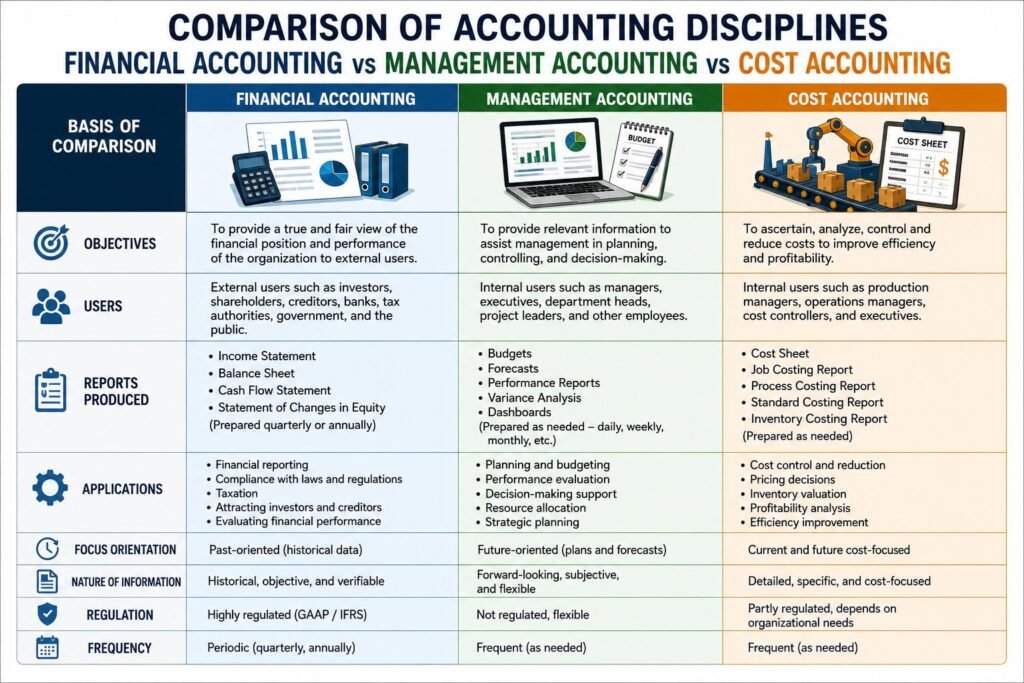
One of the biggest distinctions between such accounting professions is the users they cater to. Financial accounting is mainly for external users of the business including investors, shareholders, creditors, banks, tax authorities, government and prospective business partners. There is a need for these users to have consistent and dependable information to evaluate financial condition and make investment, lending or regulatory decisions. Management accounting, on the other hand, is focused on providing information to internal users such as senior executives, department managers, project leaders and operational supervisors who need detailed information to aid in planning and decision making. Cost accounting also is utilized by internal users such as production managers, operations managers, procurement officers and executives who manage costs and enhance efficiency. Although cost accounting may include the costs in larger strategic considerations, it is concerned mainly with cost understanding and the management of costs for operations and production activities.
Reports Produced by Each Accounting Discipline
The purpose, form and frequency of the reports produced are different in the three types of accounting: financial, management and cost accounting. Financial accounting generates formal reports, e.g. income statement, balance sheet, cash flow statement and statement of changes in equity. They are made periodically (usually quarterly or annually) and must be done in accordance with accounting standards, which are adhered to so that they are consistent and comparable. Management accounting generates reports that include budgets, sales forecasts, performance dashboards, variance analysis, profitability reports and more, as they relate to the manager’s needs. These reports can be done at any time that they are needed, and sometimes financial and non-financial information is included. The cost accounting produces a cost sheet, job costing report, process costing report, inventory costing report, standard costing report, etc. These reports give in-depth production cost and efficiency information, supporting managers to manage costs and enhance profitability.
Applications in Business Operations and Decision-Making
The usefulness of these accounting practices shows why a company can’t be fully successful without having all three of these accounting disciplines. Financial accounting is used to meet compliance, investor relations, taxation and external reporting requirements. The financial accounting of public companies is extremely important in order to ensure transparency and attract investors. Management accounting plays a part in strategic planning, business growth decisions, budgeting and performance management programs. It assists companies to calculate options and pick the most advantageous choice in view of the information and future projections. Cost accounting is used to aid pricing an action, cost reduction efforts, inventory management, and operational improvements. Cost accounting is useful in the identification of product profitability and to look at how product can be made more efficient and with less waste. All these disciplines form a complete information system that helps in achieving short-term operations and long-term strategic goals.
The Major Difference between Financial Accounting, Management Accounting and Cost Accounting
While accounting information is used in all three disciplines, each of these disciplines differs in their focus, users and reporting. Financial accounting is past-oriented and focuses on the reporting of financial performance in the past in a standardized format and in a standardized way to external parties. Management accounting is forward looking and geared towards assisting managers to take decisions that enhance organizational performance. It is flexible and is customized for the needs of internal users. Cost accounting deals with the identification and control of cost of production and operations and provides detailed cost information to enable a better organization to improve efficiency and profitability. Financial accounting is compliance-based and transparent; management accounting is planning and strategy focused; cost accounting is cost control and operational efficiency-based. These differences should be understood when making decisions in different business contexts and in different decision-making processes with regard to the type of accounting information required.
The Interrelationships between the Three Disciplines
Although the three disciplines of financial accounting, management accounting and cost accounting are quite different, they are closely interlinked and rely on each other for information and analysis. Financial accounting will give a history of financial data to help with management accounting forecasting and strategic planning. Cost accounting produces detailed cost information which is used in the management accountants’ budgeting and performance evaluation reports. Cost accounting information also might be utilized in financial accounting for purposes of valuing inventory and establishing cost of goods sold in external financial statements. These disciplines are not separate, but are all interdependent and form part of an integrated accounting system which enables the internal management and external reporting requirements to be met. Companies that seamlessly integrate these accounting methods can make informed decisions, manage costs effectively, meet stakeholder expectations, and navigate the competitive landscape with sustainable growth.
Conclusion
Each of the financial accounting, management accounting and cost accounting has a unique and critical role in the contemporary organization. Financial accounting aims at delivering standardized information to external users, Management accounting is used for internal planning and strategic decision-making and Cost Accounting is used to help the organization understand and control costs involved in the production and operation. While their goals vary, as do the users of their reports and applications, they all combine to provide a full view of business performance and health. It is important for students and professionals to have a grasp of these differences to build robust accounting knowledge and utilize accounting information effectively in practice. Understanding the capabilities of different disciplines can help businesses make informed decisions, increase efficiency, stay compliant, and succeed in a competitive landscape.
Get more well researched information about the Difference between Financial Accounting, Management Accounting, and Cost Accounting here.