Introduction
Properly accounting is the basis of any business, large or small, in any line of work. Financial statements will give you the information necessary to make decisions, to budget, to do your taxes, to plan investments, and evaluate performance. Inaccuracies in accounting records can lead businesses to make bad decisions, file false tax returns, inflate or deflate profits, and be subject to regulatory sanctions. It’s easy to overlook minor issues that may add up to major, costly financial problems that are hard to fix.
There are a number of reasons that account for accounting errors. Some of these are errors made by man, for example entering the wrong numbers when typing. Others are because of poor accounting practices, inappropriate internal controls, or lack of knowledge in accounting. Small businesses are a special case due to fewer employees who could be juggling several jobs at once and may be responsible for their accounting. Even larger firms are not spared as there is a higher risk of errors creeping into the system where there are more transactions.
By being aware of these typical accounting errors and taking proactive measures to avoid them, businesses can enhance the accuracy and reliability of their financial records. If these risks are understood by accountants, bookkeepers and business owners, they are able to keep accurate and trustworthy financial records, and minimize the risk of expensive corrections a later stage. By understanding some of the common bookkeeping errors, organizations can enhance their financial management and reporting processes.
Why is Accounting Accuracy so Important?
The financial statements are the business’s language. They are used by investors to determine profitability, lenders to determine credit-worthiness and managers to make operational decisions. If the information on which accounts are based is wrong then all the decisions made based on the information are questionable. An item not reported as an expense can appear as though profits are greater than they actually are, and an expense that isn’t reported can appear as though the business is healthier than it is.
Tax compliance issues also can stem from accounting mistakes. Governments demand accurate tax returns, payroll reporting and statutory reporting from businesses. These submissions will be subject to audits, fines, interest and damage to reputation if there are any errors. Three or four points, in some industries, not reporting or reporting inaccurately can even get you into trouble legally or provide regulations sanctions.
Time and money is also saved by keeping records accurate. When errors are a frequent occurrence, businesses may end up using precious time to look into discrepancies, fix reports, and answer external questions. Errors costs less and are less stressful to prevent than correct once they have occurred and caused issues with financial statements, tax filing, etc.
1. Transposition Errors
What is Transposition Errors?
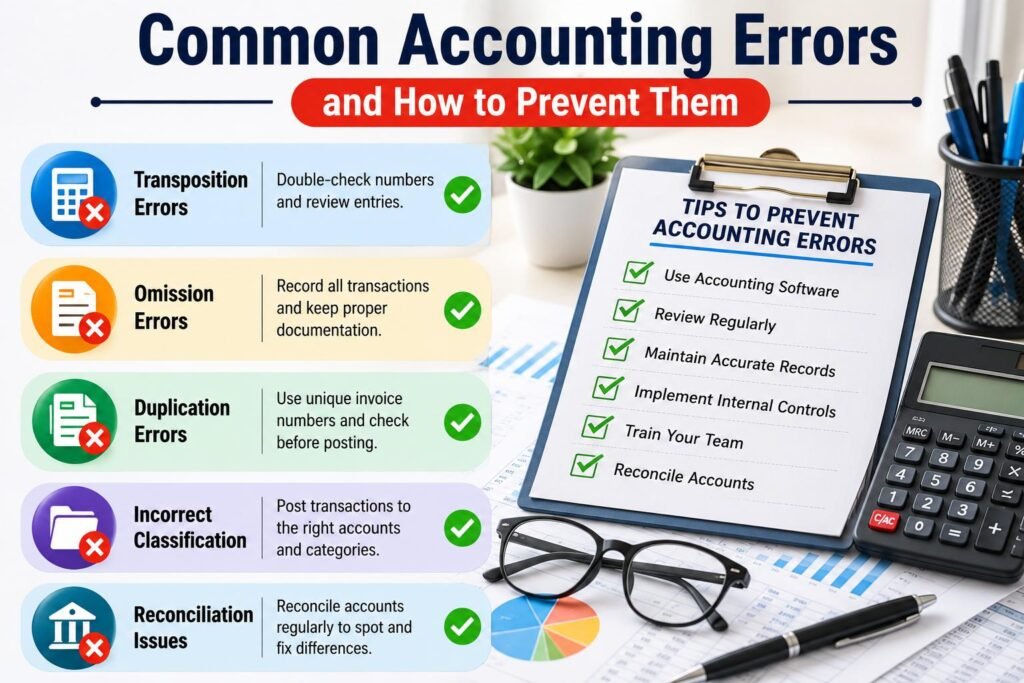
Transposition errors are when the numbers are mistyped or miscalculated during data entry or later. For instance, if you enter ₦54,321, when you meant to enter ₦45,321, or enter an invoice amount of ₦6,780, but meant to enter 6,870, then it is a transposition error. One of the most frequent accounting issues is these errors, as the accounting profession deals with lots of numbers on a daily basis.
Journal entries, invoices, payroll, inventory value and bank recon are just a few items that could be affected by transposition errors. While these could be trivial on their own, they can add up and cause financial statements to be misrepresented and discrepancies to be hard to identify. A transposition error may be one of the more common clues to be found from investigating; when the difference between the expected and the actual figure is a number divisible by 9.
How to Prevent Transposition Errors
It can be beneficial for businesses to use automated accounting systems to lessen the amount of manual data entry, thereby reducing transposition errors. Advanced accounting software contains validation checks to provide warnings if there is any kind of inconsistency or unusual numbers. Two-way verification processes can also work, as it’s important to have another person check out key transactions before they are completed.
Frequently reconciling accounts and conducting periodic reviews of accounting records can be useful in detecting transposition errors in a timely fashion that will not impact financial reports. It’s also crucial to train staff, as those who are aware of the repercussions of incorrect data entry are likely to take care when entering the transactions.
2. Omission Errors
What are the Omission Errors?
Any accounting records that have been omitted, either in full or in part from financial transactions, are called Omission errors. This can occur when suppliers’ invoices are not recorded, when payments are made to customers but not recorded, when expenses are accrued at the end of an accounting period, etc. These errors can be difficult to identify because they don’t appear in the records when they are omitted.
Failure to record expenses could overstate profits but failure to record revenue could understate business performance. If liabilities are not covered, this may cause cash flow issues when they are due. Omission errors also can result in incorrect tax calculations and problems with tax compliance.
How to avoid omitting words
Omission errors must be avoided and adequate documentation is essential as well as good workflow. All transactions should be backed with an invoice, receipt, purchase order or payment confirmation that can be correlated with the accounting records. Businesses need to have specific guidelines for financial documents submissions and approvals to simply make sure that nothing has been missed.
Checklists have proven to be very useful in closing activities at the end of the month or the year. When additional supporting documentation is provided, the records should be reconciled with the accounting records as well – this is another layer of protection against missing transactions. Cloud-based accounting software that connects with banking and invoicing software can also minimize the chance of error, as transactions are automatically imported.
3. Duplication Errors
What is Duplication Errors?
Duplication errors are those that result from having transactions duplicated. These may be such entries as supplier invoice twice or payroll payments twice or identical customer receipts more than once. Multiple transactions can cause expenses to be overstated, revenues to be overstated, account balances to be misstated and financial reporting to be confused.
Data duplication is especially likely to occur in businesses that heavily depend on manual data entry. Another cause of duplicate records is leaving multiple employees with access to the same areas of the accounting system, but without the proper communication and oversight of who has done what.
How to avoid Duplication Errors
To minimize the duplication error, it is always advisable to use unique numbers for invoices, receipts, purchase orders and journal entries. Duplicate invoice numbers or amounts of transactions can be automatically identified for review before posting to the ledger using accounting software.
It’s also recommended that organizations have clear responsibilities for transaction processing, and don’t have responsibilities duplicated between different employees. Segregation of duties helps to prevent two employees from having access to the same data to both record and approve transactions. Repeated audits and transaction checks can help prevent duplicate entries from impacting on financial reporting.
4. Incorrect Classification Errors
What are Incorrect Classification Errors?
Classification errors are transactions that are posted to the wrong accounts and/or categories. An example of this is the inclusion of purchase of recording equipment as office expenses rather than as a long-term asset or the classification of long-term debt as current liability which can distort the financial statements and make them less useful.
These errors don’t necessarily cause a trial balance to be out of balance since the debit and credit amounts are still equal. These can, however, have a significant influence on financial analysis and decision making. Errors in a classification may affect the profitability ratios, liquidity ratios and asset valuations, giving managers and investors erroneous ideas about business performance.
Errors of classification can be prevented by following these steps
First step in avoiding classification errors is to have a well-structured chart of accounts. There should be a detailed description for each account explaining what type of transactions go in each account. Accounting policies shall also be established by businesses to outline the treatment of common business transactions.
Staff training is vital as accounting rules and business activities change over the years. Before posting, reviewing unusual and/or large transactions may help to avoid classification errors in the financial statements. Many accounting systems also have account mapping capabilities that enable transactions to be automatically assigned to the proper account category based on predetermined guidelines.
5. Reconciliation Issues
What is Reconciliation Issues?
Reconciliation is a process that involves updating the accounts against an outside source like a bank statement, supplier statement, customer accounts, or inventory reports. Reconciliation problems occur when there are discrepancies between these and cannot be resolved. Common reasons are that transactions occur at different times, transactions are missing, transactions are being entered into more than once, bank errors, and unauthorized transactions.
Lack of regularly reconciling your accounts can cause small differences to mount up and cause real financial issues. Unreconciled accounts lessen confidence in financial reports, and can conceal fraud, theft or operational inefficiencies.
The Definitive and most Effective way to avoid reconciliation Problems.
Businesses need to make a schedule of reconciling regularly, either weekly, monthly or quarterly depending upon the number of transactions made. Bank reconciliations should be done promptly after statements are received to enable discrepancies to be investigated when supporting documents are readily available.
By reconciling the software can automatically resolve many of the reconciliation tasks, as it matches transactions with bank records and can identify exceptions that need to be addressed. Well organized documentation will also make investigations quick and effective if there are any differences.
Other Common Accounting Errors are listed below:
The most common problems encountered are transposition, omission, duplication, classification and reconciliation, but there are other accounting risks that businesses should be aware of. The numbers can be inaccurate due to mathematical errors, inaccurate depreciation calculations, payroll errors and posting entries to the wrong accounting periods.
The reporting date often is a time for the cut-off error, the one that is particularly prevalent in transaction dates that are reported in the incorrect accounting period. For instance, if the goods are sold in January but not recognized until December, this could result in an overstatement of profits in the year the goods are sold, and an understatement in the year the goods are delivered. It is recommended that clear cut-off procedures are put in place within the business for the period-end closing tasks to minimize these risks.
The Importance of Technology for Minimizing Accounting Errors
Today’s technology has changed the accounting practice and eliminated many manual procedures while enhancing accuracy. Automated accounting software can import bank transactions, create invoices, compute taxes and even produce financial statements with a minimum of input. All these features help to minimize the chances of human error and also enhance efficiency.
The application of Artificial Intelligence and Machine Learning technologies is increasing to recognize transactions that look suspicious, inconsistencies, and suggest corrective action. Up-to-date accounting systems can enhance the financial precision of a business while also boosting its productivity.
But even with technology, there are errors that just can’t be avoided. Human oversight is still necessary because software is dependent on the accuracy of the input and its proper configuration. Technology should be used in conjunction with good internal control and judgment to achieve maximum results for businesses.
The importance of having Good Internal Controls
Policies and procedures established to safeguard assets and to provide a high level of financial reporting accuracy. Many accounting errors can be avoided if there are effective controls. Segregation of duties, approvals, access restrictions and regular audits are examples.
The responsibility is separated to prevent a single individual from having an entire transaction process under his/her control. For instance, a purchasing person should not be responsible for payments and for reconciling the bank accounts. This segregation decreases accidental mistakes and also chances of fraud.
Additional protection comes by carrying out regular internal audits that check transactions and flags any gaps in accounting processes. Well-designed internal controls typically reduce accounting inaccuracies and increase confidence in financial information in the business enterprise.
Staff Training & Professional Development
There is an ongoing change in accounting standards, tax laws and reporting requirements. Ongoing training can help accountants and bookkeepers stay up-to-date on these changes and minimize the likelihood of errors due to lack of knowledge or outdated practices.
Employees’ knowledge of accounting systems and internal controls also benefit from professional development programs. Having staff members who know the reason for the accounting policies will make them more likely to adhere to the policies and notice any potential problems in advance.
Creating an environment of accuracy and accountability can make a difference in the quality of financial reporting. Employees should be encouraged to report any potential errors without fear of blame as errors may be found and corrected before they become larger issues later on.
Conclusion
While any size and industry can be impacted by accounting errors, the first step to preventing them is to understand why. Financial reporting is plagued by various problems such as transposition errors, omission errors, duplication, wrong classifications, and reconciliation errors. If these errors are not corrected, they may ruin the financial statements, cause compliance problems and cause poor business decisions.
Fortunately, most accounting mistakes can be avoided by using technology, implementing good internal controls, training staff and reviewing accounts on a regular basis. Automated accounting systems minimize the amount of manual data entry, reconciliations instantly find discrepancies, and consistent and reliable accounting procedures make the systems easier to understand.
In the eyes of an accountant, bookkeeper, or business owner, accuracy is more than just a legal obligation, it’s a business imperative. Financial records are paramount to making informed decisions, transparency, and the long-term success of businesses. Companies that take the time to get their books right are well on their way to sustainable growth and less financial and operational risk from accounting error.
Get more well researched information about Common Accounting Errors and How to Prevent Them here.