Introduction
It takes more than passion and expertise to run a business. Owners and managers of small business are always striving to meet the needs of their customers, promote their products and services, manage their finances, lead their team and think about the future, all in one day. If not managed properly, all of these obligations can easily become burdensome and the opportunities can be lost, productivity can be compromised, and stress can mount. Although each business has its own set of problems, knowing how to plan work, prioritize it and effectively utilize the resources at your disposal can have a profound impact on your sustainable growth. Time is one of the most valuable resources an entrepreneur can have and one that can’t be replaced, therefore it’s important to invest it wisely! Proper time management skills enable business owners to accomplish significant tasks more effectively, make better decisions and have more space for innovation and business growth.
It’s not the time that needs to be increased, it’s the way that it’s used. Effective entrepreneurs realize that all their activities need to be part of a larger organizational mission and strategy, and not just to fill the time. Productivity strategies, realistic goal setting, task prioritization, delegation, scheduling and work-life balance are all components that business owners can leverage to enhance efficiency and promote their physical and mental health. The digital tools have also made a number of tasks easier, allowing entrepreneurs to manage repetitive tasks with ease and concentrate on high-value tasks. The article delves into some of the practical strategies that can assist entrepreneurs in their time management, stress minimization and in creating businesses that continue to expand and grow while maintaining business health and wellbeing.
Time Management is very Essential and Understanding its Importance is Vital.
The process of planning, organizing and controlling the use of time in different activities to achieve desired outcomes in an efficient manner is called ‘time management’. Time is money for entrepreneurs, as it can bring them revenue, reinforce customer connections, enhance products, or even help them grow strategically. When time management is not up to scratch, projects may not be finished, deadlines may be missed, customers may be disappointed and pressure may be placed on the business and its members’ health, all of which can have negative consequences. For small business owners, who often work with limited personnel and resources, it’s important to get as much productivity as possible to stay competitive in the market. Knowing the difference between activities that are “urgent” versus those that are “important” is essential to helping entrepreneurs focus on activities that will have long term value and not just be constantly interrupted by what is urgent.
Wearing multiple hats is undoubtedly one of the most difficult things for entrepreneurs. They could start the day answering customer queries, and have a day where they deal with accounts during the middle of the day, and attend supplier meetings in the afternoon, before ending the day with marketing tasks in the evening. If there’s no planning, frequent person-to-person transfers make it difficult to concentrate and time is lost. Business owners can keep their focus on the priorities during busy times by setting structured routines, setting reasonable expectations, and periodically checking back in on priorities. Time management creates stability, it builds confidence, it enables better decision making; it is a skill that every entrepreneur, no matter what business or industry they are involved in, must have in order to run a successful business.
Methods to Productively Improve Daily Performance
Having structured systems helps improve productivity beyond what can be achieved with a motivational push or memory. While ambitious entrepreneurs may try to do everything at once, the ones who make their business a success employ workflows that are organized in a way that avoids distractions and allows for consistent growth. People find that there are certain methods that are tried and tested that help them prioritize their work, stay focused and finish projects in an efficient manner. Those who wish to delve deeper into other workable approaches will find it helpful to understand some of the frameworks which have proven effective in enhancing focus, simplifying decision-making and fostering sustainable work patterns. These methods can be used to break down daunting tasks into sensible action plans, and encourage ongoing enhancement in various parts of the company’s operations.
An effective project management technique is breaking down big projects into smaller, well-defined tasks and setting achievable deadlines. Avoid complexity by breaking down large goals into smaller steps, so that you can easily track your progress and minimize procrastination. Another great strategy is to remove distractions by designating specific work windows where emails, social media and unnecessary meetings are kept to a minimum. If an entrepreneur has a particular area of work that they want to concentrate on, having their own work session can help them get more done in a shorter amount of time due to the fact that it allows them to focus primarily on that one topic, which makes it easier to be quicker and more accurate. Reviewing past work regularly and recognizing common challenges in the workflow and making adjustments over time further reinforces productivity over time. Entrepreneurs should never look for “perfect systems”, but continually tweak systems that are consistent with their business goals, working style and resources.
1. Goal setting is the key to Effective Time Management.
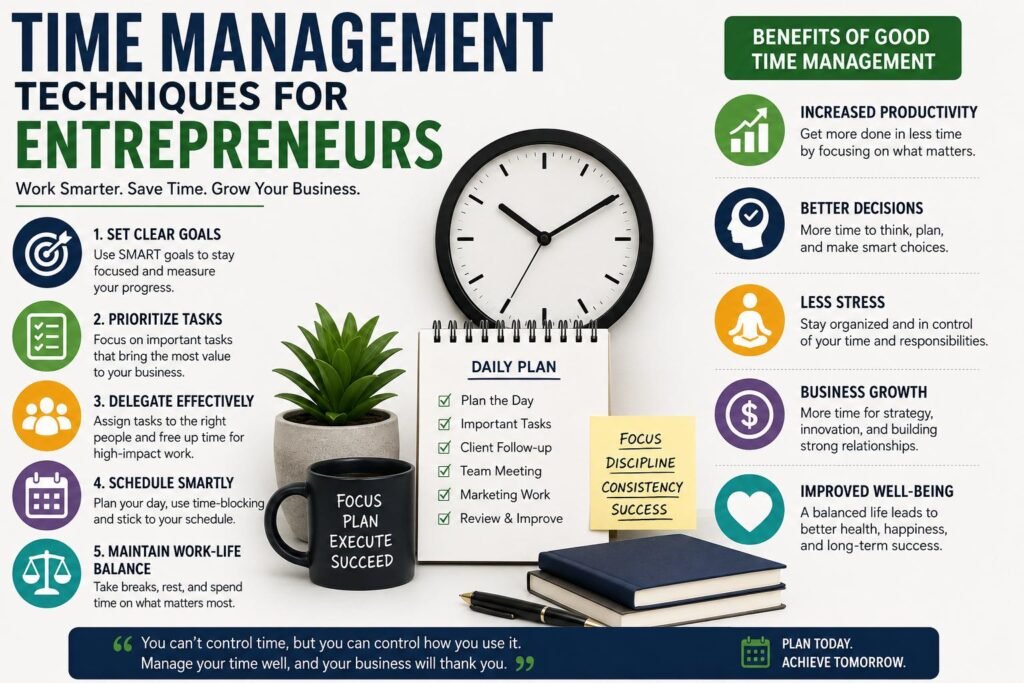
Successful entrepreneurs know that there is a difference between a productive day and a day that’s just a chore. With meaningful goals, you’ll feel direction, better motivated, and feel like every action you’re taking is working towards some bigger business goals. If there are no objectives, it can be easy to spend valuable time on low-level problems, and skip on long-term goals that can have a big impact on growth. Good goal setting requires that goals are set SMART, specific, measurable, achievable, realistic, and time-bound. The systematic way helps the business owners to track the progress, appreciate the achievements and adapt when things change. When long-term goals like gaining new markets or growing annual revenue are broken down into monthly, weekly and daily goals that are specific steps toward the action, they can be more easily achieved. Routine review of priorities and synchronization of daily activities with priorities help them stay focused on activities that produce meaningful results in their business, rather than being overwhelmed by endless demands.
Entrepreneurs should also have personal development goals to help them develop their leadership, communication and professional knowledge. Continuous learning helps businesses stay competitive in today’s market and build the skills needed for improved decision making. Read industry publications, participate in online training or learn new software in an hour a week and it can be beneficial for long-term success without putting a significant dent in the day job. If you write goals down in a planner, digital tool, or project management app, you’ll be more accountable because you have a written goal that is harder to forget than one that is just in your brain. Goal reviews are also helpful for entrepreneurs to acknowledge when they have accomplished a goal, to identify barriers early, and to keep them motivated through tough times. Defining clear objectives makes use of time less about getting things done and more about investing time for the greatest return.
2. Assigning Tasks that will Maximize Productivity by Prioritizing them
Task prioritization helps an entrepreneur determine what tasks need to be done now and what tasks can be delayed, delegated, and/or eliminated. Any business owner is faced with a variety of tasks that cannot be done in a day; prioritization is key to getting a lot of work done without constant pressure. One great strategy is to prioritize tasks by urgency and importance and then do them first, in the morning. Generally, the activities that have a direct impact on the customers, revenue, legal compliance, or critical deadlines should be given priority and other less valuable activities such as administrative ones can be done later or delegated to other team members. This systematic method helps an entrepreneur not get bogged down with the repetitive tasks and forget to perform strategic tasks which play a more significant role in the success of the business. Another benefit of prioritization is that it helps you to make thoughtful decisions, since every task is considered on its merits, not just in the order that it is listed.
As well, entrepreneurs should get accustomed to checking their task lists during the day rather than adhering to a rigid schedule. There may be times when the customer’s needs differ from what was expected, equipment malfunctions, or new opportunities in the market, so flexibility is an important part of proper prioritization. Instead of trying to do a lot of little things per day, it’s better to do 3 to 5 big things per day, which yields greater satisfaction and better results. Eliminating unneeded or irrelevant tasks from the to-do list also helps to clear out mental clutter and help entrepreneurs focus on productive tasks. When entrepreneurs take care of the responsibilities based on the business goals, they will be more efficient, less fatigued from decision-making, and investing time with maximum ROI.
3. Delegation
Many business owners find it difficult to delegate, as they think that doing it all themselves will ensure that they will get better results or better quality. This attitude can be considered to be responsible, but can cause unnecessary blocks in the growth of business and stress on the individual. Delegation is giving responsibility to others, employees, contractors or trusted partners, but ensuring that you are still held accountable for the outcomes. Delegation is a key factor that helps the entrepreneur to concentrate on strategic planning, building relationships, innovation, and revenue generation instead of becoming bogged down with mundane administrative tasks. Once repetitive or special tasks are identified which others are able to perform efficiently, it will create greater opportunity to utilize resources better and enhance overall business productivity. Delegation also helps employees grow, by enabling team members to acquire new abilities, take on more responsibilities and make meaningful contributions to the success of the organization.
The trick to delegation is to ensure that communication is clear, expectations are realistic, and follow up is adequate without supervision. It is important for entrepreneurs to define targets, allocate resources, set timelines and be on call to help when their employees have questions, but also give them enough autonomy to do their tasks. Trust is important since over-managing can be time consuming and diminish confidence and creativity for the manager and employee. Progress reviews are conducted on a regular basis to ensure projects are on track but not to the detriment of daily work. Delegation can provide the extra time and resources for entrepreneurs to concentrate on strategic opportunities and other actions that help them build better customer relationships enhance business performance and enjoy a better work-life balance, as their businesses continue to expand.
4. Using Schedule Techniques that Enhance the Daily Efficiency of the Project Team
A good schedule allows the entrepreneurs to have a structure to plan their day and ensures that each important activity is given the attention it requires. Business owners who are successful don’t just guess what time to work or what time to meet; they plan ahead and schedule certain times to work, to meet, to do paperwork, to talk to customers, and to take time for yourself. A time-blocking strategy is one of the most effective scheduling methods because it creates an allotted time to work on similar tasks, which minimizes the need to switch tasks frequently and can likely help improve productivity. For instance, an entrepreneur can use the first two hours of the morning to plan his or her day and to work on more important projects, then spend the remainder of the morning catching up on customer emails, set up appointments during the afternoon, and use the last hour of the day to check in with himself or herself and get ready for the following day. This helps the entrepreneur to concentrate on a single category of work at a time, while avoiding distraction.
There should also be some flexibility in the scheduling since some unforeseen scenarios are always going to arise in business. Changes can occur throughout the day due to customer needs, supply issues, equipment failures, and/or time-sensitive opportunities. Small space between appointments and big projects is necessary so that the entrepreneurs can allow for such changes without disturbing the whole schedule. Weekly planning sessions are also beneficial as they allow you to review priorities for your business, make sure you have enough time allocated for bigger projects and to anticipate possible problems with scheduling before they arise. Digital calendars that can offer reminders are another enhancement that will assist consistency, as a business owner won’t have to fret over vital conferences, payment deadlines, or recurring duties. By having a schedule and realistic expectations, entrepreneurs decrease the amount of stress they feel, boost punctuality, and stay focused on the activities that help the business thrive.
5. Having a Healthy Work/Life balance and not Sacrifice Business Success.
Many entrepreneurs invest hours and hours into developing their businesses and think that working all the time is the only way to be successful. Commitment and persistence are very important, but if people don’t take care of themselves, they will eventually be less productive, creative and able to make decisions. Overtime and its lack of rest is often accompanied by physical fatigue, emotional burnout, loss of motivation and poor business outcomes. Achieving a good work-life balance helps entrepreneurs to perform at high levels over a long period of time, as opposed to overwork and then recovery. This is a great way for business owners to maintain a healthy work-life balance and get their fill of rest, relaxation and time with family and friends. Breaks throughout the day, vacations, exercise, and adequate sleep all help to boost concentration, problem-solving skills, and ability to cope with business problems.
It’s also important for entrepreneurs to realize that not all work has to be done right now. Know how to turn off work devices during evenings or at specific times to prevent chronic stress. Understand how to “unplug” from work during specified personal time or evenings to help promote healthy habits and prevent chronic stress. Technology must be used appropriately – for example, set up periods of time during which no emails and business communications are constantly monitored. The business owners that value self-care finds that their health conditions have an impact on the way they lead, leading to better health, better creativity, and better performance. Instead of thinking of personal time as wasted, an entrepreneur who’s on the rise understands that caring for the body and mind is a worthwhile investment in a successful business.
Productivity Tools for Entrepreneurs to Run Their Businesses
Entrepreneurs today have a host of technology tools that help them manage their businesses with ease, enhance team collaboration and save time. Digital project management platforms enable business owners to plan, allocate, manage and monitor tasks and projects from a single place. These systems eliminate confusion, enhance accountability and make collaboration more convenient, even when working at a distance. Automated reminders and calendar applications for business rewards entrepreneurs to schedule appointments, meetings, and recurring business activities, and minimize missed deadlines. Cloud-based document storage also enhances efficiency as important documents can
be accessed securely via multiple devices, without relying on paper-based documents or local storage solutions.
Communication platforms help employees work together more efficiently by eliminating the need for unnecessary meetings, and enabling them to share information in a structured conversation without delay. Entrepreneurs can say goodbye to repetitive accounting tasks and hello to improved financial accuracy with the automation provided by accounting software. CRM systems allow companies to keep customer data in order, track sales opportunities, set up follow-up calls and customer service. Automation tools also boost efficiency by automating repetitive tasks like sending emails, confirming appointments, notifying about stock, and social media scheduling. While the brainchild of an entrepreneur should be well informed about all the available software, it is essential to assess their business size, operational needs, budget, and long-term plans to choose the right software to ensure optimal results. Choosing the appropriate set of productivity tools can help business owners cut down on manual labor, increase organization and focus more time on strategic growth initiatives.
Conclusion
Time management is a skill that is extremely important for an entrepreneur to develop as it has a direct impact on productivity, profitability, business growth, as well as personal wellbeing. All business owners have 24 hours in a day, but the difference between a struggling business and successful business often comes down to how that 24 hours is utilized. Entrepreneurs can achieve increased productivity with less stress by using basic productivity techniques, establishing meaningful goals, prioritizing important tasks, delegating tasks efficiently, developing a well-planned schedule, and maintaining a work-life balance. These strategies shift the focus of everyday operations from problem-solving to proactive problem solving aimed towards long-term success.
Technology also reinforces good time management by offering a variety of tools and applications that can automate repetitive tasks, boost communication, aid in organizing, and streamline project management. But when used in conjunction with on-going improvement and habits, digital tools can be most effective. It is important for entrepreneurs to regularly analyze their time use, eliminate unnecessary activities and adjust their routines as the business develops. While it’s important to work hard to start a successful business, it’s even more critical to work smart for a sustainable business. The methods and ideas shared in this article can help entrepreneurs and small business owner’s work more efficiently, enhance business performance, alleviate stress and establish a more balanced work-life environment.
Get more well researched information about Time Management Techniques for Entrepreneurs here.