Introduction
It’s not just about providing good products or services when running a little business these days. The internet has become a vital tool for customers to look up businesses, compare, read reviews and ultimately make purchasing decisions. This means businesses with a solid online reputation have a higher likelihood of enticing new customers, generating trust, and boosting sales. Digital marketing offers small businesses affordable, measurable strategies to compete with bigger businesses that don’t need a huge advertising budget. Using a variety of online marketing strategies, businesses can boost their visibility, attract potential customers, and build long-term relationships that lead to repeat business. By understanding the synergy between these strategies, entrepreneurs can embrace more informed decisions in their marketing strategies, optimize ROI, and ensure their business thrives in the ever-evolving digital landscape.
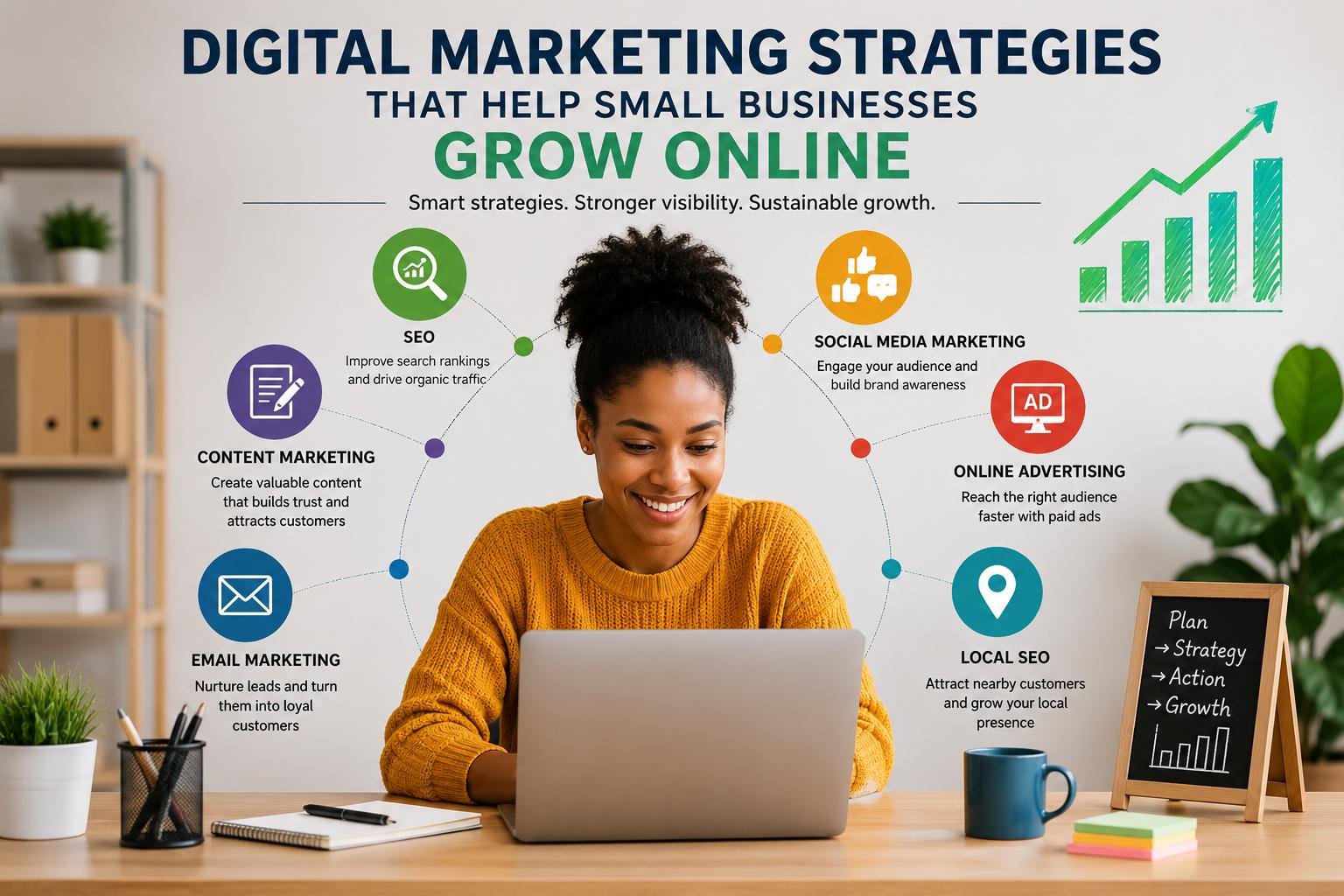
Flexibility is one of the top benefits of digital marketing. With a relatively small investment, business owners can begin with a small budget, track each campaign’s results, and fine-tune their marketing strategies accordingly. Unlike conventional advertising, outcomes of digital advertising can be better tracked, as it gives insights into web traffic, consumer interaction, conversions, and buying habits. This information will enable businesses to know what is effective and where they need to improve. Good companies do not use one of the methods to promote, they use more than one. SEO brings customers to your website, content marketing can build trust and engagement, social media can increase your reach, email marketing can turn your leads into customers, online advertising can boost visibility, and local search optimization can drive customers to your website. All these strategies make up an integrated digital marketing system that contributes to the sustainable development of businesses.
In fact, business owners must be aware of the various digital marketing strategies that are available these days before they can create a marketing strategy. By understanding the role each technique plays in customer acquisition, businesses can strategically allocate resources and develop marketing initiatives that drive tangible outcomes. Rather than targeting a single channel, entrepreneurs should understand the value of each strategy in support of the others, to gain increased visibility, qualified leads and loyalty over time.
Knowing the basics of Digital Marketing for Small Businesses is essential.
Digital marketing is any form of marketing that is done on the internet to sell a product or service to a potential consumer that spends a great deal of time online. The channels are websites, search engines, emails, social media platforms, online ads and local directories for businesses. Digital marketing can be more cost-effective than traditional marketing strategies, which tend to be expensive and broad-reaching. Unlike traditional marketing, there is no huge investment required to reach a targeted audience with digital marketing. Small businesses can target campaigns based on the demographics, interests, behaviors, and geographic location of customers and ensure that the marketing efforts are directed toward the customers who are most likely to be paying customers. In addition, digital marketing provides businesses with metrics that can be measured to promote improvement, making it simpler for companies to optimize their strategies and make the most of their ROI in ever-evolving markets.
The significance of Digital Marketing for Small Businesses
Whether they end up purchasing products online or in a physical store, many consumers start their buying process online. They look for information, compare prices, read reviews and assess businesses prior to making a selection. But when your small business doesn’t have an online profile, you can stand up to miss out as other businesses work to reach audiences on multiple online platforms. Digital marketing is key in filling that void, allowing businesses to stay visible during the entire customer decision making journey. It will help build brand awareness, establish credibility with valuable content, lead to customer engagement and provide multiple lead generation points. Digital interaction is measurable, which means that businesses can discover insights that lead to better marketing performance, while not spending money on needless interaction, making digital marketing among the most cost-efficient growth strategies at their disposal.
1.Building Long Term Visibility in the Search Engine Optimization (SEO) Process
Understanding SEO
Optimizing for search engines, or Search Engine Optimization (SEO), involves making changes to a website to boost its ranking in search engine listings when people search for the products or services supplied by the website. In general, the more you have in the higher rankings, the more traffic you will be getting to your sites as users tend to trust and click on companies that appear in the top spots of the search results. SEO encompasses optimizing website pages, enhancing technical aspects, conducting keyword research, generating high-quality backlinks from other trustworthy websites, and delivering a great user experience. Unlike other advertising methods, SEO takes time to reap rewards, but the flourishing rewards it yields last a long time as it draws in potential customers without paying for each and every website visitor. If you’re a small business with a tight marketing budget, you may get a steady stream of organic traffic via SEO which will help you continue growing your business.
Some of the Important SEO Tips for Small Businesses
The first step to a successful SEO is to grasp customer search habits. An important point to remember is that business owners should pick keywords which are relevant to their products, services and customers before using them in the pages of their Web sites, blog posts, headings, image ALT tags and page titles. It is also vital to develop informative and engaging content that addresses the inquiries of the customers and offers true value. Search engines favor websites that show they know what they’re talking about, are relevant to the topic, and are trustworthy. The technical aspects, including site speed, mobile-optimization, secure HTTPS connections, user-friendly navigation and optimized internal linking, also play a vital role in enhancing the search rankings. By continually refreshing website content, you ensure that it remains relevant and let search engines know that your business is still active, and thus has greater potential to be discovered via organic search.
2. Building Trust through Valuable Information is the Key to Content Marketing.
Definition of Content Marketing
It is a marketing practice that involves the creation and sharing of relevant, educational, or entertaining content, without the intent to directly promote a product or service. Rather than just selling something, businesses deliver content that’s beneficial to the audience that can solve a problem, answer a question, or guide them to a decision. Examples of content marketing are blog articles, videos, infographics, podcasts, downloadable guides, case studies, webinars, and commonly asked questions. This strategy can help build the company’s reputation as an industry leader and slowly start to foster connections with potential clients. As time goes on, the audience will get to know the brand better, making it more likely that they will buy the brand’s products or services when they are ready to purchase.
Developing Material that Promotes Business Expansion
The first step in effective content marketing is to know what your target audience is interested in, what they’re struggling with, and where they’re going to make their purchase. All the content must address genuine customer concerns and showcase the business’s expertise and credibility. Regularly posting high quality articles that are targeted with proper keywords will help the website rank better for the keywords it’s optimized for and will help generate more organic traffic. Educational guides and how-to articles try to keep visitors on the site for a longer period of time, while showing them that the company is trustworthy. Educational guides and how-to articles are designed to keep visitors on the site for longer, and instill confidence in the business. Content also can help other marketing channels, giving them valuable content to post on social media, put in an email newsletter, and refer to in advertising campaigns. Each piece of content will work towards greater marketing goals, while always capturing, educating and converting potential customers.
Content Marketing is Crucial to SEO, and Vice Versa
There is no better way to do SEO than to do it with content marketing, as it complements each other. Relevant and authoritative content is needed for good rankings, and SEO helps get the people looking for valuable content attracted to your site. Any business that has regularly informative articles that answer customer questions will naturally be focusing on keywords related to the articles, and will be encouraging other sites to link back to their content as well. New content also provides search engines with more pages to crawl, leading to more chances for being found in search results for different customer’s requests. Besides, content that interests the visitors will keep them on the site longer and lower the bouncing rate, which stimulates better results for their SEO. Instead of strictly separating and applying SEO and content marketing, small businesses should combine them and continuously work to bring in qualified visitors and guide them to become loyal customers.
3. Fostering Customer Loyalty through Email Marketing
If you still aren’t convinced of the effectiveness of email marketing, here are some reasons why:
These days, social media and other digital communications have taken the place of traditional methods, but email marketing is still a great way to create a solid customer base and generate sales for your small business. There’s no need for businesses to use changing algorithms to make it to their followers on social media either – they can still send them messages through email, because they’ve opted in to receiving them. This direct connection offers a constant stream of content, new product announcements, special offers and customer education without all of the posts that can be viewed. Email marketing is also cheap, which makes it extremely useful for small business people, who have a small budget for marketing. In addition to all of this, segmenting email lists for more targeted messaging that’s relevant to each customer’s interests and purchasing history, or by engagement levels for more personalized messages to encourage interaction and build long-term loyalty can be a powerful way to drive repeat sales.
Successful email campaigns are a result of the following best practices.
Effective email marketing starts with not purchasing a contact base, however making your own, based on the concepts and trust of your permission. Offer a reason to subscribe to your site, such as special discounts or useful information, newsletters, and even first look at promotions, and encourage site visitors, customers and social media followers to sign up. You should provide some actual benefit or content in each email that is informative, tips, name products or update them on business news concerning that subject. Every email should be informative, provide tips, make recommendations on products and/or provide business-related news about the subject and not just sales. The ability to read the email header, the opening sentences, the style of the email and the clear call to action keeps people reading and interested in the email and the business website. Measuring metrics such as open rates, click-through rates, and conversion rates can help companies determine what changes they need to make to future campaigns, based on what they’ve learned from their customers. Email marketing, coupled with content marketing and search engine optimization, can help to keep customers engaged after they’ve arrived on the first page of your website, resulting in more conversions, repeat business and referrals in the future.
This will enable you to reach more people and engage them with your social media marketing.
4. Using social media effectively to engage student pupil and Parent Communities
Small businesses can connect with their existing and new customers, engage them on the platforms where they are spending their days with social media marketing. Regular social media communication with people, such as highlighters, posts of informative content, answering customer questions, can increase brand awareness and promote products – all through social media such as Facebook, Instagram, LinkedIn, TikTok and X. Social media is more than a marketing tool, it can also be a great way to create real connections with customers, by fostering discussions, sharing behind-the-scenes content, highlighting customer successes and showing your company values. This constant interaction creates a sense of approachability, trustworthiness and responsiveness in businesses and also increases brand visibility. Likes and comments, shares and posts can expose businesses to visibility and exposure that can go far beyond their target audience, opening up great opportunities for organic new business acquisition.
The development of a Uniform Social Media Plan
Promotional messages after the release of new products are not enough; social media marketing is more complex and sophisticated. The goal is to create an organization’s content strategy that strikes a balance between educational content and entertaining content, customer reviews, industry news, product demos, and community involvement. Consistent posting will help maintain audience interest, and the brand will be remembered throughout the platforms. High-quality images, short videos, informative captions and interactive features, such as polls or Q&A sessions, all help to encourage more interaction with the followers. Furthermore, all the comments and messages should be recorded and taken up immediately if there are any questions asked and the concerns of the customers should be addressed properly. Analytics data from social media can be used to learn more about users who are engaging with a business’s content, the demographic makeup of those users, and the effectiveness of the content, allowing businesses to continuously optimize their social media strategies. Content marketing is paired with email marketing and social media and it’s a force that can be used to build awareness, create leads and build better customer relationships.
5. Online Advertising: The driving force behind business expansion.
Making a concept of Paid Digital Advertising a reality
Online advertising is a wonderful means to provide a company an instant lift in visibility to any target audience, whilst SEO and material marketing are excellent long-term marketing strategies. Paid advertising platforms can be used by businesses to display ads to users based on different factors such as interests, geographic location, demographic, current search intent or browsing behavior, as well as purchasing behavior. Search engine ads, display ads, social network ads, video ads and remarketing ads (that retarget visitors who have previously visited the website) are among the most popular advertising methods. Online advertising is flexible and can be tailored to the needs of all businesses, as they can set a daily budget, audience targeting and the duration of the campaign. Plus, detailed performance reports allow marketers to measure impressions, clicks, conversions and ROI and continually tweak campaigns to maximize performance and money saved by avoiding wasted effort.
Maximizing Advertising Performance
To get maximum benefits from online advertising, businesses need to design a good internet ad campaign that matches their marketing objectives and customers’ requirements. Successful ads include interesting headlines, persuasive copy, interesting images, and an effective call to action to get website users to visit the company’s website or call the company directly. The landing page should be identical in message to the ad, and provide them with the information and easy instructions to follow to purchase or call for more information about the product. Regularly testing different headlines, images, audience segments, and bidding strategies are vital in determining which are most converting for businesses. Remarketing is particularly valuable because it can be used to remind people who visited your web site but didn’t make a purchase of the fact that they were interested in your product in the first place and thus you have a higher chance of converting them into your customers. Content creation and marketing, SEO, and social media marketing, alongside paid advertising, drive faster customer’s acquisition and can help a digital marketing campaign to be more successful.
6. Local Search Optimization: Appearing to local customers
What is the need for Local Search?
For many small businesses, local search optimization is essential in getting their message to customers in their area, especially those that have physical locations. People tend to look for businesses in their area, enter ‘near me’ into the internet when considering the destination of their purchases, meals or service. Local search optimization can help companies appear in these location-specific searches and subsequently be more easily identified by consumers; this can involve providing more accurate contact information, directions, business hours, reviews and the services that you provide. Improved local search listings make them more believable and will attract customers to choose businesses that appear believable and approachable. Small businesses can gain a lot of sales, phone calls, store visits, and traffic from local search visibility for those customers that might have an instant buying need.
To increase the visibility of local businesses online
The first step in local search optimization is to establish and keep up to date business listings with the top online directories and mapping platforms. Consistency is essential across all platforms, business names, addresses, phone numbers, website info and operating hours should all be alike to help earn the confidence of search engines. Happy customers write positive reviews to boost your online reputation and attract new customers. It’s also a good idea for businesses to put in some location-specific keywords in the content of their website, create pages that promote local services, and get involved in events in the community that will be mentioned and linked to their website. It further enhances visibility by showing local involvement, which is achieved by publishing local content. In combination with leveraging SEO and actively engaging with social media, this can be one the most effective ways to generate leads for businesses in this location.
The Role of Digital Marketing Strategies in Relation to Each Other
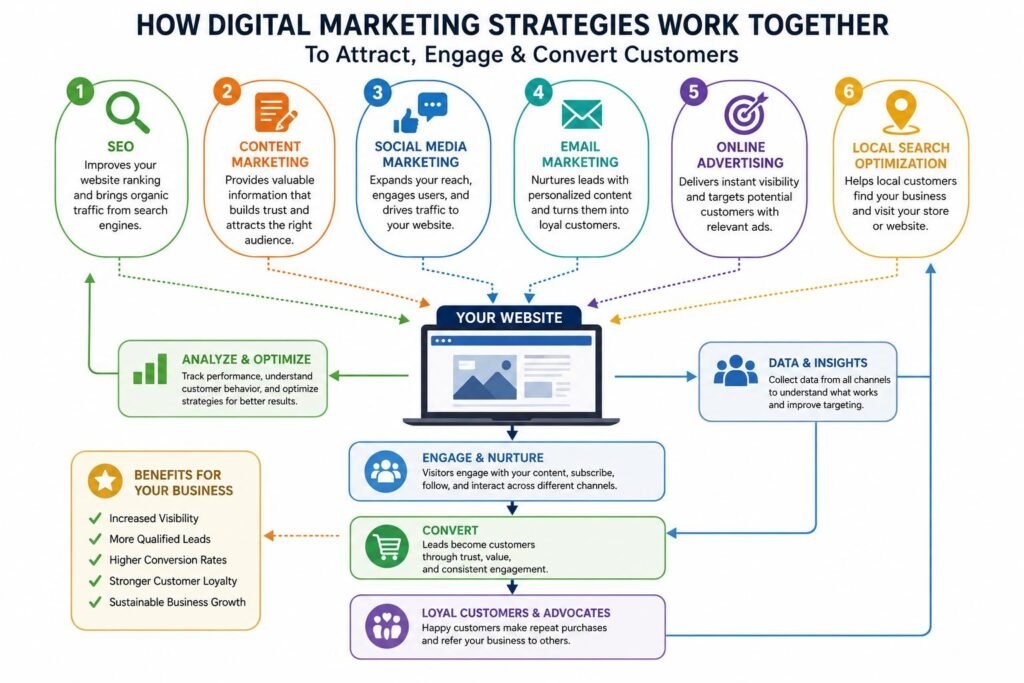
While each digital marketing strategy has its own set of advantages, they are most effective when implemented in conjunction with each other as part of an overall digital marketing strategy. SEO brings in traffic from people who are looking for information that is relevant, and content marketing enables you to offer them the information they need and want, keeping them on your site and helping them to trust you. Social media extends the reach of that content and brings it to a wider audience, plus it can spark a conversation and spread brand awareness. Over time, these relationships are cultivated with email marketing, which allows you to communicate personally with the interested prospects and turn them into loyal customers. Meanwhile, online advertising can create visibility in no time, allowing businesses to reach the right audience fast, while local search optimization will make sure customers in the area can find and reach out to the business. These strategies don’t exist in isolation, but act in concert throughout the customer journey, providing multiple touchpoints for involvement, lead generation, sales and conversion, and maximizing the impact of each marketing touchpoint.
Additionally, with a digital marketing strategy integrated with all other marketing efforts, companies can collect valuable customer data from various channels. Analytics tools for websites, e-mail lists, social media and advertising platforms all offer specific data about how visitors find the business, the content that subscribers want, how the content is being engaged with and how many conversions are being driven by advertising, respectively. Businesses can use these insights collectively to understand their customers’ behavior better, which can help them make informed business decisions and continuously improve. Rather than guessing, business owners can invest with confidence in strategies which will give them consistent measurable results. By leveraging this data-driven approach, small businesses can stay competitive, meet shifting customer tastes, and make sure they make the best use of their marketing dollars and grow sustainably.
Conclusion
The digital landscape has revolutionized the way small businesses connect with customers, foster relationships, and compete for attention in crowded markets. Instead of relying on the traditional advertising channels, companies can now access cost-effective, measurable and highly targeted advertising options as part of a long-term strategy for success. Improving their online visibility, building credibility through content marketing, expanding their brand awareness through social media, providing prospects with immediate exposure through online advertising and connecting with customers who are nearby and ready to make purchases with local search optimization are all advantages that can be gained from search engine optimization. All the strategies are valuable. But combined, they form a complete marketing system that draws in qualified leads and helps to foster sustainable business growth.
Marketing success for small businesses that want to grow online is not about picking one marketing channel, but in using a combination of different marketing channels that are part of a larger marketing strategy that caters to each of the customer’s steps in the marketing funnel. Through delivering content that resonates with their target audience, captivating engagement on various digital channels, optimizing their online visibility, fostering positive customer communication, and leveraging data insights throughout the marketing process, entrepreneurs can build a strong online footprint that creates lasting results. Therefore, businesses that are prepared to adopt digital marketing as a dynamic and continuous process of learning, adapting and improving will be the most apt to reach more customers, boost revenue and create resilient brands that will be able to flourish in the digital economy.
Get more well researched information about digital marketing strategies for small businesses here.