
Introduction
Running a small business is about more than just putting out great products or services. Behind every successful business is a financial plan which guides spend, supports growth, and prepares the business for the unexpected. While many entrepreneurs are focused on getting in front of customers and growing sales, what often determines success or struggle in the long term is financial health. Without a clear picture of income, expenses, profit, and what the future holds financially, even businesses with high sales may run into cash issues or fail to grow in a sustainable way. By learning the basics of financial planning business owners can base their decisions on fact not guesswork, which in turn creates a stronger base for long term success.
Financial planning does not pertain to large companies only which have separate finance teams. Small businesses also do very well if not better from setting up financial systems which in turn help them to see how they are doing and what the future holds. A solid financial strategy allows entrepreneurs to put resources to best use, to see where they can cut back on costs, and to make sure they have enough cash for day to day operations. Also it gives peace of mind when applying for loans, bringing in investors, or entering new markets. By learning the base of financial planning which includes; budgeting, cash flow management, expense tracking, profit analysis, and emergency savings small business owners can reduce financial uncertainty and put themselves on a path for sustainable growth.
What Is Business Financial Planning?
Business financial planning is a framework which we put in place to manage money in our companies. It includes revenue forecasting, expense projection, goal setting, performance tracking, and strategy adjustment as business conditions change. Also instead of just looking at present income and outgoings we encourage business owners to think forward to future investment, seasonal variations, tax issues, and unexpected financial issues. A good financial plan ties in day to day business decisions with long term goals which in turn see the company through stable and growth oriented financial choices instead of what may create unneeded financial stress.
Understanding that which of business plans pays off is a fluke is a concept which entrepreneurs do in time to grasp. That out of the blue each business is going to do great is a farce what we see is that which weathered the storm of uncertainty, which rode the wave of change in customer demand, and which had a plan for the unexpected did well. What you see from the success of those with detailed financial plans is that they had a handle on their fiscal standing to begin with and they have thought through how they will react to any situation. If you are looking to bone up on the basics of business financial planning we can turn to structured educational resources which present practical tools for creating more robust financial systems and making better informed long term business decisions.
Key Components of Business Financial Planning
Successful in financial planning you see a mix of key elements which as a unit better your decision making. This includes setting practical financial goals, creating in depth budgets, forecasting income, tracking expenses, managing cash flow, looking at profitability, handling tax issues, and running emergency reserves. Each element plays into the other, which in turn forms out a full financial management system as opposed to separate actions. As business owners you see to review these areas which in turn give you a clearer picture of financial performance and also in early stage is able to identify issues before they grow into larger problems.
Why is financial planning important for small Businesses?
Many small businesses don’t see success because they have issues with financial management which in turn do not have to do with the number of customers they have. Profit isn’t a sure thing if at the same time expenses are going up or you run out of cash before you get paid. What we put out there in terms of price doesn’t tell the whole story if we aren’t also looking at what is coming in and out of the business account. Also, through proper financial planning entrepreneurs can see the full picture of their business health. Rather than put out reactionary fire rescue plans for financial issues, business owners can put in place strategic solutions that also look at the big picture of what is to come. This proactive approach lessens stress and at the same time builds up confidence in the decisions made for the present and the future.
Strong in financial planning also puts a business in good light. Banks, investors, suppliers and also future business partners often look at financial health before they tie up with a company. That which presents structured financial reports, practical budgets, and opens financial forecasts is seen as professional and responsible in its management. This credibility which is built through good financial practice in turn improves access to finance, better terms with suppliers, and investment which a poorly run finance shop may not see. Also financial planning supports not only internal functions but also external business relationships which in turn fuel growth.
Benefits of Effective Financial Planning
Financial planning is a benefit to small businesses which includes:
- Better income and expense control.
- Improved cash flow stability.
- Stronger decision making from financial data.
- Increased readiness for unexpected expenses.
- Greater confidence when seeking funding.
- Easier business expansion planning.
- Improved profit performance via better resource allocation.
- Reduced financial pressure for business owners.
Each of these benefits goes into creating a business that is more resilient which in turn is able to adapt to change in the market and at the same time maintain financial stability.
Creating a Realistic Business Budget
A business budget is a key element in any financial plan. It puts forth what is expected in terms of income and at the same time details planned expenses over a certain period of time which in turn allows entrepreneurs to control spending and evaluate financial performance. Instead of looking at budgeting as a restrictive practice we see successful business people use it as a guide which they in turn use to allocate resources efficiently and to put first what the business’ goals are. A real budget instils financial discipline into the business also which at the same time gives that which is flexible to make adjustments as the circumstances change throughout the year.
Developing a good budget starts with the analysis of past financial data when it is available. Entrepreneurs should look at past sales trends, operating expenses, payroll costs, rent, utilities, marketing expenses, inventory purchases, taxes, and loan repayments to do an accurate job of projecting future financial needs. For new businesses which don’t have historical data do market research and come up with conservative revenue estimates which identified all expected operating costs. It is essential at this stage to be realistic over optimization of revenue projections or under estimating expenses will lead to financial trouble down the road. Conservative budgeting gives you a better base from which to make informed decisions and maintain financial stability.
Steps for Building a Practical Budget
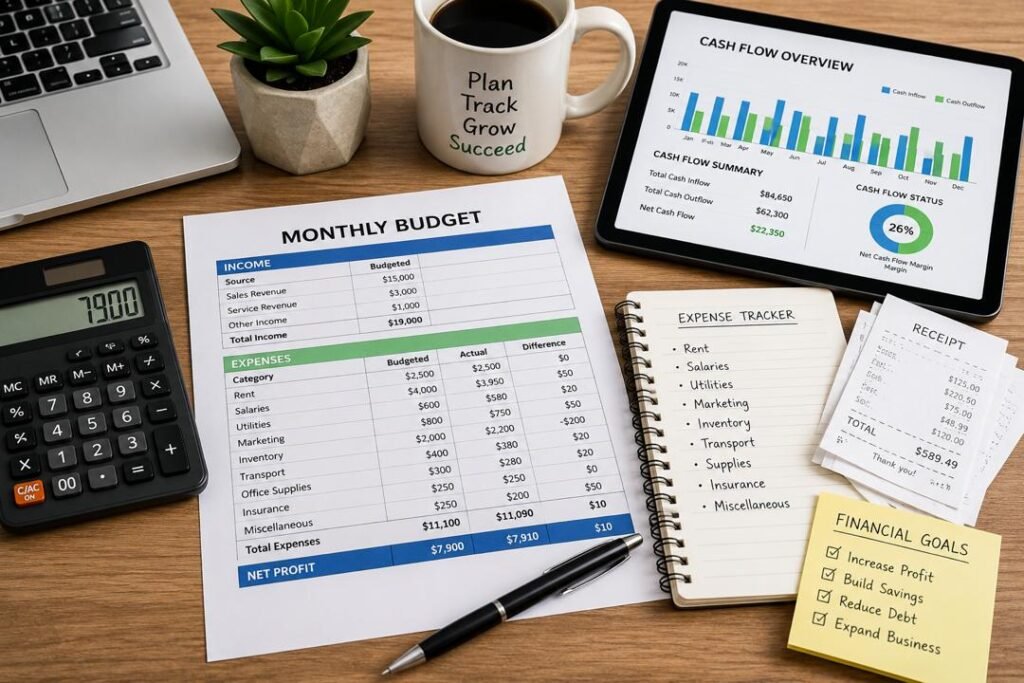
Creating out of a good business budget which at the same time accurate and accountably goes through many steps. Start by putting in monthly revenue which is based on what is realistic for sales not what is ideal. Also include in the break even analysis fixed costs which are like rent, salaries, insurance, and loan pay off terms and then variable costs which are things like inventory, marketing, utilities, transport, and packaging. Also include tax, emergency spendable funds, and growth investments to avoid fixed and variable costs put in what you know you will be taxed at, an emergency fund for when the worst happens and money for growth. Also it is important to regularly review actual financial results against what the budget is and to fine tune the projections as business conditions change which in turn will keep the budget relevant and useful all year round.
A budget is not a fixed plan. Markets fluctuate, customer wants shift, suppliers raise prices, and we see unexpected growth. By reviewing the budget monthly we allow for identification of the gap between what we projected and how we did which in turn allows us to make quick changes that keep finance in sync with business goals. This continuous monitoring turns budgeting into a dynamic process which supports financial decisions and enables sustainable business growth.
Managing Cash Flow Effectively
Cash flow management is a key element in financial planning which in turn determines if a business has what it takes to cover its every day responsibilities. Many businesses which are doing well financially run into trouble because cash just isn’t there when they need it to be. Positive cash flow is when a business brings in more money than it goes out over a given time which in turn allows the business to pay employees, suppliers, for rent, utilities, taxes and other operating expenses without stress. But poor cash flow can throw a spanner in the works, it disrupts operations, damages relationships with suppliers and forces businesses to turn to expensive loans to cover routine expenses. By understanding cash flow entrepreneurs are able to make better spending, pricing, inventory and customer payment terms decisions which in turn help to maintain financial stability through different business cycles.
Business owners we see putting together cash flow projections which in turn present what we expect in terms of income and expenses out to the coming weeks and months. These projections in turn help to identify coming shortfalls before they hit which in turn gives us time to reduce non-essential spending, to negotiate better payment terms with suppliers, or to get customers to pay us faster. Also we put out a range of convenient payment options, we send out the invoices right away, we follow up on past due accounts and we keep our inventory at a proper level which all in all contribute to a healthier cash flow. Businesses that monitor their cash flow on a regular basis do better at weathering seasonal changes, economic uncertainty or unexpected expenses without at the same time disrupt daily operations or growth.
Practical Ways to Improve Cash Flow
Although each business is unique in its operations, we see that some practical approaches which do improve cash flow management play out well. We recommend that entrepreneurs put in place clear payment terms and timely reminders best to customers for prompt payment which may also include a gentle reminder. Also in the mix is the strategy of securing longer payment terms from suppliers at the same time as you turn around and collect from your customers as fast as you can which in turn improves the out and in flow of cash. Also of note is the issue of not over buying inventory which leaves money in a tie up in products which don’t sell and also the value in very carefully going over recurring expenses to root out what isn’t necessary. Also key is the practice of keeping accurate cash flow reports and to review them weekly which in turn gives business owners early warning signs of issues which may blow up into large scale financial problems which can be hard to recover from.
Tracking Business Expenses
Expense reporting which gives business owners a full report of where money is going and if those expenses are in fact leading to business growth. Also without accurate records entrepreneurs may put forward incomplete pictures of their spend which in turn may cause them to not see true operating costs, to ignore items of spend which are not required or have difficulty in putting together financial reports and tax returns. Regular expense reporting supports better budgeting improves financial transparency and also puts out cost reduction opportunities which do not see an impact to product quality or customer satisfaction. All businesses no matter their size benefit from putting in place organized systems which record every business related transaction accurately and consistently.
Modern tech has made expense tracking a breeze compared to what we had in the past. We have accounting software, mobile apps, digital receipts, and online banking which allow businesses to input expenses which are then put into categories like office supplies, transport, utilities, marketing, payroll, insurance, equipment and inventory. Also it is very important to separate personal from business finance as to do otherwise create a mess and increases the chance of error. By going over expense reports monthly entrepreneurs are able to see what we are spending money on, to do a head to head of actual spend vs. what we budgeted and use that info to either cut out what isn’t adding value to the business or put more into what is.
Best Practices for Expense Management
Successful in large part to consistency which does not require that systems be complex. We as a business put in place an immediate record of all purchases and a secure system for storage of receipts for when we will need them in the future. Also we see to it that expenses are placed in the right categories which in turn makes budgeting, tax preparation, and financial report generation go more smoothly. Also we as business owners look at our recurring subscriptions, service contracts, and supplier agreements at a regular interval to see that they are still bringing us value. We put in place approval processes for bigger purchases and also we encourage our employees to play by the documented expense rules which in turn what that does is it enhances financial responsibility and at the same time we see to it that we are not out spending in areas that are not necessary.
Understanding Profit Analysis
Revenue is the star in business reports but profit is a better indicator of financial health. Profit analysis looks at what is left over after we account for all operational costs, tax, interest and other expenses out of total revenue. A business may see great sales numbers but be doing very little profit wise if they have high expenses. What we see is that a business may do great in terms of sales but produce very little profit if they are not managing their expenses well. Through profit analysis entrepreneurs are able to look at price points, operational efficiency, product performance and investment choices more clearly. Instead of just putting all effort into increasing sales which may not translate to profit what successful companies do is they constantly assess if those sales are in fact supporting sustainable growth.
Several types of profit analysis which business owners use to see different elements of how their business is doing, gross profit which is what you have left after you take out direct production costs from revenue, which in turn gives you info on product price and production efficiency. Operating profit also includes other operating expenses like salaries, rent, and marketing into the picture, while net profit is what you have left after you pay all expenses and taxes. By looking at this data regularly business owners can determine what products are the most profitable, which services are under performing, what to do with respect to pricing strategies and how to better run operations. Consistent profit analysis is what supports growth when it is based on good financial health rather than just an increase in revenue.
Key Financial Ratios to Monitor
Financial ratios are a tool which we gain great insight into profit analysis and also for the broad field of financial planning. The gross profit margin reports how well products or services do in terms of generating income after production costs are taken out. Net profit margin we use to see what percentage of revenue is turned into profit after we have paid all our bills. Current ratio we use to see if the company is able to cover its short term debts, and return on investment we use to determine if our business spends is paying off. By consistent monitoring of these we are able to identify what is doing well, what needs work, and to make decisions based in fact which in turn improves our long term financial performance.
Building an Emergency Fund
Unforeseen issues can impact any which are doing well. Equipment failure, economic decline, supply chain break down, natural disasters, or sudden loss of customer interest can cause financial stress with little notice. An emergency fund is a financial buffer which allows businesses to keep going through tough times without having to use up all of their lines of credit. Also by this action of putting aside money which may be used at any time they are showing financial responsibility and at the same time greatly improving business resilience which in turn means that short term setbacks do not turn into long term financial issues.
Building out an emergency fund is a matter of consistent effort as opposed to large one time deposits. Business owners should put aside a set percentage of monthly profit into a separate savings account which is to be used only for emergencies. Also it is best if the reserve covers at least 3 to 6 months of key operating expenses which include payroll, rent, utilities, insurance, and loan payments. While it may take time to build up such a reserve what you do is put in a little at a time which in the end will strengthen your financial security and reduce stress during uncertain times. Businesses which have emergency funds see quicker recovery from unexpected disruptions because they are able to continue service to their customers while they work through operational issues without the immediate financial panic.
Common Financial Planning Mistakes
Many a time we see entrepreneurs make avoidable financial mistakes which in turn may be put to rest with better planning and financial acumen. As an example, it is very common for business owners to not separate personal from business finances which in turn makes it hard to determine true business performance. Also very often we see that which is reported in bank statements is the only financial info some business owners look at which in turn leads to wrong assumptions of what is really available to the business. Also we see that many business owners do not pay enough attention to tax issues, they over spend during high revenue times, and also that they put off review of financial reports till issues have become large scale. These actions in turn play a role in increasing financial risk and also in which the business is not able to make informed decisions.
Another issue is that many businesses put too much focus on present operational requirements at the expense of long term planning. We see many companies which do not put enough into technology, employee growth, equipment repair, or strategic expansion which in the end hurt their competitiveness. Also it is typical to see businesses which pay no attention to financial forecasting or which do not modify their budgets when the market changes which in turn puts them at a disadvantage. To avoid these issues businesses should do regular financial reviews, keep accurate records, prepare realistic budgets and also be flexible in the financial strategies they put in place as the business changes.
Practical Financial Habits for Long-Term Growth
Strong financial health of a company is a result of which is not just a set of knowledge but also a practice of daily actions that promote responsible money management. We see that entrepreneurs which do the review of financial reports on a monthly basis, which includes comparing what we have achieved against what we planned, monitoring of cash flow forecasts, and looking at the profitability of different products or services. Also by setting up regular meetings with accountants or financial advisors businesses can get which they need which in turn also helps in our compliance with tax laws and financial report requirements. Also investment in financial education for business owners which will in turn enable them to better understand the economic climate we are in and to put in place better financial strategies which will see through the life of the business.
Equally so we must foster a culture of financial responsibility in all levels of the organization. Employees which are made aware of company financial goals are more likely to conservation resources, reduce waste, and put forth ideas which improve profitability. Business owners should promote transparency, put in place clear financial policies, and use reliable accounting systems that present accurate info for decision making. Financial planning should be looked at as an ongoing process instead of a onetime event because business conditions, customer preferences, and market opportunities are always in flux. Businesses that practice discipline in their financial doings are better positioned to adapt, compete, and grow sustainably over the long term.
Conclusion
Financial in which is a small business owner’s best asset as it sets the structure to manage resources well, plan for the unknown, and achieve sustainable growth. We put together budgets, cash flow manage, track expenses, analyze profits, and build emergency savings which are not done in isolation but are related practices that improve all aspects of business performance. As a whole these actions enable entrepreneurs to make better decisions, to reduce risk which is not unnecessary and to maintain financial stability in tough economic times.
As companies grow they see an increase in financial complexity which in turn makes in depth planning all the more important. Entrepreneurs who regularly look at financial reports, which they use to tweak their strategies based on what the numbers tell them and which also prepare for what the future holds do better in the long term. Thus financial planning has to become a routine part of the business rather than a sporadic practice. By adopting sound financial management principles and at the same time improving financial acumen small business owners can put in place robust organizations which are able to weather change, which support steady growth and in turn create value for customers, employees, and stakeholders.
Get more well researched information about Financial Planning Basics for Small Businesses here.