Introduction
Small businesses frequently tend to concentrate too much on sales and neglect one of the most important aspects which can impact profitability: inventory. Poor stock control is much like a leaky roof in a building, it can work away at your bottom line without you being aware of it, regardless of your level of sales. No matter what kind of business you have, from a neighborhood grocery store, fashion boutique, electronics store, pharmacy, or online store, poor stock control can be an unseen drain on your finances. Additional inventory takes up storage space, can be damaged or become obsolete, and can decrease working capital used for marketing and expansion and for day-to-day operations.
Many small business owners think that good inventory management is going to cost a lot of money with enterprise software or they need to hire an inventory expert. The fact is that simple processes and regular routines can make a huge difference in the stock turnover, waste and profitability. Retailers can make smarter decisions without going too deep into technology by knowing which products get the most focus, when to reorder products and knowing what items to watch for slow moving items before they become an issue.
It’s not just about having the most products available that makes inventory management effective. Rather, it’s about maintaining correct product volume, quantity and availability at the right time. Companies that achieve this balance have improved cash flow and customer service levels, reduced stockouts, and increased efficiency.
The eight inventory management methods outlined in this article could be employed by small retailers right away to cut down on waste, boost inventory turnover, and release working capital.
Inventory Management is more important than Sales Growth.
A lot of retailers use revenue growth to track success, but it doesn’t mean they will make a profit. Too much money becomes tied up in unsold products and a business can make quite a bit of money each month but not pay its supplier, employees or operating costs. Inventory is a form of money tied up that is not available for other uses until merchandise is sold. All the additional items on a shelf have a carrying cost which is the cost of storing them, cost of insurance, risk of spoiling, risk of shrinkage, opportunity cost for all the additional items on the shelf.
Excessive stocks are bad for the liquidity of retailers and for their financial pressure. But having insufficient stock levels means that sales opportunities are lost, and customers are disappointed. The aim is to strike a balance between product availability and inventory efficiency.
Business owners can better make the purchasing decision if they understand how inventory affects cash flow. Retailers should take into account turnover rates, seasonal demand trends and room available before ordering something that is ‘on sale’ from the supplier. Strategic inventory management can reveal profits businesses didn’t realize by boosting their sales without a corresponding rise in their sales force. By enhancing inventory turnover, retailers can re-invest in their more rapidly moving items, marketing efforts, employee training, and customer service enhancement.
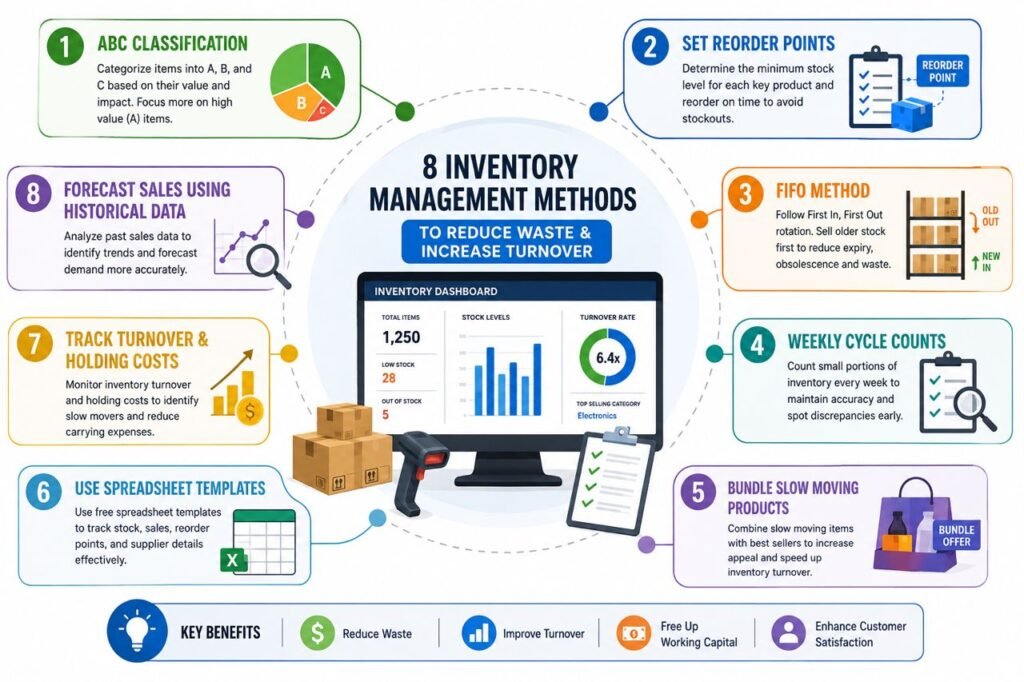
Method 1: prioritize inventory using the ABC classification
ABC classification is one of the simplest and most effective inventory management techniques that can be used by the small retailers. This approach categorizes the products based on their revenue and profit contribution, allowing business owners to prioritize their efforts on the most impactful items.
Items of category A are high value products, that contribute to most of the sales or profit made, but make up a low proportion of the total inventory. Close monitoring, accurate forecasting and reviewing frequently are necessary for these products. Category B items are of moderate sales value and need some regular attention but not as much as category A items. Category C items generally make up a significant number of inventory items but bring in a comparatively small amount of revenue.
For instance, a clothing store might find that selling high-quality denim and designer handbags brings in 70 per cent of profits, but the low dollar accessories only make up a small part of profits. The resulting differences enable the retailer to distribute resources more effectively and to not overstock items that do not perform well.
ABC classification plays a vital role in the retail buying decisions, in forecasting the products and in minimizing stocks. Business owners can focus on the products that will have the highest economic value rather than the same ones that all products are treated as being equal. Customer preference and changing market conditions are taken into account by reviewing classifications quarterly.
Method 2: Set Reorder Points for each Key Product
The most frequent error that small retailers make in their inventories is under counting. When inventories are low, ordering is often done to prevent running out, which can result in emergency buying, and poor service levels.
The minimum stock level to reorder. This calculation takes into account average daily sales, supplier lead times and safety stocks. It’s simple, average daily usage times supplier lead time and then add a margin for unpredictable demand fluctuations.
For instance, if the five units of a product are sold each day and the supplier delivers the order in seven days, the reorder point should include at least thirty-five units of the product along with some safety stock. When the inventory level drops below this point, order should be placed right away.
The use of reorder points eliminates emotion and uncertainty in purchases. Retailers will be able to prevent over or under stocking, and ensuring the presence of products at the store. Even simpler businesses that only use simple spreadsheets can automate reorder alerts using conditional formatting and simple formulas.
Regularly checking the reorder points also enables retailers to recognize fluctuations in demand. When products regularly arrive at reorder levels earlier or later than is anticipated, purchasing assumptions can be adjusted to better forecast the product.
Method 3: FIFO Method.
FIFO, in the sense of “First In, First Out,” is a type of inventory rotation, where older stock is sold off before newer stock. This is particularly crucial for retailers who sell perishable items, cosmetics, pharmaceuticals, electronics or fashion items.
If not properly rotated, products can go bad, become obsolete or be rendered worthless before being sold. This leads to excessive mark down, write off and loss of profitability. By helping to keep inventory flowing through the business in an efficient manner, FIFO reduces these risks.
There is no need for high tech technology to implement FIFO. Retailers can simply arrange shelves to ensure that stock is arranged in such a way that the older items are in the front and the newer ones are at the back of the stock. Employees should be trained in proper rotation procedures in stocking/replenishment operations.
Visual checks are done regularly, which helps to ensure FIFO practices are being complied with. Another good idea is to put receiving dates on all incoming stock so that it is easier and more consistent to rotate stock within the store. FIFO is beneficial for businesses that sell products seasonally as it helps to minimize the risk of selling outdated items in the next selling season.
The consistent use of FIFO helps to maintain high inventory turnover, minimize waste, and customer satisfaction, by ensuring that the oldest items are used first, and encouraging new purchases to keep the stock moving by ensuring shoppers receive fresher, higher-quality products.
Method 4: Weekly cycle counts are performed rather than annual stock takes.
A lot of smaller businesses only do inventory once a year and then find huge differences in their inventory after several months when they realize how many mistakes they have made. A year’s delay exposes risks, and will be hard to find the cause of errors.
Cycle counting is a better alternative. Retailers do not count the entire stock all at once, but rather a certain number of products are counted each week, according to a predetermined schedule. Items that are more expensive (A) should be counted more frequently than B and C items.
Weekly cycle counts help to ensure accurate inventory levels by spotting any discrepancies as early as possible. Variations between physical stock and recorded amounts can be due to theft, supplier error, and damage to products or administration. Early identification can stave off these problems into big ones.
Another benefit of cycle counting is that it minimizes disruption in the operation. With weekly counts, a store can often close for annual stock taking or work overtime, while weekly counts can be done during quiet time at the store. The process is integrated into a more routine part of the year instead of being a stressful yearly routine.
Having accurate inventory records will help with purchasing, forecasting and customer service. Staff can confidently provide answers to customer queries, process orders quickly and there are no unnecessary emergency purchases.
Method 5: Bundle Slow Moving Products with Best Sellers
All retailers have items that don’t sell as quickly as they thought. Keeping these products on the shelves for an extended period binds the capital and takes up space for faster selling products.
Product bundling is one of the effective solutions for inventory liquidation besides using a discount. Slow moving products and well-known products together boost the perceived value and speed up the inventory turnover.
For instance, a skincare product that has poor sales can be added to a well-selling cosmetic product. An older accessory with a popular electronic device may be a technology store idea. They can be themed packages with related items created by grocery stores. They may be themed packages with complementary items designed by grocery stores.
Successful bundles need to be of real value to customers and meet purchasing habits. There are very few good combinations that can be seen when unrelated items are paired. Retailers should review purchase information to determine what frequently co-purchased products to promote.
Limited time bundles are a way of inducing urgency to make quick buying decisions. Bundle performance is also good indication of consumer preference, and can signal retailers to add or remove items from their permanent assortment.
Having less slow-moving inventory means you’ll free up some shelf space and have more cash available for use to invest in items that are in higher demand.
Method 6: Use of Free Spreadsheet Templates for Inventory Tracking
Many small business owners put off streamlining inventory management because they think that they need advanced software. While there are other great features available in advanced inventory systems, spreadsheets are still a great, budget-friendly alternative for businesses with a limited budget.
Free spreadsheet templates can keep track of stock levels, reorder points, supplier info, stock sales history, purchase orders and stock valuation. Built-in formulas, filters and conditional formatting tools make managing inventory easier in applications like Microsoft Excel or Google Sheets.
Retailers have options to develop dashboards that list products with low stock, slow moving products as well as monthly turnover rates. Multiple members of the team can also edit the information in real time, making it easier to collaborate, and shared cloud-based spreadsheets can also achieve this.
The secret is to have good and consistent data entry procedures. Data should be maintained in inventory records as soon as they arrive in the mail, are taken off the shelf or have been identified as damaged. Standard Operating Procedures: This helps to keep data accurate.
Spreadsheets can then be upgraded to a specific inventory management system as the company expands. But for many small retailers, it’s possible to deliver meaningful improvements without extra costs by using simple tools and following disciplined processes.
Method 7: Keep track of inventory turnover and inventory holding costs.
The time required for the turnover of merchandise within a store over a given time period is also considered inventory turnover. This measurement is useful for understanding how well a product is performing and the effectiveness of inventory management.
A low turnover rate can mean the product is being overstocked, there is not enough demand, or there is a pricing problem. High turnover rates are generally an indicator of high demand as well as good buying habits; however, if turnover is too high, then a lack of stock is a possible reason.
Retailers should use a formula to calculate inventory turnover on a regular basis to determine the ratio of the cost of goods sold to the average inventory value. This is valuable to track by product category to find areas that can be improved.
Besides turnover rates, retailers need to know inventory carrying costs. The costs of storage, insurance, financing costs, spoilage, obsolescence and shrinkage. There are many businesses that don’t fully understand the expenses involved with carrying a large stockpile of goods.
Retailers can use these indicators to make better buying decisions. Business owners can see the big picture of the cost of inventory options and consider more than just discounts from suppliers or sales volume.
The benefits from improving turnover can be higher than the benefit from increasing sales as it will decrease waste and free up working capital to be used elsewhere in the business.
Method 8: Predict sales using Historical data.
Don’t make assumptions, use data when making inventory decisions. Simple historical sales data can paint a picture that may yield very helpful patterns, which can help forecast more accurately.
Retailers should look at sales records from at least the past twelve months, to determine seasonal trends, promotional effects and consumer preferences. Insights into these trends enable businesses to anticipate demand fluctuations and steer clear of excess inventory buildup.
School supplies, holiday decorations, fashion and agriculture products are examples of products with predictable demand. Retailers who are attuned to these trends will be able to adjust their buying plans.
Other issues like supplier lead times, economic conditions, local events and competition activities should also dictate forecasting. Having an open line of communication with suppliers allows retailers to be proactive when delays do arise.
The key to demand forecasting is not to forecast the future correctly. Rather, it is about the working through of informed decisions, based on information available and continually updating and modifying assumptions as new information comes in.
Retailers that are able to do this on a regular basis will find that they are able to make better purchasing decisions, waste less, and have better product availability.
Conclusion
One of the most effective methods that small retailers can utilize to boost profitability without raising sales volume is effective inventory management. But overstocking quietly eats into profitability and consumes valuable storage real estate and flexibility in running the business. Retailers can make a significant impact on inventory performance by using some of these practical measures, including ABC classification, reorder points, rotation, weekly cycle counts, product bundling, spreadsheets, inventory turnover analysis and demand forecasting.
These techniques are not software intensive or labor intensive. It is more about consistency, accurate data and disciplined process than technology investments that will lead to success. Over time, small reductions in inventory inaccuracies and/or inventory turn times can make a significant difference in financial outcomes.
A good retailer who cares about inventory management isn’t just getting improved efficiency: they’re getting better results. They’re able to provide more relevant product availability, eliminate waste, and unlock working capital for new business. With competition in the retail sector’s high, businesses that strategically manage their inventories are more likely to stay competitive, grow and sustain profitability in the long term.
Get more well researched information about inventory management for small retailers here.