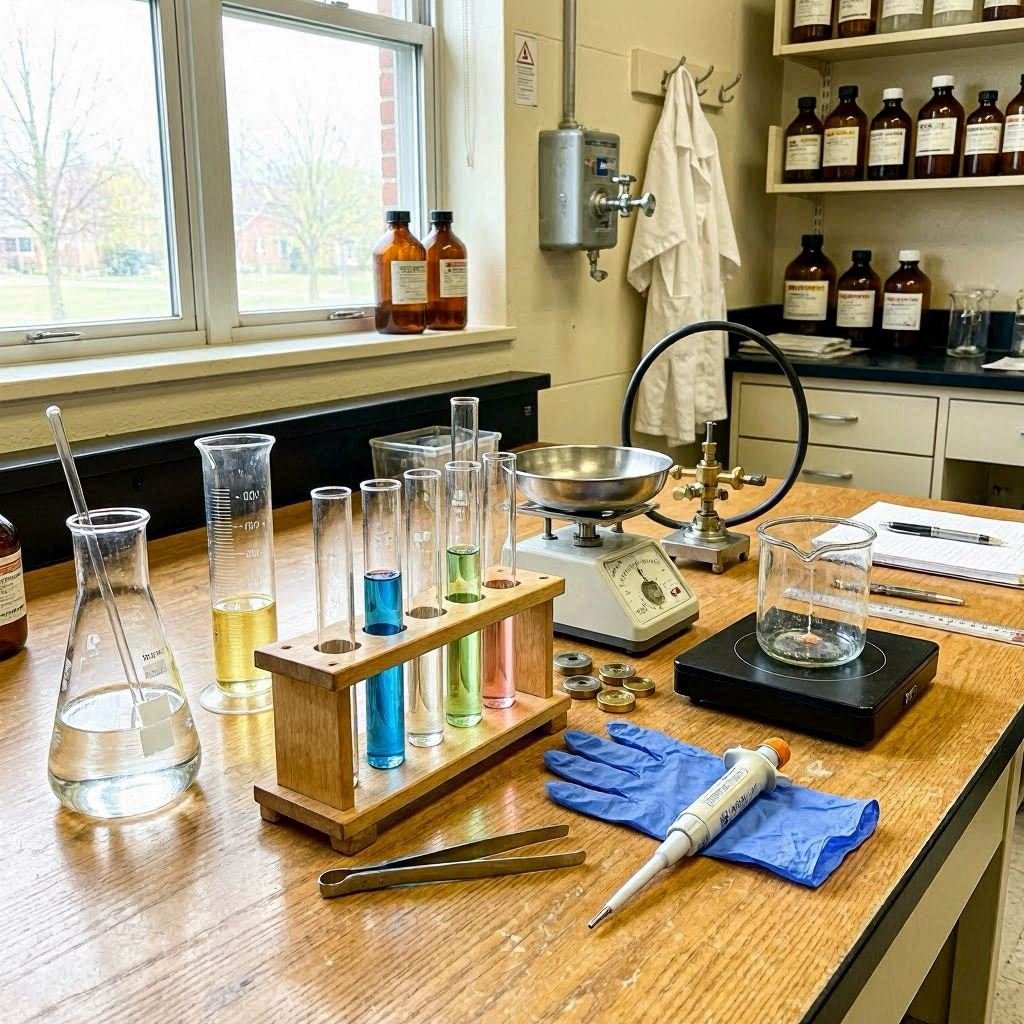
Science labs are made to enable the learner, researcher or scientist to observe, measure, test and analyse various materials and phenomena. Whether conducting a chemistry experiment, studying microorganisms in biology, or measuring physical properties in physics, laboratory equipment plays a crucial role in ensuring accuracy, safety, and efficiency. Laboratory tools serve particular functions and are used in a specific way; proper use of these tools is an essential part of scientific skills. Knowing common lab tools will help students to execute experiments properly, analyze the result in an exact manner and keep working safely.
One of the most crucial elements of laboratory education is the knowledge of common laboratory tools and their role in scientific investigations. Look at the equipment used by scientists; beakers, test tubes, pipettes, microscopes and Bunsen burners may sound like simple items, but each one of these is used for a specific purpose to help scientists collect information and experiment effectively. Knowing how to use them correctly and for their intended use decreases mistakes and risks. Students practice and become confident with laboratory equipment as they grow, and learn skills applicable to many science disciplines.
Laboratory equipment is essential for carrying out experiments and research
Scientists can use laboratory equipment to carry out tasks which might be difficult or impossible without it. Special instruments are needed for measuring exact quantities of liquids, heating materials to exact temperatures, viewing microscopic structures, and handling chemicals safely. If experiments in science were not accurate, consistent and reliable they would not be possible without the proper tools. One of the most essential rules of science is to be able to repeat observations and make measurements, which is one way that laboratory equipment helps meet this requirement.
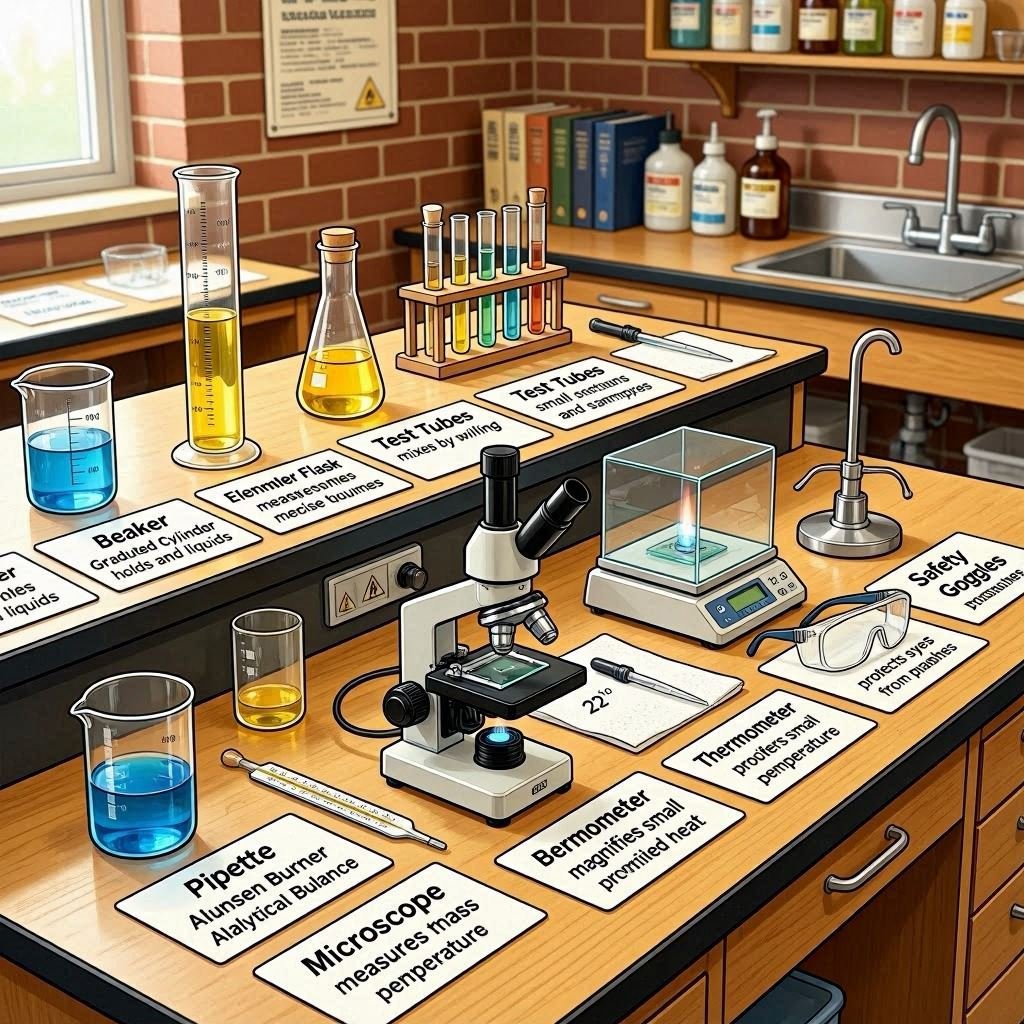
Laboratory equipment is not only more accurate, but it also makes things more safe. Numerous scientific procedures use chemicals, heat, glassware, or biological materials which require careful handling. Safeguards are provided to the user when the equipment is properly designed, but the experiments are carried out efficiently. Learning how and why to use laboratory equipment helps students appreciate scientific method and increases their ability to perform investigations responsibly.
A versatile laboratory container
Beakers are one of the most used laboratory equipment. Cylindrical glass or plastic containers are used to store, blend and warm liquids. There are different sizes of beakers so that scientists can use different amounts of materials. They are popular in a lab because they are easily filled, stirred and poured due to their wide openings.
Usually beakers have measurement marks but are used for rough measurements. Beakers are often used in the laboratory to prepare solutions, dissolve substances or to collect liquids during experiments. Laboratory beakers are made of durable material and can be used for moderate heat and general lab use. Students will come across beakers as early as in their science learning because they are versatile, easy to use and can be utilized in a number of experiments.
Sudden changes of temperature should be avoided in beakers as this may cause them to crack. Heat-resistant gloves or tongs, or other appropriate handling techniques, can be used when working with hot liquids.
Test Tubes: Miniature Reactions
Test Tubes are narrow cylindrical containers to hold, mix and heat a small amount of substance. Their small volume is suitable for chemical reactions which do not require large amount of material. The test tubes are typically made from heat-resistant glass, which can withstand moderate heating during experiments.
Test tubes are used by scientists to watch reactions, conduct initial testing and to compare samples. Test tubes allow for lower chemical usage and increase efficiency due to minimal amounts of chemicals used. A chemical reaction may result in a change in color, a formation of precipitate, or a formation of gas; the students perform a simple chemical reaction in their educational laboratory with a test tube to observe the changes.
The correct way to use a test tube is to hold it at an incline while heating it and to make sure that the open end of the test tube is not toward people around you. The precautions taken help to reduce risks of sudden boiling or splashing. The use of test tubes is a fundamental laboratory procedure that is a must learn for any lab beginner.
How to use pipettes to measure and transfer liquids
A pipette is a special type of tool which is used to transfer a small amount of liquid from one container to another with accuracy. In a scientific experiment, precision is of utmost importance and pipettes are used to guarantee uniform and reliable measurements. A variety of pipettes are used in laboratories, from the basic plastic dropper to more precise micropipettes that are capable of measuring very small amounts.
The main benefits of pipettes are that they increase the accuracy when handling liquids. Errors in measurement, no matter how small, can have a profound impact on experiments involving chemical reactions, biological samples or analytical procedures. Scientists use pipettes to dispense controlled amounts of liquids with minimum of contamination and waste.
Pipetting is a technique that students are frequently taught to develop in the learning laboratory to acquire consistency of hand and ability to measure accurately. To use a pipette properly, it must be the right size, liquid must be poured carefully to avoid catching air bubbles and the size must be appropriate. Proper pipetting skills can help ensure reliable results in the laboratory.
The Bunsen Burner is a Trustworthy Heat Source
The Bunsen burner is one of the most familiar pieces of lab equipment. It is a device that allows scientists to create a controlled flame, used to heat substances, sterilize equipment and perform experiments that require high temperatures. The burner works by combining fuel gas with air prior to combustion, to achieve an efficient and controllable flame.
Bunsen burners are especially useful for their ability to give a uniform heat. The intensity of the flame can be manipulated by the scientists as per the experimental needs. Bunsen burners are frequently used in chemistry laboratories for heating solutions, flame tests, and for a number of investigations of thermal phenomena.
Open flames are potential hazards and therefore it is important to have the correct safety precautions when using a Bunsen burner. Long hair should be kept back, flammable material should be moved away from the flame and equipment should be watched closely while heating. When learning about the safe operation of burners, it helps to prevent accidents and ensure productive lab experiences.
Microscopes: Exploring the Invisible World
A scientist uses a microscope to see things that are too small to see with his or her eyes alone. They play a key role in biology, medicine, microbiology and many other areas of science. Microscopes enlarge small objects and make them visible to see details of cells, tissues, microorganisms and materials that are not visible otherwise.
In a typical microscope there are lenses to magnify an image of a specimen. The light can travel through or bounce off the object and the observer can look into the details of the object. The student often studies plant cells, animal tissues, bacteria and other microscopic organisms through the use of a microscope. These observations will help to bring to light the concepts that are hard to understand in the books.
The ability to use a microscope requires knowledge of how to focus the instrument, change the light and prepare good slides. These are precision instruments and careful handling is required. The development of microscopy skills takes students to a new level in science observation and discovery.
Other common laboratory equipment:
In addition to the beakers, test tubes, pipettes and microscopes which are found in many laboratories, there are many other devices that help scientists perform investigations. Beakers are not as accurate to measure the volume of liquid as graduated cylinders. A flask is used for mixing, heating and storing solutions. Temperature is measured with thermometers and mass is measured with high precision balances. Test tube racks organize samples and forceps are used to safely handle small objects.
All equipment has a role in maintaining efficiency and accuracy in the lab. Scientists choose the tools they use to conduct experiments depending on the experiment’s needs and ensure that measurements and observations are made in a proper manner. Knowing the reason for the use of different tools makes students more at ease in the lab and conducting scientific procedures.
Proper use of equipment and safety in the laboratory
Laboratory equipment knowledge is closely related with laboratory safety. Simple tools can be dangerous when not used properly. Glassware can break, chemicals can react in ways they don’t expect, and heating devices can burn. Thus, students should always adhere to the instructions of the laboratory and follow the procedures of the equipment.
Safety equipment is an integral component of the operation of the lab. Wearing protective eyewear will prevent eyes from being splashed or getting debris in them; laboratory coats will keep clothes and skin clean and clear of chemicals. Gloves should be worn with an added level of protection when handling chemicals and biological materials. A clean work environment is another key factor in minimizing the risk of injury, and labels for materials help as well
Some good laboratory practices are checking equipment prior to use, reporting damaged equipment and cleaning equipment after experiments. These practices help to ensure safety and to prolong the life of laboratory equipment. Correct use of equipment demonstrates good professional practice within a scientific setting.
Scientific Skills: Laboratory Experience
Laboratory activities allow for application of scientific concepts in real world applications. While reading about science is valuable, doing experiments lets students get a first-hand look at scientific processes. Microscopes, beakers and pipettes make abstract concepts into something physical. Students learn and develop technical skills, critical thinking skills and confidence in scientific enquiry as they utilize laboratory tools appropriately.
Patience, attention to detail and problem solving are also learned in the laboratory. Experiments can go wrong, so students must learn to compare their observations with the expected results to modify their procedures when they go wrong. Knowing how to use laboratory equipment will aid this learning process for accurate measurement and reliable observations. As with any learning, students gain increased comfort in scientific investigation and are better prepared for higher levels of study.
Practical skills acquired in the laboratories are not confined to the science classes. These three abilities—precision, organization, and analysis—are beneficial in numerous school and work environments. The effective use of laboratory equipment aids in overall educational development and in gaining scientific literacy.
Conclusion
Laboratory apparatus is the backbone of scientific experiments, enabling scientists to investigate, analyze, observe, and measure the natural world. Each lab instrument is used for specific purposes to help scientists perform accurate and meaningful experiments, like a beaker, test tube, pipette, Bunsen burner and microscope. These instruments will perform a variety of tasks that the student will be able to understand and operate confidently and effectively in a laboratory setting.
Along with aiding in scientific research, laboratory equipment helps to ensure safety, accuracy, and consistency. Avoiding accidents and getting results requires proper handling techniques and responsible use. Students learn science skills from using laboratory equipment and procedures, which help them learn science and foster their curiosity about the world around them. Understanding the use of laboratory apparatus is essential for any scientific investigation, and is fundamental to learning about chemistry, biology, physics, or science in general.