Introduction
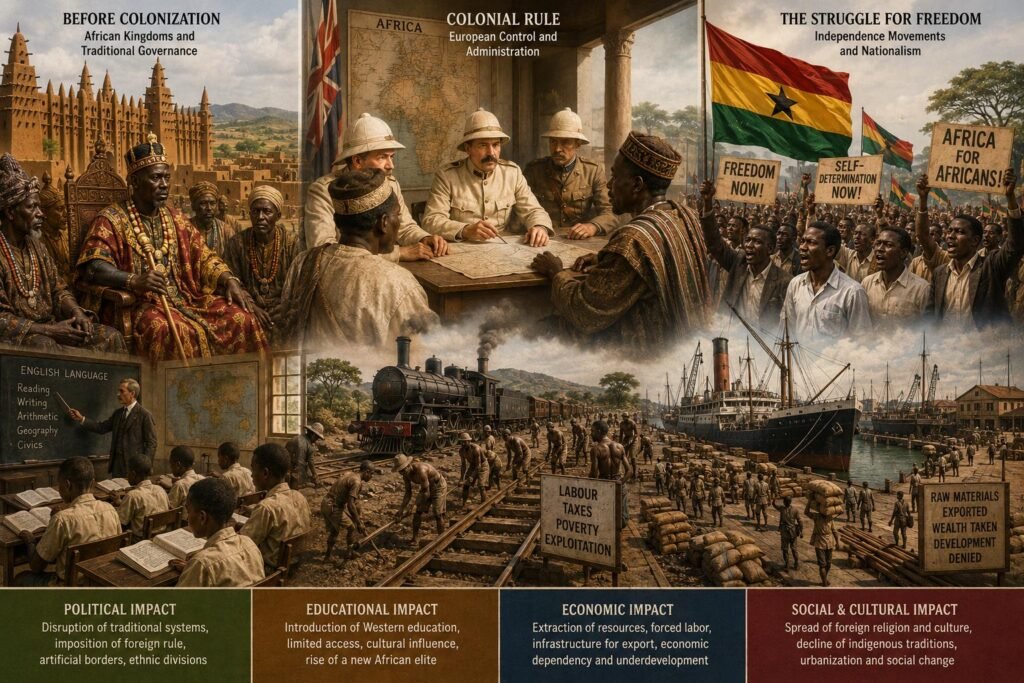
In the present time we cannot fully understand the political, economic, educational and cultural issues of Africa without looking at the colonial period. From the late 19th to mid-20th centuries European powers occupied and controlled large parts of the African land mass. Colonialism changed African societies in terms which we still see today in our politics, development, identity and international affairs. Also the borders of many African countries, the languages in administration, and even the structure of many economies were very much a product of the colonial rule. Through this we see How Colonialism Shaped African History and Modern Nations
It is important to study the historical bases of modern African states which in turn is to explain the issues that African countries face today. Colonization brought about large scale political and social changes which also saw the introduction of the Western education systems change in traditional leadership structures, and development of economy for the benefit of Europe. Although colonial powers did develop some infrastructures and administrative frameworks which at the time may have been progressive, in the long term these resulted in economic dependence, cultural disruption, political instability, and social inequality.
This article looks at the role of colonialism in shaping African history and modern day nations through its impact on political structures, economic systems, education, and cultural identity. Also we see the results of colonization which still we live today and the ways in which African societies are still putting forth responses to that history.
Colonialism’s Coming to Africa.
Before the age of colonization Africa was home to great kingdoms, empires, and societies which had developed advanced systems of government, trade, religion, and culture. Empires like that of Mali, Songhai, Benin, Oyo, Ethiopia, and Great Zimbabwe showed political and economic skill. African communities were also involved in regional and international trade which grew intensively before European colonization.
During the second half of the 19th Century European countries which included Britain, France, Portugal, Belgium, Germany, and Italy began to compete for African territories that which came to be known as the “Scramble for Africa”. At the Berlin Conference of 1884-1885 Europe formalized their claims to African territories without regard for African leaders or communities and this is how colonialism shaped African history and modern nations.
Economic Use and Political Control.
Colonialism and African Governance
One of the great results of colonization was the reorganization of African political systems. European powers put in place central administrative structures which for the most part left out traditional systems of leadership and governance.
Destruction of Traditional Political Systems
Before colonization many African societies had their own systems of government which included kings, elder councils, clan structures and community leaders. Colonization saw to it that these systems were weakened or done away with in favor of European models of authority. In some areas traditional leaders were completely done away with by the colonizers, in others they used a system of indirect rule which had the chiefs under control.
For instance the British used to put in place indirect rule which in turn was seen in parts of Nigeria and Uganda where they got traditional rulers to run things but under colonial control. The French on the other hand went for direct rule which they imposed they put their laws, language and administrative systems into African countries fully.
These colonial systems which broke down preexisting political structures and which weakened indigenous authority also saw many African leaders lose their autonomy which in turn made them proxies for colonial governments instead of advocates for local issues.
Artificial Borders and Ethnic Divisions
European powers drew up borders which paid no attention to ethnic, cultural or linguistic issues. What had been one community was put in different colonies and also the same territories which included rival ethnic groups were forced to live together.
These artificial boundaries which were drawn up later became the boundaries of independent African states. In many cases ethnic tensions and political conflicts arose from the fact that colonial powers paid no attention to historical relationships between groups. Also it is to be noted that a number of present day African conflicts have their roots in the colonial approach to territory.
Foundations of Modern African Governments
During the time of colonialism which brought many issues to the fore we also saw development of certain elements of what today we recognize as modern state institutions. Many African states adopted parliamentary systems, civil services, judicial frameworks, and military organizations from their colonizers.
English, French and Portuguese which in many states became official languages thus facilitated communication between different ethnic groups. At the same time these systems which did not usually have as their base the promotion of democracy or equal development instead served colonial powers. After independence many African countries had issues with weak institutions, authoritarian leaders, corruption, and political instability.
Economic Effects of Colonialism
Colonial powers greatly transformed African economies. They restructured production and trade to supply raw materials for their own industries.
Exploitation of Natural Resources
Colonial powers were the main players in the extraction of valuable resources which included gold, diamonds, rubber, cocoa, cotton, copper, and oil. What we see is that African colonies served as a source of raw materials and at the same time European countries took over manufacturing and international trade.
This system saw the development of strong industrial economies in Africa stifled instead we had forced the colonies into the role of primary resource providers rather which is to say that they were to produce at a very basic level which was also the stage at which they left out of colonial rule; post-independence what we see is these economies still very much in the primary products export business.
Forced Labor and Taxation
Many colonial powers put in place forced labor practices which saw the building of roads, railways, mines, and plantations. In many cases Africans had no choice but to work in very poor health and very low or no paid which they did out of necessity.
Colonial powers also put in place taxes which forced Africans into the cash economy. People had to work in European farms or in colonial industries to pay out what was required for tax. This broke down traditional agricultural practices and local economies.
Infrastructure Development
Colonial powers developed rail networks, roadways, ports, and telecommunication which mostly served to export raw materials to European consumers. While that infrastructure has since grown to support many of today’s African states’ needs it was at the time not intended as a base for comprehensive development of the colonies.
Railway networks in Africa went from connecting mines to ports which in turn did not support the development of African communities. What we see today is that economic growth was focused in terms of what was beneficial to the colonizers’ trade which in turn has left us with very uneven development in many of our present day countries.
Economic Dependency
Colonial economic policies put in place structures which caused a great dependence on foreign trade and investment. Today many African countries which inherited this system still see themselves as mainly producers of raw materials and importers of manufactured goods.
This issue has played a role in unemployment, debt, and also in terms of vulnerability to global commodity price fluctuations. Also we see that although diverse economies are being pursued in Africa we still have issues which are a result of the colonial economic structure.
Colonialism and Education in Africa
Colonialism saw also to great changes in the field of education. Missionary and colonial governments brought in Western style school systems to many parts of Africa.
Introduction of Western Education
Colonial education was for the most part in the European languages, religions, and values. Also schools’ aim was to produce clerks, interpreters, teachers, and low level administrators that would support the colonial governments. In many areas missionary schools introduced literacy and put out the first generation of formally educated Africans which in turn produced the elite that led independence movements.
Limited Educational Opportunities
During the colonial period although basic education was introduced African access to it was very limited. Also higher education was not encouraged which meant most Africans did not have a chance for advanced study. Also in that time frame which I’m referring to there was a large gap between what was put forth as the policy of education for all and what was actually achieved. There were few secondary and tertiary institutions that were in fact open to the native population.
During the colonial period which saw the focus on blind obedience and manual labor as opposed to critical thinking and innovation many African nations upon attaining independence found themselves with a deficit in skilled professionals.
Language and Cultural Influence
In the European tradition of English, French and Portuguese as primary languages we see that which has played out in many African countries which today still use these as official languages. During the colonial era we saw the introduction of a globalized education which at the same time saw the decline of indigenous languages and traditional knowledge systems. Many African students studied European history and culture in great detail as compared to that of their own.
Education and Nationalism
Ironically colonial education also gave fuel to that which would later do away with colonial rule. Out of that system came African professionals who in turn asked for a piece of the pie political rights, equality, complete independence. Also it was through education and political awareness that leaders like Kwame Nkrumah, Jomo Kenyatta, Nnamdi Azikiwe, and Julius Nyerere did which they did to form national liberation movements across Africa.
Cultural and Social Impacts of Colonialism
Colonial rule had a great impact on African cultural identity and social structures.
Spread of Christianity and Western Culture
Missionary work brought about the introduction of Christianity in many African societies. During the colonial rule churches, schools, and mission stations played key roles. Christianity which in turn spread greatly throughout Africa and to this day is one of the primary religions of the continent. Also European fashion, architecture which they introduced, legal systems and culture had an impact on African societies.
Decline of Indigenous Cultures
Many colonial powers put an end to or put down African traditions, religions and languages. We also saw them label indigenous practices as that of uncivilized and backward. This resulted in the loss of cultural heritage in some communities. What we see is that traditional belief systems, artistic expressions, and local governance practices broke down under colonial influence.
Urbanization and Social Change
Colonial economies saw large scale migration into urban centers which had the industries, mines, and administrative offices. Urban areas grew fast which in turn produced new social classes and changed family structures. Urbanization brought Africans into contact with new political thoughts and also played a role in overpopulation, unemployment, and social inequality in many colonial cities.
Historical Foundations of Modern African States
The modern African state is a product of the colonial past. While most African countries achieved independence in the 1950s and 1960s they did not wake up one morning to find the colonial structure gone.
Political Legacies
Many African governments took over what was a centralized system of power from the colonial rule. In some countries post-independence leaders took an authoritarian approach which was very much like that of the colonial administrations. Military interventions, political turmoil, and issues of national identity in part a result of colonial administrative structures and drawn boundaries.
Economic Challenges
Colonial economies which gave out raw materials to the West almost exclusively at the expense of manufactured goods’ production left many African countries in a weak industrial base. Post-independence saw little growth in industry and large scale continued resource exploitation for the benefit of former colonial powers. Today we see many African governments which are at work in different areas of development, in local industry growth, and out of the gate of too much foreign market dependency.
Cultural Identity and Language
Colonial languages still play a large role in administration, education, and international diplomacy. At the same which many African countries are pushing their indigenous languages and cultural traditions to foster national identity. African in literature, music, art and film we see more of colonial history, identity and resistance.
Pan-Africanism and Unity
The experience of colonialism which gave rise to Pan-Africanism, a movement that put forward unity and cooperation among Africans. African leaders identified the value in solidary against colonial rule and racism. Organizations like the African Union are still at work at promoting political and economic cooperation within the continent.
Positive and Negative Legacies of Colonialism
The legacy of colonialism in Africa is a mixed bag. While some see it as a period which brought in modern infrastructure, formal education and administrative systems others report on the violence, exploitation and inequality which characterized the rule.
Positive Legacies Often Mentioned
- Introduction of formal education systems
- Development of transport infrastructure and ports.
- Establishment of centralized governments
- Expansion of global trade connections
- Dissemination of modern medicine and healthcare practices.
Negative Legacies
- Economic exploitation and dependency
- Artificial borders and ethnic conflict
- Loss of culture and tradition.
- Political instability and weak institutions
- Social inequality and underdevelopment
- Exploitation of labor and resources
Most of what historians report is that colonization was for the most part a project which benefited European powers at the expense of African development. While some of the infrastructure and institutions which we see today still exist, they were for the large part put in place to support colonial rule and resource extraction.
African Resistance and Independence Movements
Africans resisted colonial rule. During the colonial time we saw many cultures rise up against foreign rule through protest, rebellion, intellectual movement, and political action. Nationalist leaders formed independence movements that called for self-rule and equality. In time Ghana, Nigeria, Kenya, Algeria, and Tanzania achieved freedom after very long struggles. These actions brought back political independence to Africa and inspired anti-colonial struggles worldwide and also how colonialism shaped African history and modern nations.
Conclusion
Colonial powers greatly influenced the course of African history and the formation of present day African states. European rule in that time restructured government, economy, education and culture across the continent. Also many of the political and economic issues we see in Africa today are a result of colonial era policies and decisions.
At the same time, Africa saw its states resist colonization and fight for independence. Post-independence Africa then focused on building political institutions, promoting economic stability, and reasserting cultural value.
Through study of the past which shaped present day African states we see how colonialism shaped African history and modern nations . Colonization left in place structures which we still see play out in political, economic, educational, and social issues. By looking at this history we see how Africa has grown and struggled which in turn gives us a better picture of the continent’s progress towards development and independence.
Get more well researched information about How Colonialism Shaped African History and Modern Nations here.