Introduction
Africa is a home to what is perhaps the oldest and most diverse human civilization in the world. Before European colonization which took place much later, African societies had very well established systems of government, trade, religion, education and culture. They were very organized and had developed in ways which reflected their environment, tradition and value. From large scale kingdoms and empires to small village based communities and chiefdoms African people put in place systems which maintained order, promoted economic growth and preserved social harmony.
In the past Africa had a very advanced history which we often do not see. In fact African societies before colonial rule were very civilized, they had strong political structures, very successful economies and also complex cultural traditions that many generations looked to.
Understanding Traditional African Societies
In different regions and among various cultures and population sizes traditional African societies were organized very differently. In some cases we see large centralized kingdoms which were ruled by kings or emperors, at other times what we had was a more decentralized government which was the domain of councils of elders or clan systems. Although they were diverse in their structure these societies did share in common such things as respect for elders, communal living, family loyalty, and spiritual beliefs.
African societies prior to colonization in large part fell into three main categories:
- Kingdoms and empires
- Chiefdoms
- Stateless or community-based societies
Each of these systems played a large role in the formation of African civilization.
Political Organization in Pre-Colonial Africa
Kingdoms and Empires
In many African areas large scale kingdoms and empires formed which had complex government systems, armies, taxation and law. These political entities in turn enabled rulers to run large territories and to promote peace and stability.
In the past the Mali Empire in the West African region stood out. It grew rich from trade in gold and salt and at the same time had great leaders like Mansa Musa. Also the Mali Empire had a structured government which saw to the appointment of governors for different provinces and in that way maintained order within the empire.
Another great empire was that of Songhai which put in place very advanced administrative and military structures. Rulers there had ministers which they used for finance, justice, agriculture, and trade issues. This is to say that some African societies had very organized systems of government before European influence.
In East Africa there were kingdoms like Buganda which developed strong monarchical systems. The King in Buganda was called the Kabak which ran the state with the help of chiefs and advisors who in turn ran different regions and made sure in total loyalty to the king. In Southern Africa large scale states like Great Zimbabwe also flourished. This kingdom is known for its stone work and extensive trade networks.
Chiefdoms
Chiefdoms were small scale political entities which were usually run by chiefs. In many parts of Africa which at the time had small or not very centralized populations these systems were very common. Chiefs in many instances passed down their leadership roles through royal families or clan systems.
The chief was a political leader, judge, military organizer, and spiritual representative. Chiefs charged with that of keeping the peace, settling disputes, distribution of land, and organization of community labor.
In many cultures chiefs did not rule as individuals. Elders’ councils, of titled men or clan leaders put in place to advise them and which in turn put chief’s power into check did so. This also brought about a culture of consultation and group decision making.
The Ashanti Kingdom which is what we now know as Ghana had a mixed system of kingship and chiefdom. The Asantehene, the king, had very close ties with regional chiefs who ran local areas but still fell under the central kingdom’s authority.
Stateless Societies and Community Governance
In not all African societies kings or centralized governments were present. Some communities had systems which were decentralized in which authority was shared between elders, family heads, or age grade associations.
In present day Nigeria which is home to the Igbo people political organization was through village assemblies and councils of elders. Decisions put forth were in most cases a result of great discussion and public input. This form of government fostered equality and community participation.
Stateless groups looked to customs and traditions for authority which in turn supported social rules. In these societies which did not have central authority what held things together was the value members placed on peace and strong interpersonal relationships.
Age based groups had a large role in governance. Individuals were put into age groups which they served in which included farming, security, sanitation, or conflict resolution. This helped communities to function well without the need for kings or armies.
Economic Systems in Traditional African Societies
Agriculture as the Foundation of Society
Agrarian based economies supported the majority in Africa pre colonization. We see that which crop was grown depended on the weather and land available. Farmers applied traditional practices for the betterment of soil fertility and saw also to improve food production. In many communities land was held in common instead of private ownership. Families got their land from the clans or community leaders which they in turn used for farming and settlement.
Livestock was also a key component which in fact played out in East and in Southern Africa. In that region the Maasai and others used cattle as an indicator of wealth. We also see that animals provided milk, meat, skins and social status. Agricultural output fueled trade, population growth, and political stability in many African societies.
Trade and Commerce
Trade was a great force which tied African societies together before the arrival of Europeans. Africans developed extensive trade networks which covered local and international trade. West Africa, North Africa and the Mediterranean were connected by the trans-Saharan trade routes. Gold, salt, ivory, leather, textiles, and kola nuts were traded between these regions. Out of this trade grew major commercial and educational centers like Timbuktu.
In the past East African coastal cities like Kilwa and Mombasa had trade relations with Arab, Persian, Indian, and Chinese merchants through the Indian Ocean trade network. Spices, cloth, beads, ivory, and gold were among the traded goods. Markets were very organized and at times supervised by local authorities. In many communities women played key roles in market activity and ran the major local trade. Trade also facilitated cultural exchange, urban growth, and economic prosperity across the continent.
Craftsmanship and Specialized Labor
African societies developed complex abilities in blacksmithing, weaving, pottery, carving, leatherwork and metalworking. We have that in skilled craftsmen which created tools, weapons, jewelry and household items that supported daily life and trade.
Black in many cultures blacksmiths were looked up to which they did for producing the tools for farm and the weapons for defense out of which some groups saw also that craft pass down through the generations and certain families became specialized in particular trades. Art and craft production in Africa was a reflection of the cultural and spiritual beliefs of their societies. Sculptures, masks, and decorative pieces often had religious or symbolic meaning.
Social Structure and Community Life
Family and Kinship Systems
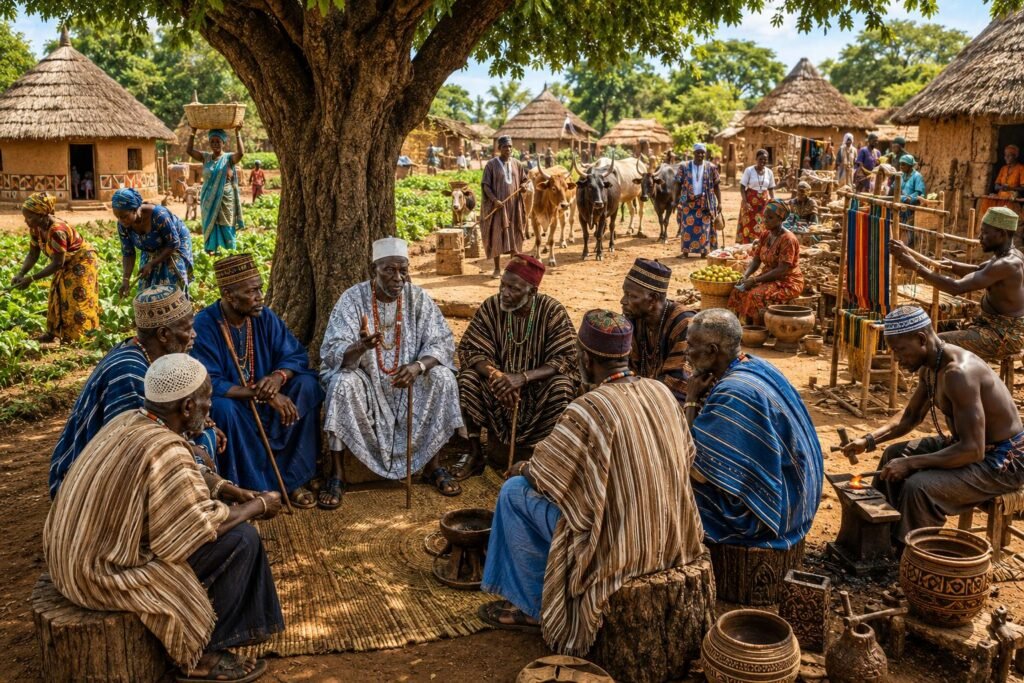
In most African communities family was the core unit of social organization. Extended families lived together and supported each other economically and emotionally. Relatives shared in responsibilities which included farming, child care, and care for the elderly.
Kinship structures which in turn determined inheritance of property, marriage practices and leadership. In some societies descent was patrilineal which means it went through the father’s line, while in others it was matrilineal which saw inheritance pass through the mother’s side.
Marriage was a key social institution which brought families together and strengthened the community. Bride price in the form of livestock or goods was paid as a token of appreciation and commitment by one family to another. Children were very much at the core of family and community.
The Role of Elders
In African communities elders held great respect which they did for being sources of wisdom, experience, and moral guidance. They resolved disputes, gave advice to leaders, and passed down culture via storytelling and oral history.
Elders had authority which they used to maintain social order and pass traditions from one generation to the next. Young people were to show respect and submit to the older members of the community. Elders had large roles in religious ceremonies and community rituals.
Education and Knowledge Transmission
African traditional education was geared up for the growth into responsible adulthood. Information was handed down through oral traditions, observation, storytelling, songs and apprenticeship. Children were taught practical skills which included farming, hunting, cooking, weaving, and trading at the hands of the senior members of the family. Also they were inducted into moral values like honesty, courage, discipline, and respect.
In some cultures initiation rituals marked the passage from childhood to adulthood. Which included instruction in social responsibility, cultural identity and community expectations. In large cities such as Timbuktu centers of study which included the fields of religion, math, astronomy, medicine and literature.
Religion and Spiritual Beliefs
In traditional African societies religion was very much a central element. Most groups recognized a supreme creator as well as spirits, ancestors and other supernatural entities. People thought that which ancestors were alive and they honored them through prayer, ritual, and sacrifice. Ancestor worship also promoted family unity and respect for tradition.
Traditional religion was very much part of natural and everyday life and of moral issues. Priests, diviners and spiritual leaders played a role in health, justice, and protective matters for their communities. Religious festivals and at worship times what we see is community coming together and identity being formed. Music, dance, and art played a large role in these.
Although for a time Christianity and Islam did see great success in Africa they at the same time which traditional beliefs and practices did not die out and in fact continued to play a large role in African culture.
Cultural Practices and Traditions
Oral Tradition and Storytelling
Before the development of wide scale writing systems, African societies used oral tradition as a means of passing down their history. Griots and story tellers would memorize accounts of historical events, family trees, legends, and cultural values.
Story in the past was a vehicle for the older which we used to pass on to the young also at the same time bringing fun to the community. Proverbs and folktales were our method of instilling wisdom, discipline and social responsibility. In present times oral tradition is very much a part of African culture.
Music, Dance, and Festivals
Music was an integral part of social life in Africa. In which we found depictions of music at weddings, funerals, harvest time, in religious practices, and at political functions. Traditional instruments like drums, flutes, and stringed instruments which played out community identity and cultural pride. Festivals brought people together to mark achievements, pay tribute to ancestors, and to strengthen social bonds.
Art and Architecture
African cultures also put forth amazing works of art and architecture. At Great Zimbabwe we see their stone work, in ancient Egypt their pyramids, and in Mali their mud mosques which display the continent’s architectural genius.
Art works in the form of masks, sculptures, paintings, and textiles often portrayed spiritual beliefs, political authority, and cultural identity. African art played also a religious, educational and political role in addition to its decorative aspect.
Conflict Resolution and Justice Systems
In traditional African communities we see that they developed systems of maintenance of law and order. Disputes which arose were generally resolved through the mediation of elders, chiefs, or community councils.
Justice was more into restoration of harmony than handing out severe punishments. We saw compensation, reconciliation, and public apology as common methods of conflict resolution. Custom in which these practices were rooted out and which promoted fairness in communities played a large role. Our laws which have been handed down through many generations also shaped behavior. Serious offenses like murder or betrayal may see the punisher exiled or put to severe penalty which in turn may break community stability.
Women in Traditional African Societies
Women took on key roles in African political, economic, and social life. In many tribes women were very much a part of farming, trading and craft production. Some women were also of great political importance. Queen mothers, female chiefs, and royal women which had great influence advised and at time ruled over territories.
In many of the West African societies women ran local markets which also saw large scale economic growth. Across cultures while gender roles may have varied women were present at the core of family stability and community survival.
Colonial Legacy’s Role in Traditional Structures
European colonization brought change to many African political and social structures. Colonizers took over from native rulers, reorganized land use and introduced new laws and economic systems. Many in Africa saw their institutions break down under colonial rule, at the same time however some adapted and survived. Although we had great disruption traditional institutions and culture still play a role in today’s Africa. Today what is seen is a greater recognition by historians and scholars of the complexity and achievements of pre-colonial African civilizations.
Africa’s Rich Pre-Colonial History
In the past we see that which pre-dates European colonization in Africa to be very important as it presents a picture of the great complexity, creativity and resilience of African societies. Before the arrival of Europeans, African communities had put in place advanced forms of government, dynamic economic systems, educational institutions and cultural practices which in turn shaped what life was like for people all over the continent for many years.
Before colonization Africa was not a place of no civilization or progress. Instead it was home to many kingdoms, chiefdoms, trade centers, scholars, artisans and dynamic communities which in turn made great contributions to world history. Studying of these societies in turn helps modern readers to see Africa’s past in a different light and to also look beyond old stereotypes.
Conclusion
African pre-colonial societies were complex and diverse. From large empires and kingdoms to loose village networks, African communities put in place political structures which in turn brought about stability and development.
Economic activity in agriculture, trade and craftsmanship which in turn supported great societies, also we see that family structure, religion, education and culture tied communities together. In terms of governance there was input from the people, respect for senior members of the community and very much a participatory approach.
Pre-colonial Africa saw great achievements which in turn present the depth of the continent’s history and culture. In looking at these societies we see that Africa’s role in human civilization is great and also the lasting value of its traditions and institutions.
Get more well researched information about African Traditional Societies Before Colonial Rule here.