Introduction
Ancient Egypt was a very captivating civilization in history. Known for their pyramids, great rulers, advanced science, and unique culture which influenced many other societies in Africa, the Middle East and Europe. For thousands of years the civilization prospers along the Nile River which gave them a stable and organized state known for its architectural, scientific, religious and written achievements.
Comprehending ancient Egyptian society is to see how early civilizations put in place the foundations of government, education, religion, and trade which in turn shaped the modern world. The ancient Egyptians did more than just build monuments; they were also thinkers, inventors, farmers, artists and scholars which today still we see the results of their ideas.
The Geography of Ancient Egypt
In the northeast of Africa Ancient Egypt developed which is along the Nile River. The Nile was at the center of Egyptian life as it provided for their water, food, transport, and trade needs. Each year the river would flood the nearby areas and leave very fertile soil which in turn produced successful crops.
In that which greater part of Egypt was desert, the Nile was a lifeline for its people. Also it is told by historians that Egypt is the “gift of the Nile” for had the river not been there the civilization would not have survived.
Desert which is a feature of Egypt’s geography protected it from invasions. For the most part deserts surrounded the kingdom which in turn made it hard for enemies to attack. Thus this natural protection enabled Egypt to have long stable periods.
The Structure of Ancient Egyptian Society
In many ways what made ancient Egyptian society interesting was its defined social structure. The social order in Egypt at that time was pyramid shaped which saw various groups occupy different rungs in the class ladder.
The Pharaoh
At the head of the social structure was the Pharaoh who ruled over Egypt. Egyptians thought of the Pharaoh as a king which also was a god chosen by the gods. The Pharaoh ran the government, military, organized religious ceremonies, and made laws.
Pharaohs were very much looked up to as they were thought to maintain balance and order in society. Notable pharaohs like Tutankhamun, Ramses II, and Cleopatra stood out for their leadership and influence.
Nobles and Priests
Below Pharaoh were the nobles and the priests. Nobles aided in running the kingdom, collecting taxes, and supervising workers. Priests ran the religious ceremonies and managed temple affairs.
In Egypt religion was a large part of daily life which in turn gave great power to the priests. Also temples which were very much at the heart of the community held onto land, wealth, and resources therefore the religious leaders became very influential.
Scribes
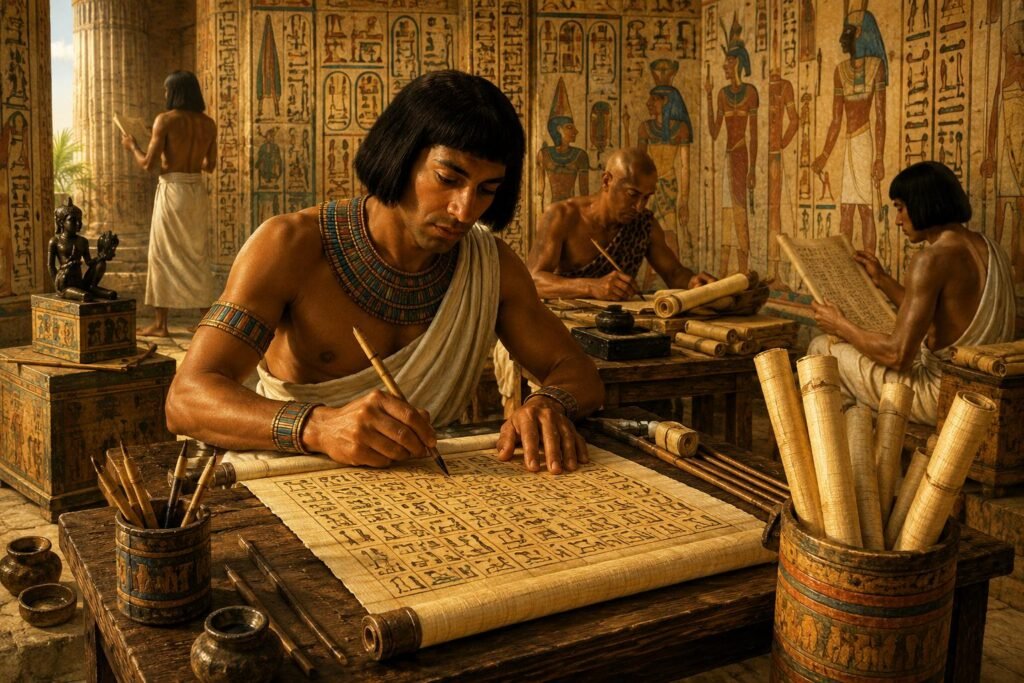
Scribes were the educated class that learned to read and write. In most cases Egyptians did not have those skills so scribes took on important roles which included recording of tax information, writing up official documents, and preserving accounts of historical events.
Becoming a scribe was a valued career which put education at the forefront of social mobility.
Soldiers
Soldier protected Egypt against foreign invaders and also played a key role in the expansion of the kingdom through military campaigns. At the same time it was at times very much in the interest of Egypt to have strong armies which determined our control over adjacent territories.
Farmers and Laborers
Farmers made up the greatest element of the population. They tilled the soil which in turn produced crops of wheat, barley, vegetables, and flax. Their work supported the entire kingdom through the food and materials they provided.
Labor which was performed by laborers and craftsmen was very much a part of the construction of temples, monuments, tools and household items.
Slaves
At the base of society stood slaves which at the time were often prisoners had captured in war. Slaves did hard labor and domestic work. But what did differ in Egypt’s slave system from that which came later was that some slaves could own property or earn their freedom.
Religion in Ancient Egypt
Religion was at the core of what the ancient Egyptians did. They worshiped many deities who controlled aspects of nature, life, death and the universe.
Major Egyptian Gods
Some important gods included:
- Ra- the sun god
- Osiris- god of the afterlife.
- Isis-which the goddess of motherhood and magic.
- Horus-deity of kings and the sky.
- Anubis-god of mummification and the dead.
Egyptians looked to these gods to influence a daily affair which is why they prayed, made offerings of sacrifice, and held festivals in their honor.
Belief in the Afterlife
In Egypt it was a strong belief in life after death. At death the soul went to another world. To prepare for this journey the bodies were preserved through mummification.
The process of mummification included the removal of internal organs, drying the body out, and wrapping it in linen. Rich Egyptians buried with treasures, food, jewelry and tools which they thought to use in the afterlife.
The Book of the Dead
The Book of the Dead was a set of prayers and instructions which saw to it that the dead made the journey into the afterlife smoothly. Also these writings were put in the graves with the dead.
Egyptian Pyramids and Architecture
In the ancient world Egypt was known for its great architecture. The Egyptians put up incredible structures which many still see today.
The Pyramids
Pyramids were large tombs for pharaohs. At Giza near Cairo we see the most famous of them. Also they display the Egyptian’s engineering talent and religious practices.
The Great Pyramid of Giza which was built for Pharaoh Khufu is a giant of the ancient world. What we see today is a result of large work forces, detailed planning, and in depth math knowledge.
Temples
Temples were a central place for worship and community events, they also served as a stage for huge stone columns, carvings and statues. Priests performed religious ceremonies in those sacred spaces.
Many temples included vivid art of gods, rulers, battles, and daily life.
Obelisks and Statues
Egyptians also produced obelisks which are tall stone structures with inscriptions that praise rulers and gods. Also large statues of pharaohs were made to symbolize power and authority.
The Great Sphinx, which has the body of lion and head of man, is also a mystery in Egypt.
Writing Systems and Hieroglyphics
The ancient Egyptians developed what is perhaps the first writing system which we know of. This system used symbols and images to represent sounds, words, and ideas.
Hieroglyphs were carved into temple walls, monuments, and papyrus scrolls. It took years of study for scribes to master these symbols.
Papyrus: Egypt’s August paper.
Egyptians developed papyrus out of reeds which grew by the Nile. Papyrus served to easily record and transport information across the kingdom.
This innovation saw growth in terms of communication, record keeping, trade, and education.
The Rosetta Stone
For long time which saw many a scholar at work, the mystery of hieroglyphics was unsolved. Then came the Rosetta Stone which broke the code as it presented the same text in different languages.
The Rosetta Stone brought to light for historians to study in detail the Egyptian culture, politics and religion.
Science and Technological Achievements
Ancient Egyptians did very well in the fields of science, medicine, engineering, and math.
Mathematics
Egyptians applied math to agriculture, construction, and trade. They had a grasp of geometry and measurement which in turn they used to build pyramids and temples with great accuracy.
Mathematics also played a role in that which officials used to determine tax and manage resources.
Astronomy
Egyptians closely looked to the stars and the sky. They noted what they saw which in turn they used to develop calendars which predicted the flooding of the Nile.
The Egyptian calendar of that time had 365 days which is the same as our present calendar.
Medicine
Egyptian physicians used herbs, performed surgeries, and reported on medical issues in their texts. They also recorded illnesses and the remedies for them.
Though some medical practices were of a religious and magical nature the Egyptians also put forth practical treatments for injuries and diseases.
Engineering
The Egyptians developed advanced engineering for the building of pyramids, canals, temples and monuments. They used ramps, tools, and organized labor to move heavy stones and finish large scale projects.
Their engineering skills are still very much a study.
Daily Life in Ancient Egypt
Daily life was different by social class, but family and community had a central role within that.
Clothing
In most parts of Egypt people went barefoot in light linen clothes due to the hot climate. The rich also wore jewelry and used make up and better quality fabrics.
Food
Common in diet were bread, fish, vegetables, dates, and beer. The Nile supplied fish and fertile land for farming.
Homes
Poor families dwelled in mud brick homes, at the same time the wealthy lived in large homes which had servants and gardens.
Entertainment
In Ancient Egypt people enjoyed music, dancing, storytelling, sports, and board games. Also they came together for festivals and religious celebrations.
Women in Ancient Egypt
In comparison to many ancient cultures women in Egypt had very strong legal rights. They could own property, inherit wealth, run businesses, and also get divorced.
Some women rose to become rulers which included Cleopatra and Hatshepsut. These queens showed that women play a role in politics and leadership in Egyptian society.
Still men dominated in terms of political and military power.
Trade and Economy
Trade was a key to Egypt’s success. Egyptians traded in gold, papyrus, grain, linen, and jewelry with neighboring regions.
The Nile was a major trade route which saw great movement of goods across the kingdom.
Trade also introduced Egypt to foreign concepts, resources which in turn strengthened their economy.
Egyptian Art and Culture
Egyptian art is very symbolic which also included religious themes and that of rulers and common life. Also they had to follow strict art rules.
Artists painted in bold colors and decorated tombs, temples and statues.
In Egypt music and literature saw great development. Stories, poems, and songs which became a part of our heritage were passed down through the generations which in turn reflected Egyptian beliefs and traditions.
The Decline of Ancient Egypt
Although for a long time Egypt was a powerful entity this all changed as the civilization broke down from invasions, political strife and economic issues.
Foreign powers such as the Assyrians, Persians, Greeks, and Romans at various times conquered Egypt. In the end Egypt became a part of the Roman Empire.
Although it had declined Egyptian culture continued to influence other civilizations after the fall of the ancient kingdom.
The Lasting Legacy of Ancient Egypt
Ancient Egypt’s legacy is present in today’s world. In architecture, science, religion and writing we see the impact of Egyptian contributions.
The pyramids are still icons of human creativity and determination. Also the Egyptians’ thoughts and work in the fields of medicine, engineering, math, and government shaped what we see in later civilizations.
Today archaeologists and we see to it that the study of ancient Egypt is an ongoing process which includes research into its people and achievements. Also worldwide there are museums that exhibit Egyptian art which in turn helps in the preservation of this great civilization’s story.
Conclusion
In the history of human civilization Ancient Egypt was a great one. It had a well-organized government, followed rich religious practices which had great influence, made key scientific discoveries, produced excellent art and also left amazing architectural achievements which shaped the ancient world.
Through study of ancient Egypt we see how early humans formed complex social structures and developed advanced knowledge systems. The Egyptians showed great creativity, intelligence and resilience which still we look to today.
From great pyramids to the invention of writing and medicine, ancient Egypt’s left its mark in many areas of what we see today in modern culture. Their story also puts into perspective how which human beings are able to innovate, organize ourselves, and leave a strong cultural legacy.
Get more well researched information about Ancient Egypt here.