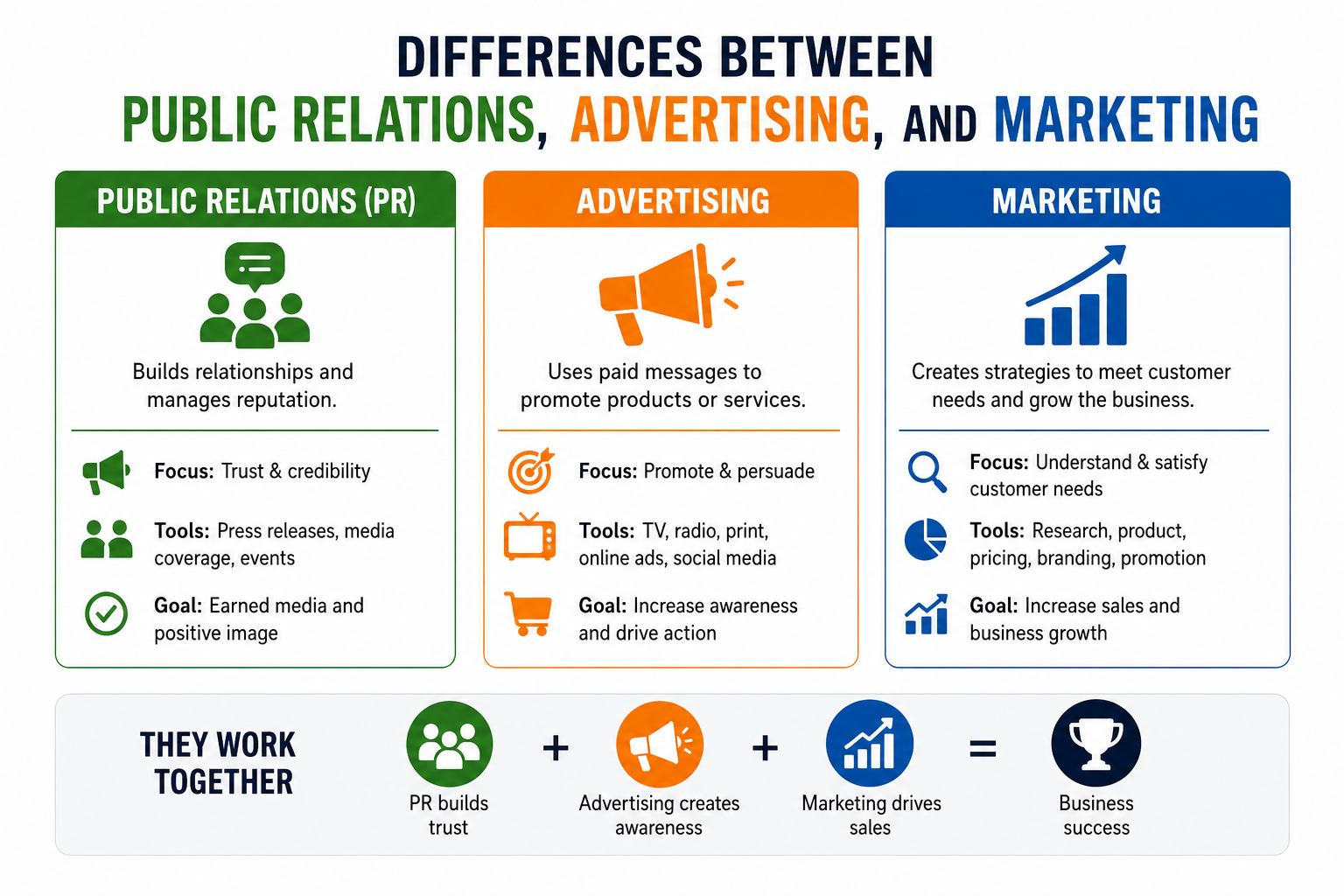
With the competitive business world in today’s time, it is pertinent to communicate strategically to create trust, attract customers, and foster a strong company branding. But many people have got mixed up public relations vs advertising vs marketing differences, and think that they are synonymous. These three disciplines are interrelated and frequently interdependent, but they have different objectives and approaches to achieve organizational objectives.
It’s vital for students, professionals, and business leaders to grasp these communication functions so they can effectively manage brand visibility and audience relationships. Each discipline has its own specific impacts on organizational communication, which ultimately affect communication between businesses, their customers, stakeholders and the public. The difference between marketing, advertising, and public relations is that marketing promotes and sells a product or service, advertising is a means to send paid messages, and public relations is about reputation and relationship building.
This article delves into the differences and relationships between public relations, advertising, and marketing. It looks at their individual goals, strategies, and applications, and how all these work together to reinforce brand positioning and business success.
Understanding Organizational Communication and Why It Is Important
For public relations to be understood and differentiated from advertising and marketing, it is crucial to first understand organizational communication. Organizational Communication (OC) is the way businesses or institutions share information within the organization and externally with the aim of achieving strategic goals. It encompasses communication with employees, customers, investors, government agencies, and the public.
Effective communication systems enable an organization to maintain consistency, develop trust, and adjust to market changes. All of a business’s public communications contribute to its image and reputation. Communication can be conveyed through the media, promotion, and customer outreach, and it influences the perception people have of an organization.
While public relations, advertising, and marketing are all very important aspects of organizational communication, they are not the same. Public Relations (PR) is about managing relationships and public image, advertising is about gaining paid promotional visibility, and marketing is about creating broader customer acquisition and retention strategies. Understanding these differences helps organizations allocate resources effectively and develop coordinated communication plans.
What Is Public Relations?
Public relations is a strategic activity that helps manage reputation and create good relationships among an organization’s different audiences. The key difference between public relations (PR) and advertising is that PR is not about paid space, but often relies on earned media and credibility instead of paid exposure. It aims to establish trust, shape public opinion, and maintain goodwill in the public eye.
Journalists, stakeholders, investors, employees, and community groups are parties that public relations (PR) professionals interact with to help craft stories about the organization. They draft press releases, arrange events, deal with crises, and track public opinion. They often become vital during periods of controversy and emergencies when protecting reputation is a major concern.
Building long-term relationships is one of the main aspects of public relations. Public Relations (PR) is not about directly selling products, but about creating a positive reputation for the organization. Supporting public trust can be achieved through positive media coverage, community engagement programs, and open communication.
Examples of Public Relations Activities
- Creating and sending out press releases
- Organizing media interviews
- Managing Corporate Social Responsibility (CSR) campaigns
- Responding to complaints, criticism, or public emergencies
- Establishing relationships with stakeholders
- Monitoring public sentiment
Public relations helps organizations communicate effectively by ensuring that the voice of the organization is trustworthy, authentic, and value-driven.
What Is Advertising?
Advertising refers to a paid communication activity designed to deliver product, service, or brand messages to a targeted audience. Advertising provides organizations with the ability to shape content, timing, and placement of messages, which is not always the case with public relations.
The media channels most commonly used in advertising are television, radio, print media, websites, social media platforms, and billboards. Advertisements are typically expensive and are used by businesses to generate interest in their products or services and encourage people to take action, such as buying products, visiting websites, or engaging in transactions.
The bottom line of advertising is persuasion. It is about influencing consumer attitudes by using engaging visuals, slogans, storytelling, and targeted messaging. Advertisements often focus on product benefits, promotions, and emotional appeal.
Common Advertising Techniques
- Television commercials
- Online display advertisements
- Social media sponsored posts
- Radio advertisements
- Newspaper and magazine advertisements
- Outdoor billboard campaigns
While public relations offers less control over messaging, advertising provides complete control of the message. However, audiences are aware that advertising content is promotional, which can affect perceived credibility. Despite this, advertising plays a crucial role in organizational communication because it allows organizations to directly communicate value propositions to consumers.
What Is Marketing?
Marketing is a broader strategic discipline that includes market research, branding, pricing, customer engagement, and sales promotion. Public relations and advertising often function as components within a larger marketing strategy and may be used as part of a broader marketing campaign.
The main goal of marketing is to identify customer needs and create products or services that satisfy those needs profitably. Understanding target audiences, analyzing competitors, and developing campaigns that attract and retain customers are essential tasks in marketing.
Important Marketing Functions
- Market research
- Product development
- Pricing strategy
- Brand management
- Customer relationship management
- Sales promotion
- Digital marketing
Marketing combines several communication techniques, including public relations (PR) and advertising, to help businesses grow. It is highly data-driven and focuses on measurable outcomes such as sales volume, customer acquisition, return on investment (ROI), and market growth.
Marketing establishes strategy and aligns communication activities with organizational goals. This makes marketing an important part of organizational communication because it coordinates messaging across departments and audience segments.
The Strategic Differences between Public Relations vs Advertising vs Marketing
Although these disciplines overlap in some areas, public relations, advertising, and marketing have important differences. These differences can be identified through their goals, communication methods, audience focus, message control, and success measurement.
1. Primary Objective
- The purpose of public relations is to establish trust and protect reputation.
- The purpose of advertising is to persuade audiences to buy or use products and services.
- The goal of marketing is to create demand, increase sales, and support business growth.
Each objective contributes differently to organizational communication and overall business success.
2. Communication Style
- Public relations (PR) commonly uses earned media and indirect messaging.
- Advertising uses paid and direct promotional communication through television, radio, internet, and print media.
- Marketing combines different communication techniques based on strategic objectives.
These differences affect message interpretation and organizational credibility.
3. Audience Focus
- Public relations focuses on a wide range of stakeholders, including employees, investors, media, and communities.
- Advertising mainly targets potential consumers.
- Marketing focuses on customer segments and market opportunities.
Understanding these audience priorities is important for effective communication.
4. Message Control
- Public relations (PR) has limited control because media outlets may edit or interpret messages differently.
- Advertising provides complete control over messaging.
- Marketing controls campaign strategy, which may involve both controlled and uncontrolled communication channels.
5. Success Measurement
- Public relations (PR) success is measured through media reporting, reputation ratings, and stakeholder sentiment.
- Advertising effectiveness is measured through impressions, click-through rates, and conversions.
- Marketing success is commonly measured through sales growth, customer retention, and market share.
How Public Relations, Advertising, and Marketing Work Together
Although these disciplines have differences, they are most effective when integrated. Coordinated communication strategies help organizations maximize impact and maintain consistency across all audience interactions.
For example, during a new product launch:
- Marketing identifies the target audience and pricing strategy.
- Advertising creates promotional campaigns to generate awareness.
- Public relations helps gain media attention and build public trust and confidence.
Together, these functions create a consistent brand experience. Effective organizational communication depends on cooperation among these disciplines rather than competition.
When public relations, advertising, and marketing work hand in hand, businesses improve brand loyalty, credibility, and their ability to respond to market changes effectively.
Common Misconceptions About Public Relations (PR), Advertising, and Marketing
Many people misunderstand the roles of these three disciplines.
- One common misconception is that public relations is free advertising. While public relations may generate media coverage, its primary objective is relationship-building rather than direct sales promotion.
- Another misconception is that advertising and marketing are the same thing. Advertising is only one component of the larger marketing process.
- Some people also believe that marketing is only about selling. In reality, marketing includes research, customer experience, and long-term brand development.
Clarifying these misconceptions helps organizations improve organizational communication and use communication resources more strategically.
Why Understanding Differences Between Public Relations (PR) vs Advertising vs Marketing Is Important
Businesses that do not understand the differences between public relations, advertising, and marketing may experience inconsistent messaging, ineffective budgeting, and missed opportunities. Each discipline serves a different purpose, and understanding these differences supports better strategic planning.
It is also important for students and professionals in communication-related careers to understand these distinctions. Some individuals may prefer the storytelling and relationship-building aspects of public relations, while others may be drawn to the creativity and persuasion involved in advertising or the analytical focus of marketing.
As communication technology continues to evolve, the integration of these fields becomes even more important. Businesses that understand how to balance these disciplines will remain flexible, credible, competitive, and reputable.
Conclusion: Public Relations (PR) vs Advertising vs Marketing
Public relations, advertising, and marketing are interrelated but distinct fields, each playing a unique role in organizational success. Public relations fosters trust and maintains reputation, advertising delivers controlled promotional messaging, and marketing focuses on customer needs and strategic business growth.
Together, these disciplines create effective organizational communication that helps organizations communicate clearly, connect with stakeholders, and strengthen their brand. By understanding their differences and leveraging their strengths collaboratively, businesses can build meaningful relationships and achieve long-term success.