Introduction
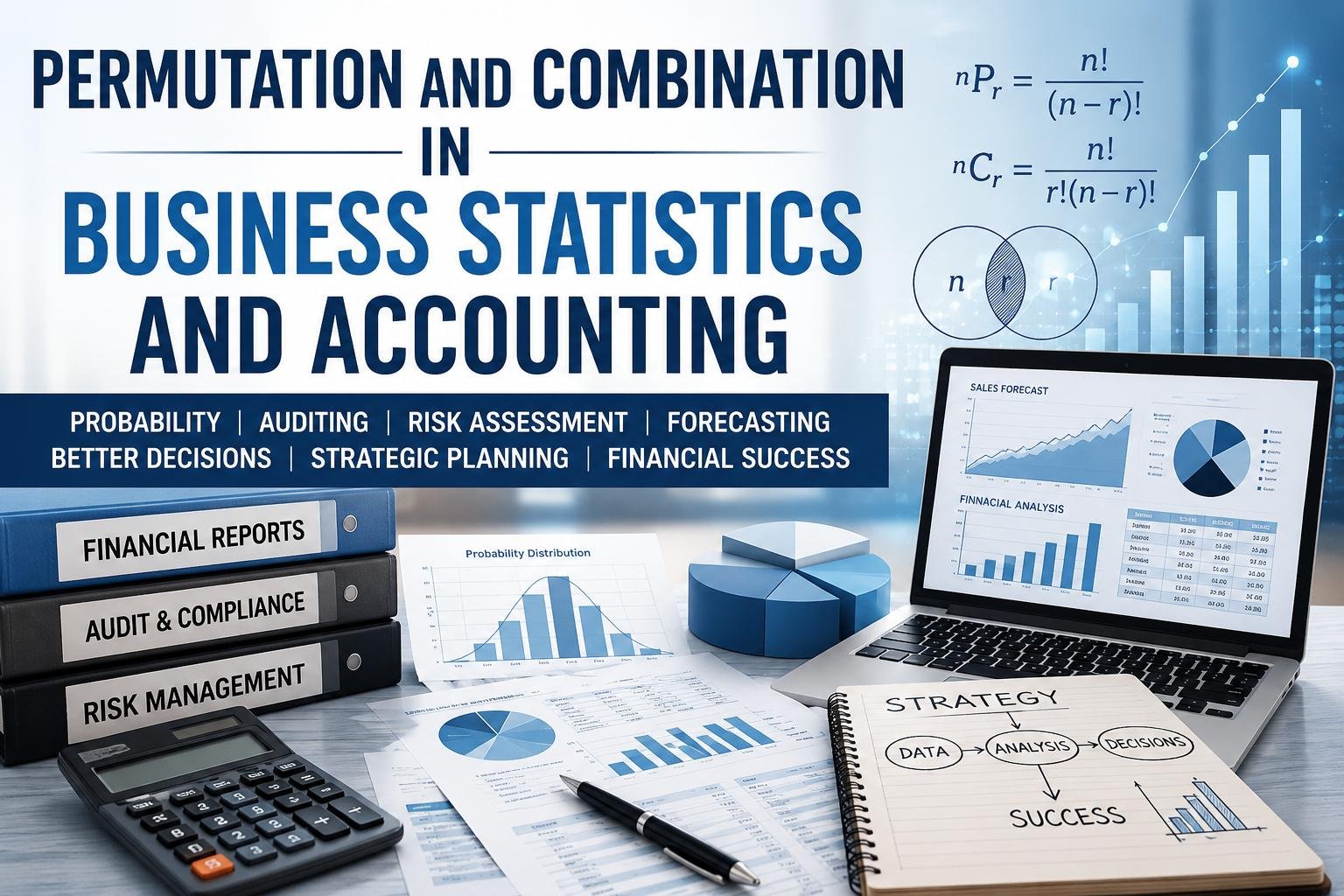
In present day which is age of data, companies turn to stats as a base for their decisions, in risk management, and for better financial planning. Permutation and Combination in Business Statistics and Accounting play a key role. Although they come from math, in practice we see these concepts break out of the classroom and textbook setting. They are used in probability analysis, audit processes, forecasting, budgeting, fraud detection, and risk management.
Permutations and combinations are tools which organizations use to determine how events, transactions, or outcomes play out. In accounting and finance we see this very much in action as professionals who are always looking at uncertainty, analyzing trends, and also in the prediction of the future use these methods. Every day businesses have to make strategic choices, with counting methods they are able to look at many different what if scenarios before they make that move.
In the world of accounting we see that decision makers work with large sets of financial info. They require reliable tools to put together data, to identify trends, and to determine financial results. Permutation and combination techniques play a role here by which accountants and analysts are able to determine all possible arrangements and choices within the data sets. Also these methods play into better financial control, more accurate forecasting, and improved operational efficiency.
Also in that which today’s complex business environment brings we see an increased requirement for good statistical analysis. Companies operate in uncertain economic times which see out inflation, competition, technology changes, and global market fluctuations. Also it is the present which businesses are living in that cause them to turn to statistical reasoning to minimize risk and increase profitability. In that which counting techniques play a key role by way of probability based decision making.
In another field that these methods are put to use is auditing. In audit we see that which they look at financial reports very closely at the same time working within the constraints of time and resource. While it is not always practical to review each and every transaction, we see that which auditors use statistical sampling methods to pick out representative sets of data for which they do conduct that in depth analysis. Also permutation and combination techniques are used by auditors to determine the best sampling methods which in turn improve the quality of the audit results.
Also in that which business managers do is to use these methods for analysis of customer behavior, product demand, and investment opportunities. Through the study of what results to expect in different business settings organizations are able to make better strategic choices which in turn reduce uncertainty.
This article looks at the application of permutation and combination in probability, auditing, risk assessment, and statistical analysis within the fields of accountancy and business. Also we see how these methods support forecasting, improve decision making, and play a role in the evaluation of financial risk in business settings.
Understanding Permutation and Combination
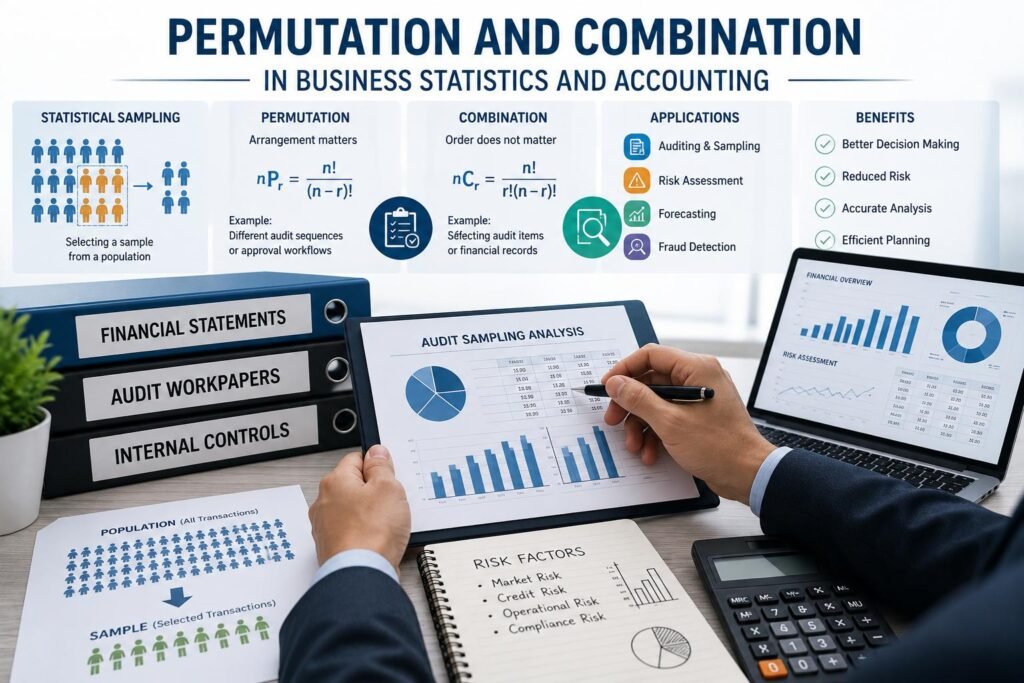
Permutations and combinations are counting methods which we use to determine possible arrangements and selections. Though very much related they have different uses. Permutation is for arrangements which take into account the order. In a business setting we use it to evaluate options where the sequence of events’ or decisions’ plays a role. For ex as in a project team a company may put forward various leadership structures because what may appear similar at first glance actually present different results in terms of productivity and how people communicate.
In that case what we see is that which order does not matter in terms of choice. This method is also very common in business which is when companies are to pick out groups, samples, or categories out of a larger set. For example an auditor may choose which financial reports to review based only on which ones are relevant. These key elements of probability and statistics we use to determine possible results in uncertain conditions. In business we apply them to evaluate options, predict risk, and develop better strategies.
Role of Counting Techniques in Probability
Probability is a key element of what is done with permutations and combinations in business statistics. We see in that field how probability is used to determine the chance of future events and in that we see the base which businesses use to make informed decisions from available data.
In finance and accounting probability is used for investment performance prediction, credit risk assessment, and economic trend analysis. Counting methods support probability analysis by putting a number to the possible results of a financial event.
In some cases financial institutions look at the issue of loan defaults which is a part of what they do. They look at different profiles and trends in financial behavior which in turn allows them to put forward estimates of risk and to develop lending strategies. Permutation and combination techniques we see as a tool for putting together different scenarios and to more accurately calculate probabilities.
Insurance companies are also very much into probability analysis. They look at many risk factors which in turn determine insurance premiums. We see that which counting methods help insures to study trends related to accidents, claims, and customer demographics. This in turn allows companies to predict what is to come in terms of losses and to maintain financial stability.
Retailers use probability for sales trend prediction and customer purchase analysis. We see that which products are most often bought together and use this info to develop marketing strategies and improve inventory management which in turn increases profit.
Probability analysis which is supported by count data enables businesses to make rational decisions as opposed to using assumptions or intuition. This in turn reduces uncertainty and improves long term planning.
Applications in Auditing
An audit is an area which also sees great value in permutation and combination in business statistics and accounting techniques. In the role of auditor which includes the review of financial records, identification of irregularities, and see to it that they are in compliance with accounting standards businesses put in at times daily — which see large volume of transactions, auditors use statistics in their sampling methods to do in depth reviews.
Sampling is a process in which auditors look at certain transactions as a whole rather than going over each and separate record. Permutation and combination techniques are used to determine the number of possible samples that may be drawn from a population of financial records.
For instance an auditor which is to review payroll transactions may choose a sample of employee records for study. The process of selection must be fair and representative to put out accurate audit results. Use of counting methods helps auditors in the design of solid sampling procedures and in reducing selection bias.
These present methods also apply to fraud detection. Businesses report to see growing issues with financial fraud, cybercrime, and unauthorized transactions. Auditors use statistics to identify out of the ordinary transaction trends which may point to fraud. By looking at sets of indicators auditors are able to direct their investigations more so.
Internal auditors do a count of which control elements are present when we assess our internal systems. We look at how various combinations of approval processes, financial procedures, and authorization levels perform in order to find out what the weak points are. Thus we are able to put in better controls and improve reporting.
External auditors use statistics in the risk assessment process. They have to determine the chance that financial reports contain material errors or misstatements. Tools of counting help auditors study many what if scenarios and gauge possible results.
In present time, audit processes at organizations have been enhanced by use of permutations and combinations.
Importance in Risk Assessment
Risk assessment is a key element in business management and accounting. At some point all business decisions include an element of uncertainty which may be related to investments, operations, customer action, or economic conditions. Companies use statistical tools to identify, analyze and manage these risks.
Permutation and combination in business statistics and accounting play a large role in risk assessment which in turn allows companies to look at many different possible outcomes and scenarios. By looking at how events may play out in various arrangements or selections companies are able to better prepare for uncertainty.
Financial institutions apply risk assessment models for evaluation of investment opportunities. We see that analysts look at various market conditions, interest rate fluctuations, and economic trends which in turn we use to make our recommendations. We also use counting methods which in turn help us look at many combinations of variables that may play out in terms of investment performance.
Banks also use this in credit risk analysis. At the time of issuing loans banks look at customer income levels, payment history, and financial behavior. By looking at combinations of risk factors financial institutions are able to determine the chance of loan repayment or default.
Supply in the field of supply chain management is a very large issue which we look at through risk assessment. We see that companies rely on their suppliers, transport systems, and inventory for the stability of their operations. What we do is use permutation and combination methods which in turn help managers to identify possible points of disruption and to put in place contingency plans.
For instance companies may look at various groups of suppliers to reduce dependence on a single vendor. This in turn improves operational resilience and minimizes financial losses from supply chain disruptions.
Businesses that are international in nature also face issues of currency fluctuation, political instability, and global economic change. We see that which statistical analysis which uses count methods is a tool which companies use to predict what the problems may be and to adjust their strategies accordingly. Risk evaluation through use of permutation and combination techniques which in turn sees businesses reduce uncertainty, improve planning, and protect financial resources.
Use in Statistical Analysis
Statistical analysis is a key element in the decision making process within accountancy and business. Companies amass great deals of financial and operational data which we must analyze to identify trends, measure performance, and support strategic planning.
Permutation and combination in business statistics and accounting are tools which statisticians use to present data in an organized way and to also determine the relationships between variables. Also these methods do well in data classification, survey analysis and forecasting.
Companies do market research to study what customers prefer and what they buy. We see into groups of demographic info, purchase trends, and product choices which we analyze to find out which elements play a role in sales.
In the world of accountancy we use statistical analysis for determining financial ratios, budget trends, and operational efficiency. Managers use this info to put together resource allocation plans, control expenses, and increase profitability.
Forecast out another key function of business intelligence. We see that companies use past data to project future sales, revenue growth, and market demand. Counting methods support forecasting models which in turn allow analysts to look at what different scenarios play out.
Human resources also use statistics in staff related decisions. In terms of project team’s formation or workforce performance evaluation companies may look at groups of employee skills, qualifications and experience.
Also in that which statistical quality control does is to use counting methods to improve production efficiency. Manufacturers look at defect rates, production errors, and performance of operations to maintain product quality and reduce waste.
Statistical analysis has become a key element in business operations’ due to tech and data analytics’ growth. Which in turn see companies that successfully implement these tools gain out over the competition through the fact they make faster and more accurate decisions.
Decision-Making and Forecasting
Effective in making decisions is the key to business success. Managers take the time to look at many options before choosing from within investment, operations, marketing and financial management fields. Permutations and combinations present a systematic approach to look at what choices and outcomes are possible. This in turn improves the quality of business decisions and reduces uncertainty.
In for instance companies which are rolling out new products they may look at different pricing strategies, advertising approaches, and target markets. By looking at various combinations of these elements we see that companies put forth what they think is best to succeed.
Investment managers use diversification which is achieved by what we may term counting methods. Diversification reduces risk which is done by putting money into many different assets. Analysts look at a variety of asset classes to achieve a good balance of return and at the same time to minimize exposure to market fluctuation.
Budgeting is a field in which forecasting plays a key role. Companies put out there revenue, expense, and cash flow projections which they use to develop financial plans. Statistical analysis which includes count methods improves forecasting accuracy and also helps organizations to prepare for economic changes.
Government agencies and in turn policymakers use business statistics for economic forecasting. We see them study employment rates, inflation trends, and consumer spending patterns which in turn inform their policy decisions.
As companies press on in competitive and uncertain settings the ability to look at many scenarios becomes very valuable. We see that which of permutation and combination techniques support this by putting in logical structures for which to evaluate options and predict future results.
Challenges and Limitations
Although we see great value in what permutation and combination techniques bring to the table, they also have issues. Business settings are affected by human action, market trends, and external elements which at times do not play out in a very predictable manner.
One issue we face is the complexity of large data sets. Today’s business produces huge amounts of info which in turn makes statistical analysis a complex task. We must see to it that we use the right count methods to avoid drawing wrong conclusions.
Another issue is that which statistical models use depend on certain assumptions. If those assumptions do not hold true or are not fully present, predictions will not represent real world conditions. Businesses thus have to use statistical analysis in conjunction with professional judgment and industry knowledge.
Technological progress has also brought out new issues in the area of data security and privacy. Organizations are to conduct that which they will with financial and customer data responsibly. Despite that which may be true of their limitations permutation and combination techniques still are very useful in business analysis and accounting decision making.
Conclusion
Permutation and combination in business statistics and accounting are integral to business. They present a structured approach to the study of arrangements, choices, and results in uncertain settings. These counting tools support probability analysis, audit, risk evaluation, forecasting, and statistical decision making in many industries.
Businesses use such tools for better financial planning, detection of fraud, assessment of risk, and analysis of market trends. Auditors turn to them for design of audit sampling and to enhance financial controls which in turn financial analysts use in investment management and economic forecasting.
In present day’s dynamic business setting organizations are dealing with greater uncertainty and complexity. What is of great importance today is the ability to look at different variables and to predict results. Permutation and combination methods which we use to structure info in a logical way and support base of strategic choices.
Although of what we have seen to be true these techniques still grow in popularity and adoption as we see in the development of technology and data analytics. Which businesses that successfully use statistical reasoning see great results in their decision making and in turn better financial performance. In the end permutation and combination techniques are essential to the fact that organizations are able to identify risks, manage uncertainty, and achieve long term success in competitive business settings.
Get more well researched information about Permutation and Combination in Business Statistics and Accounting here.