In dentistry education, science is joined with technical skills. Dental waxing is one of the more basic techniques taught as a practical exercise in preclinical dentistry; it involves creating the natural shape of a tooth with wax materials. At a first look it might seem simple, but this exercise is one of the most fundamental exercises taught in Dentistry since it helps a student grasp what the tooth is, how it works, the different contours and anatomy.
Dental waxing is a link between principles and practice in restorative dentistry. Students are able to manipulate teeth themselves to add or remove detail on the cusps, ridges, grooves, fossae and contact points. These are not only for cosmetic purposes but have an essential role in mastication, speech, occlusion, and maintenance of oral health.
Waxing is a simulation of restorative dentistry in a controlled environment in a preclinical laboratory. Learners are given confidence and skill before attempting to treat real patients. Repetitive experience builds the skills for hands-on work like crowns, orthodontic restorations, fillings, dentures and bridges allows them to acquire the necessary hand skills and anatomical awareness for techniques like these.
If learners are starting out on their scientific path in dentistry, then dental waxing is not an art, but a science teaching the ideal approach to mouth anatomy, ideal mouth function, and how they should be connected.
What is Dental Waxing?
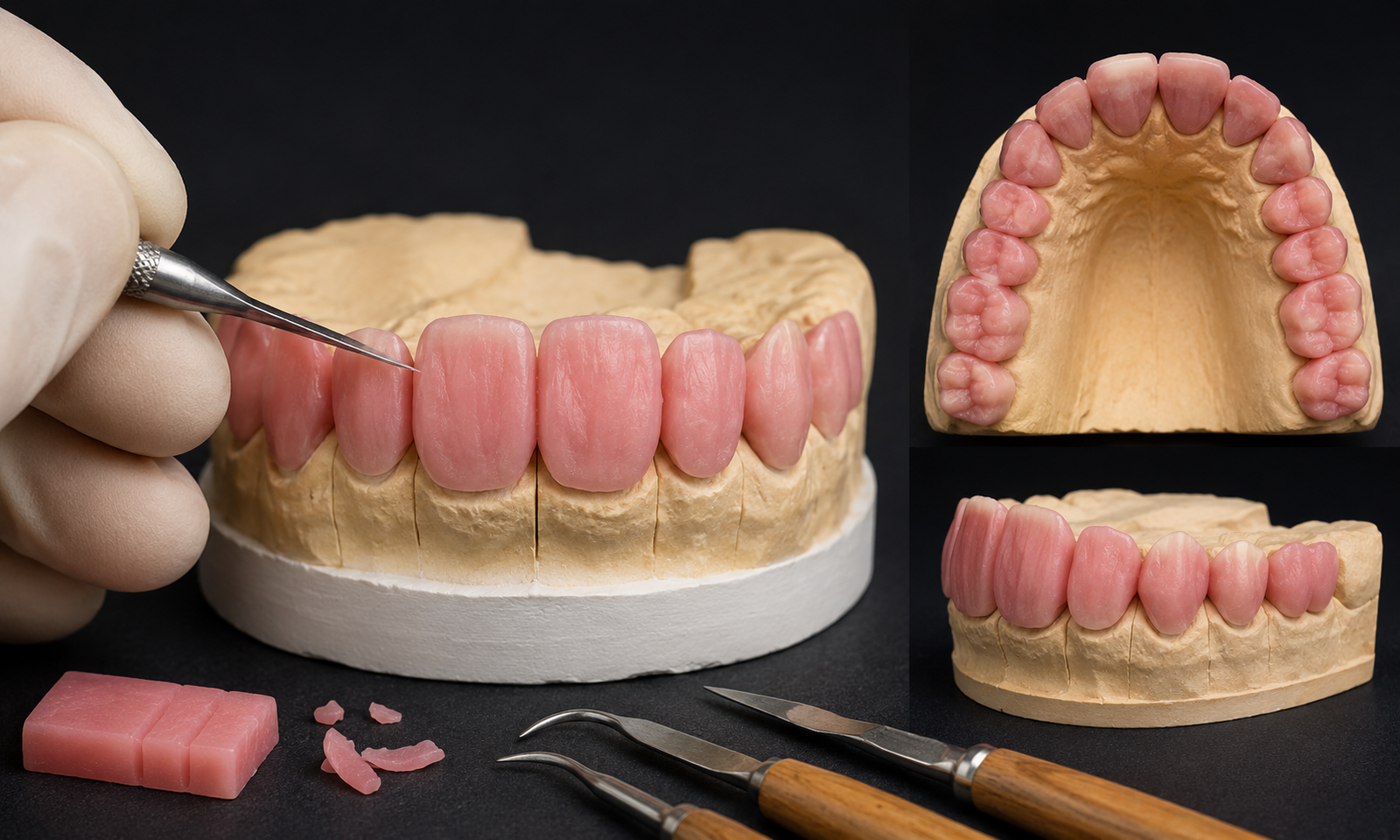
Dental Waxing means the technique used to fill molten or softened wax into correct anatomical forms of teeth set in a dental model or typodont. The drill is often done at dental school level and is a part of the preclinical training.
The target is to create the morphology of a tooth as closely as possible similar to its ideal dentition. The students employ carving tools and wax knives to produce the material in layers to arrive at the final form to remind them of a natural tooth.
Such exercises can be either:
- Waxing individual teeth
- A tooth can be reconstructed in various ways.
- Developing complete crowns
- Establishing proper occlusion
- Simulating restorative procedures
Wax is a good medium for learning anatomical form and developing manual dexterity since it can be very easy to add to, or remove from, its surface. Students also gain an understanding of the significance of both contour and contact areas that can affect plaque control, chewing function and periodontal health. Dental waxing principles and comfortability of dental appliances in oral care can be explored more to gain insight into the usage of dental waxes for dental protection.
The significance of the shape of teeth in dentistry.
Why Tooth Shape Matters
The form and function is different for each tooth in the tooth crown. The incisors adapted for cutting, the canines adapted for tearing and the premolars and molars adapted for grinding the food. Each tooth will offer their own distinct help with masticating and operating harmony in the jaws.
Students learn about the interaction of these forms in the dental arches by using dental waxing. By handmaking a memento of a tooth, learners start to gain an understanding of the relationship between function and structure.
Waxing causes important anatomical structures to be reproduced such as:
Cusps
Posterior cusps are elevated points that help to provide stability when grinding food and to keep the teeth stable during chewing.
Marginal Ridges
These ensure the definition of the limits of the occlusal tables and the food flow during chewing.
Fossae and Grooves
Mandibular movements are controlled and aided by depressions and developmental grooves, which assist in intercuspation.
Contact Areas
Proximal contacts are correct if they prevent food impaction or if they provide for the stability of the aligned teeth. A knowledge of these features is essential for future clinicians to be able to make functional and aesthetically acceptable restorations.
Dental Waxing is a Preclinical Training Exercise.
Building Manual Dexterity
Dentawaxing has many benefits including the development of fine motor skills. very precise hand movements in a restricted working field are required in dentistry. Students learn to manipulate instruments with precision and to feather subtleties on their anatomy during the Waxing exercises.
As your child repeats the procedure of waxing, they get better:
- Finger control
- Hand-eye coordination
- Instrument handling
- Spatial awareness
- Precision carving skills
These skills are later applied in clinical technical skills including cavity preparation, making of crowns and composite layering. Students soon realize that a small shift in height of the cusps or location of the grooves has an impact on occlusion and the way the teeth function. This minute detail becomes very crucial in relation to patient care.
Enhancing Three-Dimensional Thinking
Knowledge of dental anatomy can’t be gained from books alone. Wax helps students to see the 3 dimensional nature of teeth.
Learners analyse:
- Rise vs. span relationships
- Crown contours
- Occlusal anatomy
- Root alignment
- Interproximal relationships
This process enhances the knowledge of spatial perception, which aids in clinically and radiographically interpreting dental structures. Restorative dentistry, prosthodontics, and orthodontics are specific areas in which three-dimensional understanding plays a significant role and greatly impacts treatment outcomes.
Discuss various instruments and materials used in dental waxing.
Common Waxing Materials
Various waxes are used for different procedures, and different educational goals. Common materials include:
Modeling Wax
Smooth consistency, also easy to manipulate, was good for general anatomical carving exercises.
Inlay Wax
This is for precision work and is often employed in indirect restorative work.
Baseplate Wax
May be utilized for exercises and/or in the manufacture of a denture. These waxes have different properties regarding melting points and carvings and can determine how it is handled via certain techniques.
Essential Waxing Instruments
The students are equipped few special instruments that are used during waxing:
- Wax knives
- LeCron carvers
- PKT instruments
- Spatulas
- Wax heaters or Bunsen burners
These tools can be used to accurately add, contour, smooth, and carve wax. Skill in handling instruments is an important part of the pre clinic skills and help the students to prepare for operative dentistry procedures.
Recreating Ideal Tooth Morphology
Step-by-Step Waxing Process
Generally, the dental waxing is carried out in a certain day to day order, similar to that of a restoration.
An understanding of the tooth anatomy is critical in step 1.
Students examine diagrams, extracted teeth and models prior to the beginning of waxing to study ideal anatomy.
They analyze:
- Tooth dimensions
- Cusp patterns
- Ridge alignment
- Occlusal relationships
This theoretical preparation gives a direction to this practical exercise.
The next step of the process involves applying wax by increments.
Wax softened, and put in little layers to the shape of the tooth. Using incremental application to keep shape and contour under control. Students realize that adding in the construction of the building will be more accurate if they don’t add it all at one time.
Step 3: Establishing Secondary Anatomy
Major cusps and basic shape of the teeth are formed first. At this stage emphasis is placed on correct proportions and overall good form.
It is paid attention to:
- Buccolingual width
- Mesiodistal dimensions
- Crown height
- Cusp positioning
Step 4: Secondary Anatomy Revision(Developmental).
The primary form is detailed with finer elements once it is set.
These include:
- Developmental grooves
- Triangular ridges
- Supplemental grooves
- Fossae contours
The process of refinement is not sudden and does not involve any haphazard methods of carving.
Step 5: Checking Occlusion
Final wax pattern is matched with opposing teeth for correct occlusion. Students discover that occlusal discrepancies are a problem relating to jaw movement and efficiency of chewing. Adjustments are made until contact relations are harmonious.
Realistic Simulation of Real Life Restorative Procedures
Preparing Students for Clinical Dentistry
Dental waxing is intimately related to restorative dentistry. The same anatomy related concepts are applied to the clinical procedures as to waxing. Restoring damaged teeth requires the re-creation of the natural contours and occlusion accurately. Exercises with waxing help students to think about anatomy before they work on a patient.
The following procedures are simulated:
- Crown fabrication
- Inlay and onlay restorations
- Fixed prosthodontics
- Occlusal rehabilitation
- Full-mouth reconstruction
Students have repeated opportunities to learn the correct anatomy in wax so they feel confident in reproducing similar anatomy during clinical practice.
To make sense of occlusion waxing
The occlusion is the way in which the upper and lower teeth come into contact when working. A balanced occlusion is vital for chewing well, comfort and T.M.J. health.
Dental waxing will provide learners the opportunity to study:
- Centric contacts
- Functional cusps
- Non-functional cusps
- Excursive movements
- Intercuspation patterns
These exercises enable the student to identify the incidence of the teeth in extreme situations of the same to detect occlusal interference or the incorrect distribution of occlusal loads. An understanding of this is crucial for effective restorative/orthodontic treatment planning.
The benefits of repetition in education.
Learning Through Practice
It takes repetition and patience to learn how to wax. The initial efforts might be crude or out of alignment at best, but through repetition comes greater accuracy and anatomical knowledge.
Students are helped to make the most of repeated exercises by:
- Memorize tooth anatomy
- Improve carving efficiency
- Develop consistency
- Build confidence
- Enhance clinical readiness
The discipline developed in waxing can be transferred to the performance during the entire dental training.
The following are some common challenges in dental waxing:
Difficulty Replicating Anatomy
Many beginners find it difficult to get the natural contours right and this is often the miss they aim for. There are many subtle parts of the teeth that need to be deciphered.
Common mistakes include:
- Over-carving grooves
- Incorrect cusp placement
- Flat occlusal anatomy
- Improper crown proportions
- Weak proximal contacts
Students solve these problems step by step with practice and faculty supervision.
Managing Wax Properties
The characteristics of the wax can vary with handling procedures and temperature. Too much heat can result in anatomy alteration, too little can make manipulation difficult. The students should be taught to control wax and obtain a clean and stable contour. This experience also enhances their knowledge of the materials used clinically in the dental profession.
Dental Waxing and Artistic Development.
Dentistry both science and art,
Dental waxing draws the artwork part of dental care to the forefront. Although anatomy is taught with science, there is also a nature-defining element of recreating the natural tooth shape, and the combined creativity and visual awareness is essential.
Pupils acquire the ability to balance:
- Symmetry
- Proportion
- Function
- Aesthetics
- Surface texture
This art training gets valuable in cosmetic and restorative dental practice as in this the natural appearance of the dentary is of prime importance. Works instruction to get students an inclined eye toward anatomic harmony and fine detail.
How Dental Waxing is Relevant in Modern Times
Digital Dentistry and Traditional Skills
While most methods introduced for dentistry in the past few years such as digital workflows and CAD CAM, the process of waxing is still very relevant. The principles of anatomy used in waxing remain the same for these digital exercise/hands-on digital restorations. Manual understanding of morphology enables us to judge and review digital designs using other tools other than software automation.
But many dental educators feel that students who learn the traditional approach to waxing positively complete better dental anatomy training than those who learn through digital options only. The old rules and basics of waxing remain vital to modern restorations. Discussions on how to apply these concepts beyond dental school.Clinical Applications outside of the Dental School.
Benefits for Dental Professionals
Dental waxing can not only be utilized by students, but also by other consumers. Waxing techniques are also used in other clinical and laboratory practice by practicing dentists and dental technicians.
Applications include:
- Diagnostic wax-ups
- Smile design
- Occlusal analysis
- Prosthetic planning
- Implant restorations
A diagnostic wax-up is particularly helpful when planning for an irreversible treatment. The use of these wax models helps enhance communication between patients, dentists and technicians.
Conclusion
Dental waxing is one of the most valuable learning exercises in preclinical dentistry. It teaches students the importance of the complex relationship between the functions, anchorage and esthetics of the tooth. Students will appreciate dental morphology more through manually modifying ideal teeth forms, and learn fine motor skills needed in the clinical setting. Dental Waxing is more than an activity in the lab, it is a simulation of the real dentistry in function. It instructs future clinicians on how to make a natural accurate replica and effects of each contour and contact point.
Students will acquire knowledge and ability through repetition, careful observation and development of technique. In an era where technology has taken the place of traditional techniques, waxing is still pertinent to education since it allows the eye, the hands and thinking processes to learn vital skills for successful dentistry in the real world. Mastering the art of dental waxing isn’t just about creating the correct shape and size, it’s about understanding how performing the proper procedure will ensure optimal tooth morphology (shape and position) for lifelong oral health, comfort, and function.