
Introduction
The crypto space has seen great growth over the past decade. What was at the time a small scale financial play has turned into a worldwide network of traders, investors, developers and institutions. As we see greater adoption of fast crypto trading we also see that users expect the same speed and convenience from it that they get from traditional finance. At the same time it is very hard for us to see fast transaction processing in decentralized networks.
In crypto trading we see that which is to balance speed, security, and decentralization is a major issue. In many cases improving one feature does in fact hurt the other. Traders are after immediate order execution and low delay, at the same time they also want in put on their funds’ activity and protection from manipulative practices. Centralized exchanges do offer speed but ask that users place trust in a third party. Decentralized exchanges do provide transparency and user control but at a tradeoff of slower transacting and higher fees.
This issue at hand has brought forth what we see today in hybrid exchange models which put together off chain performance with on chain verification. We see in these systems an attempt to resolve the age old tradeoff between speed and decentralization. Exchanges like https://verifiedex.com/ are examples of which put off chain order books to the fore but at the same time they do on chain the settlement and verification.
To get a better look at how this approach works and why it is relevant in today’s crypto trade, click here.
Understanding the Speed vs. Decentralization Problem
Blockchain technology is a design which puts security and decentralization at the fore. In the case of Bitcoin and Ethereum we see networks which use distributed consensus protocols that require many nodes to validate transactions before they go through. This in turn increases transparency and also reduces the need for trusted third parties.
However we see that decentralization has its issues. Each transaction must go through the network which at times may take a while based on the design of the blockchain and the level of traffic. At times of high activity users report delayed confirmations and higher transaction fees.
For traders which include high frequency traders delay is an issue. In financial markets which are very fast even a few seconds may determine profit or loss. This in turn puts at odds the goal of decentralization with that of speed.
Users must count on the exchange to handle their assets in a secure and honest manner.
In the past we have seen central systems fail. Many exchanges have had hacks, insolvencies or manipulation which in turn has produced large scale user losses. These incidents have in turn increased interest in decentralized solutions which in which there is less of a role for centralized parties.
The challenge is clear. Can crypto exchanges deliver for speed traders in terms of security and transparency which blockchain provides?
The Rise of Decentralized Exchanges
Decentralized exchanges also came up as an alternative to traditional, more centralized markets. As opposed to holding user funds in their own controlled digital wallets, DEXs get users to keep custody of their own assets at all times which in turn they use for trade between each other via smart contracts.
This model offers several advantages:
- Greater transparency
- Reduced counterparty risk
- Improved censorship resistance
- Enhanced user control over assets
Despite these benefits early decentralized exchanges had performance issues. Since each trade took place on the blockchain we saw low transaction throughput. For example with Ethereum which processes few transactions per second. At high demand times we see congestion which in turn increases gas fees greatly. Traders trying to place or cancel orders may have to deal with slow execution which in turn makes for tough active trading.
These issues which in turn caused most of the decentralized exchanges to fail to compete with their centralized counterparts in terms of user experience. As of which what we saw was developers look into what we today call hybrid solutions which at the time were in their infancy.
What Are Off-Chain Order Books?
An order book is a system which logs buy and sell orders of assets. In traditional finance we see order books used to do efficient trade matching. Also in crypto we see the same model adopted which is for its fast execution. In within a fully on chain exchange every trade, change and cancel is put onto the blockchain. Although this is a transparent model what it does is also prove to be inefficient because block chain transactions are a slow and costly process as compared to database operations.
Off chain order books fix this by taking order management out of the blockchain. We see that instead of putting each order on the network’s platform, users put orders in with an off which matching engine. The exchange does this very fast using high speed infrastructure which is very much like that of traditional trading platforms. Once transactions are confirmed the final settlement takes place on chain. This mix of architectures which is put forth performs a balance between performance and security.
How Off-Chain Order Books Work
To see the benefits of this system it is best to go through the process step by step.
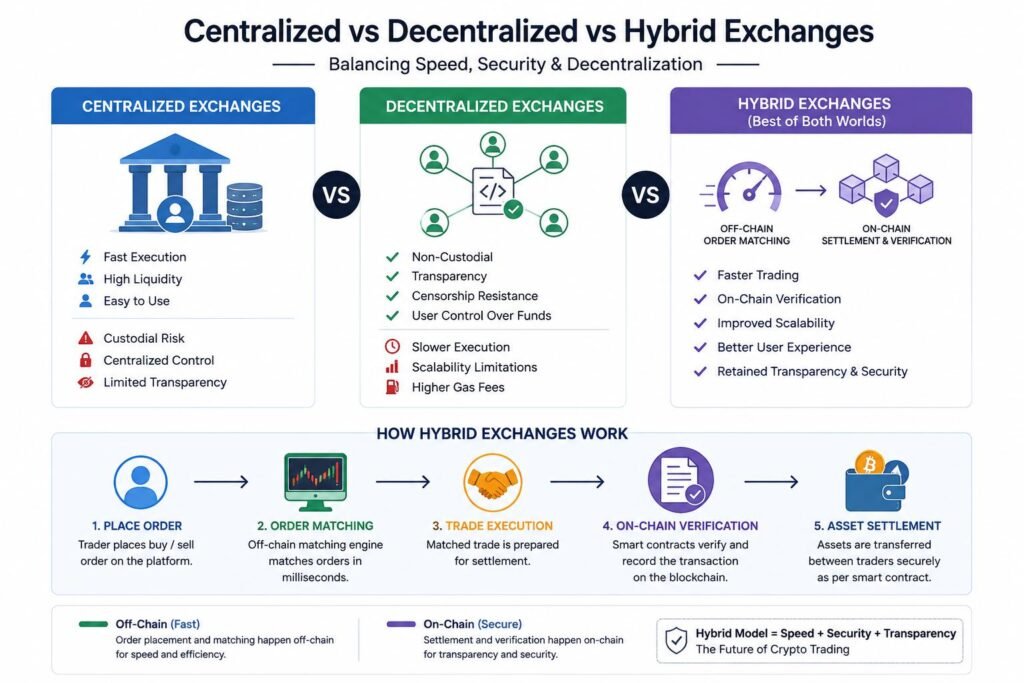
Place Order.
A trader places a buy or sells order via the exchange interface. Instead of what goes out to the blockchain right away the order is taken in by an off-chain matching engine. In the off chain process this is what happens almost immediately.
Order Matching
In the present market we see that the matching engine which is put to use for buy and sell orders’ comparison to point out which trades are a fit. Also this system reports to function in a manner very much like that of the past financial exchanges and is able to process in a very short time frame a large volume of orders. Since we are going outside of the blockchain for the match, latency is greatly reduced.
Trade Performance
Upon a match we prepare the transaction for settlement. Once the trade is agreed upon it is put onto the blockchain for verification and final record.
On-chain Verification
Smart contracts enforce the trade which in turn makes sure that the transaction plays out as per the pre-determined rules. This step also provides transparency and security which we see in the form of the block chain’s permanent record of the settlement.
Asset Wind Down.
Upon verification of the trade details assets are transferred between traders as per the smart contract terms. This structure allows for the better trading performance of e.g. VerifiedEx which at the same time does not give up on blockchain based accountability.
Why Hybrid Models Matter
Hybrid systems are growing in importance which is due to the fact that they overcome issues see in pure centralized and full decentralized exchanges.
Improved Trading Speed
Off chain matching engines process orders within milliseconds and thus which in turn smoothen out trading experiences. This is especially so for professional traders and institutions that rely on quick execution.
Lower Blockchain Congestion
Recording each trade on the blockchain causes great network traffic. By putting order management off the chain exchanges reduce blockchain congestion and also lower transaction costs.
Enhanced Scalability
Hybrid systems see great increase in trading volume which full on-chain platforms do not. This is very important for broad adoption and global use.
Better User Experience
Fast crypto trading execution provides a more familiar environment for traders making the switch from the traditional markets. Traders are able to place, change, and cancel orders in real time which is a far cry from what they are used to.
Retained Transparency
Unlike fully centralized exchanges, hybrid platforms still use blockchain for transaction confirmations. We have an audit trail of transactions and which in turn improves trust.
Security Considerations in Hybrid Exchanges
Although we see that hybrid systems perform better they also present very serious security issues. As some functions move off the main chain we are introduced to new risks which must be very carefully managed. Platforms on the like of VerifiedEx put in place many security measures.
Smart Contract Verification
On chain settlement is via smart contracts which also act to enforce trade rules automatically. These contracts reduce what we see in unauthorized asset transfers or manipulation.
Non-Custodial Features
Some exchanges which are hybrid in nature allow users to retain control of their private keys until settlement which in turn reduces the risk of centralized custody.
Cryptographic Proofs
Advanced systems may put in place crypto proofs which check that off chain action is a match to on chain settlements. This in turn improves transparency of the process even as some functions go beyond the blockchain.
Auditing and Transparency
Regular reviews of smart contracts and trading systems, in turn present an opportunity to identify weaknesses before they are exploited.
Distributed Infrastructure
In a distributed architecture which breaks up the system into many components failure of any one is less of an issue. In that which is to say no system is perfect, by combining off-chain efficiency with blockchain verification we see to greatly improve exchange reliability.
The Role of VerifiedEx in present day crypto trading.
VerifiedEx is a class of exchanges that is seeing growth as they work to fill the balance between centralized performance and decentralized security. Its model is a part of the larger industry shift which is towards hybrid infrastructure that values both usability and transparency.
Through the use of off-chain order books in combination with on-chain settlement which is what we see in the case of VerifiedEx we have:
- Faster transaction processing
- Reduced trading fees
- Improved liquidity
- Greater transparency
- Enhanced user trust
This model stands out in today’s competitive crypto market which has a great demand for speed and accountability. Instead of having users pick between convenience and security, hybrid exchanges instead present elements of both.
Challenges Facing Hybrid Crypto Exchanges
Although there are benefits to them, hybrid exchanges still have to deal with a number of technical and regulatory issues.
Smart Contract Vulnerabilities
Even with well put together smart contracts issues of bugs or security problems still present themselves. In decentralization we have seen how costly these vulnerabilities can be.
Regulatory Uncertainty
Governments around the world are putting out new regulations for digital assets and trading platforms. In the case of hybrid exchanges they may have to meet the same compliance requirements as centralized platforms which at the same time run in decentralized environments.
Liquidity Competition
Large present day centralized exchanges, are the primary players in market liquidity. In hybrid platforms we see the need for them to attract enough traders to maintain efficient order matching and competitive spreads.
User Education
Many traders today still have a hard time with hybrid exchanges. We still see value in educating users about custody models, smart contracts, and blockchain verification.
Infrastructure Complexity
Combination of off-chain structures with on-chain validation introduces technical complexity which in turn requires strong engineering and maintenance. Despite these issues the growth of decentralized finance we see as a trend which will in turn support the development of hybrid systems.
Comparing Centralized, Decentralized, and Hybrid Exchanges
To see the value in hybrid exchanges it is best to look at the three main exchange models.
Centralized Exchanges
Centralized exchanges provide fast and easy service. But users have to trust that the platform is secure and fair.
Strengths
- Fast execution
- High liquidity
- Easy user experience
Weaknesses
- Custodial risk
- Limited transparency
- Vulnerability to hacks
Fully Decentralized Exchanges
DEXs are known for their transparent and user oriented approach which in turn may report lower performance and higher transaction fees.
Strengths
- Non-custodial trading
- Transparency
- Censorship resistance
Weaknesses
- Slower execution
- Scalability limitations
- Higher gas costs
Hybrid Exchanges
Hybrid models put forward the best of both.
Strengths
- Faster trading
- On-chain verification
- Improved scalability
- Better user experience
Weaknesses
- Increased technical complexity
- Partial reliance on off-chain infrastructure
- Regulatory uncertainty
This analysis in turn presents to us that which many in the industry see to be a practical solution of the hybrid exchanges.
The future of fast and secure crypto trading
The growth of fast crypto trading will see in to play systems which balance out efficiency, transparency and decentralization. As we see it with the growth of the blockchain space, we will also see the introduction of which may improve hybrid exchange performance.
Layer-2 Scaling Solutions
Layer 2 solutions like rollups and payment channels which see to it that transaction throughput is increased and fees reduced.
Zero-Knowledge Proofs
In zero knowledge cryptosystems users may trade and transact without revealing private info.
Cross-Chain Interoperability
Future we may see fast crypto trading which crosses multiple blockchain networks at the same time which in turn will improve liquidity and access.
Institutional Participation
As the institutional players join the crypto space we see an ever growing demand for secure and efficient trading infrastructure.
AI and Automated Trading
Artificial intelligence and algorithmic trading platforms have the requirement of very high speed in transactions at the same time that transparency is not compromised. Hybrid exchanges are at an advantage in this regard as they present a mix of scalable infrastructure with blockchain based verification.
Conclusion
Transaction speed versus decentralization has been the issue which crypto exchanges have had to deal with for years. Traders look for quick execution, low fees, and a smooth experience which in turn block chains focus on transparency, security, and decentralization. Traditional large scale exchanges go for efficiency which in turn asks users to put faith in central authorities. In terms of full decentralization users get more control and transparency which in that report speed and scalability issues.
Hybrid systems which include platforms like VerifiedEx are a step forward in this issue. These platforms which combine off-chain order books with on-chain verification are able to process trades quickly and at the same time maintain blockchain based accountability. This approach enables exchanges to reduce latency, increase scalability, and improve the user experience at the same time we don’t fully give up on decentralization. Although issues of smart contract security and regulatory uncertainty still exist, we see growth in hybrid exchange models as the crypto space matures.
In the end what we are seeing is a growth in which security is not given up for speed in fast crypto trading. That which we are to see out of the use of off-chain for efficiency and on chain for trust may in fact be what defines the next age of digital asset exchange and in that we may see out a more scalable, transparent, and secure financial system.
Get more well researched information about fast crypto trading here.

