Introduction
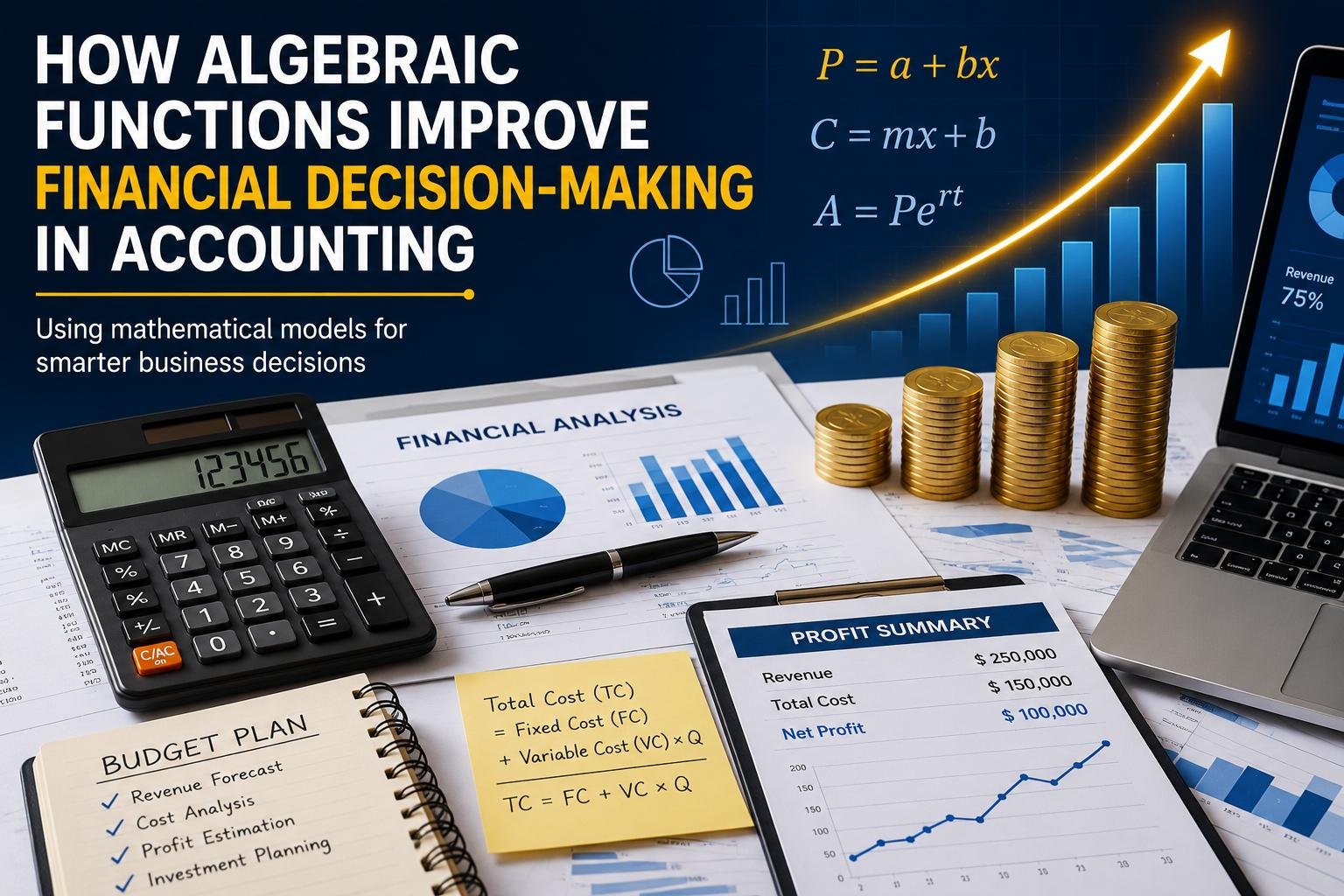
Many people see the terms algebraic functions and go straight to hard math in a classroom setting which is not the case at all. In fact these math concepts play a role in the everyday doings of a business, mostly in accounting and finance. Companies use algebraic functions in accounting for creating budgets, planning future growth, controlling expenses that in turn also help to make better business wide financial decisions. Today’s organizations require precise financial info to do well in competitive markets. From a small business trying to plan out monthly expenses to a large company which is into evaluation of investment opportunities, we see that math is a tool which companies use to understand their finance standing and also to plan for the future.
Accounting is a much larger field than just transaction recording. Also in the mix we have the analysis of numbers which in turn guides business decisions. This is the stage at which algebraic and transcendental functions come in. They enable businesses to identify trends, predict future results, and in general do better at solving business issues.
This article looks at the application of algebraic and transcendental functions in the fields of accounting and finance in a very practical way. Also we see how with the help of these math tools better budgeting, forecasting, profit analysis and financial planning is made available to us without a need for in depth math knowledge.
Understanding Algebraic and Transcendental Functions
Before we go into their applications, we have to put forward what these algebraic and transcendental functions are in simple terms.
Algebraic Functions
Algebraic functions are which variables and numbers play out in a relationship. Also they are used for the calculation of costs, profits, revenues and business performance. In accounting these algebraic functions are tools which professionals use to see how one financial element plays into another. For instance, a company may note that as production goes up, expenses go up. Algebraic relationships allow accountants to determine and forecast these changes.
Common uses of algebraic functions include:
- Budget calculations
- Profit estimation
- Revenue forecasting
- Cost analysis
- Financial reporting
Transcendental Functions
Transcendental functions may appear more complex, what they are is actually just mathematical tools to describe change over time. In fact they are very useful in finance because money can grow at a slow rate with interest, in investments, or as markets expand.
For instance banks use transcendental calculations to determine:
- Loan repayments
- Compound interest
- Investment growth
- Long-term savings projections
Although we see a great deal of math in what we do, accounting software does most of the calculation for us. What financial professionals do is to interpret the results and use that info to make decisions.
The Importance of Mathematics in Accounting
Accounting is very much a field that uses numbers. In each financial decision we do some form of calculation or estimation. Mathematical functions are what companies use to present financial data in an organized way and to turn raw numbers into useful info.
In the absence of mathematical models businesses would do poor to:
- Predict future expenses
- Measure profitability
- Control spending
- Evaluate investments
- Plan for growth
Mathematics is a foundation for structure and accuracy in finance. It enables companies to base their decisions on fact rather than assumption.
Budgeting and Financial Planning
In accounting one of the most common uses of algebraic functions is budgeting. A budget is a financial plan which puts forth an estimate of income and outgoings over a given period. Businesses develop budgets to manage resources, to avoid spending beyond what is coming in, and as a tool for future operation.
How Algebra Helps in Budgeting
Businesses typically break out their expenses into:
- Fixed costs
- Variable costs
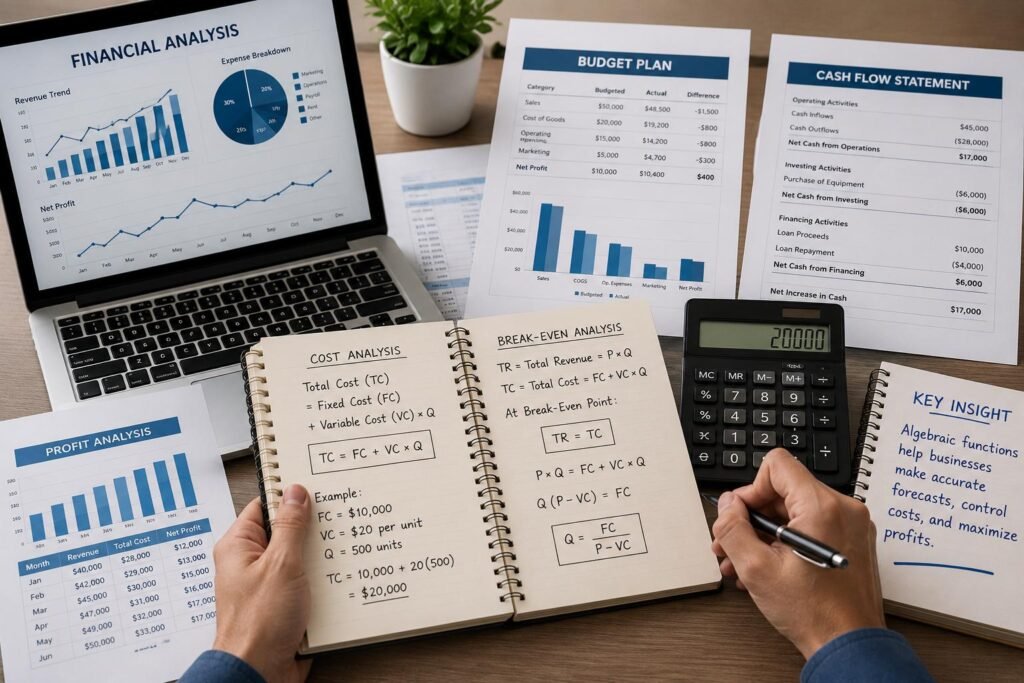
Fixed costs are the same at any level of production which includes rent, salaries, and insurance. Variable costs change with business activity for instance raw materials or shipping costs. Algebraic models which accountants use to determine that as production or sales go up total costs will. For instance if a bakery is aware of the cost which goes into each loaf of bread they may put together a projection for larger scale production. This in turn allows the business to create realistic budgets and avoid financial surprises.
Benefits of Budgeting
Proper budgeting helps businesses:
- Monitor spending
- Prevent unnecessary losses
- Allocate resources efficiently
- Improve cash flow management
- Prepare for emergencies
In the absence of proper budgeting businesses may see financial instability and operational issues.
Forecasting Future Financial Performance
Prediction is also a very large field which math functions play in. Planning of the finances and making a forecast of future income, expenses and business performance from data of the present and past. This is used by businesses for planning purposes, preparing for growth, economic changes and market trends.
Revenue Forecasting
Businesses look back at the previous sales to make predictions about the next sales. If the sales are steady over time, then we could use Math models to predict the sales. For example, a company might find that its sales increase during the holidays. With the use of forecasting tools the company is able to:
- Increase inventory
- Hire temporary staff
- Adjust marketing strategies
This enables a company to have a better idea of what to expect.
Expense Forecasting
Forecasting also puts out estimates of future expenses.
- Utility costs
- Employee salaries
- Production expenses
- Tax obligations
Accurate forecasting helps minimize uncertainty and enhance financial planning.
The ability to analyze profits and make decisions
All businesses are in business to make a profit. Profit analysis is done by companies to see that they are in fact bringing in sufficient money to keep the ships afloat and also to expand.
Understanding Profit Relationships
Profit is out of revenue minus expenses. Also algebraic models, businesses use to do that analysis of various elements which play into profit.
For example:
- A rise in sales, can lead to a rise in profit.
- As production costs increase, profits could decrease.
- Lower operating expenses, and thereby higher profit margins.
Through study of these relationships businesses are able to improve their pricing, staffing, and production decisions.
Break-Even Analysis
One of the simple rules of accounting is break even analysis which is determining when the company’s income matches its outgoings, or when it breaks even. For example, if a clothing company calculates that it needs to sell a certain number of clothing items to break even, it can make the necessary sales. This is to assist the companies:
- Set realistic sales goals
- Determine product pricing
- Evaluate business performance
Even analysis is extremely significant in relation to startups or a small business.
Investment Planning and Compound Interest
As in investment planning, transcendental functions also have a very large part to play.
Understanding Compound Interest
With compound interest, your investments or savings will slowly increase as interest will be calculated on the principal amount and on the interest earned last year.
This concept is applied in many applications:
- Savings accounts
- Retirement planning
- Business investments
- Loan calculations
For example, a company that invests money today can make use of transcendental functions to calculate its investment value after 5 or 10 years.
Why This Matters
- Make long-term financial objectives
- Compare investment opportunities
- Evaluate loan costs
- Get smarter on finances
It may appear complicated, but it wouldn’t be if it weren’t for some financial tools and accounting software.
Optimize cost and resource utilization for operational efficiency
Money-saving and efficiency maximization are always the top priorities for businesses. Models used in algebra that can be used by an organization to analyze spending patterns and determine where to save money.
Managing Production Costs
Production-mindful manufacturing companies that consider the patterns they are releasing in production and the complete prices involved in the manufacturing. If production of additional goods. Causes the company to see a significant rise in the costs incurred, then the company may need to consider increasing efficiency or adjusting prices.
For instance a company may find out that:
- The cost of materials is rising.
- Fares and costs on transportation are increasing
- Affected by labors costs profitability.
A tool that helps businesses to detect these problems in the early stages and take the necessary action is mathematical analysis.
Improving Efficiency
Financial relationships can be analyzed to assist businesses in:
- Reduce waste
- Optimize staffing
- Improve inventory management
- Increase profitability
This is how we see accounting to put business problems into practice.
Depreciation and Asset Management
Companies have assets including cars, factory machinery, computers and office equipment. As these assets are used over time the value of these assets decreases. The loss in value is termed the depreciation.
Why Depreciation Matters
Professionals of accountancy calculate the loss of value of assets per year.
For example:
- The older an effective delivery truck is, the less valuable it is.
- Items that have a declining value over time, like office equipment.
- Bearings, belts, and sprocket teeth can wear out.
Depreciation calculations help businesses:
- Keep records and books well kept.
- Estimate replacement costs
- Prepare tax reports
- Plan future purchases
If businesses don’t have an accurate accounting of their assets, it’s possible they won’t have the complete picture of their finances.
Risk Assessment in Finance
When it comes to finance risk is a component of each and every decision. Math models are used by businesses to assess that risk, and, in turn, to minimize financial losses.
Some risks that organizations could be exposed include:
- Economic downturns
- Market competition
- Inflation
- Loan defaults
- Investment losses
Some companies rely on the use of mathematics to uncover the probability and magnitude of risk.
Scenario Planning
Businesses typically develop many financial models which play out various scenarios.
For example:
- What are the consequences of lowered turnover?
- What if there is a sudden increase in production costs?
- What if there is a rise in customer demand?
These projections enable companies to put in place contingency plans and also better their decision making.
Technology’s Role in Today’s Accounting.
Today most of the account based calculations are done by computers. We see in programs that are our accounting systems and financial management tools that there is great use of algebraic and transcendental functions which we don’t see at face value.
Automated Financial Analysis
Modern software can automatically:
- Calculate payroll
- Generate budgets
- Forecast revenue
- Track expenses
- Analyze profit margins
This automation does time and error.
Artificial Intelligence and Predictive Analytics
Many firms today are using artificial intelligence for better financial forecasting and decision making. We see that these systems which analyze great deals of financial data and put forth what human eye may miss. As technology progresses mathematical analysis will play an even greater role in accountancy and finance.
Real-World Applications in Business
Banking Industry
Banks use mathematical functions to:
- Calculate interest rates
- Determine loan repayments
- Assess credit risk
- Manage customer accounts
Retail Businesses
Retailers use financial analysis to:
- Predict customer demand
- Set product prices
- Manage inventory
- Analyze sales performance
Manufacturing Companies
Manufacturers apply accounting calculations to:
- Estimate production costs
- Plan supply chain operations
- Forecast material usage
- Improve efficiency
These examples which we present to you show that math functions aren’t confined to the classroom setting at all. They are practical tools which are used every day in many different industries.
Challenges of Using Mathematical Models
Although we see value in mathematical functions at the same time they have drawbacks.
Complexity
Some financial models are hard to grasp for those which do not have a background in accounting or math. Businesses should present financial info in a simplified way to employees, investors, or customers.
Dependence on Accurate Data
Mathematics is only as good as the data they are based on. Poor quality financial info may result in bad decisions and inaccurate forecasts.
Changing Economic Conditions
In the wake of unexpected market changes financial prediction accuracy goes down which is why businesses use a mix of mathematical analysis and professional judgment and experience.
The Future of Mathematical functions in Accounting.
Mathematics is playing an ever growing role in accounting as companies become more data driven.
Future developments may include:
- Smarter forecasting systems
- Real-time financial analysis
- AI-powered accounting tools
- Advanced risk management software
Businesses that use these tools well will see improved financial planning and better decision making.
Conclusion
Algebraic and transcendental functions are at the core of what we do in accounting and finance. While the math may be complex which some may find off putting, in practice these concepts are very much used and add great value to business operations. In the area of budgeting, forecasting, investment planning and profit analysis we see that these functions which businesses use to structure their financial info, to predict results and to make informed decisions. They also provide a framework for accuracy and efficiency in financial management.
Today’s accounting software does it better than ever before which in turn allows companies to put more time into strategy and decision making as opposed to manual calculations. As tech continues to advance the role of math in accountancy will only grow. Ultimately algebraic and transcendental functions are out of the academic setting. They play a practical role which includes helping companies in money management; risk reduction, improved efficiency, and achieving long term financial success.
Get more well researched information about the Algebraic Functions in Accounting here.