The media has an influence on people getting information, interacting with society, and understanding what is going on in the world. Indeed, mass media has revolutionized communication between generations, from newspapers that arrive in people’s houses every morning to social media that comes to people’s smartphones as soon as they turn them on. It influences politics, education, entertainment, business, and personal relationships in general. With the development of technology, the ways information is produced and disseminated keep changing, and access to mass communication has become more immediate and accessible than ever before.
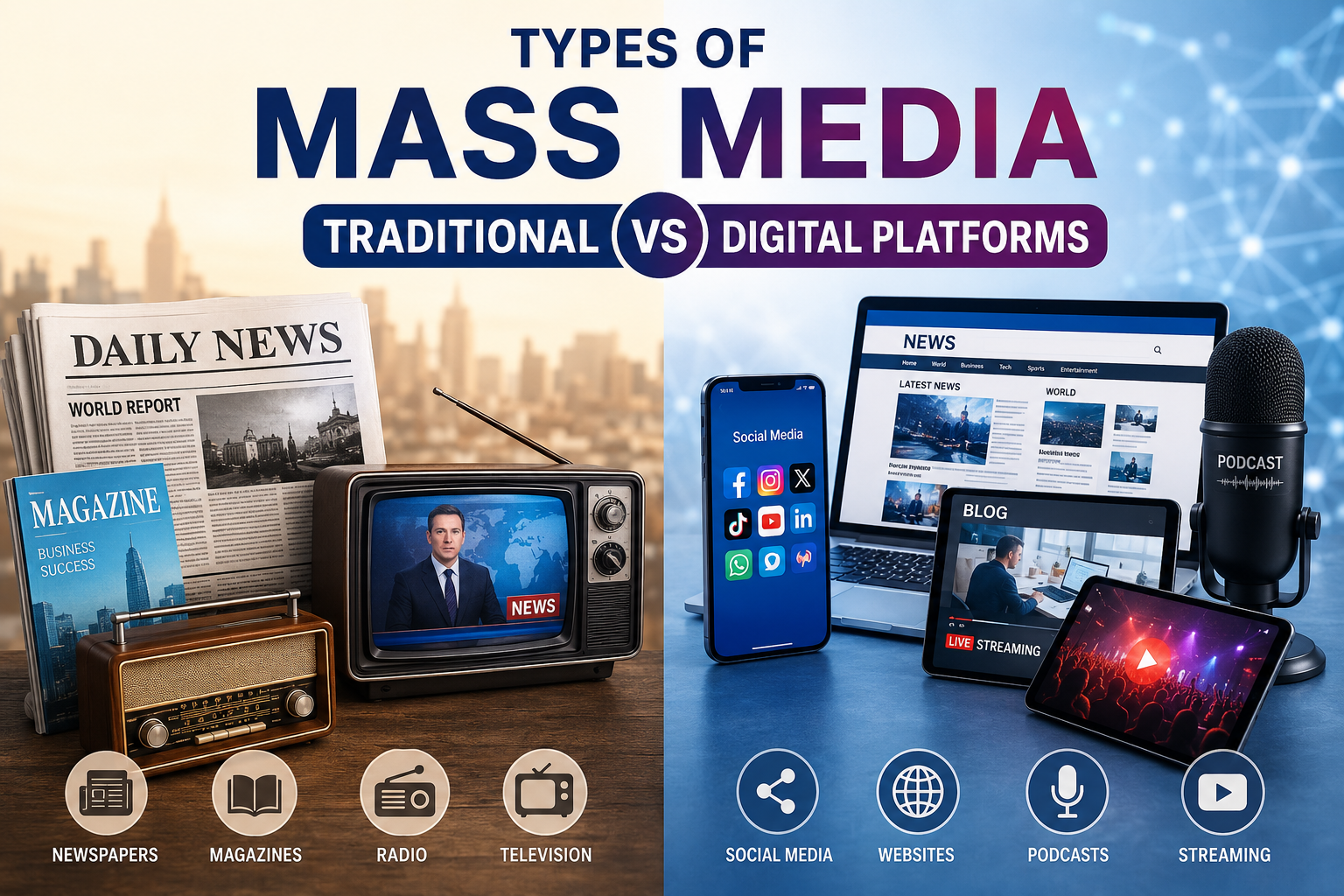
With the development of communication technology, there are two types of media platforms: traditional media and digital media. Traditional media is defined as newspapers, magazines, radio, and television, and digital media as internet-based communication vehicles like websites, social media apps, podcasts, blogs, and streaming. There is no one-size-fits-all approach to each medium and no single way in which to communicate with each audience. The platforms are in-depth, fast, interactive, or entertaining.
In order to understand the different forms of mass media, it is important to understand how mass media works, how it affects the people, and its relevance in the current communication landscape. While digital technology has certainly impacted people’s habits, traditional media can still be effective as it is still credible and widely circulated. The integration of traditional and digital media remains a key aspect of communication, influencing global communication in the future.
What Is Mass Media?
Mass media are any communication channels used for transmitting information, ideas, entertainment, and advertising to a wide audience. It serves as a link between organizations, governments, businesses, and the public. The main goals of mass media are to educate, entertain, and influence society through different communication media.
Mass media is transmitted in various forms such as print, audio, television, web, mobile, and other formats. These platforms are used to move information rapidly within and across cities, countries, and continents. Mass media serves as an important source in today’s society for news, learning, entertainment, and socializing.
The Major Functions of Mass Media
Mass media serves society in various ways such as:
- Making people aware of what is happening around them in the country and around the world
- Conducting educational programs, articles, and documentaries for the audience
- Offering entertainment through films, songs, television programs, and through the internet
- Commercial and corporate communications, particularly by advertising products and services
- Shaping public opinion and politics
- Promoting cultural interaction and social consciousness
The role of mass media is to influence public perception; therefore, it has great responsibility in shaping the perception of the public fairly, accurately, and ethically.
Types of Traditional Mass Media
Traditional media are communication platforms which were used before the development of internet technology. These were the types of media that were used to communicate for decades and are still very relevant in the world today, particularly in areas not connected to the internet.
Traditional media is usually perceived as being professional and credible, as the content is filtered by editors and producers, and meets editorial standards and legal requirements before it reaches the audience.
1. Print Media
One of the oldest methods of mass communication is print media: newspapers, magazines, journals, brochures, newsletters, and books. Prior to the advent of widespread internet access, print media played a key role for millions of people around the world in terms of news and information.
Politics, business, sports, entertainment, and community events are covered in newspapers. Magazines will have a specific theme, like fashion, health, technology, lifestyle, or finances. The function of academic journals is to provide scholarly research and analysis, which helps in the process of education and research.
Benefits of Print Media
- Provides detailed and permanent records of information
- Possesses high standards for editing
- Promotes purposeful reading (distraction-free)
- Establishes rapport and trust with readers
- Suitable for learning and work
Disadvantages of Print Media
- Expensive printing and distribution costs
- Fall in circulation among younger readers
- Restricted speed compared to web publishing
- Issues with paper manufacturing and the environment
- Slowed revenue from advertising because of digital competition
Despite these challenges, print media continues to have strong and loyal readers who appreciate traditional reading and trustworthy reporting.
2. Broadcast Media
Television and radio communication are considered broadcast media. They were very influential as they were able to broadcast information and entertainment to millions of people at once.
Television
Television is one of the most engaging communication tools that uses both words and images. Television programs include:
- News broadcasts
- Sports coverage
- Educational programs
- Reality shows
- Movies and dramas
- Documentaries
- Talk shows
Television advertising continues to work well and is more likely to get viewers’ attention than text-based advertisements.
Radio
Even in many communities, radio plays a significant role due to its affordability and accessibility. Radio can be broadcast during various activities such as driving, working, or traveling.
Radio stations provide:
- News updates
- Music programs
- Sports commentary
- Public service announcements
- Talk shows and interviews
As an emergency tool, radio has the advantage of being able to broadcast information to masses of people.
Benefits of Broadcast Media
- Gets a lot of exposure
- Has a huge reach
- Uses sounds and images to enhance engagement
- Ideal for use in public announcements and live events
- Easy to understand for those who may not be able to read or write very well
- Creates emotional engagement using storytelling
Disadvantages of Broadcast Media
- Expensive production and broadcasting
- Limited audience interaction
- Reduced flexibility associated with scheduling programming
- Fast life of the content in comparison to print archives
Television and radio are still adapting to the digital world through online streaming and mobile apps.
Digital Types of Mass Media
Digital media is a term for communication tools that are supported by internet technology. These platforms have revolutionized information creation, consumption, and sharing. Digital media does not only allow for immediate interaction between creators and audiences, as in traditional media, but it also suggests more possibilities.
With the advent of smartphones, social networking, and high-speed internet, digital communication is becoming an integral part of life.
1. Social Media Platforms
Social media has revolutionized the communication landscape around the world. Facebook, Instagram, TikTok, and X (previously Twitter) are applications where users can create and share content in real time.
The use of social media includes:
- News updates
- Business promotion
- Entertainment
- Political discussions
- Educational content
- Brand marketing
- Community engagement
Social media has also given opportunities to independent creators, influencers, and small businesses to create audiences without relying on conventional media companies.
Benefits of Social Media
- Quickly share information and ideas
- Global audience reach
- Interactive engagement through comments and shares
- Affordable advertising opportunities
- Widely accessible via smartphones
Disadvantages of Social Media
- The dissemination of misinformation and fake news
- Bullying and harassment via technology
- Problems relating to privacy and data security
- Excessive use of screen time
- Reduced attention spans
With everyone able to publish content on the internet, it is important that audiences learn how to find credible sources of information.
2. Online and Website Publications
Another type of digital media is websites and online publications. Most newspapers and television stations now have a website so they can provide the latest news and multimedia content.
Online publications include:
- News websites
- Blogs
- Online magazines
- Educational websites
- Corporate websites
Digital publications can be updated anytime throughout the day, unlike print publications.
Advantages of Online Publications
- Rapid dissemination of information
- Lower publishing costs
- Global accessibility
- Use of multimedia (videos, animation)
- Interaction with the audience through comments and sharing
Problems of Online Publishing
- Information overload
- Competition for audience attention
- Clickbait headlines
- Inability to verify online sources
- Dependence on internet connection
Despite this, websites are still vital means of communication and journalism in the 21st century.
3. Streaming Services and Podcasts
Streaming services and podcasts are another relatively new section of digital media. Netflix, YouTube, and other streaming sites let viewers watch their shows when they want, not when they fall into schedules.
Podcasting has also been growing in popularity as listeners can listen to content while commuting, working out, or working.
The Most Popular Kinds of Streaming Content
- Movies and TV series
- Educational videos
- Live broadcasts
- Music streaming
- Gaming content
- Podcasts and interviews
Benefits of Streaming Platforms
- On-demand access
- Personalized recommendations
- Flexible viewing schedules
- Global content distribution
- Individual opportunity to create
Problems with Streaming Services
- Subscription costs
- Internet dependency
- Content piracy
- Increasing market competition
The continued growth of streaming media is due to the convenience and flexibility for audiences.
The Comparison of Traditional and Digital Media
There are a number of differences between traditional and digital media. Both have a goal of providing information to an audience, but they have different ways, technologies, and modes of communication.
Key Differences between Traditional and Digital Media
1. Speed of Communication
- Traditional media is published and broadcast on a regular schedule
- Digital media allows immediate updates and real-time communication
2. Audience Interaction
- Traditional media has limited audience participation
- Digital platforms allow users to comment, share, and engage directly
3. Accessibility
- Traditional media is based on physical distribution and broadcasting networks
- Digital media requires internet access but is available globally
4. Production Costs
- Traditional media can be costly in terms of equipment and infrastructure
- Digital media is more affordable to produce
5. Credibility
- Traditional media generally has higher standards of editing
- Digital media can present inaccurate information
Despite these differences, both communication media are still influencing how communication is carried out.
Why Traditional Media Has Not Been Outsourced
Traditional media is still significant in the era of digital technology development. Media like TV and radio still reach rural populations despite limited internet access. There is still reliable news reporting and in-depth reporting in newspapers.
Traditional media is also very important during emergencies or state calls. Television and radio are sometimes used by governments to broadcast information rapidly in emergencies.
Reasons Traditional Media Is Still Relevant
- Higher public trust and credibility
- High-quality professional journalism standards
- Easy access in case of an emergency
- Official information sources that can be trusted
- Famous among older generations
Several media outlets now have a hybrid approach of traditional and digital media to reach more audiences.
The Future of Mass Media
Mass media will continue to be more integrated in the future between traditional and digital media. Television, websites, mobile apps, and social media are emerging outlets for the same content appearing in media outlets.
Audiences are also consuming media in new ways thanks to emerging technologies like artificial intelligence, virtual reality, and augmented reality. In digital communication, personalized recommendations and interactive aspects are becoming more prevalent.
Factors Influencing the Future of Mass Media
- An uptick in mobile-first communication
- Excessive and extended video streaming
- The growing role of AI in news reporting
- Increased immersive media experiences
- Increased awareness of data privacy and digital ethics
Media workers need to be aware of technological evolution and assert responsible communication.
Conclusion
Mass media is still impacting contemporary society by molding people’s opinions, providing information, and linking people globally. Print media like newspapers, television, and radio created the first means of mass communication, and digital media created new, faster, more interactive, and accessible means of communication.
The pros and cons of traditional and digital platforms are highlighted in the comparison. Traditional media has high credibility and professionalism, and digital media is convenient, fast, and participative. Nowadays, both types are not in complete competition, but coexist and complement each other in communication.
To make people more informed consumers of information, it is important to understand the various kinds of mass media. As communication technology is constantly changing, critical thinking and media literacy will be increasingly important attributes in today’s responsible information environment.
Frequently Asked Questions (FAQs)
What are the major types of mass media?
There are three categories of mass media: print media, broadcast media, and digital media.
What are the similarities and differences between traditional and digital media?
Traditional media includes newspapers, television, and radio, while digital media utilizes internet technologies like social networking, websites, and streaming.
What is the role of mass media in society?
Mass media provides information, education, entertainment, and influences public opinion.
Is traditional media still relevant today?
Yes, traditional media remains relevant, especially in areas with reduced internet connectivity.
What are some of the benefits of digital media?
Digital media provides instant communication, global access, lower publishing costs, and audience interaction.
What are the issues of digital media?
Issues include misinformation, privacy concerns, cyberbullying, and internet dependence.
How has social media transformed communication?
Social media has made communication quicker, more interactive, and more direct.
What will mass media be like in the future?
Mass media will become more integrated, AI-driven, and personalized.