In the frantic moments after an unexpected inflation report, a retail trader watches a promising tech position turn blood-red. The reversal takes seconds, triggered by algorithmic trading systems that react faster than any human possibly could.
This classic “whipsaw” in a volatile market is a costly lesson in a new reality: the tools that worked a decade ago are often outmatched. As traders hunt for an edge, market analysis tools are evolving.
Industry experts often point to platforms like CandleMind as the new breed of software built for today’s high-speed, unpredictable conditions. So what really sets these platforms apart from the sea of charting websites?
While many platforms boast endless lists of technical indicators, their most powerful advantages often lie in features that aren’t advertised on the front page. These are the capabilities that go beyond plotting past price action to offer a predictive, context-aware view of the market.
For anyone serious about managing their investment risk, understanding these deeper features is crucial before spending a dollar on a subscription.
What Role Does AI Play in Navigating Market Volatility Today?
The conversation around artificial intelligence in finance has changed. Not long ago, AI was reserved for high-frequency trading at massive institutional firms. Now, it’s becoming more of a “co-pilot” for individual traders.
For the retail investor, AI’s role in stock market prediction is about processing huge, unstructured datasets, things like news sentiment, regulatory filings, and social media chatter, to find patterns the human eye would miss.
Modern trading software for volatile markets uses AI not just to flag a past event, like a stock hitting its 50-day moving average, but to analyze the context of what’s happening now and project potential outcomes.
This shift from reactive alerts to proactive intelligence is where platforms like CandleMind are focusing, aiming to level the playing field between institutional and individual traders.
1. Context-Aware Sentiment Analysis
Most traders have seen basic sentiment indicators, often just a simple “bullish” or “bearish” meter. In a nuanced market, that’s a blunt instrument. A sudden spike in social media mentions could be genuine breaking news, or it could be a coordinated pump that will collapse in minutes.
One of CandleMind’s core, and often overlooked, features is its context-aware sentiment analysis. Instead of just counting the volume of chatter, its engine reportedly analyzes the source, authority, and historical impact of the information.
CandleMind learns to tell the difference between a credible financial news outlet reporting on earnings and a burst of bot activity on Twitter. This provides a clearer signal, helping traders sidestep emotional decisions based on market “noise” and focus on real shifts.
That’s a critical function whether you’re developing crypto trading signals or trading news-driven forex pairs.
2. Predictive Pattern Recognition
Technical analysis is built on identifying patterns on a chart. The problem with traditional software is that it’s purely historical. It can show you that a “head and shoulders” pattern has formed, but it can’t give you the statistical probability of it playing out, especially in today’s volatile market. This is where advanced market analysis tools are pulling away from the pack.
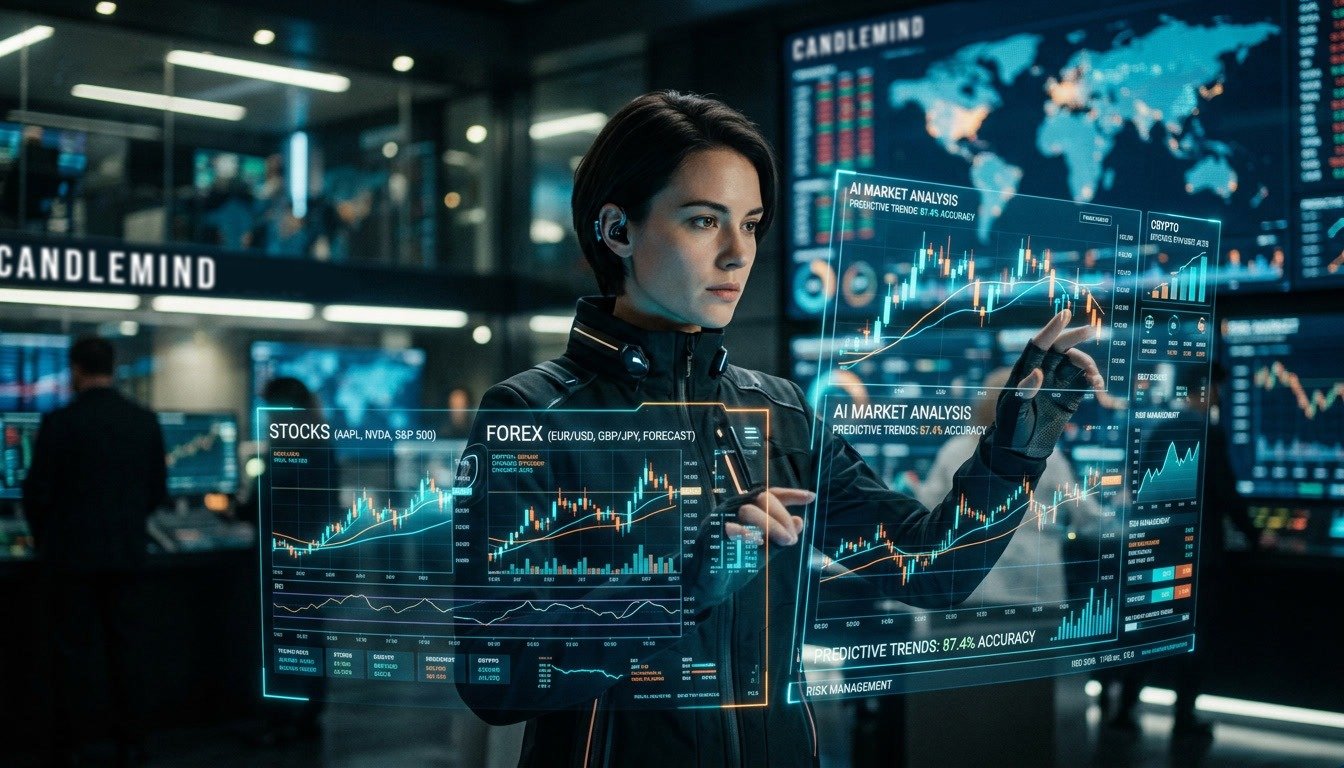
CandleMind uses a predictive pattern recognition engine. This AI-driven system doesn’t just spot a pattern. It cross-references it with thousands of historical examples and, crucially, layers on current market conditions, like the VIX index level, sector fund flows, and options market activity, to generate a forward-looking probability score.
Thus, a static observation becomes an actionable, data-driven insight about what might happen next.
3. Volatility-Adjusted Backtesting
Backtesting a trading strategy is standard practice, but conventional methods have a dangerous flaw. They often use smooth, averaged historical data that completely ignores the chaos of a real market crash.
A strategy that looks great over a 10-year period might fail spectacularly during a single week of intense stock market volatility. A vital feature for survival is volatility-adjusted backtesting. This lets a trader stress-test their strategy against historical “black swan” events and periods of pure market panic.
By simulating how a strategy would have performed during the 2008 financial crisis or the 2020 COVID-19 crash, traders get a much more honest look at its true risk profile.
Learning to use the backtesting tools in CandleMind for strategy development can be a powerful way to reduce potential losses before risking real capital.
How Does CandleMind Compare to Free Tools like TradingView or Yahoo Finance?
With powerful free platforms available, any subscription fee needs a strong justification. Comparing CandleMind to a tool like TradingView reveals a fundamental difference in philosophy.
Free tools are fantastic libraries of historical data; paid, AI-driven platforms are built to be forward-looking decision engines.
• Focus of Analysis: Free tools are masters of descriptive analytics, offering excellent financial data visualization to show you what has already happened. CandleMind is built around predictive market analytics, using its AI to project what is statistically likely to happen next.
• Managing Risk: On a free platform, risk management is a manual process of drawing lines on a chart and setting stops. Advanced platforms integrate risk management directly into the workflow with dynamic tools like volatility stress-testing and risk-based position sizing suggestions.
• Signal Quality: Free platforms often have a vast library of community-built indicators and scripts, but their quality can be hit-or-miss. A specialized platform like CandleMind provides signals generated from a proprietary, centrally-managed AI engine that is always being refined.
Is CandleMind Worth the Investment for a Beginner Trader?
For a novice, the price of a sophisticated trading platform can seem steep. It might be better to frame the cost as an investment in managing risk. The biggest expense for a new trader isn’t a software subscription, it’s the string of costly, avoidable mistakes they make in their first year.
A platform like CandleMind can potentially pay for itself by helping a beginner avoid just one or two major blunders. By providing tools that reduce emotional trading, clarify market sentiment, and stress-test ideas before they’re implemented, it gives a new trader a fighting chance.
CandleMind is a tool designed to grow with you, offering basic guidance for novices and deep analytical power for experts.
5-Point Checklist for Choosing Market Analysis Tools
When you’re trying to find the best trading platform for your needs, especially in unpredictable markets, look beyond the feature list and ask these questions:
1. Is it predictive? Look for tools that use AI or quantitative analysis to model what could happen, not just plot what already did.
2. How smart is the sentiment analysis? Does it offer more than a simple “positive/negative” score? It should analyze the context and quality of the source.
3. Can I break my strategies? A solid backtesting engine that simulates performance during historical crashes is essential for serious risk management.
4. Does it fit my trading style? A long-term investor needs different tools than a day trader. Make sure the features align with how you trade.
5. Is it easy to use? All the data in the world is useless if it’s confusing. The platform should bring clarity to the market, not more confusion.
Who Should Use a Tool Like CandleMind?
A platform like this isn’t for everyone. It’s built for active traders who see market volatility not as a threat, but as an opportunity. The ideal user is probably one of these:
• Day Traders and Swing Traders: People who make frequent decisions and need real-time, high-quality data to find and validate short- to medium-term opportunities.
• Technical Analysts: Traders who lean heavily on chart patterns and stats and want to augment their skills with AI-powered predictive insights.
• Forex and Crypto Traders: Anyone participating in 24/7 markets where news and sentiment can dramatically impact price.
On the other hand, it may not be the right fit for passive, long-term buy-and-hold investors. If you rarely make changes to your portfolio and see daily market swings as noise, a simpler tool will do.
As algorithms and AI play a bigger role in the markets, the tools for retail traders have to keep up. The edge today isn’t just about having data, but being able to interpret it with speed and context. Features that offer predictive insights, nuanced sentiment analysis, and tough risk simulation are no longer “nice-to-haves,” they’re becoming essential.
The platforms that will lead the way are those that successfully make AI an intelligent partner for the human trader, not just another alert generator. They will be the ones that equip their users to not only survive volatility but to thrive in it.