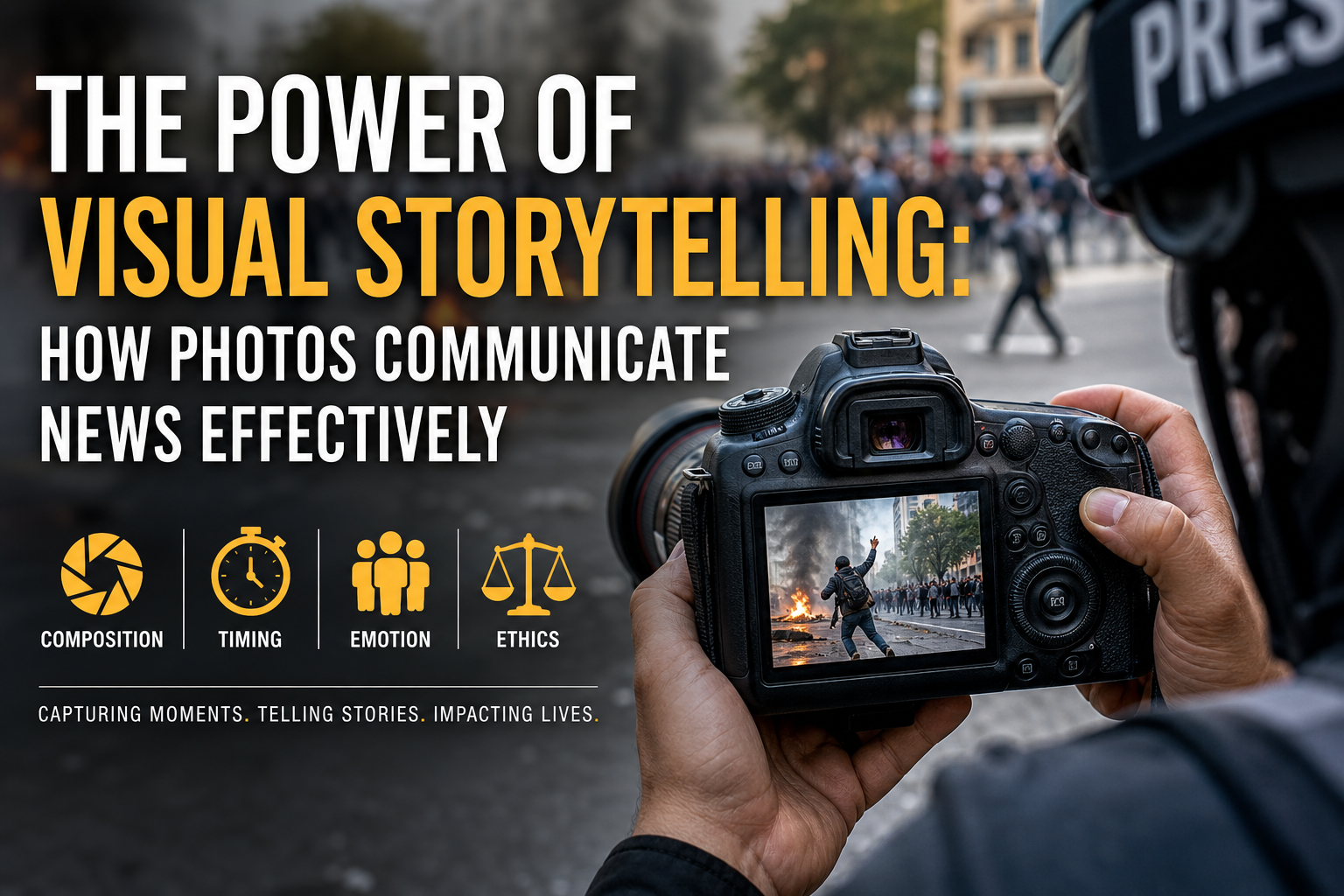
In the dynamic media space, the need to convey information rapidly, clearly, and engagingly is important. News and information are abundant in online media environment and can be difficult for journalists to communicate. In this context, visual communication plays an important role in journalism, and photography is an important element. Images can be used to bypass language barriers, convey feelings and ideas. So the use of photography as a communication tool in journalism is a vital element in the production, dissemination and consumption of news around the world.
Images communicate information instantaneously, while words take time to read. Photographs can convey information and feelings. Images are visual representations of events, documenting war, victories, and injustices. This piece looks at the power of images in reporting news, and how composition, timing, and subject matter contribute to the effectiveness of photography in news reporting.
Recognising Photography as a Communication Medium
Journalistic photography doesn’t just represent reality, but also illustrates and translates events to communicate and entertain. Photography is a representation, and the photographer will control how to frame, position, light, and place the subject. And this affects the viewer’s perception of the narrative and its meaning. So, photography as a communication tool in journalism is art and information.
To understand this, it’s important to consider the principles of photography as a communication tool in journalism, which focuses on using images as narrative elements in media. This perspective emphasizes that photographs are not just depictions of reality but also narration elements. They direct the viewer’s attention via composition, focal points, and context.
Roles of Photography in Journalism
In journalism, photography performs many crucial functions in the communication of news:
Documentation
Provides visual evidence of events that happened.
Explanation
Illustrates complex story through imagery.
Engagement
Attracts and engages audience attention, encouraging interaction.
Emotional Connection
Evokes emotions that aid comprehension.
Memory Formation
Creates lasting memories.
Images are news stories’ most memorable element. Sticky pictures can live on beyond the text and become part of our collective and public memories.
The Importance of Composition in Photography
Organizing Visual Elements
Composition is an important element of photography. It’s the way the elements are arranged in the image to create a composition. When it comes to journalism, composition is more than art, it is also about information. Good composition assists the viewer to understand the subject and story.
Essential Composition Techniques
There are many techniques that photojournalists use to aid storytelling:
Rule of Thirds
Gracing the image with lines to help place the subject.
Leading Lines
Directing attention.
Framing
Creating a frame around the subject.
Contrast
Creating contrast with colours, tones, and/or textures.
Balance and Symmetry
Creating visual balance and uniformity within the image.
These are key in news images, as they must communicate the message effectively and efficiently without explanation.
Emotional Influence of Composition
Composition also impacts the emotional response. A portrait can create intimacy, and allow identification with the person portrayed. Long shot can give context and scale, emphasising the scale of the event, such as a natural disaster or rally. Compositions enable photojournalists to direct the viewer’s interpretation and reaction to a story.
Timing in Photojournalism
The Decisive Moment in Journalism
Timing is an important factor of photojournalism. Timing is also known as the “decisive moment”. Timing involves taking a photograph at the exact time when all of the components of a scene come together to convey something. This is particularly so in journalism where there are constantly changing events.
Why Timing Matters
Effective timing contributes to storytelling in different ways:
Captures Peak Action
Depicts the most important moment in an action.
Reveals Emotion
Depicts genuine reactions.
Enhances Realism
Captures spontaneous moments.
Enhances Storytelling
Emphasizes key elements in a story.
The perfect moment can communicate feelings, actions, and moments that are difficult to put into words.
Skills Required for Perfect Timing
To get the perfect moment, photojournalists have:
Observation Skills
Always being aware of the environment.
Anticipation
Predicting when key moments will happen.
Camera Skills
Quickly adjusting camera settings.
Quick Reflexes
Reacting immediately to occurring events.
These abilities help photographers respond to the fleeting moments that explain powerful stories.
The Importance of Subject Matter in Storytelling
What to Include and Exclude
The subject of a photograph is crucial and central to its meaning. For a photojournalist, the subject is the event and the story. It is an editorial and moral decision, since it has an impact on public consciousness.
What Photojournalists Shoot: Types of Subject Focus in Photojournalism
Popular subjects include:
People
Showing people’s individual experiences.
Event Coverage
Depicting major events.
Environmental Context
Using surroundings for background.
Symbolic Imagery
Using objects or locations to represent something.
Depictions of people can often humanise issues, making them more accessible and engaging.
Inclusion and Exclusion Power
All images are selective. Some elements that are included in the frame are used to tell the story, while what is excluded could alter the meaning and have a negative influence. They have to make choices, and demonstrate objectivity and not be biased or prejudiced.
Instant Communication: Visual Speed
Instant communication is a characteristic of journalism photography. In an information age, where information is moving at a fast pace and audiences read quickly, images provide a fast track to the story. A good image can be identified in a few moments, enticing the viewer.
Advantages of Visual Communication
Efficient Processing
Information is processed quickly.
Cross-Lingual
Visuals are cross-cultural.
High Retention
Images are more memorable.
More Effective
Appeals to reason and emotion.
For instance, a picture of an area ravaged by a flood illustrates a disaster.
Emotional Appeal and Audience Connection
Images also need to have emotional appeal. Photography’s ability to create emotion is one of its most powerful attributes. Audiences respond to news in an emotive way. Images that evoke empathy, surprise, or interest are more likely to be viewed and read.
How Photography Engages Audience Emotionally
Generates Empathy
Connects audience to subject.
Raises Awareness
Points out social and global issues.
Stimulates Change
Inspires activism or support.
Enhances Memory
Emotional images are more memorable.
Photos help news stories as they appeal to the audience and aid understanding.
Ethics of Photojournalism
Ethics is involved in journalism photography. A photojournalist needs to follow the ethics of accuracy, fairness, and respect to gain credibility.
Core Ethical Principles
Accuracy
Accurately depict events with images.
Integrity
Don’t manipulate to change meaning.
Respect
Respect and protect human dignity and privacy.
Accountability
Taking responsibility for visuals.
Common Ethical Challenges
• Balancing individual privacy with public interest
• Respecting delicate issues by avoiding sensationalism
• Not taking things out of context
• Navigating cultural sensitivities
Ethical photojournalism helps to make visual storytelling legitimate, accountable, and trustworthy.
Technology’s Impact on Visual Storytelling
Photojournalism has been transformed by technology. High quality cameras, mobile phones, and image editing software have made it easier to produce images. Photos can also be distributed through social media, and have the potential to go viral in minutes.
Technological Advantages
Instant Sharing
Sharing images in real time.
Better Resolution
High resolution images enhance clarity.
Accessibility
More storytelling possibilities.
Global Reach
Greater audience reach.
Emerging Challenges
• Risk of image manipulation
• Spread of misinformation through images
• Challenge in validating user-generated images
• Excess of imagery
Looking over these challenges, technology is also opening up new possibilities for journalism photography.
Conclusion
Digital storytelling is an important part of news reporting, and photography is a crucial part of communication and understanding. Content, composition, and timing are just some of the ways to communicate ideas through photography. Photography can resonate with viewers, facilitate understanding, and create attractive and persuasive images.
The use of photography in the media is growing in the dynamic world. In this highly visual world, it is important that journalists are skilled in telling effective and ethical stories through photography. With an awareness of the principles of visual storytelling and ethics, those in the media can communicate, educate, and entertain viewers across the globe.



Your tips are practical and easy to apply. Thanks a lot!