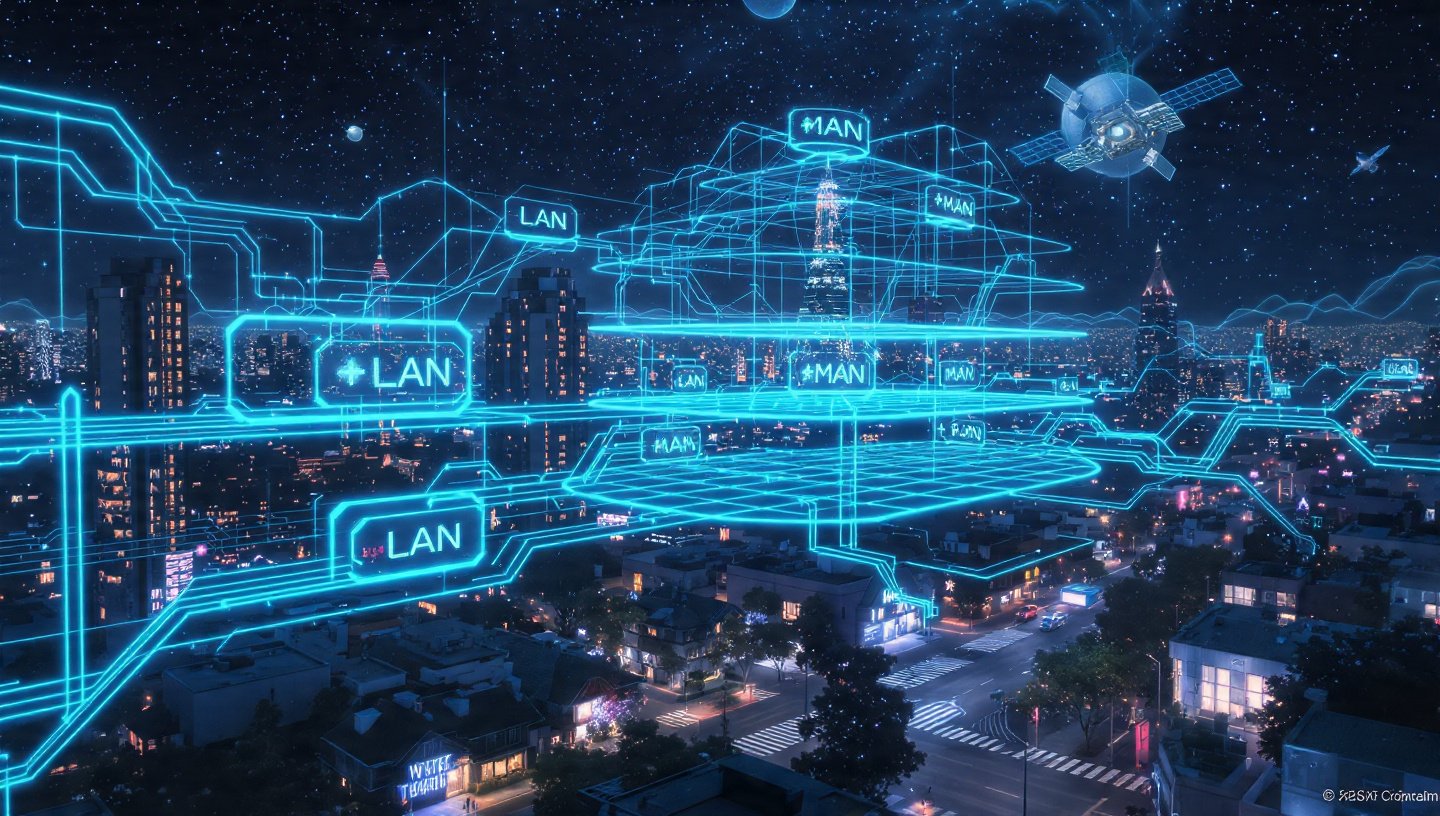
Computer networks in the interconnected world today constitute the backbone of almost all digital interactions. Networks enable communication between the receipt of a message on your phone and running the financial systems of the world. But not any networks are the same. They are varied in terms of size, use and complexity. Thus, the concept of the various computer network types- and their application in real life- would assist in closing the gap between the theory and its application.
This article will discuss the main classifications of computer networks, such as Local Area Networks (LANs), Metropolitan Area Networks (MANs) and Wide Area Networks (WANs). Furthermore, we shall also look at the way each type is used in home, businesses as well as in the world communication systems.
Understanding Computer Networks
A computer network is a group of interconnected devices which share resources and exchange information. Such devices could be computers, servers, smartphones, and IoT devices. In addition, networks may also be either wired or wireless based on the connection of the devices.
Networks are usually categorized in terms of their geographical scope. Indicatively, certain networks are restricted to a small locality such as a home whereas others cover the whole country or even continent. This has led to the various kinds of networks being created to suit various needs.
Local Area Networks (LANs).

Local Area Network (LAN) is a network that links devices in a small geographical territory, which can be home, school or office building. Typically, LANs are privately owned and managed.
Important features of LANs.
- Small geographic area (building or campus)
- Speedy data transfer.
- Small latency and high reliability.
- Generally controlled and owned by one entity.
Applications of LANs in the real world.
Home Networks
To-days LANs are used to connect devices like laptops, smartphones, smart TVs and gaming consoles. As an illustration, a Wi-Fi router will enable the family members to share the internet and files. Consequently, processes such as streaming, online games and printing of documents are smooth.
Educational Institutions
LANs are very important to schools and universities to link computer labs, classrooms and administrative offices. In addition, students have access to common facilities like printers, e-learning systems and internal databases. LANs are thus important towards improving the learning process.
Business Environments
LANs allow employees working in offices to share files, work on projects and use centralized systems. An example is that internal email server and file storage systems of a company are in a LAN. Moreover, LANs allow such tools as video conferencing and enterprise software to work, enhancing the level of productivity.
Metropolitan Area Networks (MANs)
A Metropolitan Area Network (MAN) is broader in terms of geographical scale compared to a LAN, and is typically a city or a big campus. MANs tend to interconnect up to smaller networks unlike the LAN. They thus serve as an interface between local and wide-area networks.
The main features of MANs.
- Is over cities or urban areas.
- Connects multiple LANs
- Average to high data speed.
- Provided by service providers or government agencies.
Applications in MANs in the Real World.
City-Wide Internet Services
Most cities are installing MANs to offer connectivity to the internet to its citizens and companies. To illustrate, in cities, the MAN infrastructure is frequently used to support public Wi-Fi systems. This has led to the availability of the internet by the users in various places within the city.
Government and Public Services.
MANs are used in government agencies to network various departments within a city. An example is that traffic management systems, surveillance networks and emergency services are based on MANs to share data in real-time. Thus, such networks contribute to the safety and effectiveness of people.
University Campuses
MANs are frequently used by large universities that have more than one campus located in a city and use them to interconnect their LANs. Such an arrangement enables easy interaction and exchange of resources among the departments. Moreover, it facilitates centralized management and research partnership.
Wide Area Networks (WANs).

Wide Area Network (WAN) is a wide geographical network, e.g. country or continent. Actually, WANs are used to interlink several LANs and MAN to provide international communication. The most visible one of such WAN is the internet itself.
Some of the main features of WANs.
- Cover large geographical locations.
- Brings together a number of smaller networks.
- Reduced speeds than LANs (because of distance)
- Depends on the public and private communication infrastructure.
Applications of WANs in the real world.
Global Internet Connectivity
The biggest WAN is the internet. It links billions of gadgets globally, facilitating services like email, social media and cloud computing. Consequently, individuals are able to interact and to get information in real-time, without the need to be at a particular place.
Multinational Businesses
WANs are implemented in large corporations that have multiple offices in various countries. Using the example, a firm which has its branches in Lagos, London and New York can share information and be in touch in real time. Further, WANs facilitate cloud-based applications which are critical in the contemporary business activities.
Financial Systems and Banking.
WANs are important to banks as they are used to make transactions among branches and ATMs worldwide. Thus, customers will have an opportunity to take money or send money anywhere it is virtually possible. Moreover, WANs guarantee secure and reliable communications among financial institutions.
Comparison of LANs, MANs and WANs.
The differences between these types of networks are useful in selecting the appropriate type of network to be used in certain needs.
- Feature
- LAN
- MAN
- WAN
- Coverage Area
- Small (building)
- Medium (city)
- Large (country/continent)
- Speed
- High
- Moderate to high
- Less than LAN.
- Ownership/ Private/Public/Private.
- Cost Low, moderate, high.
- Sample
- City Wi-Fi
- Internet
- Home network.
As indicated in the above illustrations, all types of networks have distinct functions. Thus, the choice of the appropriate network is dependent on the size, budget and the necessary performance.
Other categories of computer networks.
Although the most common types of networks are LANs, MANs, and WANs, there are others that are worth mentioning.
Personal Area Network (PAN).
A Personal Area Network links gadgets over a very limited distance typically around a person. As an example, a smartphone and wireless earbuds using Bluetooth connections will create a PAN. Therefore, PANs are suitable in personal use.
Campus Area Network (CAN).
A Campus Area Network resembles a LAN except that it is larger in scope e.g. a university campus. It links together several buildings in a small area. Thus, CANs are widely applied in schools and companies.
The Networks Play a Role in the Contemporary Society.
Computer networks play a crucial role in life today. They facilitate communication, business activities, education and entertainment. In addition, they facilitate the new technologies like cloud computing, artificial intelligence, and Internet of Things (IoT).
As an example, smart homes are based on networks and use them to integrate appliances, such as thermostats, security cameras, and voice assistants. Correspondingly, networks enable businesses to analyze and make informed decisions. Consequently, networks are the source of innovation and economic development.
Challenges and Considerations
Computer networks have their disadvantages as well as advantages. Hackers and data breaches are just one example of security threats that are of high concern. Thus, companies need to establish effective security.
Moreover, network congestion and hardware capacity can also influence network performance. Then, it is necessary to have the proper network design and maintenance. Scalability is another factor which is significant particularly in expanding businesses.
Conclusion
To conclude, computer networks are classified according to their size and area of coverage with LANs, MANs and WANs being the most common. They all have different uses, including linking appliances in a house to worldwide communication.
In addition, the insight into the functioning of these networks in the real world emphasizes the significance of the networks in the daily life. Networks are important whether it is a student utilizing the online resources, a business running its operations, or a bank in its transactions.
With the ever-evolving nature of technology, there will be increased need to have efficient and reliable networks. Thus, to be able to navigate the digital world, one should have a good grasp of these types of networks.