Introduction
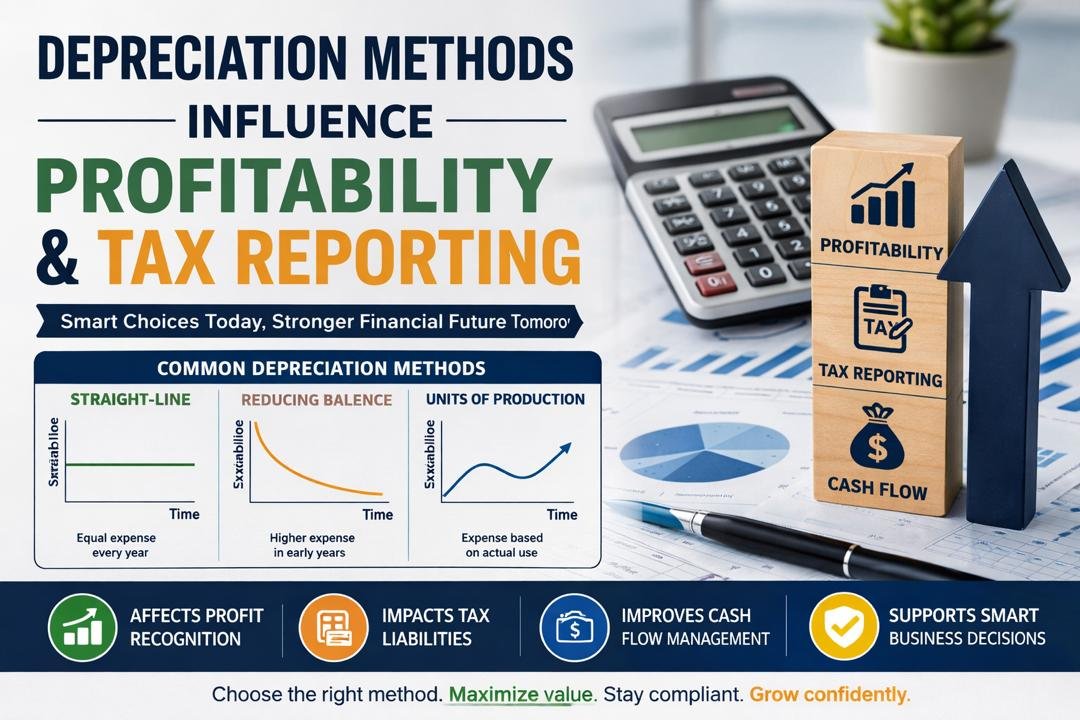
Depreciation is a basic principle in accounting which allows companies to report the value of tangible assets over those assets’ useful lives. Although it may seem like a basic accounting entry, the choice of depreciation methods influence profitability and tax reporting has large scale effects on a company. What we put forward for depreciation method may greatly report which profits a company is seeing, which taxes it is paying out, and also how the public looks at the health of a company’s finances.
In practice companies should pay close attention to what depreciation method they choose as this is not a trivial issue of form it is a strategic issue. What method you choose determines the time in which expenses are recognized which in turn reports on income and taxes. This article looks at how different depreciation strategies play out in terms of profitability and tax reporting and we use practical examples to show their real world impact.
Understanding Depreciation and Its Purpose
Depreciation is the process of allocating an asset’s cost over that which it is to be used. We see that machines, vehicles, buildings, and equipment over time wear out, become obsolete, or are used up. Instead of recording the full price of an asset in the year of purchase we instead see that the cost is spread out over the term of the asset’s useful life.
Primary aims of depreciation are:
- Matching outlays with revenue from the asset.
- Reflecting asset depreciation over time.
- Presenting a practical measure of profit.
- Ensuring compliance with accounting standards
However although the goal is the same the method of depreciation may differ which in turn produces different results.
Common Depreciation Methods
In accountancy there is a variety of depreciation methods which are very much in use. Each method has its own way of approaching things which in turn causes different patterns of expense recognition.
Straight-Line Method
The straight line method of depreciation reports the same amount of expense each year over the asset’s useful life. Also it is the easiest and most popular method.
If a firm buys equipment at ₦1,000,000 which has a useful life of 5 years and no salvage value the annual depreciation expense will be ₦200,000.
This approach produces steady and consistent expenses which in turn makes it easier to predict profits.
Reducing Balance (Declining Balance) Method
In the reducing balance method depreciation is calculated at a constant rate of the asset’s book value at the beginning of each year. Which in turn causes large depreciation expenses in the early years and small in the later years?
For example, if an asset which is worth ₦1,000,000 is depreciated at 40%:
- Year 1: N400,000.
- Year 2: N240,000.
- Year 3: ₦144,000.00.
This method reports that which is true that many assets lose value very fast in the early years.
Units of Production Method
This method of depreciation is based on the use of the asset instead of time. It is applied mainly to machinery and equipment which wear out according to how they are used.
For instance, if a machine is to produce 100,000 units over its life and it produces 20,000 units in a year then 20% of its cost will be written off in that year.
This approach has that depreciation track asset’s productivity very closely.
Impact on Profitability
The way in which a company chooses to account for depreciation has a large role in what it reports for profit as depreciation is to be treated as an expense in the income statement.
Timing of Expense Recognition
Different approaches see different expense patterns:
- Straight-line method: Equal outlay each year.
- Reducing balance method: At first higher expenses, later lower.
- Units of production: Variable cost per use.
Expenses which include depreciation are what causes profit to go down and thus the timing of when we report depreciation will see profits report as either higher or lower.
Early vs. Later Profitability
Using the accelerated method of depreciation, it lower profits in the early year’s reports due to large depreciation charges. As we go out into the later years of the asset’s life Profits report higher.
The straight line method also does so.
Example:
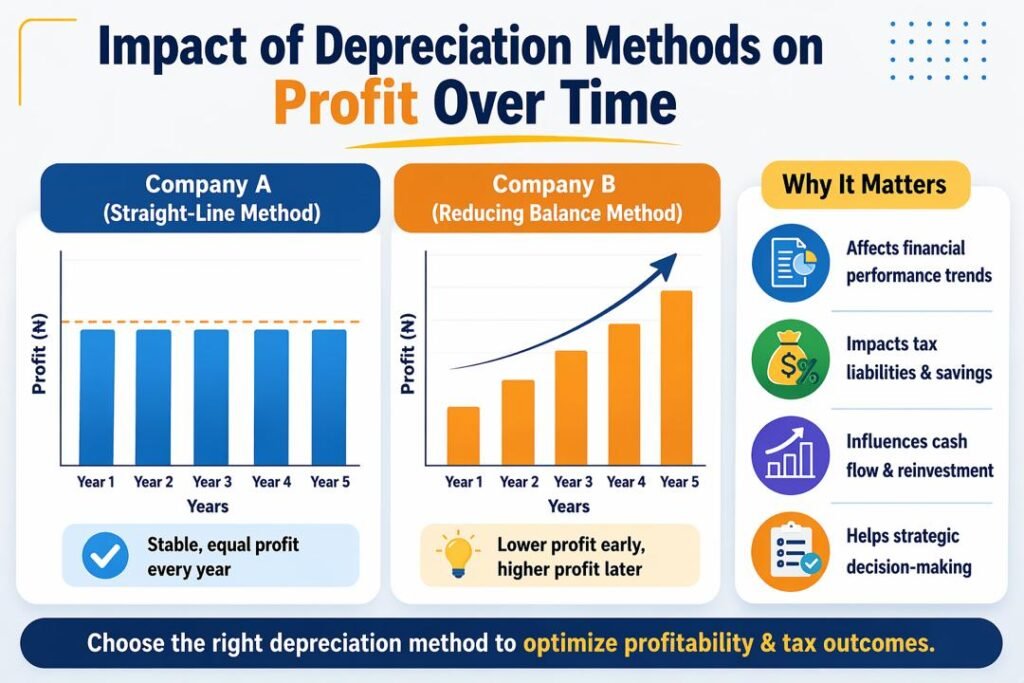
Two companies buy the same equipment for ₦1,000,000.
- Company A has a straight line depreciation of ₦200,000 annually.
- Company B uses the reducing balance method (40%)
In Year 1:
- Company A reports greater profit (reduced depreciation expense).
- Company B reports lower profits (greater depreciation expense).
In later years, the situation reverses.
This shows how the choice of depreciation method will affect financial performance trends.
Impact on Financial Ratios
Depreciation also plays a role in determining:
- Net profit margin
- Return on assets (ROA)
- Earnings before interest and taxes (EBIT).
Higher depreciation is a factor in reduced net income and as a result may also reduce profitability ratios but that is not the same thing as poor performance it may just point to a different accounting approach.
Impact on Tax Reporting
Depreciation is a key element in the calculation of taxable income. Also it is a deductible which means the greater the depreciation the lower the taxable profit.
Tax Savings through Depreciation
Companies that tend to use which speed up the depreciation of assets for tax purposes in the early years of an asset’s life.
For instance through use of the reducing balance method a business is able to claim greater deductions at the start which in turn results in lower tax during those years.
Deferred Tax Implications
While accelerated depreciation may lower taxes in the short term it also puts off rather than eliminates, which is what many think. Also time sensitive, it does put back these tax payments until a later date instead of reducing them out entirely.
Through the asset’s lifetime:
- Total depreciation remains the same
- Total tax paid is the same.
However at different times tax payments are due.
This has a tax deferment benefit which allows companies to hold onto cash for reinvestment.
Regulatory Considerations
Tax authorities put out what is and isn’t an acceptable method of depreciation and rate. In the case of Nigeria for example tax regulations may differ from what is put forth by accounting standards which in turn require companies to keep separate records for tax purposes.
This results in:
- Differences between reported profit and tax profit.
- Deferred tax assets or liabilities
Companies need to comply with tax laws at the same time which is when they are also to optimize their depreciation strategy.
Practical Examples of Financial Implications
Example 1: Industry Group.
A business buys output of machinery for ₦5,000,000.
- Using straight-line depreciation (5 years): ₦1 million per year.
- Using reducing balance (40%): Greater depreciation in early years.
At the start of the first year:
- Straight line method produces greater profit and higher tax.
- Reducing balance lowers profit and tax.
This is a big factor in terms of cash flow, in particular for growing companies.
Example 2: Transport which also includes business operations of transport.
A logistics company has large vehicle use. As wear and tear goes by mileage, we use units of production method.
In years with heavy usage:
- Depreciation expense increases
- Profit decreases
- Tax liability decreases
In low-usage years, the opposite occurs.
This approach better represents asset consumption.
Example 3: Tech Company.
A technology company which has bought out dated equipment is using an accelerated depreciation method.
This approach:
- Decreases tax liability in the early years.
- Depreciates with the rate of asset’s fast decline.
- Improves cash flow for reinvestment
Strategic Considerations in Choosing Depreciation Methods
Choosing a depreciation method is a strategic issues not just an accounting one.
Nature of the Asset
Different assets require different approaches: Different types of assets have different strategies:.
- Buildings: Straight line method.
- Machinery: Depreciation methods based on use.
- Technology: Accelerated approaches.
- Selecting practices which mirror real world application improves the accuracy of financial reports.
Business Objectives
Companies may choose depreciation methods that which to achieve their financial goals:
- To show stable earnings: Use right angle.
- To minimize taxes early: Use fast paced methods.
- To match usage: Depreciation by units of production.
Cash Flow Management
Accelerated depreciation is also better for startups and that which pays off in the early years’ tax savings. Also true for companies which are in growth phases.
Investor Perception
Consistency in profits is what many investors see as a plus. For companies which want to sustain the same level of financial performance yearly the straight line method is preferred.
However smart investors usually review base accounting policies which present the true financial picture.
Compliance and Reporting Standards
Companies have to follow accounting standards like IFRS and GAAP. These are frameworks in which in turn require that depreciation methods be applied in a consistent and transparent manner.
In any case of method change it must be reported.
Advantages and Disadvantages of Different Methods
Straight-Line Method
Advantages:
- Simplicity
- Predictability
- Easy to apply
Disadvantages:
- May not represent true asset usage.
- Does not account for early wear and tear.
Reducing Balance Method
Advantages:
- Matches higher early usage
- Provides tax benefits early
Disadvantages:
- More complex
- Lower profits in early years
Units of Production Method
Advantages:
- Highly accurate
- Reflects actual usage
Disadvantages:
- Requires detailed tracking
- Less predictable
The Role of Depreciation in Finance Planning
Depreciation is a key element in financial planning.
- Manage earnings trends
- Optimize tax payments
- Improve cash flow
- Align expenses with asset usage
Also it is a fine line between which we must walk.
Ethical Considerations
While companies may choose which depreciation methods to use, ethical issues should play a role in that decision. Presenting a distorted picture of financial results through the manipulation of depreciation is to mislead stakeholders and go against accounting principles. Transparency, consistency, and compliance with standards are the bases for credibility.
Conclusion
Depreciation methods influence profitability and tax reporting in companies finances. The choice of which approach to use impacts on what is reported for profit as well as tax liabilities, cash flow, and shareholder perception. Although the total depreciation of an asset over its lifetime is the same for all methods the timing at which that expense is recognized which is different and thus produces various financial results.
Comprehension of how various depreciation methods influence profitability and tax reporting allows businesses to report to their strategy. As for which to choose between tax savings, stable earnings, or precise cost allocation it is up to the company to thoughtfully choose.
In many cases the choice of depreciation methods goes beyond what is required by accounting rules it is a strategic issue which affects a company’s long term financial health and sustainability.
Get more well researched information about Depreciation methods influence profitability and tax reporting here.