Introduction
In the field of accountancy accuracy is the key. We see that companies depend greatly on precise financial reports to make informed decisions, run transparent books, and also to be in compliance. To that end we have the bank reconciliation process which is a very important element of that. While very important many people particular beginners find it a confusing and daunting task.
In fact we see that bank reconciliation is a very simple and practical process once you grasp what it is you’re doing and the steps involved. This article we put out in very simple terms, we break down the concept into structure pieces which also touch on why we see differences between what we have in our cash book and bank statement, how to go about preparing a reconciliation statement, and how to find out and fix common issues.
What is Bank Reconciliation?
Bank reconciliation is what a company does to compare its own financial records (cash book) with the bank statement which the bank provides. The aim is to see that both sets of record agree and report the true financial picture of the business.
In most cases what we see is that the balances do not agree. This may not be an error in fact it is at times a result of timing issues or unrecorded transactions.
Why is Bank Reconciliation Important?
In financial management bank reconciliation is of great importance which also includes:
1. Identifying Issues
It is a tool which brings to light errors in the cash book or the bank statement like incorrect entries or omissions.
2. Preventing Crime
Regular review of accounts can identify which transactions are unauthorized which in turn helps businesses to detect fraud at an early stage.
3. Guaranteeing Accuracy
It’s that which we see to it that the financial records are current and correct which in turn is key to good reporting and decision making.
4. Enhancing Cash Flow Management
Businesses can better control their cash flow and avoid overdrafts or liquidity problems.
Grasping the concepts of Cash Book and Bank Statement
Before jumping into reconciliation notes that which two primary records we are working with are what you should first familiarize yourself with.
- Cash Book: The business maintains a cash book which includes all cash and bank transactions that is receipts and payments.
- Bank Statement: The bank issues the statement that includes all transactions which go through the account.
Although there is similarity in what they record, what we see are differences which come from the timing and different methods of record keeping.
Why Do Discrepancies Occur?
Time variation issues and errors are common.
1. Time Variations
At times accounts reflect transactions which have not yet been recorded in the other.
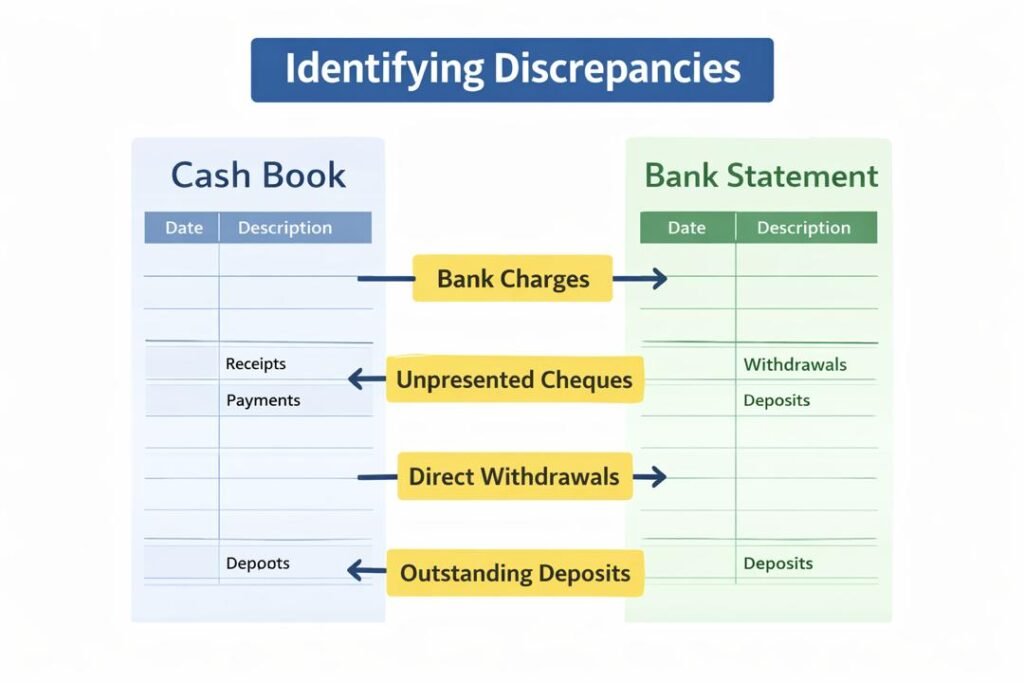
- Unpresented Cheques: These are checks which the business has written out but which have not yet been taken to the bank for payment. That is they appear in the cash book but not in the bank statement.
- Outstanding Deposits (Uncleared): These are entries in the cash book which have not yet been posted to the bank.
- Bank Process Time Issues: At times banks’ processing of transactions is delayed which in turn causes temporary variances.
2. Items recorded by the Bank
Some transactions are recorded by the bank but have not yet been posted to the cash book.
a. Fees charged by the bank.
Banks take out service fees right from the account which the business may not have even known about.
b. Interest Revenue.
Interest which is put in by the bank may still be out of the cash book.
c. Direct Withdrawals from account for payment of bills etc.
Automatic utility bill and loan repayment charges are processed by the bank without a prior entry in the cash book.
d. Standing Rules.
Account holders may set up regular payments that go through the bank but don’t show right away in the cash book.
3. Errors
Errors which may happen in the cash book or the bank statement:
Errors in the General Journal of Cash
- Omission of transactions
- Double entries
- Incorrect amounts recorded
Errors in the Bank Statement
Banks do make errors which include posting wrong amounts or repeating transactions.
Steps in the Bank Reconciliation Process
The reconciliation process is a system wide check of records and correction of differences.
Step 1: Get into the details.
Gather up the latest cash book and bank statement for that time period.
Step 2: Compare Payments.
Tick out matching entries in both records. Also note which items are present in one record and not the other.
Step 3: Point out Differences.
List out all that which are amiss such as postdated cheques, pending deposits, bank fees, and mistakes.
Step 4: Update the cash book.
Adjust the cash book to include items which the bank has noted but that have not yet been entered in our records like bank charges and interest.
Step 5: Prepare the annual bank reconciliation report.
Use the adjusted cash book balance in the process of reconciling with the bank statement balance.
Format of a Bank Reconciliation Statement
A usual bank reconciliation statement begins with:
- The revised cash book balance, or.
- The bank statement balance
Then issues of time are addressed.
Example Format:
Bank Reconciliation Statement as at (Date)
Balance as per cash book
Add: Distinguished deposits.
Less: Outstanding cheques.
Adjusted balance= Balance as of the bank statement.
Practical Illustration
Let’s consider a simple example: Here is a simple example:.
- Cash book balance: N50, 000.
- Unpresented cheques: N10, 000.
- Outstanding deposits: 5, 000 Naira.
Calculation:
Balance in the cash book = ₦50, 000.
Add outstanding deposits = ₦5, 000
Less unpresented cheques = ₦10, 000
Adjusted balance = ₦45, 000
This should align with what is reported on the bank statement.
Common Errors and how to fix them
Awareness of what goes wrong is the first step to accurate reconciliation.
- Omitted Transactions: If there is a missing transaction in the cash book it should be recorded at once.
- Misidentifications: Correct the figures in the cash book and record the changes.
- Multiple Entries: Remove the repeat entry and correct the balance.
- Transposition Errors: These happen when numbers are put in reverse (e.g. 54 instead of 45). We can fix them to restore accuracy.
Adjusted Cash Book
Before putting together the reconciliation report the cash book is adjusted to include all entries.
Adjustments Include: Includes:
- Bank charges
- Interest income
- Direct debits
- Standing orders
After changes the revised cash book balance is the start of reconciliation.
Tips for Effective Bank Reconciliation
Here are some tips to make the process easier and more efficient:
- Reconcile Regularly: Conduct a monthly review to identify issues early.
- Keep accurate records: Make sure to record all transactions immediately and accurately.
- Use account software: Today’s tools are for automation of reconciliation and error reduction.
- Review your statements closely: Check for unusual or unauthorized transactions.
- Divide responsibilities: Assign separate personnel for transaction recording and reconciliation to reduce fraud risk.
Challenges in Bank Reconciliation
As it is simple in theory, we see that in practice:
- High volume of transactions: Large companies may have trouble with that.
- Slow bank updates: Bank processing delays can complicate reconciliation.
- Mistakes by humans: Manual input increases the chance of errors.
- Lack of Records: Lack of receipts and records makes it hard.
How Technology Simplifies the Process
In recent years due to growth in accounting technologies bank reconciliation has improved.
- Automated Matching: Software is able to automatically match transactions within records.
- Real-Time Updates: Integration of bank feeds provides real time data.
- Error Detection: Systems highlight discrepancies for quick resolution.
Role of Bank Reconciliation in Financial Management
Bank reconciliation is a core element of internal control systems.
- Enhancing Transparency: All transactions are covered.
- Supporting Audits: Accurate reconciliations are the foundation for audit reliability.
- Strengthening Accountability: It is the responsibility of the individual to keep accurate records.
Conclusion
The bank reconciliation process is a key element of accounting which is put in place to ensure the accuracy and reliability of financial reports. Although we see a great many discrepancies between the cash book and the bank statement they are in most cases due to time differences or small errors.
Through the analysis of what causes these differences and by implementing a systematic reconciliation process businesses may see to it that their records are accurate, errors are identified at an early stage, and financial control is improved. No matter what your role student, accountant, or business owner improving your bank reconciliation skills is a valuable asset which in turn improves your confidence in financial management.
Through consistent practice and attention to detail what once was complex is now simple and routine which in turn brings clarity and control to your financial operations.
Get more well prepared information about Bank Reconciliation here.