Most burnout among homeschoolers doesn’t come from the amount of work – it comes from the wrong model of work. They start off trying to replicate the public school day in their home: set periods, bells, a solid six hours at the desk. And in no time flat, they’re miserable. But the goal here isn’t to rebuild a classroom in your living room. It’s to build something better.
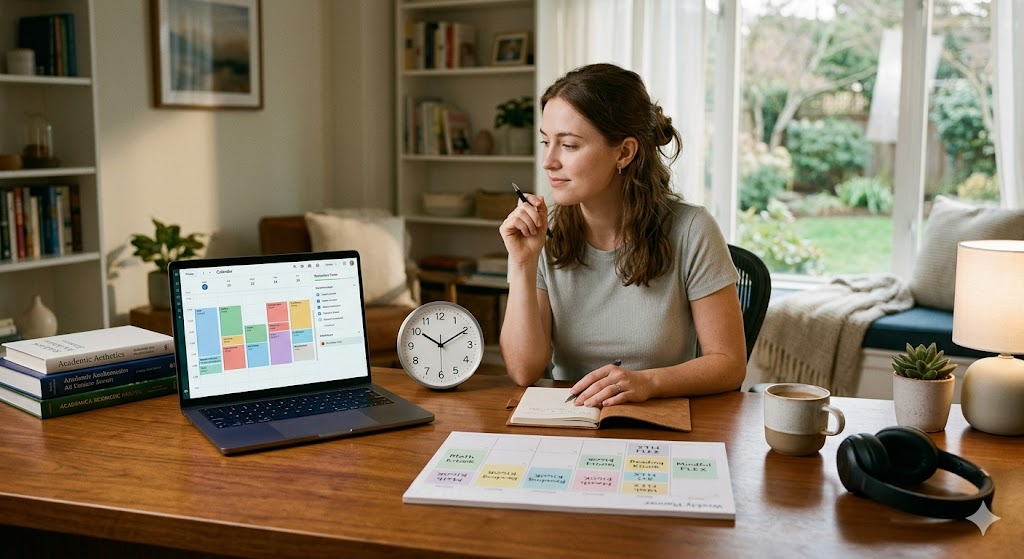
Build around anchor points, not time slots
One of the best things you can do is establish two or three fixed points in the day – a morning routine to start the day, lunch as a break somewhere in the middle, some kind of physical activity – and leave everything else open. These give the day a structure without precluding sweeping the whole setup away on a mad whim.
Between those, though, you play it loose. A kid on a roll shouldn’t have to stop because a bell rang. One who’s stuck and frustrated at 11:30 shouldn’t have to soldier through something else because the clock says 11:30.
Match subject intensity to mental energy
This is also where you can get creative with field trips, hobby clubs, apprenticeships, incubators, and other “shadow real life” experience. These might only happen during the cognitive scheduled blocks or after 4:30 pm, and that’s fine.
Grade school is not about punching all the tickets; it’s about learning how to learn. When colleges look at homeschooling, they tend to ask for the curriculum and test results more than the number of hours in a classroom. The Accredited Online School model is worth considering here – having an external framework that defines what subjects need to be covered means parents aren’t guessing at rigor.
If anything, most households err in the other direction with the core subjects. It’s easy to cover mathematics required for a grade in three days, for example; the rest of the time can be math games reinforcing those lessons from the morning. The temptation will be to do more worksheets, more structure, and more “sunk cost” pushing through the blocks. That’s not necessary, generally; media studies and physical education will seem to take care of themselves by comparison.
Protect Friday for spiral review, not new content
One approach to teaching that consistently works: a spiral review day on Fridays. Research confirms what makes it so effective, too. The short- and long-term benefits of a weekly review of previously taught content and skills have been detailed in study after study.
For example, the journal Science published a study back in 2011 showing that students in a spiral review class (a group that consistently revisits previous material) outperformed students in a traditional class on the final exams – and not just the questions related to previously taught concepts. Spiral review students outperformed their peers on entirely new questions also.
One simple and effective way to implement a spiral review is to schedule it in during the last day of the week.
Document more than you think you need to
Every state or district will require a slightly different documentation, ranging from nothing to something pretty detailed. But this certainly doesn’t entail every test your child takes or every paper they write. Tuck away a representative sample – the first essay, one from halfway through the year, one mapping out evidence of improvement, and a concluding reflection or summary. Also slip test scores and any detailed special project documentation in there. Flip through these at the end of the year, and if you feel like you can tell a story about what they’ve learned and how well they’ve learned it, that’s probably enough.
Hand the schedule over, gradually
This is the piece most families skip and later regret. Through elementary school, the parent is the architect. By middle school, the student should be helping design the day. By high school, the student should own it almost entirely.
Executive function – the planning, prioritizing, and self-regulation skills that universities assume incoming students have – doesn’t develop without practice. A rigid schedule imposed from the outside doesn’t build those skills. Neither does complete unstructured freedom.
The middle path is a weekly planning meeting where the student lays out their blocks, identifies what they want to accomplish, and takes responsibility for hitting those targets. The parent’s job shifts from scheduler to accountability partner. That transition, done gradually, produces students who can actually manage a university workload without falling apart in the first semester.
Structure and flexibility aren’t opposites
The anxiety that prompts the question is understandable. If school does not occupy a set block each day, how can you be sure learning is not neglected? The answer is in granularity. It is easy to say “6 hours in school, 6 hours homeschooling” and feel you’re meeting obligations but it has no meaning. Insist on knowledge of the underlying schedule.
For instance, children spend more time in school than 6 hours because the hours from 8:00-3:00 are not all class time. That schedule includes time to homeroom, check attendance, get everyone seated and ready to learn, move to the next class, settle down, prepare to leave the class for the next subject, lunch, may also include recess and potentially others. That represents a lot of lost, task-switching time that you don’t have in a similar measure homeschooling.