Introduction
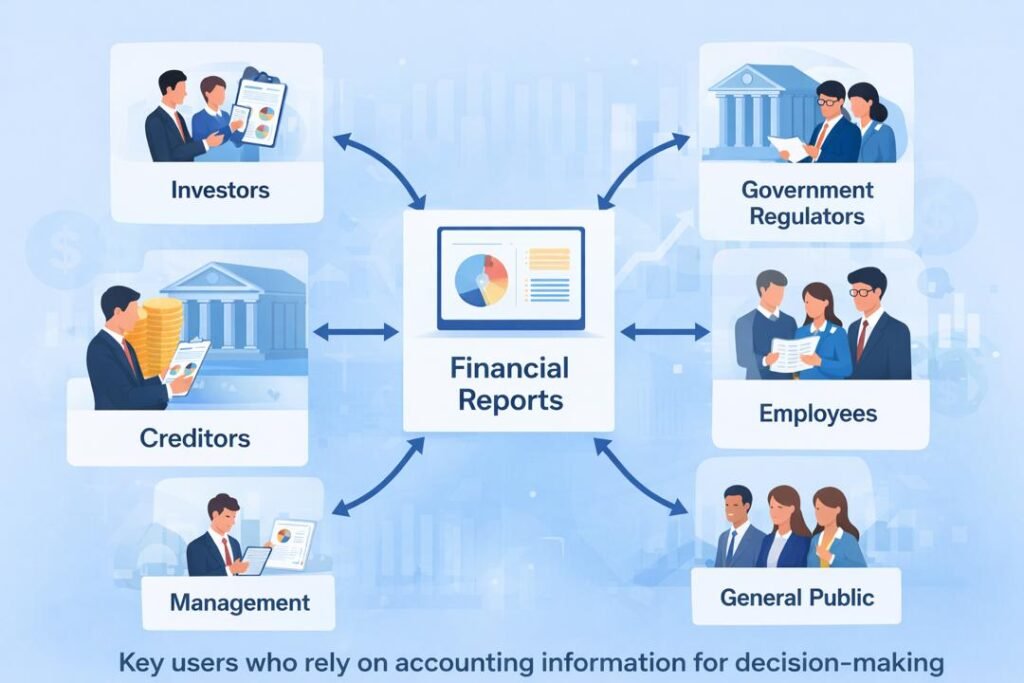
Users and Uses of Accounting information is a very important aspect in the contemporary organization and economies. Any financial decision, such as investing into a company, granting a loan, or controlling the work of the company, is based on the correct financial reporting. Such reports are briefs of the financial performance and status of a business, which enable various interested parties to evaluate the performance of an organization. Not every stakeholder, however, utilizes financial information in the same capacity. Various parties need financial information to fulfill their respective needs, which may include investment choices, regulatory supervision and so on.
The thing is that to understand the value of financial reporting, it is vital to understand the users and uses of accounting information. Accounting information is used by investors, creditors, management, regulators and the general population in assessing the financial health of a company and make well-informed decisions. Financial reports are also intended to meet two significant purposes including stewardship, which assesses the manner in which the management has used the company resources, and the decision usefulness, which furnishes the pertinent data to inform economic decisions.
This paper discusses the important users and uses of accounting information, their unique requirements and how financial reports have tried to address these different expectations whilst dealing with the possible conflicts amongst the users.
Understanding the Purpose of Accounting Information
Financial data that is gathered, processed, and reported by organizations in the form of financial statements are called accounting information. Such statements usually involve the statement of financial position (balance sheet), statement of income, statement of cash flows and statement of changes of equity. All these reports contribute to an organized report of financial position and performance of a company.
Financial reporting is mainly aimed to communicate effective information to the stakeholders relying on it to make decisions. Since organizations deal with a lot of diverse groups of people- investors, banks, employees and government agencies among other groups, information generated must be reliable, transparent and relevant.
To comprehend more clearly the way the financial information can be used by various groups, it is desirable to find out the key users and uses of accounting information, and review their specific needs.
Major Users of Accounting Information
Financial reports should be useful to many users. The internal users and external users can generally be classified into these users based on their affiliation to the organization.
Internal users are people who operate in the organization and depend on the accounting information to coordinate the operations and strategize. External users on the other hand, are not within an organization but one that would need financial information to assess the performance and financial stability of the company.
1. Investors
Among the greatest users of accounting information include investors. They avail of capital to businesses through buying of shares or ownership rights. Investors require sound information to determine the risks and the profitability of the investments they have in a company since their financial returns are determined by the performance of the company they have invested in.
Financial reports assist investors to consider important factors of a firm such as:
- Profitability and increase in revenue.
- Liquidity and Financial security.
- Long-term sustainability
- Dividend potential
As an illustration, the investors will use the income statement to know whether the company is making steady profits. They also explore the balance sheet to determine the level of assets and liabilities as well as the equity. The insights aid investors in making decisions of whether to buy, retain, or divest shares.
Accounting information is also critical in helping the investor compare companies operating in the same industry. Regularity in accounting standards like International Financial Reporting Standards (IFRS) can be used to make sure that organizations can compare and understand financial statements.
2. Creditors and Lenders
Creditors include Banks, financial institutions, and suppliers are some of the creditors as they give loans or credit to businesses. Creditors should consider the financial capability of a borrower before giving him or her the loans. The accounting information hence is critical in the evaluation of credit risk.
The creditors mainly dwell on:
- Liquidity levels
- Cash flow stability
- Debt obligations
- Asset value
As an example, the statement of cash flows is reviewed by the lenders to ascertain whether the firm is making adequate cash to pay loan repayments. They can also analyze financial ratios like debt to equity ratio and interest coverage ratio.
The suppliers of goods on credit as well use accounting information to ascertain whether a company is stable enough to be able to pay its debts. When a company is seen to be weak financially, creditors will charge increased interest or deny them credit.
3. Management
Management is the internal organization leadership of an organization, executives, and departmental managers. The managers also have access to the financial and detailed operational data unlike external users. Nevertheless, official financial reports continue to be a key factor in decision making by managers.
Accounting information is utilized by the management in a number of ways:
- Planning future operations
- Budgeting and forecasting
- Monitoring performance
- Controlling costs
- Assessment of the investment opportunities.
Financial reports enable managers to assess how the strategic goals are being met. As an illustration, in case the expenses are increasing at a quicker rate than the revenue, the management might be required to exercise the cost management tactics.
Also through accounting information, the managers are able to measure the performance of the department and see the areas where betterment can be made. Through time analysis of the financial outcomes, the managers are in a position to revise the strategies in an attempt to enhance efficiency and profitability.
Moreover, books of accounts are needed in terms of internal accountability. Managers have the role of ensuring that the company resources are put into proper use and one of the ways that can be observed is through the financial reports.
4. Government and Regulatory Authorities
Accounting information is of great importance to government officials and regulatory bodies who have to keep a check on corporate activities and make sure that they do not break the laws and regulations. These agencies apply the fiscal reporting to impose taxes laws, to safeguard investors, and ensure economic stability.
Financial statements are usually examined by regulators to enable them to determine that the companies:
- Pay appropriate taxes
- Adhere to accounting standards.
- Report correct financial data.
- Avoid fraudulent practices
Financial records, as an example, are used by tax authorities to get an idea of the corporate tax required. On the same note, to ensure that investors are not deceived and the transparency within the financial markets is upheld, securities regulators compel publicly traded companies disclose audited financial statements.
The accounting data is thus very important in ensuring confidence in the financial system and discourages corporate bad behavior.
5. Employees and Labor Unions
Other significant users of accounting information are the employees and labor unions. This is because workers rely on the financial stability of their employers to secure jobs, stability in wages and career opportunities.
Through accounting information, employees get to know:
- The economic capability of the employer.
- Wages and benefits of the company.
- Bonuses or profit sharing.
During the wage negotiations, labor unions usually scan through the financial reports to understand whether such an entity can meet their demands of paying higher wages or better working conditions.
In case of the negative financial reports with decreasing profits or rising debt rates, the employees might start worrying about their job security. On the other hand, when earnings are good, then better remunerations or benefits will be sought.
6. The General Public
The general population also uses the accounting information particularly in the cases when the companies have major positions in the national economies. Financial reports are commonly examined by communities, analysts, researchers and advocacy groups to assess the corporate responsibility and economic impact.
An example is that financial information can show:
- Corporate donations to the economy.
- Environmental or social expenditure.
- Contributions to corporate taxes.
- Employment generation
Big businesses tend to influence the communities of people in ways such as employment, creation of infrastructure and environmental practices. Financial reporting is transparent and therefore enables the masses to assess the responsiveness and ethical conduct of the businesses.
Stewardship Function of Financial Reporting
Stewardship is one of the basic aims of accounting information. Stewardship is the practice whereby the management has the duty of ensuring that the resources of the company are properly managed to the benefit of the shareholders and other parties that have interest in the company.
Financial reports enable the stakeholders to assess the level in which the management has utilized resources. In a typical case, investors use the financial statements to know whether the management decisions have enhanced the profitability and growth of the company.
Accountability is also promoted by stewardship. Since financial reports are usually audited and publicly announced, the management should take care of the fact that its activities correspond to the organizational objectives and expectations of stakeholders.
In doing so, the information provided by the accountant acts as a control tool that encourages responsible corporate governance.
Decision-Usefulness Objective of Financial Reporting
Decision usefulness is yet another significant goal of accounting information. Financial reports are meant to give the relevant information that will be used in economic decision-making.
Various users use financial information to make various decisions; they include:
- Shareholders making decisions to either sell or purchase.
- Decision making by creditors to give out loans.
- Managers determining the allocation of resources.
- Regulators who determine the compliance of companies to the laws.
Financial information should have some qualitative features in order to justify such decisions, which are reliability, relevance, comparability, and understandability.
When financial information satisfies these attributes, users would be in a position of making quality decisions that enhance economic efficiency and transparency of markets.
Conflicts among User Expectations
Even though the aim of financial reporting is to meet the needs of various stakeholders, in the majority of cases, there is a clash between the various users of accounting information. The group interests are different, and they are not necessarily the same.
1. Investors vs. Management
Investors tend to demand high returns and higher dividends whereas the management would want to re-invest profits into business growth. This clash in priorities can cause conflict, when the results in finance are viewed in a different perspective.
2. Creditors vs. Investors
Creditors are after financial stability and low-risk, and investors can support growth strategies that are aggressive to the extent that it leads to higher profits and higher risk.
As an example, a firm can go into more debt in order to grow business. To the investors, it may present a growth opportunity but to the creditors, it may present a greater risk of loan repayment.
3. Corporate Profit vs. Public Interest
The society might require that companies make investments in protecting the environment or social programs, whereas the shareholders might favor profit maximization. Social responsibility and financial performance may hence create a challenge to the corporate management.
Due to such conflicting interests, financial reporting standards seek to provide neutral and unbiased information, which can be interpreted by the users without any outside pressure.
The Role of Accounting Standards
Accounting standards are important in the sense that they may make certain financial information uniform and dependable across organizations. International standards include IFRS which offer principles of preparing and presenting financial statements.
These standards assist in solving the conflict between users as they set standardization of recognizing, measuring and disclosure of financial information.
Consequently, the stakeholders are assured that financial reports are true financial position and performance of a firm.
Conclusion
Modern economies and organizations are inseparable to accounting-related information. Financial reports are relied on by the various stakeholders, such as investors, creditors, management, regulators, employees, and the public to assess the overall performance of a corporation and make quality decisions.
The users and uses of accounting information are diverse and they include evaluating investment opportunities as well as ensuring compliance with the regulations. Financial reporting has hence two major purposes; stewardship and decision usefulness. The concept of stewardship holds the management responsible to the resources that have been entrusted to them and the decision usefulness offers relevant information to the stakeholders to make economic decisions.
Although these have their advantages, user expectation clashes may develop due to various priorities held by the various stakeholders. These conflicts should be reduced with the help of accounting standards and transparent reporting practices that should ensure that the financial information is reliable, consistent, and unbiased.
Finally, good financial reporting fosters confidence between the organizations and the stakeholders. Clearly and accurately reporting accounting information allows businesses to make informed decisions, account and increase accountability, as well as enhance the financial market stability in general.
Get more well researched information on the Users and Uses of Accounting Information here.