Introduction
Essential tools and techniques in project management are very important in the attainment of organizational objectives in an efficient and effective manner. Currently, the business environment is dynamic and so projects are sophisticated as they involve many stakeholders, have limited resources, have limited time, and there is more uncertainty. The projects lack timely planning, monitoring, and control and with this, they can easily fail because of the lack of coordination, unrealistic schedule, cost overruns, or uncontrollable risks. That is why project managers cannot do without numerous tools and methods to lead projects through the initiation to the completion.
Project management tools and techniques are designed procedures, Essential tools and techniques in project management are applied to facilitate project planning, scheduling, execution, monitoring and evaluation. These tools assist project managers to visualize work, allocate resources, evaluate risk, monitor progress as well as make good decisions. They also enhance interaction among team members and stakeholders, and all people are aware of project objectives, duty, and expectations.
This article discusses some of the most important tools and methods utilized in project management such as the work breakdown structures (WBS), Gantt charts, risk registers, project management software, and performance metrics. It describes how the tools can assist in making informed decisions and enhance efficiency and control of the project on the whole.
The Significance of Tools and Techniques in Project Management
It is necessary to know the reasons why project management tools and techniques are required before looking at the specific tools. Projects are usually defined by uncertainty, lack of time and scarcity. It is hard to organize work, deal with the people and monitor performance without adequate systems.
The key advantages of applying project management tools and techniques are:
- Better planning: Tools assist in defining project scope, objective and deliverables.
- Improved scheduling: They help in the establishment of realistic schedules and also establish dependencies between tasks.
- Effective resources management: The tools assist in the efficient allocation of human, financial, and material resources.
- Risk management: They allow identifying and preventing any possible issues early.
- Improved communication: Visual aids facilitate openness and comprehensiveness of stakeholders.
- Performance control: Performance metrics and tracking enable managers to gauge progress and amend strategies.
Altogether, these tools make project management a systematized and thought-out process rather than a guesswork.
Work Breakdown Structure (WBS)
Definition of Work Breakdown Structure
One of the most basic project management tools is a Work Breakdown Structure (WBS). It is a hierarchical breakdown of a project into smaller and manageable parts or tasks. WBS is meant to divide complex projects into less complicated components that could be planned, allocated, monitored, and managed easily.
In a simple definition, WBS will provide an answer to the question What work do we have to complete this project?
Features of WBS
An example of WBS is structured as follows:
- Level 1: The overall project.
- Level 2: Significant deliverables or stages.
- Level 3: Sub-deliverables or work.
- Level 4: Detailed activities.
The levels are more detailed and no significant task is left out.
Significance of WBS in Project Management
The WBS is helpful in managing projects in the following ways:
- Defines project scope: It makes sure that all the necessary work is determined.
- Enhances task allocation: Managers will have a better allocation of responsibilities.
- Improves time estimation: Dividing the task into small segments increases the accuracy of the schedule.
- Supports cost estimation: It is possible to apportion costs on individual tasks.
- Simplifies things: Huge projects simplify.
Lack of WBS can lead to scope creep, missed tasks and unclear responsibilities in the project.
Gantt Charts
Meaning of Gantt Charts
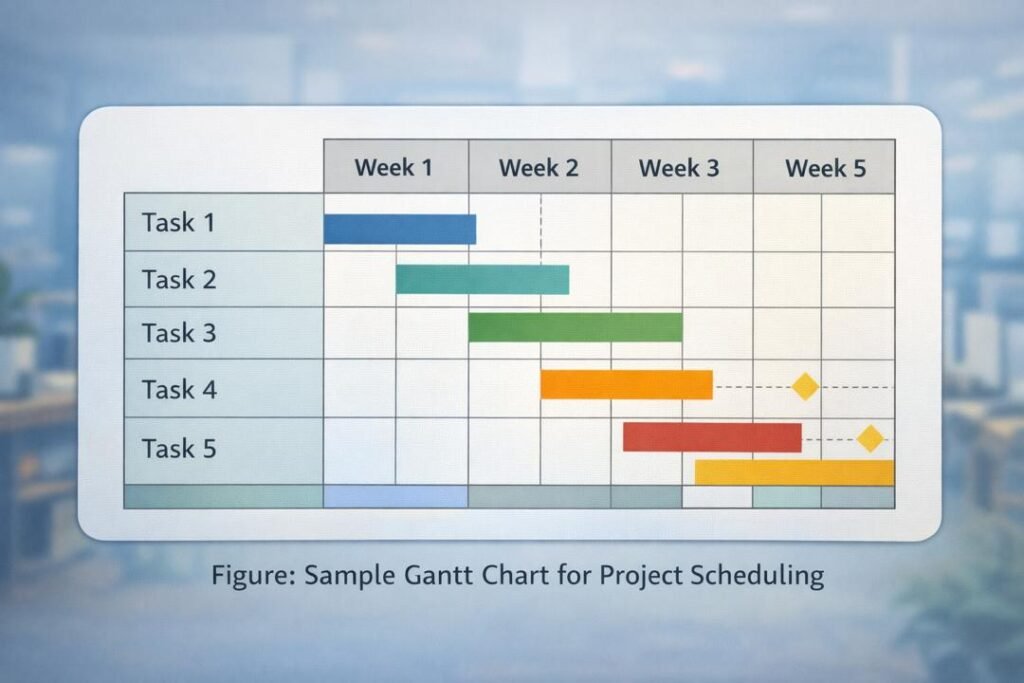
Gantt chart is a graphical scheduling software that can be used to display the project activities on a timeline. It displays the activities that should be carried out, their commencement and termination dates and durations. Activities are represented in form of horizontal bars on a calendar.
The wide usage of Gantt charts is explained by the fact that they offer a straightforward and clear visualization of project schedules.
The major elements of a Gantt chart
A typical Gantt chart entails:
- Task names.
- Start and end dates.
- Duration of each task.
- Task dependencies.
- Progress indicators.
Gantt Charts are important in Project Management.
Gantt charts can help in the management of projects in the following ways:
- Graphical planning: They give a clear idea of the project schedule.
- Task coordination: Managers are able to distinguish overlapping and dependent tasks.
- Time management: The milestones and deadlines are not difficult to track.
- Progress monitoring: Tasks that have been and still are to be completed are well displayed.
- Stakeholder communication: Gantt charts help to explain schedules to non-technical stakeholders in an easier manner.
As an example, in a construction project, a Gantt chart can be used to display the time of foundation work commencement, time of the beginning of electrical installation and then the finishing touches. This assists in keeping everybody on track with the plan.
Risk Register
Meaning of Risk Register
A risk register is a document that is applied in identifying, analyzing and monitoring possible risks to a project. Risks can be considered as uncertain events that could affect either positively or negatively the project goals of time, cost, quality, or scope. A risk register is a key risk management tool.
Elements of a Risk Register
The risk register of a typical risk contains:
- Risk description.
- Probability of occurrence.
- Impact level.
- Risk priority.
- Risk owner.
- Mitigation strategies.
- Risk status.
Significance of Risk Register in Project Management
Risk registers are beneficial to project managers in a number of ways:
- Early diagnosis on such problems: Problems are identified early before they manifest.
- Enhanced preparedness: Preparedness reduces the effects of risks.
- Better decision-making: Managers are able to give priority to high-risk areas.
- Accountability: Risk owners are given responsibilities.
- Fewer uncertainties: The projects are more predictable.
As an example, in a software project, there might be a risk of key developer leaving the team. The mitigation strategy may involve cross training of the other developers.
Project Management Software Explanation
Project management software Project management software are digital tools and applications to help with project planning, scheduling, collaboration and tracking. They are Microsoft project, Trello, Asana, Monday.com, Jira, and ClickUp.
These tools bring together a system of several functions of project management.
Important Project Managing Software Characteristics
The majority of project management software includes:
- Task management.
- Gantt charts and timelines.
- Resource allocation.
- Communication tools.
- File sharing.
- Reporting and analytics.
- Risk and issue tracking.
Value of Project Management Software
Project management software is more efficient in a number of ways:
- Automation: Lessens human error and work force.
- Live updates: Teams will be able to see what is going on in real-time.
- Teamwork: There are no problems when it comes to communication among team members.
- Centralized data: All the information of the project is saved in a single place.
- Remote access: Virtual and distributed teams.
Project management software is nearly mandatory in the current organizations particularly in large or complex projects that have various stakeholders in different locations.
Performance Metrics
Definition of Performance Metrics
Performance measures are numerical data, which are applied in measuring project performance and progress. They assist in finding out the project progress concerning time, cost, quality and scope.
The performance measurements transform the project management into a process that is data-driven.
Ordinary Project Performance Measures
Among the most common metrics, there are:
- Schedule Variance (SV): Calculates the variance between the planned schedule and the actual schedule.
- Cost Variance (CV): Takes the difference between planned and actual cost.
- Key Performance Indicators (KPIs): A specific indicator, e.g. completion rate, productivity, or defect rate.
- Earned Value Management (EVM): Unites the costs, schedule and scope to evaluate the project performance.
Relevance of Performance Metrics
Performance metrics assist the project managers:
- Track the progress: Recognize various delays or cost overruns.
- Support decision-making: Find new plans in the light of actual data.
- Enhance accountability: Team performance can be measured.
- Improve transparency: Pure objective results can be seen by stakeholders.
- Control project: The project managers can make corrective actions.
The performance metrics make performance objective and measurable in the absence of it.
Additional Critical Tools and Techniques in Project Management
Critical Path Method (CPM)
The Critical Path Method establishes the longest path of dependent activities in a project. These activities define the shortest amount of time of the project. Any postponement in the activities on the critical path postpones the whole project.
CPM helps in:
- Prioritizing tasks.
- Managing deadlines.
- Proper resource allocation.
SWOT Analysis
SWOT analysis assesses the following of a project:
- Strengths.
- Weaknesses.
- Opportunities.
- Threats.
When initiating and planning a project, it helps to determine feasibility and strategic fit.
Stakeholder Analysis
Stakeholder analysis determines those who are going to be impacted by the project. It assists the managers to comprehend the interest, expectation, and influence of the stakeholders.
This improves:
- Communication strategies.
- Conflict management.
- Stakeholder satisfaction.
Communication Plan
Communication plan depicts the flow of information to the stakeholders. It specifies:
- Communication of what
- Who will receive it
- The frequency of communication
- Communication channels
Good communication will minimize the miscommunication and conflict of projects.
Informed Decision-Making
Essential tools and techniques in project management are one of the key aims of supporting informed decision-making. Intuition is not a decision maker, and can result in errors, inefficiencies, and failure of the project. The data, structure, and visibility are offered by tools.
For example:
- WBS is a way of ensuring that there is clarity of what is available.
- Gantt charts indicate the time during which tasks must take place.
- Risk registers- These identify the risks that may occur.
- Software systems avail up-to-date data.
- Performance measures are a measure of actual progress.
All these tools assist project managers:
- Compare actual and planned performance.
- Identify deviations early.
- Examine alternative solutions.
- Allocate resources wisely.
- Defend decisions to the stakeholders.
The informed decision making enhances the project success.
The role of Tools in project efficacy and control
Efficiency is the ability to accomplish things at a minimum waste of time, expense, and effort. Control is the measure of how project activities can be monitored and controlled.
Project management tools enhance efficiency and control in the following ways:
- Minimizing uncertainty: Uncertainty risks and issues are expected.
- Better coordination: Responsibilities and duties are well established.
- Improving visibility: Development is clear.
- Promoting accountability: Roles and performance can be measured.
- Facilitating unrelenting enhancement: Lessons learned are recorded.
An example is that in project management software delays due to lack of communication is minimized whereas the performance metrics make sure that deviations are rectified as soon as possible.
Difficulties in the application of project management tools
In spite of the advantages, the project management tools also have their challenges:
- Complexity: There are tools that need technical knowledge.
- Resistance to change: Employees could want to stick to the old ways.
- Price: high-technology software is costly.
- Data overload: Too much information may be too much.
- Ineffective implementation: There is no proper training of tools.
Thus, companies need to make sure that there is appropriate training, user participation, and a selection of the tools depending on the project requirements.
Conclusion
In the modern competitive world, Essential tools and techniques in project management are the key to the successful implementation of a project in the complex environment. Work Breakdown Structures (WBS), Gantt charts, risk registers, project management software, and performance metrics are just a few tools that allow structure, clarity, and control of project throughout the lifecycle.
These tools aid the project managers to plan efficiently, allocate resources wisely, risk management, track progress, and make better decisions. They are also effective in enhancing stakeholder communication, accountability and transparency. Despite the difficulties in the application of these tools, they have much more benefits than restrictions. Project management tools, when properly executed, help to convert chaotic activities of projects by a well-organized process that produces value on time, within budget, and of the necessary quality standards.
To sum up, the procurement of the necessary project management tools and techniques is not a convenience but a requirement of all individuals or organizations that strive to succeed in terms of project success.
Get more well prepared information about Essential tools and techniques in project management here.