The human mouth cavity is much more than just a food entry point, but rather a highly dynamic system which is controlled by complex neural networks. The oral functions salivation, chewing and swallowing are necessary processes that depend on specific neural control. These mechanisms help learn the physiology of the human body as well as neurobiology, understanding how the brain orchestrates the oral motor tasks to establish homeostasis and general well-being.
Introduction to Salivation and Oral Reflexes
Salivation functions perform several very important roles: it lubricates the mouth, triggers the digestive process by dissolving starches under the influence of enzymes, maintains the health of oral tissues, and helps to perceive the taste. Oral reflexes such as chewing and swallowing are necessary in the safe processing of food and oral hygiene. Neither of the two is purely mechanical: salivation or oral reflexes are closely controlled by neural pathways and reflex arcs, which makes the timing, intensity, and coordination of the oral functions optimal.
The Salivary Glands and Oral Structures Anatomy
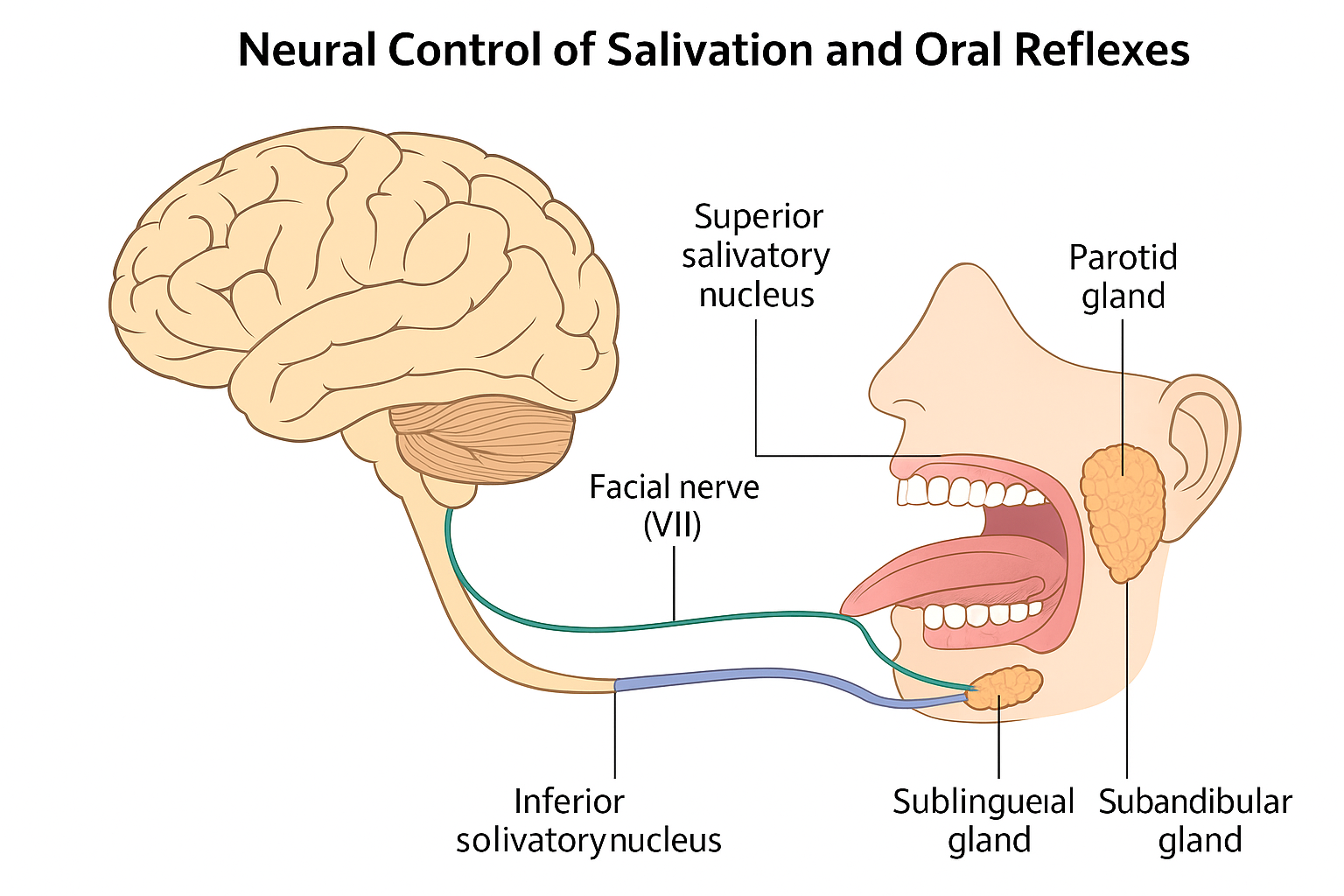
The secretion of salivation is achieved by three sets of large salivary glands namely the parotid, submandibular, and sublingual glands and lots of small salivary glands located around the mucosal area of the mouth. All glands react to neural stimulation differently:
- A serous and enzyme-filled secretion is mostly produced by parotid glands.
- The glands found under the mouth secrete mucous and serous.
- Most of the mucous secretions produced by the sublingual glands are used to lubricate the mouth cavity.
Oral reflexes (mastication and swallowing) require the coordination of the activity of teeth, tongue, jaw muscles, soft palate, and pharyngeal structures. These elements collaborate in unison with direction of the central nervous system, and peripheral nervous system.
Control of Salivation in the Neural System
The secretion of saliva is an activity of the autonomic nervous system, consisting of the sympathetic and parasympathetic parts.
Parasympathetic Pathways
Salivation is mostly triggered by the parasympathetic part of the nervous system. The source of the neural signals: The neural signals start at the salivatory nuclei of the brainstem:
- The submandibular and sublingual glands are regulated through the facial nerve (cranial nerve VII) by superior salivatory nucleus.
- Poor salivatory nucleus regulates the parotid glands through the glossopharyngeal nerve (cranial nerve IX).
The response of the parasympathetic stimulation is a liberal and watery secretion that is rich in enzymes, which helps in digestion and cleansing of the mouth.
Sympathetic Pathways
The thoracic spinal cord gives rise to sympathetic stimulation which runs along superior cervical ganglion to the salivary glands. In contrast to the parasympathetic activation, sympathetic stimulation leads to lesser volume of the viscous and mucous rich saliva. This kind of secretion is specifically significant in times of stress responses to prepare the oral cavity for protective functions.
Reflex Arcs in Salivation
To a great extent, salivation is a reflexive act that is mediated by neural and reflexive arcs. Sensory inputs are provoked by the sensory organs: the sight, smell, or taste of food that induce signals with the help of the cranial nerves and inform the salivatory nuclei. The glands receive motor outputs then to secrete, driven by the nuclei.
These reflexes will fall under:
- Unconditioned reflexes: Inbuilt reflexes which react to stimuli automatically such as tasting bitter or sour substances.
- Conditioned reflexes Learned responses, e.g., Pavlovian responses to visual or olfactory stimuli of food.
Chewing: The Masticatory Reflex
Mastication is a complicated oral reflex that needs a high level of coordination between motor response and sensory feedback. Masticatory central pattern generator (CPG), which is in the brainstem, is the coordinator of rhythmic movements of the jaw.
Sensory Inputs
- The periodontal ligament has mechanoreceptors that sense the tooth pressure.
- The jaw muscles have muscle spindles that give proprioceptive feedback.
- The mouth mucosa has taste and touch receptors that affect the duration and force of chewing.
Motor Outputs
The masseter, temporalis and pterygoid muscles are stimulated by motor neurons of the trigeminal nerve (cranial nerve V) to generate powerful jaw movements, which are controlled. The feedback loops also make sure that the teeth do not put undue pressure on the tissue, which damages it but allows breaking down food.
Ingestion: The Deglutition Reflex
Another significant oral reflex is swallowing and it has three stages:
- Oral Phase – Voluntary, this is the movement of the bolus towards the pharynx.
- Pharyngeal Phase- The involuntary one started by the sensory receptor in the pharynx and the soft palate. The swallowing center is located in the medulla oblongata and it is to this that signals are sent.
- Esophageal Phase – Reflex, entails a peristaltic movement of the esophagus which advances the food into the stomach.
The sequence of these stages makes the airway secure and the bolus move effectively. The nerves that are involved are trigeminal nerve (V), facial nerve (VII), glossopharyngeal nerve ( IX ), vagus nerve (X), and hypoglossal nerve (XII), which mediate certain muscle contractions and sensory responses.
Correlation of Salivation and Oral Reflexes
Salivation, chewing, and swallowing do not take place separately. These processes can interact smoothly because of neural integration. For example:
- Higher salivation helps in the easier mastication and bolus.
- Mechanoreceptors are triggered by chewing which further encourages salivary glands.
- The consumption of food is synchronized to the maximum secretion of saliva in order to avoid choking and guarantee lubrication.
The integrating nature accentuates the beautiful framework of the neural networks and reflex loops involved in the establishment of oral functionality.
Clinical Implications
Oral health problems can be severe due to the disturbance of the following neural pathways:
- Xerostomia (dry mouth) is a condition that takes place due to impaired parasympathetic innervation, which also influences digestion, speech and oral health.
- The difficulty in swallowing (dysphagia) may be caused by damage to the cranial nerves or the brainstem, which contributes to the risk of aspiration.
- The development of bruxism and impaired mastication may be due to the abnormal sensory feedback or motor control.
Knowledge of these pathways is crucial to clinicians, especially dentists, neurologists and speech-language pathologists to diagnose and treat disorders of oral motor functions.
Research Frontiers
The recent research in neurobiology and dental physiology has investigated:
- Effects of cortical modulation on conditioned salivary reflexes.
- Plasticity in neural activities of patients who have recovered skull injuries.
- Central pattern generators in the brainstem as a therapeutic intervention to dysphagia.
The development of imaging, including functional MRI and electrophysiology has given the first ever insight into the way the brain networks and reflex circuits coordinate oral functions, enabling novel interventions in oral motor disability.
Conclusion
The salivation neural regulation and oral reflexes is a good example of the complex interaction between neurobiology and dental physiology. Neural pathways and reflex arcs make sure that the salivation, mastication, and swallowing are correctly synchronized to ensure the health of the mouth and the successful digestion. Alterations in these pathways may have a severe effect on the quality of life, which highlights the significance of integrative clinical strategies. The neural basis of such basic oral processes helps us to recognize how intertwined the brain and oral health are and the beauty of human physiology which is complicated.