Introduction
Starting out in retail often means you will use foreign suppliers. Although importers may have a choice of a large product range, that which comes with it is a series of issues such as foreign exchange changes, shipping delays, customs duties, and complex logistics. Also for the small scale retailers, there are smart ways to source wholesale products locally. By buying from within the country instead of overseas, retailers see short lead times, reduced transport charges, pre inspection of products before purchase, and also better relationships with suppliers.
Local supply chains are growing in importance for entrepreneurs who are out to build sustainable businesses. In commercial centers like Onitsha, Aba, and Lagos we see which at present have a wide range of products including clothing, footwear, electronics, household items, and packaged food are also used as distribution centers. Which then enter into these markets is able to secure for themselves reliable inventory which in turn protects their profit.
In many cases businesses which look into local options instead of import have found that local suppliers provide better flexibility, easier communication, and faster turnaround time as compared to foreign vendors. The issue is to determine product origin, how wholesale players function, and what it takes to check quality and negotiate for better terms.
Understanding How Local Supply Chains Work
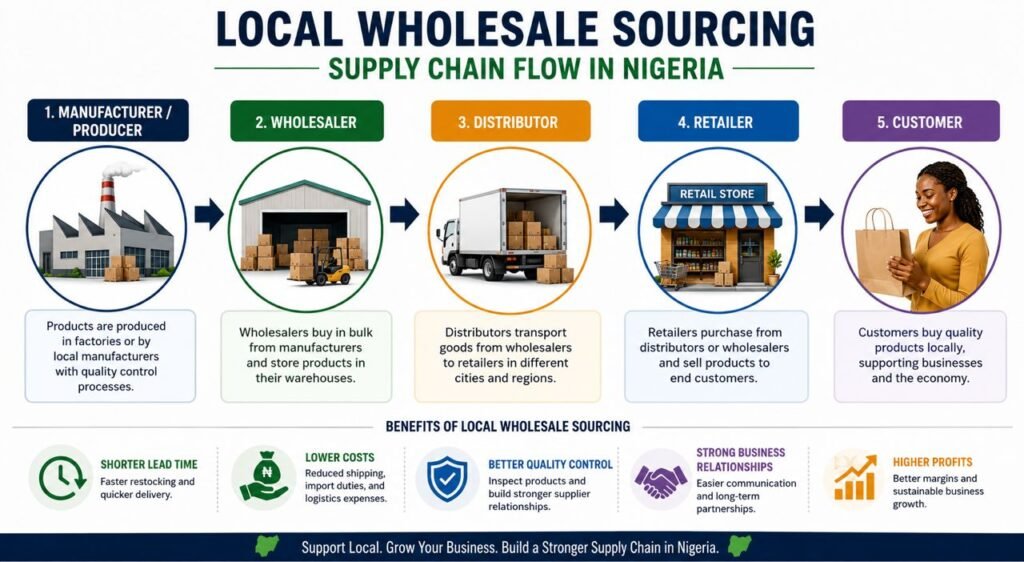
In every case our products travel through a supply chain before we get them to the final customer. In local markets we see the supply chain begin at the point of the manufacturer, processor, or import distributor. These suppliers then go on to sell to the wholesalers which in term distribute to the retailers in cities, towns and local communities.
Unlike international supply which may span many countries and shipping routes local supply chains are more compact and easier to manage. Retailers have the ability to visit suppliers in person, see warehouses in person, enter in to direct negotiations, and arrange transport. That which brings about a higher degree of access for the producers and in turn allows business owners to make quick purchase decisions.
A successful local sourcing approach is one which determines the origin of products and identifies key players in the distribution. Some wholesalers buy direct from factories, also there are which play the role of aggregators that buy in bulk from manufacturers and resell in smaller quantities. Retailers which play into this structure may find it which to remove unnecessary middle men and in that improve profitability.
Another benefit of local sourcing is that it enables a quick response to market trends. As customer preferences shift retailers are able to restock within days as opposed to waiting weeks or even months for imported products to arrive. Also this flexibility which local sourcing provides helps companies to sustain customer satisfaction at the same time which in turn reduces the risks of overstocking.
1. Source Product from Onitsha Main Market
Why is Onitsha a primary wholesale center?
The large scale of which the Onitsha Main Market is known has made it a leading commercial point in the West African region. It is also a hub which deals in many different types of products which range from fashion accessories, electronics, cosmetics, household items, stationery, to packaged consumer goods.
In Onitsha many wholesalers buy in very large quantities from manufacturers and importers which is also a large scale. What we see is that price points for these wholesalers are usually lower than what retailers get in the more regional markets. This gives retailers the edge in terms of profit margin which in turn enables them to stay competitive.
Visiting Onitsha is a study in itself. We advise that retailers put together a research which includes which product categories to go after and also to check prices among many suppliers. What you find is that the same products are sold by many wholesalers which in turn present room for negotiation. By the time you walk through different market sections you will see great results in terms of cost savings.
Another advantage of doing business in Onitsha is that which has in place extensive transport networks. We have many logistics players which run daily routes which take products from the market to cities all over the country. This infrastructure we see to be what enables retailers to move their goods very well and also at an affordable cost.
2. Directly from Manufacturers in Aba.
Access Factory-Level Pricing
Aba has become known as a manufacturing hub especially for footwear, leather products, garments, bags, and fashion accessories. Many retailers look to factories in Aba which they see as a way to reduce the number of intermediaries in the transaction.
Working with manufacturers is a hands on approach which in turn gives us better control of product details, packaging, and also allows for great customization. Retailers are able to ask for changes that play into what will best reach the local customer which at the same time we are able to maintain competitive prices. This flexibility is a great asset for companies which are after that unique product which will put them out from the competition.
Factory sourced materials also provide us with a look into production capabilities. Business owners may see in to what goes on at the factory level, evaluate quality control systems and study out supplier dependability prior to placing large orders. Also these visits put us at ease and reduce the chance of receiving poor quality products.
Although at times we see that large order volumes are a must from the factory, in which we also include that the results can be very large scale cost savings. Also we see that retailers which put out the same products very often may benefit greatly from factory relationships for long term growth and profit.
3. Leverage the wholesale distribution in Lagos.
Take Advantage of Nigeria’s Commercial Capital
Lagos is a key commercial hub in the country which also serves as an access point to a large scale of wholesale, retail and manufacturing players. At these markets which include Trade Fair Complex, Balogun Market and many industrial parks buyers from all over the nation come in.
In Lagos we see that which has great advantage in terms of product diversity. From electronics and fashion to building materials, food products and industrial supplies retailers have it all. Also this range allows business owners to compare different suppliers out there and identify the best for their specific category.
Many distributors in Lagos have put in place formal business structures which include warehouses, inventory systems, and customer service departments. We see that these professional operations which also tend to be more consistent and reliable as compared to informal suppliers. Also retailers may enter into long term purchase agreements, get better payment terms, and report regular stock turn.
The city has very good transport infrastructure which supports efficient movement of goods. In Lagos we see access to ports, highways, and logistics providers which in turn allows suppliers to quickly restock thus enabling retailers to maintain stable supply chains all year round.
4. Develop Relationships with Regional Distributors.
Expand Beyond Major Commercial Cities
In Onitsha, Aba, and Lagos we see large scale activity but what we also have is a great opportunity for regional distributors which are closer to retail markets. These distributors in turn represent manufacturers and larger wholesale companies which in effect brings products to retailers’ doors thus eliminating the need for retailers to travel great distances.
Develop in to relationships with local suppliers which have a variety of benefits. Transportation costs are reduced, time for delivery is cut, and communication issues are also improved. Also retailers are able to create stronger associations through continuous interaction in the business.
Local wholesalers’ knowledge of regional markets is in many cases better than that of remote distributors. They have a better sense of what will move out of the store quickly and which products will not do well. Also at times distributors may put in some marketing help, product training, or promotional material.
Although at times prices will be a bit higher we have found that what we save in terms of transport, accommodation and travel costs makes up for it. For many small scale retailers, regional distributors present a practical and efficient source option.
5. Secure Better Wholesale Rates.
Master the Art of Supplier Negotiation
Negotiation is a key skill in wholesale sourcing. Many suppliers include flexibility in their pricing which means the first quote may not be the best.
Effective in negotiation is having your research done. Retailers should look at what the market is offering, see what the competition is putting forward, and determine what we are willing to pay for what we want to buy before we go to the suppliers. Information empowers and also serves to avoid paying too much.
Building out relationships also improves results of negotiations. We see that which suppliers do give in to repeat business by way of discounts, priority service, and flexible payment terms. Also what we put forth in terms of professional communication and honor of agreements plays a role in to do stronger business partnerships over time.
Negotiation isn’t to be reduced to only issues of price. Retailers can bring up production schedules, payment terms, packaging ideas, return policies, and promotional support as well. Also, in many cases we see that these extra benefits do in fact greatly improve overall profitability which may not change much the price.
Successful negotiators put forward solutions which benefit all parties instead of just asking for reduced prices. We see that which feel valued by the negotiator are more to put forward long term relationships and in turn present good business options.
6. Verify Quality before placing large orders.
Protect Your Business from Costly Mistakes
Quality assurance is a must when it comes to wholesale products we source locally. We see that which goes in at the low quality end out the other is damaged customer trust, increased return rates, and reduced profitability. In any which we put in place through inspection processes that are very thorough we see that which helps to minimize these issues.
Retail it is best to have product samples when you can. We put our buyers in the position to evaluate materials, construction quality, and packaging and overall look of a product before we place large orders. Also by looking at samples from different suppliers we are able to find out key differences which in turn affect customer care.
Factory tours which also serve as a protective measure. We see value in our suppliers’ production floors and quality control processes. We are able to identify at large scale issues which may grow into bigger business issues.
Documentation is of great importance. We put out that purchase orders, invoices, and product details should be very clear to avoid issues. Also we note that in writing we have a reference point for when disputes come up and which also which helps to enforce accountability in the sourcing process.
Businesses that put out high quality products see also that they grow base of loyal customers and see increased repeat sales. Although quality checks are a step which may at first look extra which out, these actually are a form of investment in the company’s long term success.
Understanding MOQ and Why It Matters
MOQ (Minimum Order Quantity) is the smallest sale which a supplier will honor in one go. MOQ’s greatly vary by product type, manufacturing cost, and supplier policy.
Retail businesses should pay close attention to MOQs before they finalize purchase orders. We see that over ordering which ties up large sums of capital and increases storage costs is an issue. Also if we order too little we see that unit costs go up and profitability goes down.
Negotiation of MOQ’s is a practice which we see play out in many cases when it comes to the introduction of new supplier relationships. Also some manufacturers will go so far as to reduce the required quantity for first time buyers or to put together mixed product orders which in turn will hit the MOQ. By being aware of these options retailers are able to better manage their inventory which in turn also helps to control financial risk.
Careful planning of inventory levels to fit what is sold which in turn sees our sales volume and stock requirements match. Which in turn we see improved cash flow and reduced operational stress for businesses.
Managing Transportation and Logistics
Transportation is a key element in what makes local sourcing successful. Although we may find products at great prices from a supplier, we see that in many cases the logistics costs are what break the bank which eats into profit margins. Thus it is very important for retailers to look at the total transport and handling picture as they compare different suppliers.
Choosing dependable logistics partners is a way to reduce the risk of damaged or delayed shipments. Also retailers should check out carrier reputations, insurance options, and delivery performance before they pass off valuable inventory to transport providers.
Consolidation of orders is also a solution. Instead of breaking up purchase into many small shipments, retailers may see great savings by combining orders into larger delivery units. By coordinating procurement timing we see to it that transport value is maximized and admin complexity is reduced.
Inventory management and shipment tracking also improve supply chain performance. Companies which have visibility into the logistics process are able to react quickly to delays and thus reduce disruption to customer service.
Conclusion
Local wholesale markets present retailers with a solution to import related issues. In commercial hubs which include Onitsha, Aba, and Lagos businesses have access to a wide range of products, shorter supply chains, and in turn better supplier relationships. Also we see that direct factory ties, regional distributors, smart negotiation tactics and in depth quality control practices play a key role in improved business performance.
Success in wholesale sourcing is not a matter of just getting the best price. Retailers must look at the whole chain from producer to shelf and check out how reliable the suppliers are. Also they should pay attention to MOQ issues and do a great job with transport. Those that take a strategic view do better at protecting their profit margins, keeping inventory available, and delivering the same high level of service to customers.
As retail competition grows so does the importance of local sourcing which entrepreneurs that do well at it will see as a key to creating flexible businesses which also sustain growth.
Get more well researched information about local wholesale sourcing here.