Organic agriculture has received a great deal of interest from around the globe since many farmers and gardeners are striving to find sustainable methods for healthy food and environmental protection. In contrast to conventional farming methods, which tend to be dependent on synthetic fertilizers and chemical pesticides, organic farming emphasizes natural soil processes that increase long-term productivity of the land, promote biodiversity and encourage natural soil processes. Combined with successful organic agricultural principles, growers can ensure healthier crops, a positive environmental impact and soil quality for future generations.
Organic farming offers practical solutions that address issues of soil health, water quality, and food safety while maintaining productivity, aligning with the growing concerns people have. The systems focus on doing agriculture with nature and not against nature, establishing resilient agricultural systems that benefit crop growth and the environment. Awareness and using good organic practice can allow the farm benefactors to lower the costs of production with the use of chemicals and make better quality and better-priced output products.
Principles of Organic Farming
Successful organic agriculture is built on both a foundation and adherence to rules of organic agriculture, which are all based on sustainability, health, ecology and fairness. Farmers are motivated to increase soil biology, protect natural resources and maintain dynamic, balanced ecosystems to support plant growth naturally. Organic farming should be based on ecological processes instead of synthetic inputs, respect the health of soils, ecosystems, and people, and be grounded on the organic farming principles set up by IFOAM.
Organic farming is aware that in order to produce healthy crops, the soil must be healthy. In organic agriculture, as opposed to symptomatic treatment (pest management, nutrient management etc. using chemical methods), ecosystems are enhanced to create resilient, healthy soils and support biodiversity to prevent problems from occurring. This way a more sustainable farming system can be established without compromising the quality of the plantain and livestock production and maintaining the natural resources. Adopting these practices can lead to better soil health, water holding capacity, biodiversity and resilience to environmental pressures.
1. The Composting process, Natural Soil Fertility.
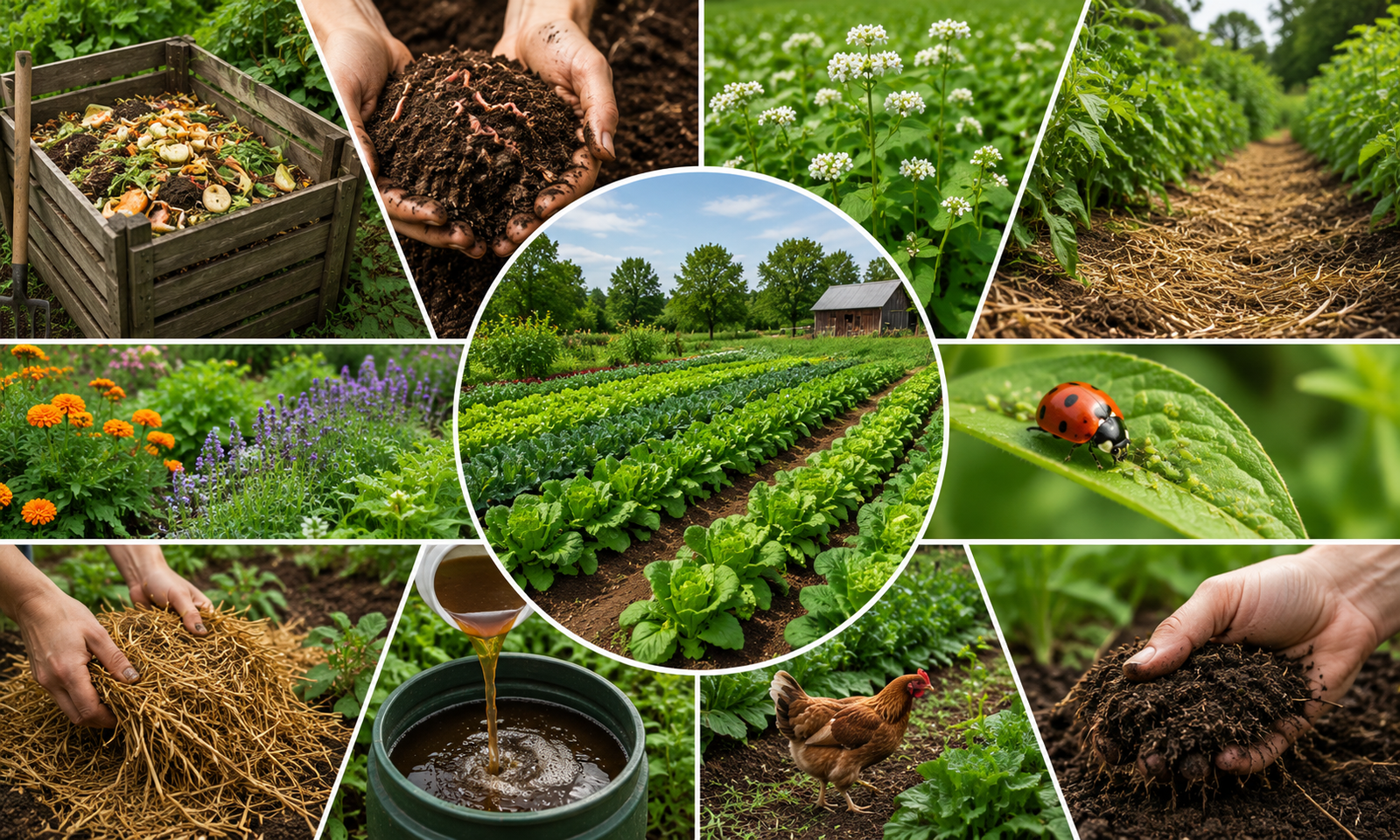
Composting is considered as one of the most significant soil management practices in organic farming which enhances soil health and fertility. Refers to the process of breaking down organic matter (crop residues, animal feces, leaves, kitchen scraps, and grass clippings) into rich humus for the soil. The natural fertilizer supplies the necessary nutrients to crops and enhances soil structure and microbial activities.
Well-composted material has the appropriate microorganisms in the compost which will decompose organic matter and allow release of nutrients over time. Unlike artificial fertilizers which have the potential to leach into the ground water, compost provides nutrients gradually which means that there is less waste, and more sustainable use of the soil overall. Routine applications of compost can help build soil organic matter, its water-holding capacity, and root growth. On-farm compost piles or composting systems composed of locally available materials can be implemented in economic and eco-friendly ways for fertility management and are an affordable option for farmers.
2. Rotate crops in order to avoid soil depletion.
Crop rotation is one of the oldest methods which controls the practice of intercropping different crops in a specific crop field during different seasons. This approach avoids the recurrent cycling of identical nutrients in soil and controls cycles of pest and disease often disturbed in mono-cultures.
The nutrient and rooting needs of different crops differ. Legumes, like beans and peas, can convert air nitrogen into soil nitrogen which is available for other crops. The deep-rooted plants bring up nutrients from deeper soil layers and the shallow-rooted plants absorb nutrients from the upper layers of soil. Crop rotation practices that are properly designed can help to optimize soil fertility and minimize reliance on inputs. Crop rotation also helps to maintain a good soil structure, lower weed pressure and enhance the farm’s sustainability.
3. Biological Pest Control Methods
Organic farming promotes natural methods of pest control through natural predators and beneficial organisms. Biological pest control helps maintain an ecological balance and minimises the use of chemical pesticides within the farming system. The beneficial insects like the ladybugs, lacewings, and parasitic wasps control harmful pests which attack crops.
Flowering plants can be planted in perimeter areas of fields, and can be used to help attract beneficial insects. Habitats that support biodiversity can also be established in the same areas. Predatory insects, frogs and birds are other natural pest managers. Biological control methods offer the advantages of being cost effective and introducing natural predator-prey relationships into the ecosystem, thus offering long-term solutions. This will help reduce pesticide resistance, minimise impact on pollinators and help to maintain a productive growing environment while improving general agricultural health.
4. Using Natural Fertilizers
In organic farming, natural fertilizers are essential to fulfill the needs of the plants and not to cause pollution in the surrounding so that the process is carried out without consuming any harmful chemicals. Animal manure, compost, green manure, bone meal, fish emulsion, as well as other plant-based nutrients are some of the examples of organic fertilizers. These materials promote beneficial soil microbes and enhance soil fertility.
Natural fertilizers release nutrients as the organic compounds break down over time, rather than providing nutrients in concentrated levels like synthetic fertilizers. This is a process that releases slowly, thereby preventing loss of nutrients and increasing the efficiency of nutrient uptake. Natural fertilizers can help improve soil health, increase the variety of microorganisms in the soil, and boost the quality of the crops grown. Applying nutrients to the right rates and timing is crucial to maximize nutrient availability and avoid nutrient imbalance issues which could impact plant growth.
5. Choose Cover Cropping of Soil Protection
Cover crops are crops that are established to cover the ground and to improve soil conditions rather than for their potential harvest. Some clover, rye, vetch and legumes inter-seeded for crop use are common cover crop choices. pounds of green plant material per acre withstand erosion, inhibit weeds and as crop is incorporated into soil add organic matter.
During times when the main crops are not in the ground, soil fertility is maintained with the use of cover crops, which prevent nutrient leaching. The use of leguminous cover crops leads to biological nitrogen fixation, thus decreasing the need for fertilizer. They help to build soil structure, enhance the ability of soil to absorb water and promote beneficial soil organisms. Use of cover crops can help improve the health of soils for improved crop productivity over time.
6. Mulching to help preserve moisture and control weeds
Mulching is the practice of applying plant residues to the ground surface, like straw, leaves or grass clippings, wood chips or compost. In this practice, there are many beneficial aspects corresponding to the goals of organic farming. Mulch is used to conserve water from the soil, control soil temperature, reduce weed growth, and prevent wind and water erosion.
As organic mulches decompose over time they provide beneficial organic matter to the soil. They promote soil fertility, thriving earthworm populations and beneficial micro-organisms. Mulching also helps to stop weed from growing and thus helps to prevent weed competition for nutrient and water uptake and to save labour on weed control. In hot climates mulching protects plant roots against excessive temperatures and also helps to protect them from excessive watering, especially in a water-stressed environment.
7. Soluble Organic fertilizer to Improve Water Holding Capacity
Planting of certain plants, often legumes, for their green manure and subsequent ploughing into the soil in green state to enrich the soil with organic matter and fertility. Sericea lespedeza, red clover, and alfalfa are used commonly because they are leguminous and possess the nitrogen fixation ability.Leguminous plants with nitrogen fixation ability are commonly used such as sunn hemp, cowpea and alfalfa.
Plowing in green manure crops allows for the nutrients they provide to be available to future crops. This process can provide benefits such as building soil organic matter levels and improving soil microbial activity and soil structure. Weeding and soil erosion also are suppressed through green manuring. Farmers doing this practice often get better soil health and cut back on the amount of purchased fertilizer to use and have seen this as worth a part of sustainable organic farming systems.
8. Tillage Reduction
Over tilling can disrupt soil structure, increase erosion and decrease the amount of organic matter in the soil. To maintain both soil health and production, organic farmers are more inclined to undertake reduced or conservation tillage. Sustaining healthy soil organisms with a reduction in soil disturbance.
Less tillage helps to increase water penetration, decrease run-off and keep soil aggregates for good root growth. It also helps reverse soil carbon loss, thereby reducing climate change impacts. Farmers may be able to maintain soil microbial communities which are essential for nutrient cycling and plant health by reducing soil disturbance. Switching to no-till will necessitate changes in the way certain weed control methods are used, but the positive impacts of no-till on soil health are apparent.
9. Diversified Farming Systems
Diversity is an essential trait of organic successful farms. IPM practices, such as growing more than one crop at a time, including livestock operations and keeping natural habitats, help build healthy crop ecosystems that are less vulnerable to pests, diseases and environmental stressors. A diversified farming system minimizes the vulnerability of dependence on one single crop, and offers more than one income stream.
Diversification practices, such as with intercropping, agroforestry and mixed farming, improve sustainability. A variety of plant species provide habitat for beneficial insects, enhance nutrient cycles and also help build ecosystem stability. Livestock integration can help provide manure for fertilization, while adding value to the farm productivity. These interdependent systems are found as a natural ecosystem and help to build the health and resilience of agriculture.
10. Good Water Management
In an Organic farming system, water management is an important issue for sustaining both crop and soil functionality. Organic methods emphasize practices that conserve water, enhance soil water holding capacity and ensure water quality. Well-structured soils with good organic matter content can absorb greater water quantities and release them when water is needed by the plants.
Water-use efficiency can be improved by various techniques like drip irrigation, rainwater harvesting, contour farming, and mulching. Compost and Cover crops help build soil structure and improve infiltration and reduce runoff. Appropriate water management helps carry out plant development, lowers drought stress, and helps to ensure sustainable agricultural production. Farmers who manage to save water resources, can boost their ability to adapt to the variable climatic conditions and to preserve local ecosystems.
Benefits of Organic Farming
The cultivation of organic agriculture has many advantages, not only related to the production process of the crops. Plants with healthy soils are naturally stronger, healthier, more pest, disease and environment tolerant. Soil structure that allows better water holding capacity and less erosion will help ensure the success of a farmer during stressful weather conditions. There is also an enhanced biodiversity in organic systems, as they create habitat for beneficial insects, pollinators, and soil organisms.
Organically-raised food products are framed as being more valuable to consumers in relation to their concerns around chemical residues and sustainability of the environment. This growing demand is an opportunity for farmers to grow food organically and achieve success in the market. Furthermore, moving away from synthetic inputs can contribute to long-term sustainability of farm operations and help to decrease long-term production costs. The advantages of organic farming illustrate its ongoing appeal as a sustainable and profitable option for farmers striving for solutions.
Conclusion
Sustainable agricultural production, fertile soils and healthier crops organically grown obtained through effective organic farming methods is one of the best ways. Improved farming systems based on organic farming principles are enhanced by practices including, but not limited to, composting, crop rotation, biological pest control, natural fertilization, CaCll culture, mulching, green manuring, reduced tillage, diversification and efficient management of resources, particularly water and energy.
Emphasizing ecological balance and soil vitality can help to lessen dependence on synthetic chemicals while also enhancing productivity and farm profitability. The eco-friendly ways involve all of these methods, which are not only environmentally friendly but are also essential for the sustainable production of ‘green’ crops in the future. The overhang of debt on farms and the withdrawal of bank credit to support farmers’ requirements remain prominent issues.