People who want to establish poultry enterprise business should have this in consideration that there is a heavy learning curve involved in the business and it could also be very lucrative. Many new entrants are motivated with great excitement, but lacking in hands-on experience, which results in expensive lapses that impact on farm productivity, bird health and overall enterprise sustainability. Following some of these hurdles early on in the program is an important key to success over the long term. In this article, it is discussed about the 10 Major mistakes made by the novice poultry farmers which should be avoided and which will help the farmers to establish a solid base for them. A major difficulty faced by new farmers is to know the very common mistakes committed by novice poultry farming (sometimes because of the lack of foresight and knowledge).
Many poultry failures do not occur because poultry farmers don’t have the resources – rather, because of failure to observe important management principles. The problems of improper house structure, erratic feeding habits, overcrowding and inadequate disease control are frequently interrelated and are due to poor planning of the house. Sometimes the new farmer is unaware about the sensitivity of poultry birds to the environmental and nutritional conditions and their performance drops precipitously, once introduced. If the chickens are stressed in some way, such as if it is too hot, or not enough oxygen in the house, or they are poorly cared for, they become weak and easily attackable by outbreaks of illness. Further, often unmet expectations and losses because of the lack of understanding about production cycles and breed needs. Acknowledging the fundamental challenges at an early stage will help farmers to implement better systems to achieve efficiency, substantial reduction in livestock deaths, and sustainable production over a long period.
10 Common poultry keeping mistakes beginners should avoid
1. The lack of good housing design and ventilation.
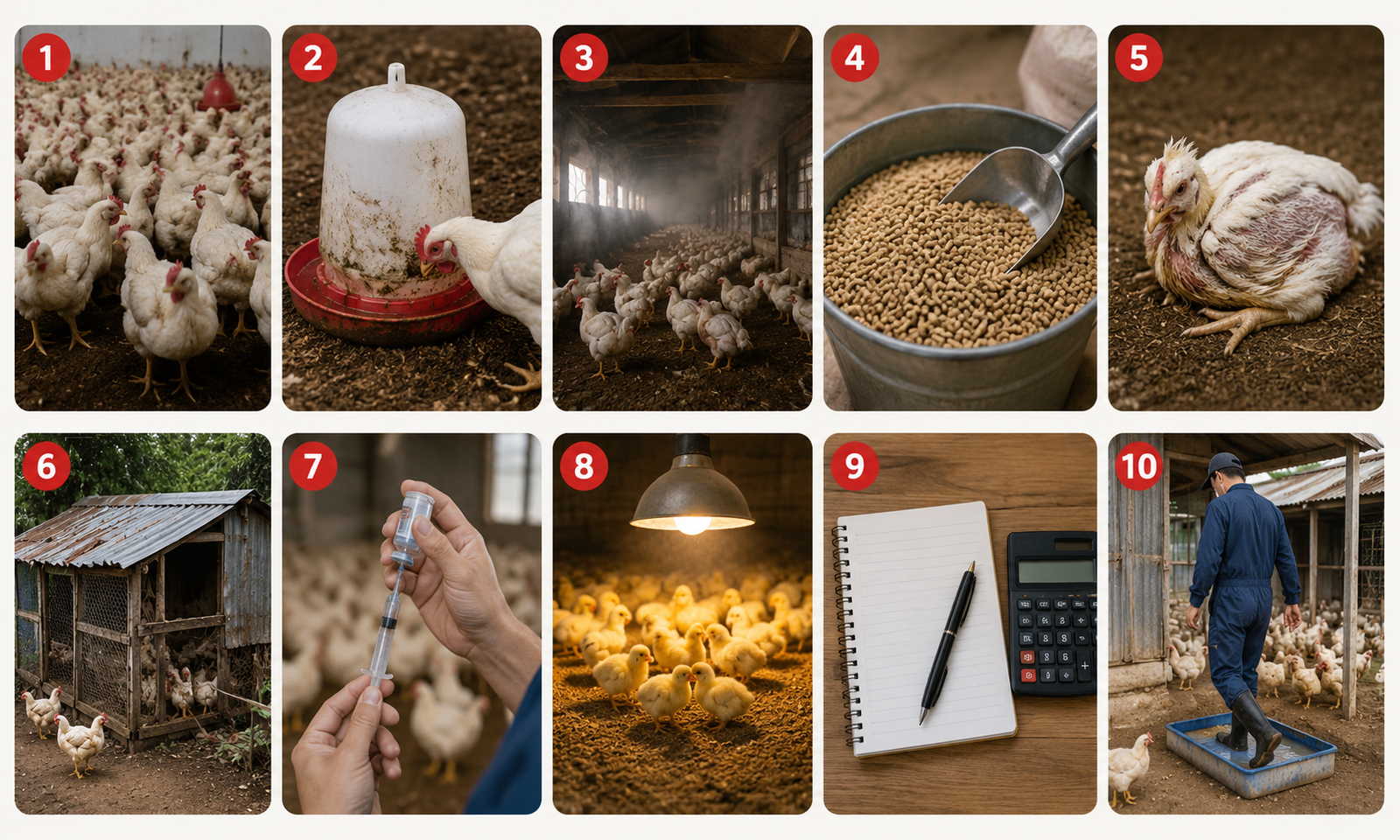
Poorly designed poultry houses are one of the worst blunders made by the first time poultry structure builder. Concurrent housing conditions are important for temperature, ventilation and to protect from predators. In unventilated manure heaps, ammonia can accumulate causing respiratory issues and decreased growth rate in chickens. Stress, such as the rise or drop of temperature, in the poultry house or too much dampness is also a factor which weakens the ability of the birds to resist diseases. Newcomers don’t consider the function in lieu of cost reduction, so they wind up losing money over time. The right designed poultry house would make the right natural airflow, proper space and easy to clean. Placing birds in an appropriate housing system from the outset has a very positive impact on the wellbeing of birds and on disease risks.
2. Inadequate Feeding Programs
One of the fundamental needs in poultry businesses is feeding but not many beginners have a developed feeding program. As birds change from one stage of growth to another, they need balanced feeds according to their age such as starter feed, grower feed and finisher feed. Poor weight gain, weak immunity and fewer eggs are produced due to poor quality and/or unbalanced feeds. To save money, some farmers might opt for inferior feed ingredients, resulting in ultimately greater losses. For best performance, there has to be regular feeding and an adequate nutrient formula given. Knowing feed convolution ratio also enables the farmer to assess efficiency and increase profits over time.
3. Overcrowding of Birds
Another mistake that greatly impacts poultry health and productivity is overcrowding. Frequent and heightened aggression occurs when there are too many birds in a small available area. Overcrowding also helps the distribution of diseases and parasites to happen quickly and easily, making it harder to manage an outbreak. When first time keepers raise chickens, they think that if more birds are crowded in there, it’s going to make them more money. The difficulty is that the opposite is true; poor bird spacing can result in less performance and higher mortality rates. The right stocking density is important and should always be adhered to according to bird type and age. Having proper space will help to provide a proper air circulation, better growth and greater production efficiency.
4. Poor Disease Prevention and Biosecurity
One common mistake that new poultry businesses make is not having proper biosecurity practices in place. Infected equipment or travelers, or even wild birds can quickly transmit the disease. If the suitable immunisation programmes, hygiene and quarantine measures are not implemented, a whole flock can be wiped out in days. Cleaning and regular disinfection of the housing, tools and footwear are things that many beginners do not pay attention to. Controls on farm access, routine cleaning and good vaccination programs are vital components of a strong biosecurity program. It’s much cheaper to prevent disease than to treat outbreaks once they have happened.
5. Neglecting Water Quality and Supply
It’s often overlooked, but water is just as critical as feed when it comes to poultry production. Inadequate or polluted water sources can cause dehydration, digestion problems and a decrease in productivity. Sometimes, user groups may use unclean water sources without assessing for bacteria or harmful minerals. This can cause disease to be introduced to the flock and reduce feed efficiency. Clean, fresh water should always be available to the birds at all times and water containers must be cleaned regularly. The proper hydrominulation is important for the digestive system, thermoregulation and other metabolic processes of poultry birds.
6. Failure to maintain proper records.
Poor record keeping of the poultry operation is something many beginning producers don’t do and contributes to lack of good decisions. Good record keeping assists with keeping a track of feed usage, mortality, egg production and medication plans. This data is important for determining problems or profitability, if available. When well-explained documents don’t exist, it can lead to consistent errors and financial confusion. Farmers who maintain records have a better idea of how well their companies are operating and can adjust accordingly to gain greater efficiency. It also assists to make better production planning in future cycles.
7. Allergic reaction to substances present in the air.
Regulation of temperatures in poultry is an important aspect for survival because of the need for accuracy in temperature control, particularly for chicks. Many novice bird owners don’t use the right type of heaters or don’t compensate for the environment when they take into account the age of the bird. High mortality rates, reduced feed consumption and stress can result from high or low temperatures. It is important to achieve optimal conditions using adequate insulation, ventilation and heating systems. Another part of environmental management is humidity control and appropriate lighting programs which strongly influence bird behavior and productivity.
8. Delayed Vaccination and Medication
Common poultry diseases including Newcastle disease and infectious bronchitis can be prevented by vaccinating them with vaccination schedules. Many people put off vaccinating their birds or forego vaccinations completely because they don’t know about them or because of the cost. After a disease is spread, treatment will cost more and will be less effective. It is important to have a well-defined vaccination program depending on the type and the age of birds in order to achieve long-term stability on the farm. Consulting veterinarians ensures that appropriate vaccinations and/or the correct medications are given at appropriate times.
9. Poor Waste Management Practices.
Uncontained poultry waste supports the growth of bad smell, flies and disease germs. It’s easy to minimise the importance of regularly removing droppings and controlling the litter conditions in a beginner’s environment. Waste accumulations will result in elevated ammonia levels and this has a negative impact on the respiratory systems of birds. They adopt routine collections, manure composting and dry litter which are included in effective waste management. Good hygiene for the welfare of the birds, cleanliness in the farm for a good hygienic aspect and sustainability in the environment.
10. A lack of adequate marketing and business planning
Farmers of poultry production are only interested in production; they neglect to attend to the marketing and business strategy. If there is no plan for egg or/or meat sales, farmers might have problems making a regular profit. When starting to make a product, novices tend to overlook target markets or even reliable buyers. This results in the problems of oversupply and price volatility. Successful poultry farm operation depends on a good business model that should involve market investigation, pricing and customer interaction management. Planning ahead helps ensure that production meets the demand and helps to maximize the profit.
Conclusion
As a poultry farmer, it is incredibly important to prevent these plagued things from happening. Bad health, lack of knowledge, inadequate planning, and inconsistent handling are factors in poultry failures, which are also related to hard work. A lot of the problems encountered by novices can be attributed to preventable issues like bad house management, insufficient feeding, overstock, and ineffective disease management. Early identification of such concerns will enable farmers to minimize losses and increase productivity. With the correct strategies and discipline, poultry farming can be a very profitable endeavor. With the right training, robust observation and a commitment to ongoing improvements this will ensure the industry is successful and sustainable in the long term.