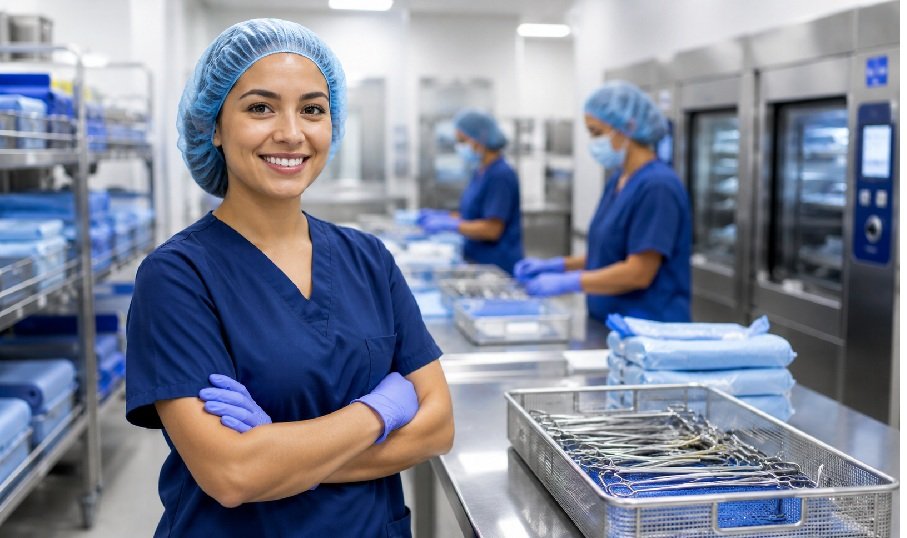
Healthcare has a well-deserved reputation for job security. What’s less appreciated is that not every healthcare career requires four years of college and six figures of debt. Sterile processing is one of the clearest examples of a path where a focused, affordable training investment leads directly to stable, well-compensated employment — in a field that isn’t going away.
The employment reality: why demand is durable
The volume of surgical procedures in the United States increases every year. The aging population requires more operations. Outpatient surgical center capacity is expanding. Every surgical case requires properly sterilized instruments, and every set of instruments requires a trained technician to process it. This isn’t a niche skill set that can be automated away or outsourced — it’s work that must be done in person, in the facility, for every case.
Hospital HR departments in major metro areas consistently report difficulty filling sterile processing positions, which means certified candidates with good references move quickly. In several states — New York, New Jersey, California — certification is now legally required, which has raised the bar for who can fill these roles and, consequently, their compensation.
What the training costs — and what it returns
The cost of entry is dramatically lower than most healthcare education. A quality program — one that genuinely prepares you for the CRCST or CSPDT certification exam — typically runs a few months. The exam itself costs under $400. Entry-level sterile processing technicians earn $18–$25/hour depending on location. In high-cost markets like New York or San Francisco, starting rates run higher. Team leads earn $30–$38/hour. Supervisors earn $40,000–$100,000 annually.
These aren’t extraordinary numbers — but they’re solid, professional compensation accessible in under a year from enrollment. That ratio of investment to return is genuinely unusual in healthcare.
What central sterile processing technician classes cover
Central sterile processing technician classes with CRCST prep central sterile processing technician classes with CRCST prep are more substantive than many people expect. The curriculum covers the microbiology that underlies sterilization science: why steam kills spores, how biofilm forms and resists disinfection, what the Spaulding classification system tells you about instrument risk. Regulatory content includes OSHA bloodborne pathogen standards, CDC infection control guidelines, AAMI ST79 for steam sterilization, and Joint Commission compliance requirements. Practical skills include instrument identification, tray assembly, sterilizer operation, and electronic tracking. Multyprep’s program integrates all of these elements with direct alignment to CRCST exam preparation.
Certification: what it signals to employers
CRCST (Certified Registered Central Service Technician, issued by IAHCSMM) and CSPDT (Certified Sterile Processing and Distribution Technician, issued by HSPA) are the two recognized credentials in the field. Many hospitals now require certification for hire or promotion. The regulatory momentum toward mandatory credentialing is increasing — more states are moving in this direction, which means the certified pool shrinks relative to demand in markets that don’t yet require it.
Career trajectory: where sterile processing leads
Entry-level employment is the beginning, not the ceiling. Experienced technicians with additional certifications — CHL for leadership roles — advance to team lead and supervisor positions. A director of sterile processing at a major hospital system manages a department, interacts with OR leadership and administration, and earns accordingly.
Travel sterile processing is another option after the first year or two: contract positions in high-need areas typically pay 20–40% above standard rates plus housing stipends. For anyone weighing healthcare career options and prioritizing speed and affordability, central sterile processing classes for career changers represent one of the most efficient career investments available — a defined training path, a recognized credential, and immediate employment demand on the other side.