Writing test cases by hand is one of those tasks that everyone agrees is important and almost nobody wants to do. Enter the AI test case generator, a category of tool that has quietly become one of the most impactful shifts in how development teams ship reliable software.
The Quiet Crisis in Software Testing
Ask any engineer on a fast-moving team how much time they spend writing tests versus shipping features, and you will usually get an awkward pause. The uncomfortable truth is that testing often becomes a second-class activity, squeezed into the end of a sprint, written hastily, or skipped entirely under deadline pressure.
The consequences show up downstream. Regressions slip into production. On-call engineers debug failures at 2 AM. Customer trust erodes. The cost of a bug caught in production is, on average, four to five times higher than one caught during development. Testing debt compounds just like technical debt, and it tends to be far less visible until something breaks loudly.
What makes this situation particularly frustrating is that the information needed to write good test cases already exists in every running application. It flows through APIs with every request, every response, every user interaction. The problem has never been a lack of data. It has been the lack of a practical way to turn that data into structured, maintainable tests.
What an AI Test Case Generator Actually Does
The term “AI” gets thrown around loosely, so it is worth being precise. A modern AI test case generator works by observing real application traffic, the actual HTTP calls, database queries, and service interactions that occur when your application runs, and converting those observations into structured test scenarios complete with inputs, expected outputs, assertions, and mocks for external dependencies.
This is fundamentally different from code generation tools that write tests based on source code analysis or documentation. Traffic-based generation captures what your system actually does, not just what it is supposed to do. Edge cases that a human tester might never think to write, unusual parameter combinations, race conditions exposed under load, unexpected response formats from third-party APIs, all get captured organically because they happened in real usage.
The Core Problems It Solves
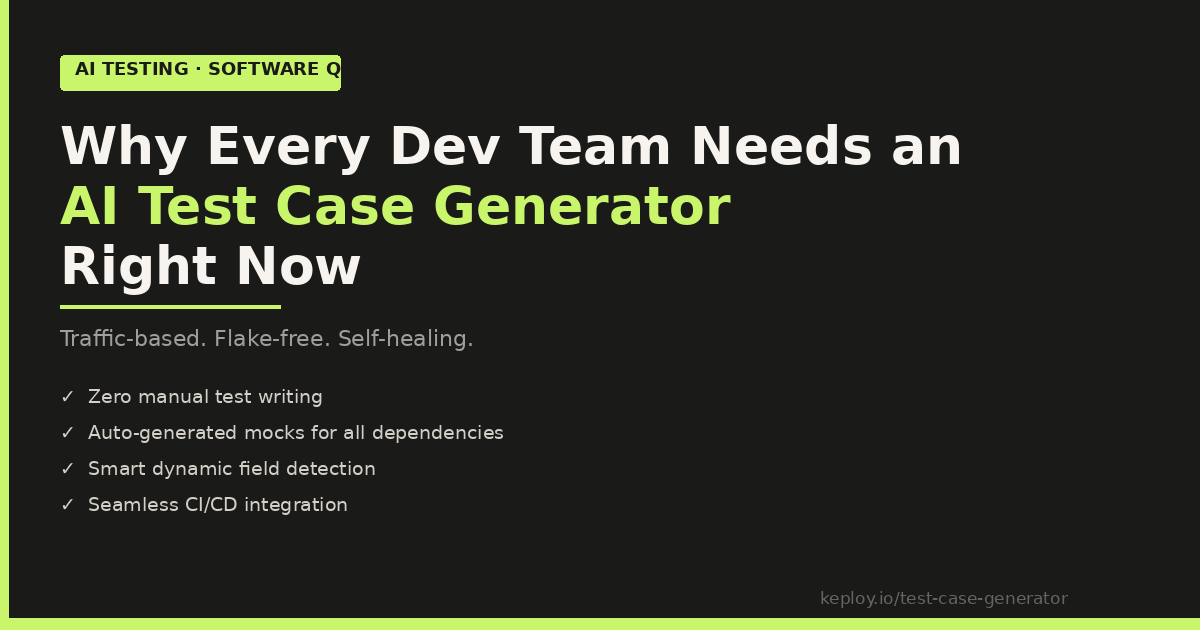
Zero manual effort. Tests are captured from real traffic, not written from scratch by engineers staring at a blank file. Flake elimination. Dynamic fields like timestamps and session IDs are automatically detected and excluded from assertions, so tests do not break between runs for reasons unrelated to your code. Dependency isolation. Mocks for databases, payment gateways, and external APIs are generated alongside tests, making the suite runnable anywhere without a live environment. Self-healing tests. When APIs change, tests can be re-recorded in seconds rather than rewritten by hand across dozens of files.
Why Flaky Tests Are a Team Problem, Not a Tool Problem
Flaky tests, those that pass sometimes and fail at other times without any change to the code, are one of the most corrosive forces in a CI/CD pipeline. Engineers start ignoring red builds. The feedback loop that automated testing is supposed to provide breaks down. Teams begin treating their test suite as background noise.
The root cause is almost always dynamic data. Most APIs return timestamps, request IDs, session tokens, or random nonces as part of their response. A test that records an exact response body and then asserts against it verbatim will fail on the very next run because that timestamp has moved by a millisecond.
A well-designed AI test case generator solves this at the source. Rather than asserting on every field, it runs a statistical analysis across multiple observations to identify which fields are stable, user IDs, roles, business logic outputs, and which are inherently noisy, timestamps, random tokens. Stable fields get asserted. Noisy fields get ignored. The result is a test suite that stays green when the system is healthy and turns red when something actually breaks, which is exactly what tests are for.
The Dependency Problem in Integration Testing
Integration tests are often the most valuable and the most painful to maintain simultaneously. They validate that your system works end-to-end, but they depend on databases being available, external APIs being reachable, and third-party services behaving consistently, none of which is guaranteed in a CI environment.
Good test cases for integration scenarios require mocks that accurately replicate the behavior of external dependencies. The challenge is keeping those mocks in sync with reality. An API you depend on changes its response schema; your mock does not; your tests pass; production breaks.
Traffic-based test generation sidesteps this problem entirely because mocks are recorded from real interactions with the actual dependency. The mock is not someone’s assumption about how Stripe or Redis or your internal auth service behaves. It is a recording of how they actually responded under real conditions.
How This Changes the Developer Workflow
Before AI test generation, the workflow looked something like this: feature gets built, sprint ends, engineer writes tests from memory, often missing edge cases that were obvious at implementation time but forgotten two weeks later. Tests are thin, coverage is patchy, and the suite provides limited confidence.
After adopting an AI test case generator, the workflow changes at a structural level. The engineer exercises new endpoints while developing. Traffic is captured automatically. A comprehensive test suite covering the happy path, error responses, boundary inputs, and dependency interactions is generated without any separate test-writing phase. Coverage is high because real usage was captured, not imagined.
This is the shift that matters. It is not about writing better tests faster. It is about removing the test-writing step from the cognitive load of shipping features altogether.
What Teams Often Get Wrong When Starting Out
The biggest mistake teams make is treating test generation as a one-time event. They capture traffic during a demo or staging run, generate a suite, and consider the job done. Then the codebase evolves, the generated tests break, and the team concludes that automated generation does not work for their use case.
The correct mental model is closer to version control than to documentation. Just as you commit code continuously as features evolve, test generation should be woven into regular development and release cycles. Traffic captured from each release candidate becomes a baseline for the next. Tests evolve alongside the system rather than lagging behind it.
The ROI Calculation Most Teams Underestimate
When teams evaluate testing tools, they typically measure time saved on test writing. A senior engineer might spend five hours a week writing and maintaining tests. An AI test case generator eliminates most of that. Multiply by team size and you get a compelling number.
But this undersells the real value. The bigger return comes from bugs caught earlier, reduced production incidents, faster debugging because a failing test points directly at the broken behavior, and higher confidence in deployment, which means shorter release cycles and less risk aversion around shipping. Teams that ship more frequently because they trust their test suite ship better products. That competitive advantage is harder to quantify than hours saved per week, but it is almost certainly larger.
Is This the End of Manual Testing?
No, and it is worth being honest about the limits of any automated system. Traffic-based generation is extraordinarily good at capturing and verifying known behaviors. It is less suited to exploratory testing, usability evaluation, security edge cases that require adversarial thinking, or validating business logic that has never been exercised in the real system.
Human testers bring judgment, creativity, and domain knowledge that automated systems cannot replicate. What AI test generation eliminates is the rote mechanical work of transcribing observed behavior into test code, freeing human testers to focus on the work that actually requires human thinking. The best testing strategies combine automated capture for regression coverage with targeted manual exploration for risk areas. Neither alone is sufficient.
Getting Started: What Actually Matters
If you are evaluating an AI test case generator for your team, focus on three things above all else.
First, check how it handles dynamic data. Look at the assertions it generates. If it is asserting on timestamps, random IDs, or session tokens, you will spend more time managing flaky tests than you save on writing them. Smart noise detection is non-negotiable.
Second, evaluate mock quality and completeness. A test that passes locally because it mocks external dependencies but fails in CI because the mock is missing something is worse than no test at all. Look for tools that record mocks from actual traffic rather than generating them synthetically.
Third, ask about the re-recording story. Your APIs will change. Your dependencies will change. A tool that requires manual test rewriting every time an endpoint evolves negates much of the time savings it offers. Self-healing or easy re-recording capabilities are what separate tools that stay useful long-term from those that quietly create their own maintenance burden.