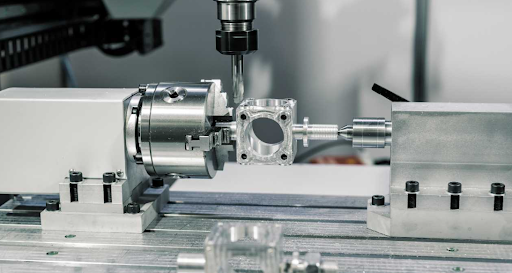
Have you ever thought about how tiny machine parts, every single time, manage to fit together with such perfection? This is what precision engineering does. In a precision engineering company, components get built where tolerances are so tight, they are measured in microns instead of millimeters. To give an idea, a human hair is around 70 microns in thickness, and in some industries, a part is not allowed to be off by more than a few microns, or else real problems start showing up. Such level of accuracy is not just something impressive, it becomes necessary. Starting from aircraft components, all the way to the small screws inside a pacemaker, even a single small mistake can bring failure, and this failure, at times, carries consequences that are quite serious.
What Precision Engineering Actually Looks Like
Think of a metal block that goes inside a machine, and then comes out looking nothing like before, cut, shaped, and smoothed according to specifications that by hand would be nearly impossible to reach. This, in simple terms, is what CNC machining is about. CNC stands for computer numerical control, and nowadays, this forms the base of most precision related work. Instead of a machinist controlling the tool with his own hands (and no matter the skill level, this always leaves some space for mistake), it is a computer program that takes charge of the cutting tool’s exact movement.
Mostly, this process starts with a design that is digital. Engineers build this through CAD software, and after that, it gets turned into instructions which the machine follows. What becomes interesting is, once this program gets set, the same cut can be repeated by the machine again and again, sometimes even thousands of times, without any drift from what was originally specified. To reach this kind of consistency by any other way is, honestly, not an easy thing.
Who Really Needs Such Accuracy
It may come as a surprise how much of daily life is dependent on parts made with precision. Aerospace can be taken as one example here. Inside aircraft engines, turbine blades and structural brackets deal with heat and stress at extreme levels, so a part that is only “close enough” simply cannot be allowed. In the automotive world, things are not much different. Engine parts, transmission components, fuel injectors, all of these depend on precision, because when consistency here goes missing, it does not only mean bad performance, in some cases it turns into a safety risk as well.
Then there is the medical field, which is perhaps the most demanding of them all. Diagnostic devices, implants, surgical instruments, these are things that either enter the human body or get used in procedures where error has no space at all. Defence sector, electronics, even manufacturing of wind turbines, all of them follow this same basic idea, that parts have to be exact, otherwise the entire system begins to suffer.
Why the Right Material Choice Makes a Difference
Every job does not call for the same material or metal, and this choice matters more than what most people think. For medical and food related applications, stainless steel remains a common pick, mainly because corrosion resistance is strong and it holds up well with time. Aluminum, on the other side, gets used widely in automotive and aerospace work, since it manages to stay lightweight while still keeping strength, and this combination becomes important whenever weight matters just as much as durability does.
Titanium, no doubt, is harder to machine, yet for parts where strength-to-weight ratio really matters, like premium medical implants or aircraft components, putting in the extra effort is worth it. And material selection is not always about metal either. Engineering plastics such as PEEK or Delrin are becoming more common in situations where chemical resistance or electrical insulation takes priority over raw strength.
Quality Control Is Not Something Optional
Here is a thing worth understanding about precision manufacturing: making the part itself is only half of the actual job. What confirms the work was done right is proper checking. Coordinate measuring machines get used by most manufacturers, mainly to catch the kind of discrepancies a human eye is simply not able to detect. A part might look flawless on the surface, yet still be off by a fraction most people would never even notice, and this small fraction, depending on where the part gets used, can end up mattering a lot.
A lot of companies also choose to follow ISO certification standards, which basically set the benchmark for traceability and consistency throughout production runs. Making one part that is excellent is one thing. But guaranteeing that the ten thousandth part turns out identical to the first, that is a completely different challenge.
How Technology Keeps Moving This Industry Forward
Automation together with robotics has changed quite a lot in this field. Nowadays, machines run for longer stretches, manage several operations together, and need much less hands-on supervision than what used to be the case earlier, all while keeping the same tight tolerances intact. Compared with just a decade back, this has reduced production times by quite a margin.
3D printing, too, is slowly making its way into this space, mostly used for prototyping or for shapes that through traditional tools are genuinely tough to cut. It does not replace conventional machining, rather it works alongside it, especially during the early stages of design.
Why All of This Actually Matters
Products keep turning smaller, faster, and more complicated as time passes, which leaves even less room for error than there used to be before. A part that is off by just a fraction of a millimeter might not look like a big deal on paper, yet it can result in a machine breaking down early, a device malfunctioning, or something even worse. This, in a way, is the whole point behind precision engineering. It is not just some small detail in manufacturing, it is what keeps much of the technology we depend on, actually working the way it is meant to.