There is a good chance you have heard these three words thrown around in conversations about digital marketing: SEO, GEO, and AEO. Maybe someone pitched you a service using all three in the same sentence. Maybe you nodded along and quietly made a note to Google them later. Either way, if you are running a local business in the Philippines right now, these are not just buzzwords worth understanding eventually. They are the difference between your business being found by the right people and your business being completely invisible to them.
So let us go through each one honestly, without the jargon, without the sales pitch.
SEO: The One Everyone Has Heard Of but Few Actually Understand
Search engine optimization has been around long enough that most business owners have at least a surface-level understanding of it. It is about showing up on Google. Getting on the first page. Being found when someone types in what you offer.
That is all true. But the way SEO actually works in practice, especially for local Philippine businesses, is more specific than that general idea suggests.
When someone in Quezon City types “best pasta restaurant near me” or “affordable dental clinic Marikina,” Google does not just pull up any website that mentions pasta or dental services. It looks for signals: how relevant is this business to this search? How credible does the website look based on who links to it? How fast does the page load? How well does the content answer what the person is actually looking for? A business that has done the work to send all the right signals shows up. One that has not, does not, regardless of how good the actual product or service is.
For most small and medium businesses in the Philippines, the SEO work that matters most is not complicated. It is making sure Google can find you, understand what you do, trust that you are a real and credible business, and match you to the right searches. The problem is that very few local businesses have ever had anyone sit down and actually do this work properly.
GEO: The Layer Most Local Businesses Are Completely Missing
GEO, or Generative Engine Optimization, is newer and honestly more interesting. It is about making sure your business shows up not just in traditional search results but in the answers that AI-powered tools generate when someone asks them a question.
Think about how behavior is shifting. More and more people are not just typing keywords into Google; they are asking questions. Full questions, conversational questions, the kind you would ask another person. “What is a good marketing agency in Manila for a food business?” “Which local restaurant in BGC is worth trying for a group dinner?” These questions are increasingly being answered not by a list of blue links but by AI tools that synthesize information and give a direct recommendation.
If your business is not part of the information these AI tools are drawing from, you simply do not exist in that answer. GEO is the work of making sure you do. It involves having the right kind of content published in the right places, being mentioned and referenced in credible sources, and building the kind of digital footprint that AI systems recognize as authoritative.
This is part of why publications like The Manila Times matter beyond just traditional PR. When a business is covered in a credible outlet, that coverage becomes part of the information landscape that AI tools draw from. It is not just visibility for human readers; it is data for machines that are increasingly the first point of contact between a potential customer and a recommendation.
AEO: Being the Answer, Not Just a Result
Answer engine optimization takes the logic of GEO one step further. If GEO is about appearing in AI-generated responses, AEO is about being the specific answer when someone asks a direct question.
When someone asks Google, “Who is the best business automation specialist in the Philippines?” and a featured snippet appears at the top of the page before any other result, that is AEO at work. When a voice assistant reads out a direct answer to a spoken question, that answer came from a page that was structured specifically to be that answer.
For local Philippine businesses, AEO means thinking about content differently. Instead of writing only about what you offer, you also write in a way that directly answers the questions your potential customers are already asking. What does a business automation specialist do? How much does it cost to work with a marketing agency in the Philippines? What is the difference between lead generation and sales automation? If your website and your published content answer these questions clearly and credibly, search engines and AI tools are far more likely to surface your business as the answer rather than just one of many options.
Why These Three Work Together and Why Ignoring Any One of Them Costs You
The mistake many local business owners make is treating these as separate choices. Some invest in SEO and ignore the newer channels entirely. Others chase social media and neglect search altogether. Very few have a strategy that intentionally covers all three: being found on Google, being recommended by AI tools, and being the direct answer to the questions their customers are asking.
The businesses that are building this kind of integrated presence right now are putting significant distance between themselves and competitors who are still operating the way they were five years ago. The search landscape in the Philippines is changing faster than most people realize. Consumers are changing how they find businesses. Businesses that adapt to where their customers are actually looking will capture disproportionate attention. Those that do not will find their ad spend working harder and harder for diminishing returns.
This is the foundation of what marketing strategy looks like in 2026 for any serious local business: not just posting content and hoping for the best but building a deliberate presence across every channel where buying decisions are being made.
What Chi Rivers and The Digital Authority Actually Do With This
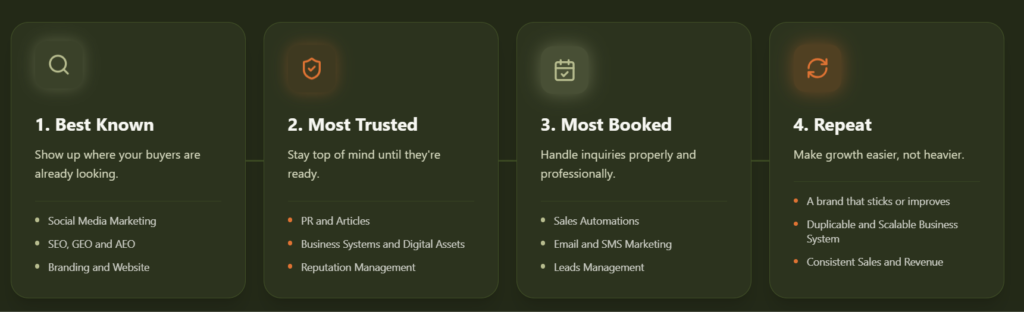
Chi Rivers and The Digital Authority built their approach around exactly this reality. The framework is not built on one channel or one tactic. It is built on the understanding that a local business in the Philippines needs to be the most known, most trusted, and most booked option in its category and that achieving all three requires working across SEO, GEO, and AEO simultaneously, not sequentially.
For businesses that have been putting money into ads and not seeing the return they expected, this is often the explanation. The visibility is there, or at least parts of it. What is missing is the strategic layer that connects discoverability to trust to conversion. Anyone can run an ad. Very few businesses have built the infrastructure that makes the ad spend compound into something sustainable.
Beyond her work with The Digital Authority, Chi Rivers is also currently working on her upcoming fiction novel titled “All the Lies She Lived.” It is a side of her that surprises people who only know her through her marketing work, a reminder that the sharpest strategic thinkers are rarely one-dimensional. The book is soon to be available on Amazon, Kindle, and Barnes and Noble.
For now, though, the work continues: helping Philippine automation strategies reach the local businesses that need them most so they stop being invisible to the customers who are already looking for exactly what they offer.