Introduction to Pre-Clinical Operative Dentistry
As one of the fundamental courses in dental education, pre-clinical operative dentistry is particularly important in the debut years of the dental student to educate and teach practical operative steps of dentistry. It emphasizes teaching fundamental manual skills, the theoretical basis and clinical reasoning in a safe laboratory setting before students can start treating patients. Pupils do not work immediately in a dental clinic but gain confidence and accuracy with the use of models, simulators and extracted teeth. This is an important period, as this is the period in which students link what they have learned in the classroom to dental procedures and activities in the real world. Gradually, pre-clinical training in tooth preparation, cavity design and preparation methods equips the student to the training of safe and effective clinical skills progressively across the training.
Pre-clinical Operative Dentistry in Dental Education.
Pre-clinical operative dentistry is of immense importance in dental education as it is the foundation for all subsequent learning in operative dentistry and is expected to be the context for future studies of these subjects in the clinical setting. During this phase, students develop the skills to operate dental instruments, grasp the morphology of these teeth and apply restorative principles as a systematic approach that can be repeated regularly. This foundational experience would be overwhelming, and possibly unsafe to the profession of patient care, if it were not preceded by this experience. One major component of this learning curve is learning to maintain the integrity of the natural tooth while still removing the decay and restoring function. Students learn to critically analyse all the processes of a procedure–from present diagnosis to restoration design. Students frequently use this clear guide pre-clinical operative dentistry on the operating procedures to get academic experience in structured techniques for better knowledge of foundational principles. A balance of theory and experience enables the student to be adequately equipped for clinical duties.
The following skills will be developed with the support of pre-clinics.
In the pre-clinical operative dentistry training experiences, students gain adequate multi-faceted skills that would be important in their future practice as a dentist. The first skill is hand-eye, handing the students the ability to make accurate movements, an active maneuver in a confined area in the oral cavity. They have also been instructed on postures and ergonomics, to help prevent fatigue and ensure long term health issues during clinical practice. A fundamental skill, like one is reading the tooth anatomy, knowing what grooves, cusps and contact points pertain to and how this knowledge will carry over to the restorative process. The use of cavity preparation techniques is practiced so often that students repeat the practice to get consistent and accurate results. The more times this is repeated, the more your muscle memory will be developed, which is crucial when you were to perform on patients. Particularly, pupils receive lessons on the concepts of minimally invasive dentistry, with a focus on maintaining as much dental structure as possible during successful treatment of dental decay and damage.
To know the dental lab environment
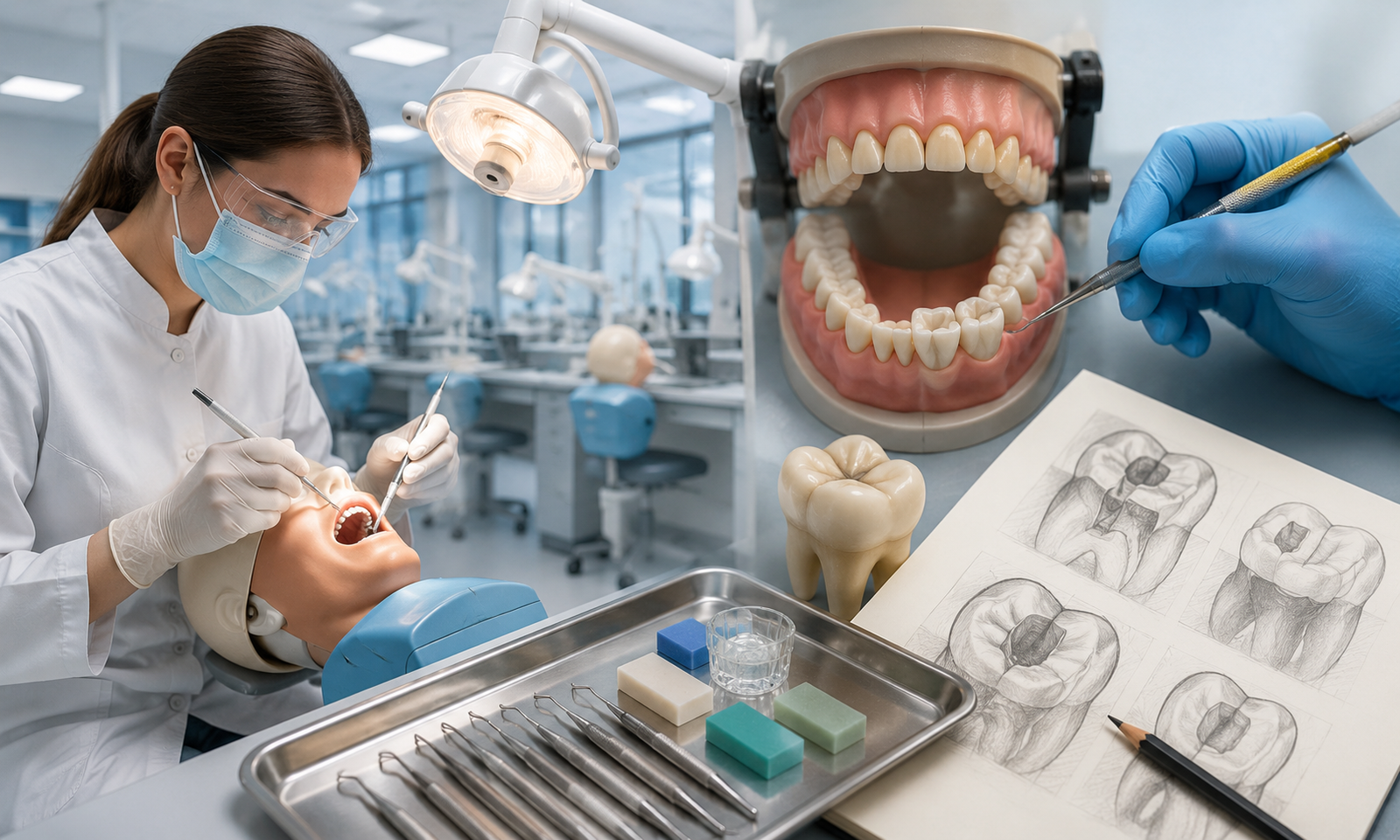
Dental Laboratory Environment is an essential part in the shaping of the pre-clinical oral operative students’ learning environment. The laboratory offers students a “safe” and “controlled” environment in which students can make an error and (receive a correction without working) harm to patients. The environment offers dental mannequins, simulators, and special workstations that simulate realistic clinical scenarios as faithfully as possible. Long hours are spent practicing the procedures of cavity preparations, restoration placement and polishing techniques. The lab also promotes discipline and attention to detail; even the smallest mistakes in technique can make a big difference in the restoration procedure’s success. Use of teaching and learning resources is well monitored and feedback and corrections are given while students are still learning. This built-up environment allows students to confidently build their confidence and accuracy, fully prepared for their patient-based clinical work.
Training is conducted using the sets of instruments and materials that are essential.
One of the most important parts of pre-clinical operative dentistry is getting to know the large number of instruments and materials used in restorative dentistry. Students learn to select, use, and care for hand and composite, amalgam, finishing burs, and excavators. There is one instrument for each purpose and one way of playing it to use it effectively. Students use a variety of teaching materials as well as restorative materials such as bonding agents, glass ionomer cement, amalgam and composite resins. An awareness of the properties of these materials is necessary in order to choose the right material for the right clinical situation. For instance, because of their impression of tooth appearance, composite restorations are utilized for aesthetics, while amalgam is used for its durability in posterior teeth. By teaching students the properties of these materials in response to various conditions, they are better furnished for future clinical decisions so that their restorations will be both long-lasting and functional.
The process of moving from pre-clinical to clinical practice
This is an important step on the path from a student in a pre-clinical situation to a student in a clinical setting as a dentist. Whilst spending time developing technical skills within the laboratory students start to put these skills into practice with actual patients under supervision. This requires in addition to the technical skills a certain emotional preparation as the work with patients brings new problems, among others the communication, the management of patient anxiety and the ethical responsibility. Displays skills learned in the laboratory but must readapt these skills in a changing clinical environment with each patient’s needs being different. Pre-clinical training offers very good preparation but in the clinical world you’ll need to be able to think on your feet and be able to make decisions. It is important to note that the role of instructors in this stage is very important in aiding students in procedures, and ensuring safety for patients. Confidence built during pre-clinical experiences helps minimize anxiety and enables the student to concentrate on providing quality care and to practice and enhance skills in a real-life setting.
Pre-clinical operative dentistry’s role in the skill development
Pre clinical operative dentistry is very fundamental as it covers the foundation of all future skills acquired in dentistry. This would leave students with less confidence and technical skill to effectively do restorative procedures. It promotes precision, patience and consistency and all are essential in a dental practice. Furthermore the merit of conserving natural tooth structure, which is a core tenet of contemporary tooth restoration, is highlighted. Learners also develop the ability to critically assess their work to identify areas for development and to enhance their techniques in time. The continual learning process aids in developing professional discipline and attention to detail. The repetition of procedures in a highly controlled setting inculcates in students a high sense of responsibility and clinical judgment. These skills help to enhance technical skills as well as in the long term help to achieve good patient outcomes.
The problems first year dental students face
When starting their pre-clinical learning experiences in operative dentistry, many first-year dental students have a number of learning hurdles. A challenge often faced is learning how to handle the level of precision involved in dental treatments. Even the tiniest of inaccuracies can have a huge impact on the final restoration. Also many pupils have poor hand stability and co-ordination, particularly when playing unknown instruments. Finally, time management can be an issue, with some procedures taking longer than anticipated to get off the ground and running. Furthermore, learners might also feel overburdened with theoretical knowledge that they need to be able to practically apply the knowledge in the lab. These challenges, however, are an intrinsic aspect of learning and can be enhanced with regular training and instruction from teachers. Students gradually gain confidence, efficiency and accuracy in doing procedures, handling initial complexities and struggling, and become more able to do these procedures with ease and understanding over time.
Conclusion
Operative dentistry is the building block for the entire dental curriculum and is crucial for building basic skills. It affords first year students the chance to advance their clinical reasoning, professional discipline and technical skills in a protected and supervised setting. Students develop theoretical knowledge plus hands-on experience, allowing them to sequentially progress in becoming autonomous future clinicians. This is a crucial step, as when they are patient in their job, they are showing their readers that ability.This step is non-negotiable and affects how savvy they will be towards patients in their job. Constant practice, instruction, and evaluation encourage students to become proficient with the skills involved, and to be confident in their ability to succeed during actual clinical practice. Pre-clinical operative dentistry therefore is not simply training but the foundational area in dental education to ensure that the students are equipped to provide safe, effective and patient-centred dentistry.