Introduction
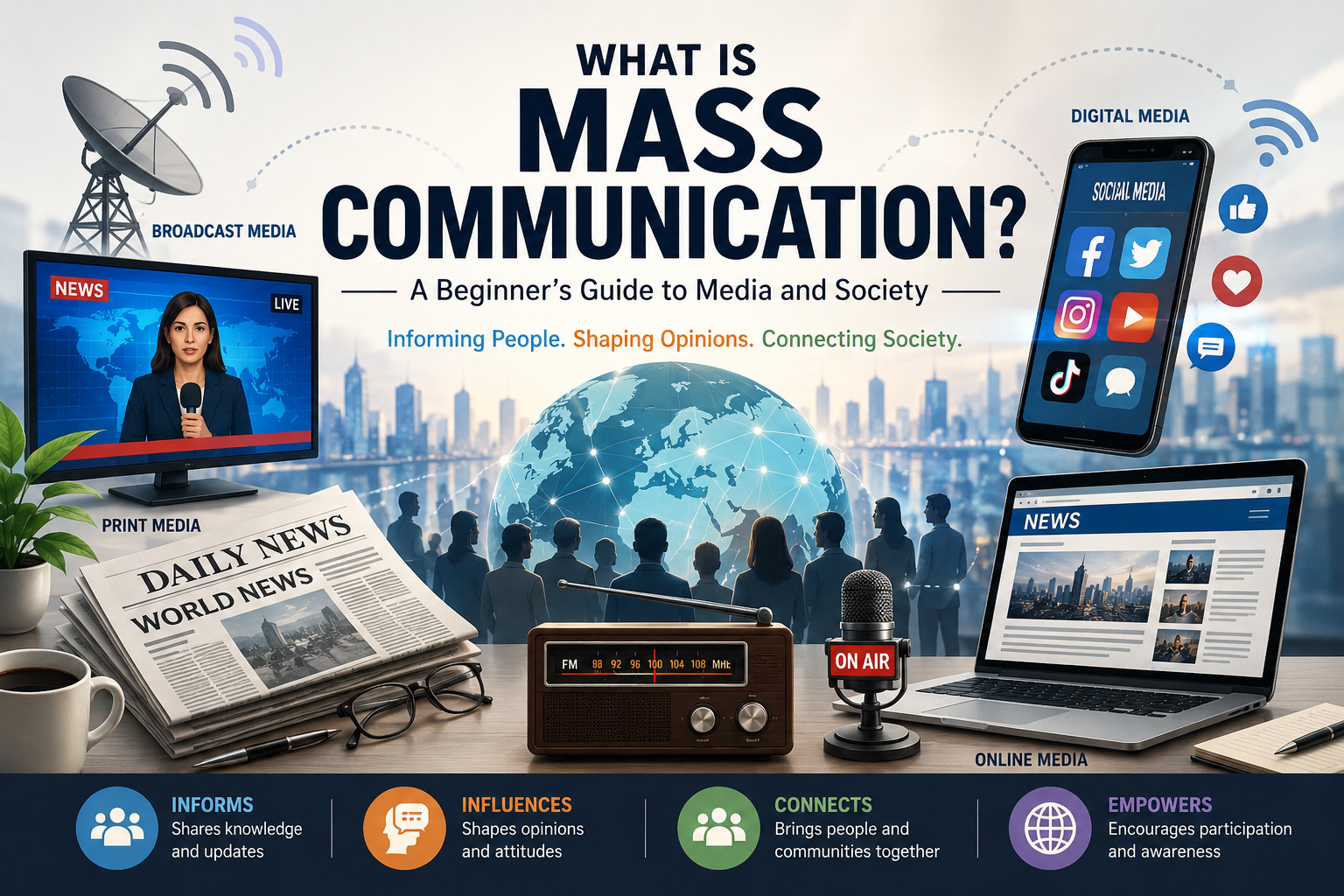
Mass communication constitutes a very important aspect of the contemporary world as it defines the way people think, socialize, and perceive the surrounding world. Mass communication through television, radio, social media, and news sites on the internet has an impact on almost every facet of society. To a beginner, the working of this system may seem daunting, but by breaking it down into easy-to-understand concepts, it can become easier to understand. This article presents the basics, how messages are created and disseminated and why the media is such a powerful tool in changing the opinion and culture of the masses, which are the core concepts of mass communication.
Knowledge of the Core Concept of Mass Communication
Mass communication can be defined as the act of sending, receiving, creating, and interpreting messages using the different media channels available and reaching large audiences. It is not merely about the transmission of information, but rather it involves a lot of planning, narration, and strategic delivery in order to make sure that messages are comprehended by various groups of people.
Mass communication is not similar to interpersonal communication since mass communication is directed to wide audiences as compared to interpersonal communication, which targets individuals or small groups. One message, e.g., a news report or advertisement, can be delivered simultaneously to millions of persons. This is achieved through media channels such as television, newspapers, radio, and digital networks. The fact that mass communication can influence the general thinking and behavior of a group of people is what makes mass communication particularly powerful.
The Major Characteristics of Mass Communication
Vast Reach
The type of messages is aimed at reaching very large and diverse audiences at the same time.
Application of Technology
Communication relies on media resources like print, broadcast, and the internet.
Standardized Messages
Content will usually be written in a manner that attracts a general audience as opposed to individuals.
Limited Direct Feedback (Traditionally)
Feedback, which is normally immediate in face-to-face communication, may be delayed or indirect in this kind of communication.
Impact on Society
Messages are capable of influencing opinions, beliefs, and cultural norms.
The other important facet of the same is that mass communication is no longer a one-way process. Previously, audiences engaged with content in a passive manner, but currently, digital platforms are enabling users to respond, share, and create their own content. This change has turned the audience into participants in the communication process, as the communication process has never previously become dynamic and interactive.
The Development of Mass Communication
Mass communication has seen much development over the years as it has had to adapt to the changes in technology and society. During the previous centuries, communication was highly dependent on print media including books, pamphlets, and newspapers. These formats enabled the dissemination of information on a larger scale as compared to oral communication, but they were still limited by literacy levels and distribution issues.
Key Stages in the Development
Print Era
Books and newspapers allowed information to spread throughout the region.
Broadcast Era
Radio and television brought about real-time communication.
Computer Age
The internet has transformed communication to be instant and global.
Social Media Age
Audiences turned into content producers and distributors.
This was to change after the invention of radio and television, and people were able to communicate in real time and over long distances. These broadcasting media brought in a new wave of immediacy and emotional involvement, in that the viewers/audience could hear the voices and see the images of the events which were happening around the world. This period marked the media as an influential instrument to influence public opinion, particularly during significant events in history.
Mass communication has taken a new step with the emergence of the internet and digital technologies. The online medium enabled the dissemination of information in real time, breaking down geographical boundaries and giving people the freedom to access content at any time. Social media also hastened this change as users can use social media to widely share any content, and in most cases, ordinary people become influential voices. Mass communication today is quicker, more interactive, and more accessible than it has ever been and is now a driving force in contemporary society.
The Most Important Aspects of Mass Communication
To have a clear understanding of mass communication, it is important to look at the key elements of mass communication, which combine to bring out messages. These factors are the sender, the message, the medium, the audience, and feedback. Each of them is important in successful and meaningful communication.
Core Components Explained
Sender
Who is the sender of the message (journalist, media house, organization).
Message
The content or concept of a message that is being communicated.
Channel (Medium)
The medium of the channel (TV, radio, print, internet).
Audience
The recipients of the message are usually varied and extensive.
Feedback
This is the reaction of the audience, and this is most evident in digital media.
It is the duty of the sender to come up with content that is understandable, precise, and captivating. The message itself should be designed in a manner that puts across the intended message to the targeted audience, whereas the medium dictates the manner in which the intended message is passed to the audience. Communication is a highly multifaceted and complicated activity as the message is interpreted by the audience according to their background and perspectives.
Another essential aspect is feedback, in particular, in the digital age. It enables audiences to react to messages, which offers information on the reception and interpretation of content. This communication assists media producers in perfecting their strategies and producing more captivating content. All these factors are interconnected so that mass communication is made possible and efficient within various media and situations.
Forms of Mass Media Channels
Mass communication is based on different media avenues to disseminate information. The channels are unique in their characteristics and impact the way messages are delivered and received. Knowing these channels will enable beginners to understand the differences in communication strategies with changes in platforms.
Main Types of Media Channels
Print Media
- Newspapers
- Magazines
- Books
Broadcast Media
- Television
- Radio
Digital Media
- Websites
- Social media platforms
- Streaming and blogs
One of the oldest mass communication media is print media, and this medium is known to be deep and credible. It can be used to tell and analyze stories in detail, and hence is useful in in-depth reporting. Broadcast media, in turn, provide audio and visual information to a large audience, establishing a powerful emotional appeal using sound and imagery.
Digital media has revolutionized communication as it is interactive and accessible. It lets users interact with content in real time, get information disseminated far and wide, and even create their own messages. This change has transformed the communication process to be participatory, with audiences playing a bigger role in the process.
How Mass Communication Forms Public Opinion
The ability of mass communication to influence the opinions of people is one of the greatest effects of mass communication. The media play a major role in the thought processes of people, as they determine which items should be featured and how these items should be presented. It is through this process that issues are prioritized and those that are ignored.
The Means Through Which Media Affects Opinion
Agenda Setting
The raising of certain issues so that public attention would be guided.
Framing
The presentation of information in a specific manner to influence interpretation.
Repetition
Strengthening ideas by repeated exposure.
Emotional Appeal
Storytelling that is used to reach out to audiences.
Mass communication also puts information into certain perspectives, which affects the way that the audience interprets events. As an illustration, the same news can be given from different angles, and thus may have different interpretations. This framing effect may influence attitudes, beliefs, and even behaviors, and therefore, the media is a great tool in influencing society.
Moreover, when some messages are repeated, the ideas might be strengthened, and a common perception among audiences might be formed. This may eventually result in the development of cultural values and common beliefs. Due to this, mass communication not only informs but is also important in influencing how people perceive the world around them.
The Role of Mass Communication in Culture
Mass communication is closely intertwined with culture, and it reflects and forms the values, traditions, and identities of society. Media content tends to reflect cultural norms, and this gives audiences a sense of belonging and experience. Simultaneously, it brings new ideas and points of view, as well as cultural change.
Media Cultural Functions
Representation
The reflection of society and its values and identities.
Cultural Exchange
Exchange of ideas in various societies.
Preservation
Recording traditions and heritage.
Innovation
The introduction of new trends and perspectives.
Through globalization, mass communication has become global, and therefore, cultures have interacted and influenced each other. People get exposed to a wide range of cultural expressions through films, music, and social media, and this leads to understanding and exchange. Nevertheless, it also brings questions of cultural homogenization, when dominant cultures subdue local traditions.
Nevertheless, mass communication has still been an effective tool towards the safeguarding and endorsement of cultural heritage. The media can embrace cultural diversity and promote discussion between various groups of people by promoting different voices and stories.
Ethical Implications of Mass Communication
Mass communication poses significant ethical concerns, and great responsibility comes with great influence. Media practitioners need to reconcile the necessity to inform the people with the need to give accurate and fair information.
Common Ethical Issues
- Fake news and misinformation
- Discrimination and absence of impartiality
- Privacy violations
- Sensationalism
Ethical Best Practices
- Information to be fact-checked prior to publication
- Providing balanced perspectives
- Developing respect towards individuals and communities
- Being transparent and accountable
Ethical mass communication entails fact-checking, giving balanced views, and appreciation of the dignity of people and communities. Nowadays, it is more important than ever before that ethical standards be upheld in the digital age, where information spreads like wildfire.
Audiences also contribute to the promotion of ethical communication by critically assessing the content they read or watch and share with others. As informed and responsible consumers, people may help to create a more trustworthy and reliable media landscape.
The Future of Mass Communication
Mass communication is being influenced by technological changes and the shift of the audience in the future. The use of artificial intelligence, virtual reality, and data analytics is one of the innovations that are changing the way content is created and delivered.
Emerging Trends
- Personalized Content Delivery
- AI-Driven Journalism
- Immersive Media (VR/AR)
- Increased Audience Participation
Concurrently, issues like information overload and internet misinformation keep increasing. With the growing number of content, audiences now have to navigate a complex media landscape, and thus critical thinking skills are more important than ever.
Even in the face of these challenges, the main principles of mass communication have remained unchanged: the need to create meaningful messages, the need to deliver messages to the audience, and the need to achieve understanding. Mass communication will remain very important in its functions of influencing society as it adjusts to new technologies and adheres to ethical principles.
Conclusion
Mass communication is an effective and multifaceted mechanism that unites people, forms opinions, and shapes culture. Knowing its main elements and mechanisms, amateurs will be able to enjoy the role media plays and how it works. Mass communication is always changing and has undergone many changes, adapting to new technologies and expectations of the audience.
With the ever-increasing involvement of media in day-to-day life, the role that it plays is now more important than ever before. By learning to think critically and be responsible in their interactions with the media, people could effectively navigate the information environment and help to create a more informed and connected society.
Frequently Asked Questions (FAQs)
In simple words, what is mass communication?
Mass communication refers to the process of communicating information to a large audience using media such as television, radio, newspapers, and the internet. It enables the transmission of messages to a large number of people simultaneously.
Why is mass communication important?
It educates, forms opinions, and unites people in various parts of the world and is important in education, entertainment, and cultural exchange.
What are the principal forms of mass media?
The primary ones are print media, broadcast media, and digital media, which have varying communication functions.
What is the effect of mass communication on society?
It influences the way people think and act by shaping opinions, setting agendas, and reflecting cultural values.
What are the skills that assist in learning mass communication?
Interpreting and evaluating media content is a key skill that is necessary to interpret and evaluate the contents of the media.