Introduction
At first, accounting might appear overwhelming, but each accounting system is based upon a solitary formula referred to as the accounting equation. You can use the equation to master financial reporting, whether you’re a secondary school student, university undergraduate, aspiring an accountant, an entrepreneur or a small business owner. This equation is balanced with every business transaction from equipment purchases to receiving customer payments.
Bookkeeping, financial statements and preparing a balance sheet are based on the foundation of accounting equation. If you do not grasp it, debits and credits, journal entries and financial reporting are more difficult to learn. Fortunately, the accounting equation is very simple to understand once you understand the connection between assets, liabilities and owner’s equity.
A good explanation of the accounting equation that gives a deeper understanding of why this equation is the basis for modern accounting. This article expands on that idea and does so by providing simple explanations of the equation and providing some examples that could be understood by a complete beginner.
What Is Accounting Equation?
The accounting equation is an accounting’s basic formula that summarizes all the financial transactions. It states:
Assets = Liabilities + Equity
In other words, the equation signifies that all the assets of the business are funded, either by taking loans from others or by investing their money into the business themselves.
Every transaction will always involve at least two accounts, thus maintaining equation. If one of the equations’ sides changes, so does the other side. This principle is about balance to ensure that financial documents are accurate and complete.
The accounting equation is referred to as the foundation of accounting because all financial statements, particularly the balance sheet, is the basis for it. This equation is used by anyone who works in business professional accountants, auditors, investors, lenders and business managers. Students should first grasp the meaning of this accounting equation before moving on to more complex accounting principles like “adjusting entries,” “depreciation,” and financial statement analysis, as it is the basis that ties all other parts of accounting together into a coherent system that ensures consistency and reliability in financial information.
The Three Parts of the Accounting Equation: Assets = Liabilities + Net Worth.
Assets
Assets are the resources that a business owns or can draw upon that can generate economic value for the future. Assets are used in business to create revenues, to operate the business and to satisfy customers.
Assets are things that are used to help you pay bills, such as:
- Cash
- Inventory
- Buildings
- Land
- Office furniture
- Computers
- Equipment
- Vehicles
- Accounts receivable
- Investments
Some assets are used up over a long period of time; others are turned into cash over a short period of time. All assets will be listed on the left side of the accounting equation since they are resources available to the business.
For instance, the bakery acquires an oven – this is an asset because it can be used to produce products which bring future income. Similarly, assets include any funds in a bank account that can be used to cover expenses or to buy more resources. Students will be able to identify and appreciate the assets that a business may have and how they support the business in the day to day running and long term success.
Liabilities
The Liabilities column refers to the money that a business is liable to pay others or organizations. They are debts which have to be repaid at some time.
Common liabilities include:
- Bank loans
- Accounts payable
- Salaries payable
- Taxes payable
- Utility bills
- Mortgage loans
- Interest payable
When a business accepts something of value now, and agrees to pay for it at a later time, the business has incurred a liability. For instance, if you buy credit inventory, you are responsible to pay back the supplier at a later date.
Liabilities are not necessarily bad. Many profitable companies are working on using loans to increase the operations, acquisition of equipment, or investing in growth opportunities. But, it’s important for businesses to handle their debts properly as too much debt can lead to problems. Correctly recording liabilities will ensure that businesses know what they owe and if they have sufficient assets on hand to pay the liability when it is due.
Equity
Equity is the owner’s investment in the business, or the net worth of the business. Also known as owner’s equity, shareholders’ equity or capital, depending on the form of business.
Equity generally includes:
- Owner’s capital
- Retained earnings
- Additional investments
- Profits earned
- No drawings or withdrawals
One easy-to-understand concept of equity is the ability to sell all of the business’s assets to pay all of the liabilities. If there is still any left then it is for the owner’s. The equity is that money that’s left.
Equity should grow as equity equals retained earnings + profits. Generally, equity should grow as equity equals retained earnings + profits as equity will grow as the businesses make profits. Equity is decreased when businesses suffer losses or withdrawals by the owner. Equity is understood and is important for students to value the contribution that the business will make to the owner’s finances in the long-term.
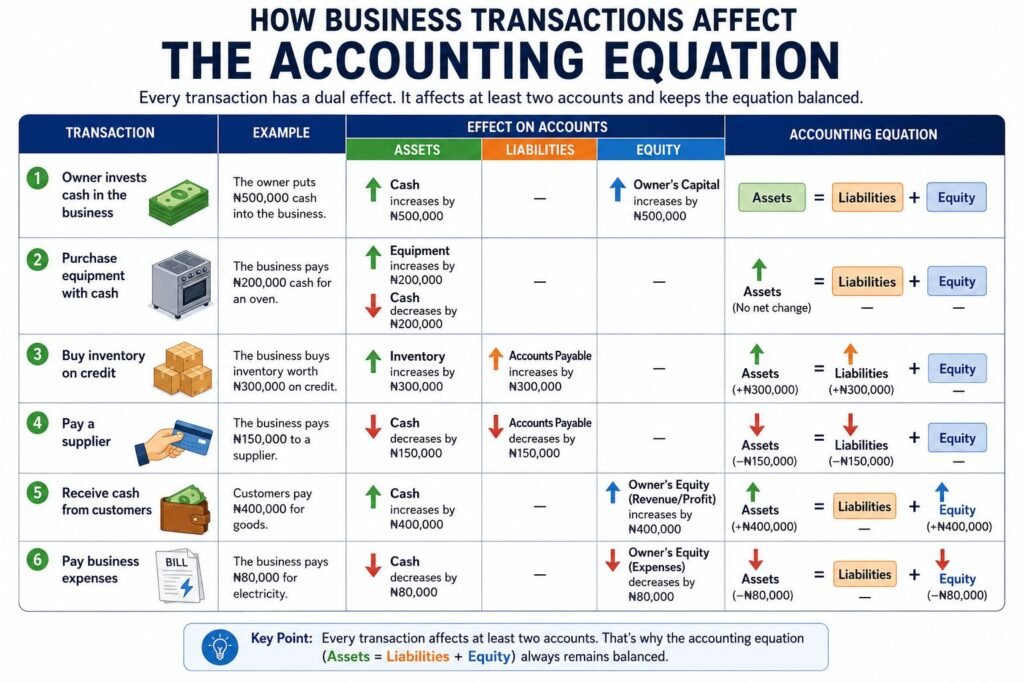
Why the Accounting Equation always Remains Balanced.
One of the most fundamental accounting rules is that the accounting equation must always be balanced. Each individual transaction has two corresponding effects so that both sides of the equation can be balanced.
The double entry bookkeeping system is based on this balancing process. Instead of only recording the amount of funds raised accountants record the amount of fund raised and used.
For instance, a firm may take out a loan from a bank, which will add cash to the balance sheet as the business receives the money. Meanwhile, loans payable rise and the business now have to pay that amount to the bank. Asset decreases by the same amount as a liability so that the equation remains balanced.
Likewise, if the owner invests more money in the business, then the amount of cash will also increase, and the amount of owner’s equity will also increase by the same amount. Both sides increase equally, and the balance is the same. This continuous check and balance enables the accountants to identify the errors with ease and helps in the financial statements to provide the correct view of the financial situation of the business.
How Common Business Transactions Affect the Accounting Equation
Knowing how each of the normal transactions impacts the accounting equation makes accounting much easier. Students start to identify patterns, rather than learning rules.
Owner invests cash
If funds are contributed by the owner to the initial creation of a business:
- Assets increase (cash)
- Money invested in the business by the owner (owner’s capital)
The equation remains balanced
Purchasing equipment with cash, instead of borrowing or financing
If equipment is paid for with cash:
- Equipment increases
- Cash decreases
Both the accounts are asset and thus, total assets remain unchanged.
Buying stock on the credit
What if a business buys stock, but will be paying it off at a later date?
- Inventory increases
- Accounts payable increases
Both assets and liabilities are added on the same amount.
Paying a supplier
When the business pays part of what it is on the hook for:
- Cash decreases
- Accounts payable decreases
The value of assets falls, the same amount as the value of liabilities falls.
Generating revenue from the consumers
If customers pay for their service services at the time of use:
- Cash increases
- When people earn profit in their business, equities are increased.
This is due to a rise in owner’s interest due to earned income.
Paying business expenses
When bills (rent, electricity etc.) are paid:
- Cash decreases
- Note that expenses have a negative impact on equity because they lead to a decrease in profit.
Both sides of accounting equation decrease the same amount, and thus the accounting equation still balances.
Observe that no of these transactions causes the equation to be “unbalanced”. The consistency that is achieved is what gives accounting reliability and trustworthiness in the decision-making process.
Why the Accounting Equation is Important.
Many novice accountants ask why one simple equation is so important to accountants. Well, almost all accounting procedures rely on it.
The accounting equation is used to ensure that financial transactions are fully recorded, which helps maintain financial records. It decreases the chances of error as at least two accounts are involved in each transaction. It also sets out the framework to prepare financial statements, particularly the balance sheet which shows a company’s financial position at a particular time.
The business owner can use the equation to determine if the company will be funded with debt or the owners. Investors use the equation to determine financial stability, and lenders will look at the equation prior to making loans. The accounting equation is also used by auditors to check the financial statements for fairness with respect to financial activities. To sum up, this one equation not only maintains financial reporting integrity in businesses of all sizes, but also across it.
The Relationship between the Accounting Equation and the Balance Sheet
One of the most significant financial statements, the balance sheet provides information on what a business owns, what a business owes, and what is owned by the business.
The accounting equation is followed by a balance sheet.
On a balance sheet:
- Assets appear first.
- The next section of the report includes the liabilities.
- The equity is listed below the liabilities.
The sum of the numbers on the totals will always be equal to:
Assets = Liabilities + Equity
If the balance sheet is not balanced, then it means that there has been a mistake in one or more of the accounting entries. Due to this, accountants often have to audit the transactions and balances in accounts prior to creating the financial statements. The understanding of this relationship enables the student to appreciate the structure of the accounting equation as the basis of one of the most important financial statements of a business, rather than just a formula he/she has to memorize.
Common mistakes Beginners Make
The accounting equation is the one area in accounting that is difficult for many students to begin with, due to incorrect understanding of what assets, liabilities or equity is. A frequent error is assuming that all income that is received is profit. The fact is that borrowing cash would boost cash and also introduce a debt, however it does not boost the wealth of the proprietor. An equally common mistake is mixing up business assets and personal things. The accounting records of a business should only contain resources owned or controlled by the business.
Students will also sometimes think that each transaction alters the amount of assets. Some transactions, though, only involve trading in assets and the like, such as a cash trade of equipment. Total asset value does not change but the proportions of the assets do. These differences are important for the students to be aware of so that they don’t get confused when moving on to more advanced accounting concepts.
Tips for mastering the Accounting Equation
It’s easier to learn the accounting equation by practicing it, rather than memorizing it. The first step in a transaction analysis is to determine if each element of the transaction is an asset, liability or equity. When those categories are established, decide if they go up or down due to the transaction. Lastly, see if both sides of the equation is equal. This activity can be repeated using new examples, thus gaining confidence and strengthening logical thinking skills in accounting.
Pupils should also relate accounting equation to real-life businesses that they see everyday. Describe how a supermarket buys, sells, gets paid by, pays to, and borrows from banks. All of these activities will impact the accounting equation and keep it balanced. Using practical scenarios to discuss accounting makes it more real to the students and less abstract, and can help students understand the importance of the accounting equation in financial reporting.
Conclusion
The accounting equation is the fundamental concept of accounting and financial reporting. The assets – liabilities, equity equation might seem straightforward but it will form the basis for all trading in the business entered into within the accounting system. Students who learn about assets, liabilities and equity will develop the knowledge to read financial statements and learn how businesses operate their finances and how to prepare balance sheets.
Each transaction maintains the equation and ensures transactions are complete and accurate, giving confidence to the financial records. Regardless of whether one is an aspiring accountant, a business owner, a business student or anyone desiring to better understand financial information, mastering the accounting equation is a necessary first step. Once you understand this, a lot of the more complicated accounting principles are simpler to understand as they are all based on this one.
Get more well researched information about Understanding the Accounting Equation here.