Introduction
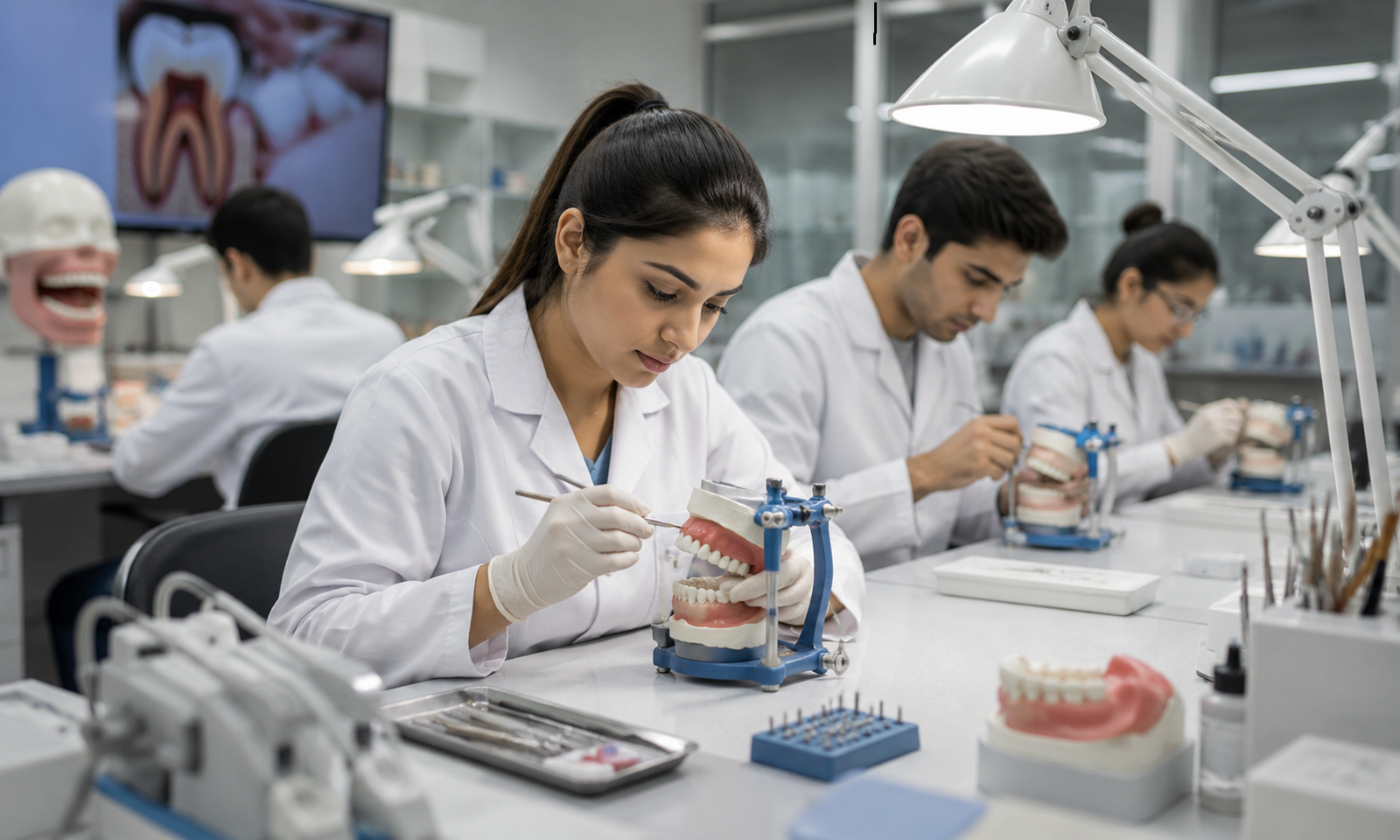
Taking laboratory components is a fundamental part of competent dental professionals’ formation. That is, lecture and textbook information is needed in order to obtain theoretical knowledge; however, in the laboratory, students have to learn to apply the knowledge to practice. Hands-on training is vital to subjects like oral biology, restorative techniques and particularly dental anatomy, as students acquire the understanding and manual dexterity necessary to excel in the clinic.
The knowledge of dental anatomy is not only a fundamental requirement for the dental school curriculum, it is the foundation for nearly all of dental practice. The understanding and replication of the natural tooth morphology are significant for such treatment success as restoring a broken or decayed tooth, or designing a dental prosthesis crown. Because of this, exercises like the tooth carving and waxing sessions cannot and should not be taught in a detached fashion, but they become a vital piece of dental education.
It reviews the importance of laboratory training in dental education and how it helps to reinforce what they have learnt in the lectures, increases psychomotor skills and helps students prepare for actual practice.
A discussion of the importance of laboratory training in Dental Education.
Unlike other health sciences it has the needs of integrating fine motor skills with cognition in dental education. Not only must students learn to understand biological processes but they must also apply biological processes very precisely and delicately in a very delicate environment.
Laboratory training has several important functions are:
Firstly, it is a link between theory and practice. Learners might be taught through a lecture about the morphology of a tooth, but if nothing practical happens to it, it will not be a practical matter for the learners. They are given lab exercises to do in which to recreate anatomical structures, making the learning more concrete and memorable.
Secondly, laboratory training develops confidence. Students who have seen simulation will not be as anxious when they enter the situation with real patients. Learners can make mistakes without cause while practicing in a controlled setting and also correct the mistakes in a supervised fashion.
Thirdly, it promotes psychomotor coordination. Hand-eye coordination, precision and control are essential in the field of dentistry. These skills are honed gradually through a series of laboratory exercises, enabling students to conduct clinical procedures accurately. In this set of exercises, Core Laboratory explores tooth Carving and Waxing. Tooth carving and waxing are among the most important of the laboratory activities in dental education. The exercises are pivotal in the development of understanding about tooth form and function.
Tooth Carving
The points of tooth carving are usually made of wax or soap and can take the shape of various teeth: incisors, canines, prosthetic teeth, molars etc. There are anatomical structures for each type of tooth that need to be captured.
Carving helps students to recognize and duplicate important surface characteristics like cusps, ridges, grooves and fossae. This exercise enhances their knowledge about the relationship of tooth structure and function. The broad occlusal surface is seen in molars, which are used for masticating food, for instance.
Other than that spatial awareness is trained when carving. Students need to always think in 3 dimensions working on a 2 dimensional block. This mental translation is important for clinical applications like restoring contoured bone and crown preparation.
Waxing Techniques
Waxing exercises often are performed that are more advanced and are more similar to restorative exercises. Students make copies of tooth shape by using dental wax, either plastic models or prepared dies. This enables them to practice real life situations like the fabrication of crowns or anatomical correction, etc.
Occlusion is the contact between upper and lower teeth during jaw movement, which is made more easy to understand using waxing. Occlusal relationships play a crucial role in function, comfort and long-term oral health. Learners through the processes of waxing gain understanding of the importance of small variations in tooth shape on the force of bite alignment.
Theoretical Knowledge and practical application “bridging”
A major learning problem in dentistry is the ‘gap’ between the knowledge that is taught to the student and the subsequently acquired skills. In between these two concerns sits laboratory training. During lectures, the students learn about tooth morphology, occlusal relationships and restorative principles. But it is only in actual practice that these ideas become fully realised. For example, although one can have knowledge of, and see in theory, a curvature for a cusp, it is different to carve out a curvature that fits a natural cusp.
There are laboratory courses to ensure that memory retention is improved by active learning. Education research has demonstrated that educationally, kinesthetic activities facilitate better learning. Consequently, carving and waxing in dental art not only help to develop skill but also enhance conceptual understanding.
In addition, lab training engages the student in problem solving. Pupils need to be continually evaluating and correcting their work. This is an iterative process similar to what occurs in the real clinic in which the dentist would have to adapt the technique depending on the condition of each patient.
Clinical preparation of students.
One of the most significant features of their lab training is when students can engage in actual patient interaction. While moving from the classroom to practice never comes easily, it’s even harder if it doesn’t extensively involve hands-on experience.
Developing Clinical Precision
In a dental practice, precision plays a key role. The difference of even 1/10 of a millimeter can make a big difference in the comfort level or if the restoration fits or not. Lab work helps students develop skills to work within close tolerances, hence making the process more delicate. Students will have muscle memory from a repeated practice of tasks like carving and waxing. This helps them to carry out complex movements in clinical situations with greater efficiency and precision.
Creating confidence through instruments with instruments
The students learn about the dental instruments in the lab, including handpieces, wax spatulas, and carving knives. This familiarity results in less hesitation in clinical procedures. Students have the tools and experience to use them safely and effectively in a real patient care scenarios.Students will be familiar with patient care tools; will know how to be familiar with using them safely and effectively.
Understanding Patient-Centered Application
Laboratory operations involve modelling but they are to mirror real-life activities. Students learn to take into account aesthetics, function and occlusion which have a direct impact on the patients’ satisfaction. When building a tooth they have to consider shape as well as what effects that tooth will have on opposing teeth during mastication. Such a comprehensive view is necessary in order to provide quality dental care.
Repeat and practice to develop skills.
Laboratory training is strongly focused on the habit of repeating a task to master the skill. Along with many manual professions, dentistry is an area where practice is needed to master it.
Enhancing Fine Motor Skills.
Fine motor skills are those which require delicate coordination of the hand/fingers. A gradual progression of lab exercises allows students to be able to do more and more complex things with increasing stability and control.
Visual-Spatial Coordination
Dentists have to interpret three dimensional structures and convert these to physical work. Lab training has an impact on visual spatial coordination resulting in better visualization of tooth morphology before and during lab procedures.
Attention to Detail
Even minor anatomical variations can have a big impact on clinical results. Laboratory exercises are designed to teach students to notice and reproduce fine details, resulting in a high degree of accuracy that they need to have on the job.
Simulations and Innovation in teaching.The use of simulations and innovations in teaching.
These days, there is a lot more emphasis on advanced simulation technologies being used for traditional carving and waxing that are also vital to dental education today. This is complemented with new digital simulation and 3D printing exercises that have been introduced. With these technologies, students can be allowed to view tooth anatomy in digital models and perform virtual restorations as a preview to the physical materials.
But, in spite of the progress in technology, practical sessions are more valued than technology. Being able to handle materials offers a level of sensory feedback that digital is not yet able to provide. Traditional and Modern approaches work together to provide a holistic learning experience, which promotes both knowledge and skill building.
Ideas on how to improve Laboratory Based Dental Education.Issues relating to Laboratory Based Dental Education. While lab training is very effective, it is by itself a challenge. A big problem is the time consuming practice. Proficiency with carving and waxing can be time consuming, as there is a great deal of repeating to be done, even for students taking multiple courses.
A further difficulty is the differences in the speed of acquisition of skills. Some students make great strides vs. others need more time and support. This requires customized teaching and continual feedback to students from instructors.
Limitation may also be issues related to resource availability. The use of high quality materials and instruments is vital in the context of effective training, but all institutions do not necessarily have access to such materials and instruments. In spite of these, there are distinct merits of laboratory training more than the restrictions and that is why laboratory training is a paramount necessity in dental education.
Conclusion
Laboratory training is an integral part of dental education as the bridge between theory and practice. Students learn hands-on skills like tooth carving and waxing, followed by laboratory opportunities that help them produce a comprehensive grasp of dental anatomy, foster precision with their hands, and instill confidence in their performance with patients.
Learn by interacting with tooth morphology and occlusion, to obtain skills in real life conditions. This hands-on learning will help students to develop their knowledge and critical thinking skills, and will also prepare them for the accuracy and accountability levels demanded in the real clinical setting.
With the continuous advancement of dental education, laboratory training will also continue to be a key factor, contributing to the establishment of dental skills and the development of future dental professionals.


