In the current digital society, the computer networks are relied upon in communication and sharing of data. Whether it is sending messages using your smartphone, or using the services provided by the cloud, what makes modern technology is networks. Students, IT professionals and ordinary users should understand the different kinds of computer networks to have an understanding of how devices interact and communicate.
Computer networks are classified in accordance to their physical location, size and their functions. Local Area Network (LAN), Wide Area Network (WAN), Metropolitan Area Network (MAN) and Personal Area Network (PAN) are the most prevalent ones. They have their purpose and perform in various environments. This knowledge about these types of networks will enable users to make a more informed decision with regards to designing, managing or utilizing network systems.
What are Computer Networks?
A computer network is the system of sharing data and resources between more than two devices like computers, servers, smartphones, and printers. These connections enable devices to interact, share information and have access to common services such as internet connections, storage systems and applications.
Key Components:
- Devices: Mobile devices, switches, routers, servers, and computers.
- Transmission Media: Wired (ethernet cables, fiber optic), wireless (wi-fi, Bluetooth).
- Protocols: Communication protocols like TCP/IP that make sure that the data is sent in the right format.
- Network Interface Cards (NICs): Hardware which connects devices to a network.
How Networks Function:
- Data Transmission: Data is divided into packets and it is transmitted over the network.
- Routing: Routing devices such as routers decide the most appropriate route of data.
- Error Checking: Checks that the data comes in correctly.
Learning about networks and how they work gives a good base to discuss the various kinds.
Local Area Network (LAN).
Definition:
Local Area Network (LAN) is a network which links devices over a small geographical location like a home, office or school.
Characteristics:
- Covers a small area (single building or campus)
- High-speed data transfer
- Privately owned and managed
- Both wired and wireless connections.
Advantages:
- High Speed: Data transfer rates are much faster than larger networks.
- Cost-Effective: Reduced costs of installation and maintenance.
- Simple Sharing of Resources: It is simple to share files, printers and applications.
- Centralized Control: Simpler to administer security and updates.
Disadvantages:
- Limited Range: Not able to cover a large area.
- Install Dependency: needs appropriate design and care.
- Security Risks: Easy to get into unless secured.
Real-World Applications:
- Home Wi-Fi networks between phones, laptops, and smart TVs.
- Workplaces with file sharing and printers.
- Schools or universities having computer labs and networks on campus.
LAN Technologies:
- Ethernet: Wired networking technology.
- Wi-Fi: Wireless network standard.
- Switch-Based Networks: Enhance performance through minimizing data collisions.
Most daily networking environments are built upon LANs and are commonly used to create larger networks.
Wide Area Network (WAN).
Definition:
Wide Area Network (WAN) is a network which connects various LANs within a wide geographic location within cities, countries and continents.
Characteristics:
- Covers vast distances
- Shares service with or rents communication infrastructure.
- Farther than LAN is because of distance and complexity.
- Controlled by several organizations.
Advantages:
- Global Connectivity: Allows global communication.
- Remote Access: The user is able to access it anywhere.
- Scalability: Will be able to scale as organizations increase.
- Centralized Data Access: Allows remote server and cloud computing.
Disadvantages:
- Expensive: Infrastructure and maintenance is costly.
- Latency: Time delays associated with long-distance data transmissions.
- Security Issues: Additional vulnerability to online attacks.
Real-World Applications:
- The biggest WAN in the world, the internet.
- Banking networks linking branches all over the world.
- MNCs connecting offices in different countries.
- Airline reservation systems
WAN Technologies:
- Leased Lines: Special communication lines.
- Satellite Links: This is used in isolated locations.
- MPLS (Multi-protocol Label Switching): Enhances efficiency in data flow.
WANs play a crucial role in companies that have a global operation.
Metropolitan Area Network (MAN)
Definition:
Metropolitan Area Network (MAN) spans across a city or a big urban area and connects a number of LANs in it.
Characteristics:
- Smaller than WAN and bigger than LAN.
- Light speed connectivity in a city.
- Frequently run by telephone companies or the government.
- Uses fiber-optic infrastructure
Advantages:
- Wide Coverage: Unites institutions in a city.
- High Performance: WAN is slower than high performance in local areas.
- Efficient Sharing of Resources: Suitable in urban infrastructural implementation.
Disadvantages:
- Expensive Setups: Need a sophisticated infrastructure.
- Complex Management: Requires technical skills.
- Urban Only: Cannot be used in the rural areas.
Real-World Applications:
- City-wide internet services
- Cable TV networks
- City systems that are smart (traffic management, surveillance)
- Campuses of universities all over a city.
MAN Technologies:
- Fiber Optics: It is a high-speed communication.
- Wireless Backhaul: links network segments.
- Public Network Infrastructure: Shared between organizations.
The urban connectivity and infrastructure needs MANs.
Personal Area Network (PAN).
Definition:
Personal Area Network (PAN) is a personal network, where devices are connected in a very small area.
Characteristics:
- Travels several meters.
- Typically wireless
- Simple and portable
- Low power consumption
Advantages:
- Ease of Use: Easy to install and operate.
- Low Cost: Does not need much equipment.
- Mobility: Supports portable devices.
- Energy Efficient: Uses less energy.
Disadvantages:
- Limited Range: There is a small coverage area.
- Reduced Speed: In comparison with LAN.
- Security Risks: Exposed to unauthorized access.
Real-World Applications:
- Smartphone and earbuds Bluetooth.
- Smartwatches that can be connected with mobile devices.
- Mice and keyboards that are wireless.
- Fitness trackers
PAN Technologies:
- Type Technologies PAN Most common Bluetooth: Bluetooth PAN devices are predominant.
- Infrared: This is used in short-range communication.
- Zigbee: Smart home devices.
PANs are conveniently structured and aimed at dealing with personal devices.
Comparison of LAN, WAN, MAN and PAN in detail.
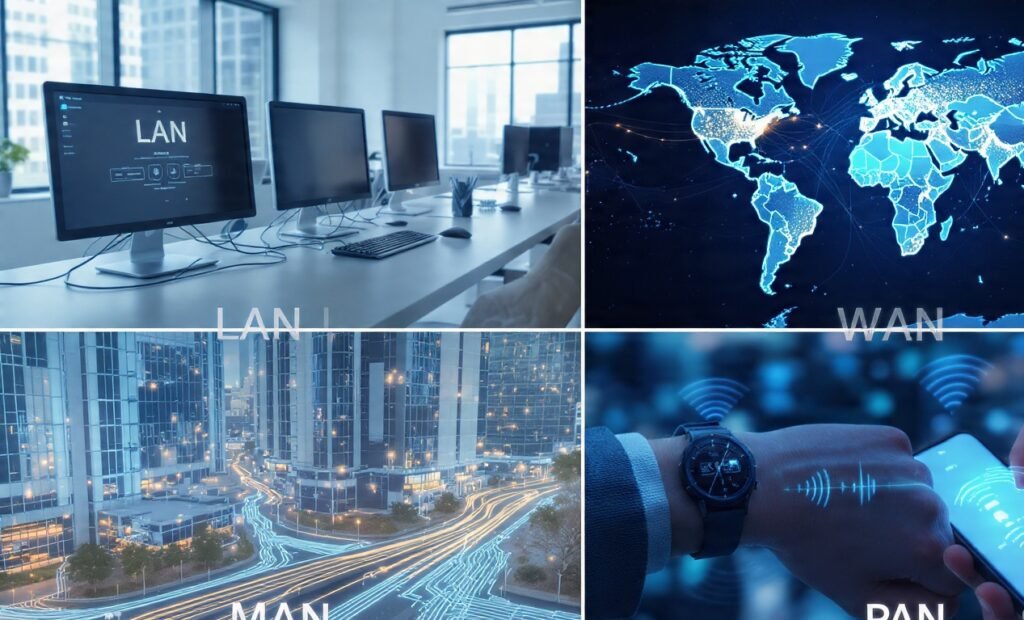
To choose the appropriate network, it is important to know the difference between the two networks.
Comparison Overview:
- LAN:
- Small geographic area
- Very high speed
- Low cost
- Privately owned
- WAN:
- Global coverage
- Moderate speed
- High cost
- State and private property.
- MAN:
- City-wide coverage
- High speed
- Medium to high cost
- Controlled by big institutions.
- PAN:
- Personal range
- Low speed
- Very low cost
- Individually managed
Selecting the appropriate Network type.
The choice of the network is based on particular needs and requirements.
Important Factors:
- Geographic Scope: The distance that the network should go.
- Budget Constraints: cost of set up and maintenance.
- Performance Requirements: Speed and reliability needed.
- Security Requirements: Level of data protection needed
- Scalability: Ability to expand in the future
Practical Examples:
- Home Use: LAN and PAN.
- Small Business: LAN and internet (WAN connection)
- Big Company: WAN with various branches.
- City Infrastructure: MAN
Selecting an appropriate network will guarantee efficiency, cost-effectiveness, and the best performance.
Significance of Learning Network types.
It is important to know about the different computer network types due to a number of reasons:
- Efficient Network Design: Aids in choosing the appropriate architecture.
- Cost Savings: Avoids excess expenditure on unnecessary infrastructure.
- Better Security: Allows more effective protection measures.
- Better Troubleshooting: Makes it easier to identify the problem.
- Career Development: Skills and expertise that IT professionals must possess.
Computer Network in the Future.
Networking is also rapidly developing with new technologies.
Emerging Trends:
- 5G Technology: High-speed wireless connections with reduced latency.
- Internet of Things (IoT): Growth of the use of PAN and LAN.
- Cloud Computing: More dependency on WAN.
- Smart Cities: Increase in MAN infrastructure.
- AI in Networking: Intelligent network management.
These innovations are changing the way the networks operate and interact.
Conclusion
Computer networks are very important in contemporary communication and technology. The four broad categories of LAN, WAN, MAN, and PAN are created to suit various requirements depending on geographic location and functionality.
- LAN works well in small, localized settings.
- WAN allows worldwide communication.
- MAN promotes connectivity on a city wide basis.
- PAN is concerned with personal device interaction.
Knowing these networks and the different types of computer networks, users can make better decisions in constructing or deploying network systems. It can be personal use, business operations or large-scale infrastructure, the right choice of the type of network guarantees efficiency, scalability and future success.