Introduction
It is said that accounting is the language of business because it conveys, summarizes and records financial information for organization, which they need to stay alive and grow. But many students and business owners are taken aback to learn that accounting has no single purpose, and isn’t one field. Instead, accounting is a number of specialized regions, which cater to various purposes and audiences. Some branches are created to develop reports for investors and regulators, others to assist the managers to make strategic decisions, to control costs or to fulfill tax obligations. It is crucial to recognize these differences when studying and understanding them when planning a career and starting a business.
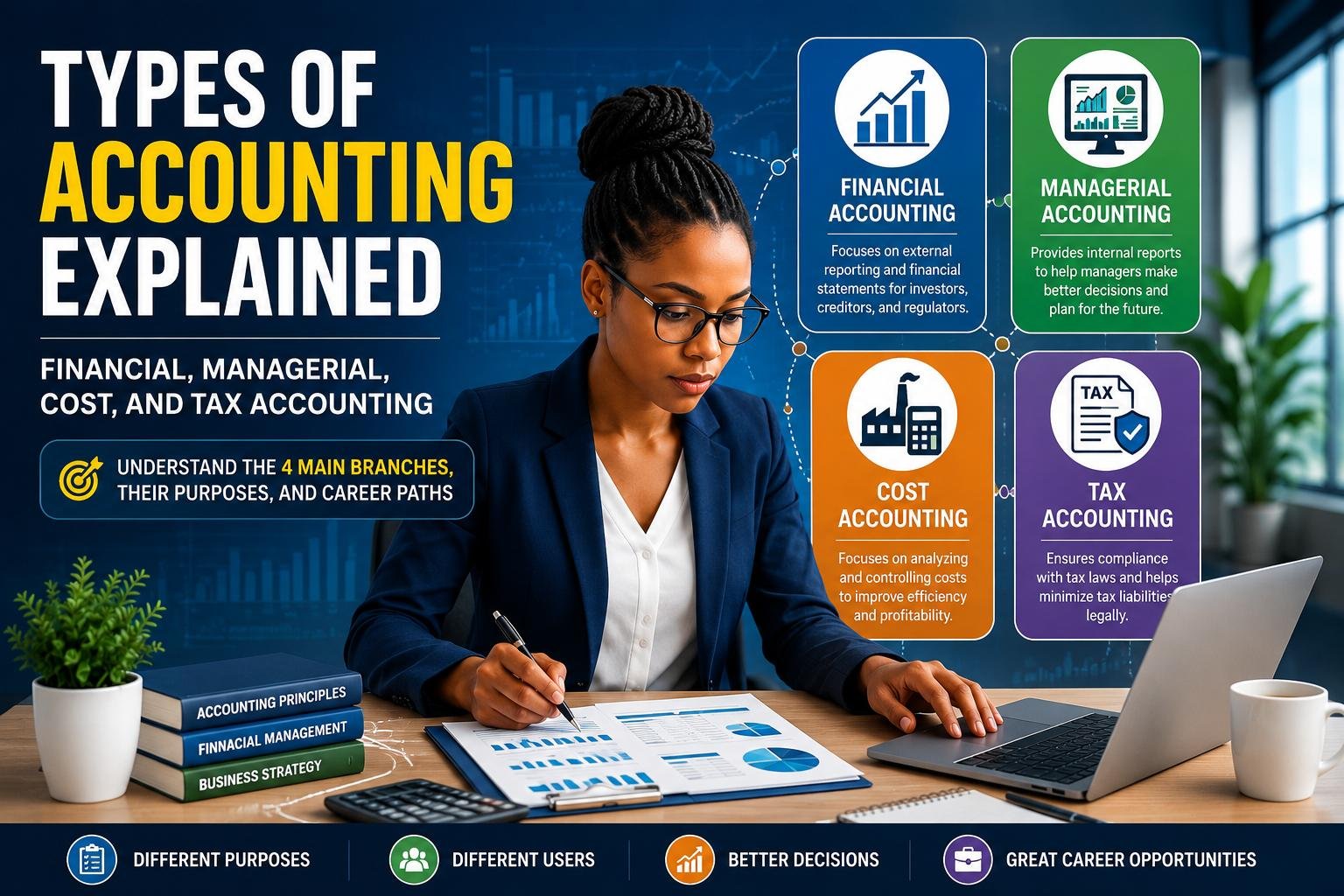
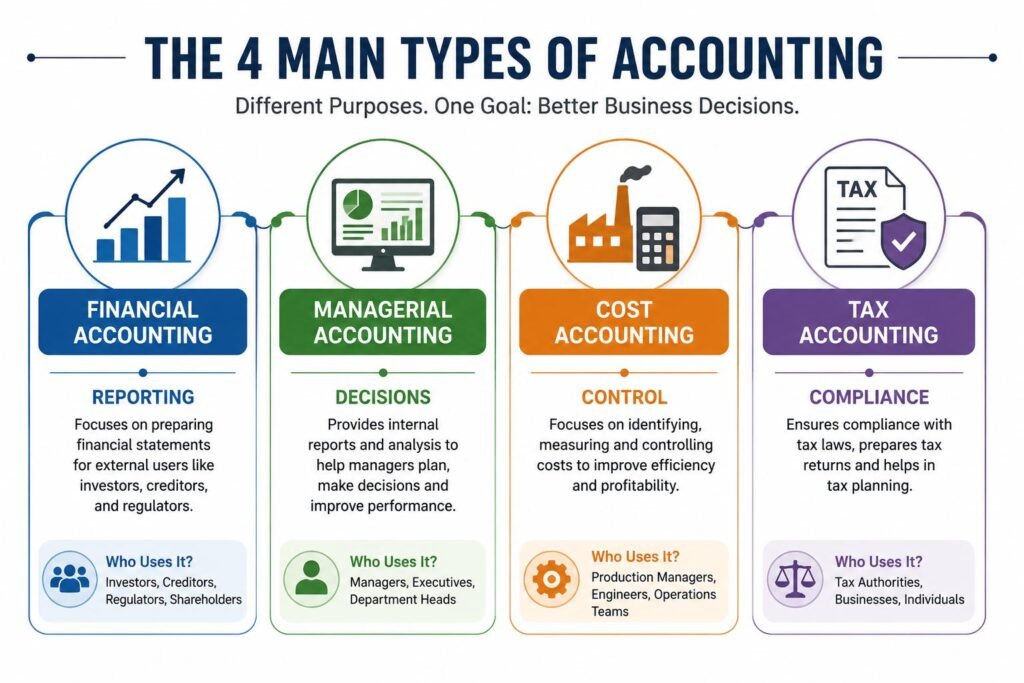
The four major branches of accounting are the most critical areas: Financial Accounting, Managerial accounting, Cost accounting and Tax accounting. Each branch has distinct tasks and responsibilities, and operates in a different way to disseminate information to facilitate decision-making. The reports that are created through managerial accounting can help a business owner decide whether or not to introduce a new product, whereas, the reports that are created through financial accounting can help an investor decide on the profits and stability of a company. Similarly, tax accounting provides adherence to the tax regulations and cost accounting assists the businesses to discover waste and enhance the proficiency.
Businesses need to select the right type of accounting, but there’s more to it than just that; students and job seekers who are investigating career opportunities should do the same. Different branches have various career paths, professional certifications, and responsibilities. Knowing their difference can assist persons in their educational and career decisions and help organizations to take full advantage of accounting information.
Understanding the Various Kinds of Accountancy
Accounting branches evolved because there is a number of accounting information users whose needs could not be met by one type of accounting information. Information needed by investors, government agencies, managers, employees, lenders and customers for various reasons. Typically external stakeholders require standardized reporting in accordance with accounting principles and internal managers require reports that are flexible in accordance with business objectives. For tax authorities, information must be accurate and adhere to the tax laws, and for production managers, it is essential to have detailed cost information to optimize production and minimize losses.
Accounting specialization enables accountants to concentrate on resolving particular business issues with the aid of monetary info. The manufacturing company can rely heavily on cost accounting to track costs and the multinational corporation may need sophisticated tax accounting methods to ensure compliance with the laws of several countries. With businesses growing in complexity and becoming increasingly international, the need for more expertise in accounting has been growing in all fields.
1. Financial Accounting
Financial Accounting: Definition.
Financial accounting is the process of summarizing and reporting company’s financial transactions to the external users. They are external users of information such as investors, creditors, government bodies, lenders, regulators and shareholders, who require information to help them assess the financial health of an organization. Financial accounting is conducted according to such standards as IFRS (International Financial Reporting Standards) or GAAP (Generally Accepted Accounting Principles) that would ensure uniformity and comparability between businesses.
Financial accounting’s main purpose is to present a true and fair view of the financial performance and financial position of a company for a given period. This information is typically provided in financial statements, generally the income statement, balance sheet, cash flow statement and statement of changes in equity. External reports involve high levels of importance in terms of the accuracy, transparency and adherence to accounting standards.
Financial Accounting Functions
Financial accounting has a number of functions within an organization. It documents business transactions systematically using journals and ledgers; creates financial statements; and makes sure that the business adheres to accounting regulations and standards. It also includes financial data from the past, which investors and creditors are interested in to determine the risk and profit potential prior to investing or lending.
One of the other roles is to ensure accountability and transparency. The public companies, especially, must publish audited financial statements to assure public stakeholders that management is utilizing the companies responsibly in their use of company resources. Financial accounting is thus an important part of establishing the trust between businesses and the stakeholders.
The Role of Financial Accounting in the Real World
Financial accounting statements are crucial to bank’s loan approval procedure. Investors analyze the company’s income statement and balance sheet before buying stock in the company. Financial information is provided to suppliers to be reviewed to determine if customers can pay. Financial reports are also beneficial to governments in compliance and economic monitoring of industries.
For instance, a manufacturing firm that wishes to lure in new investors will showcase their financial statements that are audited, showcasing their revenue growth, profitability and financial stability. If a business didn’t keep financial accounting, external parties would not have a lot of confidence in the information it provides.
Career Opportunities in Financial Accounting
Financial Accounting is a field that has a lot of job options such as Financial Accountant, Auditor, Financial Analyst, External Auditor, Reporting Accountant and Chief Financial Officer. Many professionals in this field go for qualification like ICAN, ACCA, CPA or ACA for better career opportunities and salary. Because financial accounting serves as a solid basis for accounting principles and reporting standards, most accountants start out in that field.
2. Managerial Accounting
Definition
Managerial accounting is also known as management accounting, it is for the purpose of giving financial information to the internal decision makers within an organization. Managerial accounting reports are not prepared for external users, and are not constrained by formal accounting standards, unlike financial accounting. Rather, this information is tailored to aid managers in their planning, control of operations, resource allocation and achievement of strategic goals.
Managerial accounting focuses not just on past performance, but future focus as well. Involves budgeting, forecasting, variance analysis, measurement of performance and strategic planning. These reports provide managers with valuable insights to guide their decisions and enhance efficiency and profitability.
The Functions of Managerial Accounting
Managerial accounting is most important in helping to make decisions. It can give management an idea if they should increase their business, introduce new products, add more staff or invest in new equipment. It also helps with budgeting as it forecasts future revenues and expenditures, and also tracks actual results to the expected levels.
Another use of managerial accounting is to analyze performance by measuring productivity, profitability and operational efficiency of a department. Variance analysis can help managers discover what’s causing results to fall short of budgets and can help them take corrective action to achieve better results.
Real World Applications of Managerial Accounting
Let’s assume a retail store is interested in establishing a new store in another city. Management accountants would perform a cost analysis, a sales analysis, a staffing analysis and a profit analysis, as they would do before management approves the investment. Likewise, restaurant owners might rely on managerial accounting reports to establish menu pricing, staffing plans, and buying inventory.
Managerial accounting information is frequently at a high frequency as the business decisions need up to date and relevant information. The reports can be weekly, daily or even hourly based on the needs of the organization.
Career Opportunities in Managerial Accounting
Careers in managerial accounting are attractive to professionals seeking strategies and making decisions in business. They can work as management accountants, financial planning analysts, business analysts, budget analysts, controllers or finance managers. CMA and CIMA qualifications are considered prestigious in this industry and can boost career prospects.
3. Cost Accounting
Cost Accounting: Definition
Cost accounting is a specialized field of accounting, which is concerned with the identification, measurement and control of the cost of the production of goods and services. In manufacturing, construction, healthcare, logistics, and other sectors, where the efficiency of operations directly impacts profitability, it is particularly crucial to control operational costs.
Cost accounting involves a study of the actual cost of products or services by analyzing the costs of materials, labor and overhead. Knowing the costs allows businesses to set the right price for their services and products and find ways to make them more efficient.
The Functions of Cost Accounting
Cost control is one of the most important activities of cost accounting. Keeping a close watch on costs can help businesses identify waste, cut down on inefficiencies, and boost their profits. Cost accounting also helps in pricing because it helps to enable the sale of the products at the price that will cover cost and be able to give reasonable profit.
Another significant one is inventory valuation. For manufacturing companies, it is essential to have precise cost data to help establish the value of inventory and compute the cost of goods sold. Cost accounting can also help in budgeting and production planning, by helping to estimate future costs and resource needs.
The Real-World Applications of Cost Accounting
Cost accounting can determine the cost of wood, labor and overhead in a furniture company to make a table. If production costs suddenly rise it is possible for management to delve into the reason and adjust it in a timely and effective way before the profits fall.
Likewise, hospitals employ cost accounting to establish the cost of treating patients and airlines employ it to find out the operating cost per route. These insights enable businesses to better direct resources and boost profitability.
Career Paths Available in Cost Accounting
Careers in cost accounting include cost accountant, inventory accountant, cost analyst, operations analyst and manufacturing accountant. People who love to study how things work and make them work better are well suited for this career. Continuing education courses like CMA and ICAN can positively impact job prospects and professional standing.
4. Tax Accounting
An overview of Tax Accounting
Tax accounting involves tax return preparation, tax liability calculation, and tax law and regulation compliance. Tax accountants are vital to businesses and individuals for reducing tax risks, tax penalties, and benefiting from tax deductions and incentives.
Tax accounting is not like financial accounting where tax accounting is done as per tax laws and not accounting principles like IFRS or GAAP. Tax laws change often and it is important for tax practitioners to continually learn and develop.
The Purpose of this Tax Accounting
The tax accounting plays several important roles such as tax planning, tax compliance, tax return preparation, tax advisory services etc. Tax Accountants help companies file accurate tax returns on time and help them plan their tax affairs to minimize legal tax liabilities.
Tax accountants also keep an eye on new laws and regulations and provide guidance to management on the impact of new laws on operations. They are able to assist companies in preventing expensive mistakes, audits, and fines imposed by the tax authorities.
The Real-World Implications of Tax Accounting
Tax accounting is a method employed by companies to complete their tax returns, determine value-added tax responsibilities, and to make investment decisions eligible for tax incentives. Individuals use tax accountants in a variety of situations, such as when they’re preparing personal income tax returns or dealing with tax issues for their investments.
A newly established business may seek the advice of a tax accountant prior to equipment purchase to ascertain if tax reliefs are available to lower the total cost of equipment purchase. This can have a major impact on cash flow and long-term budgeting.
Career Opportunities in Tax Accounting
There are different tax accounting career options including tax accountant, tax consultant, tax adviser, revenue officer, and corporate tax manager. Some tax professionals choose to specialize in tax accounting by acquiring additional qualifications like ICAN, ACCA, CPA, or specific tax certifications to boost their skills and career opportunities.
Comparing the Four Branches of Accounting
In some aspects, these branches of accounting have cross-over functions, however, they have different purposes and audiences. Financial accounting is mainly for external parties and is historical based. Managerial accounting is used to assist with internal decision making processes and future planning. Cost accounting focuses on managing production and operational expenses, whereas tax accounting deals with adhering to tax laws and planning.
All four branches may be used in combination by businesses, each offers different information which can help in overall success. In short, financial accounting helps attract investors, managerial accounting aids in decision making, cost accounting helps to improve efficiency, and tax accounting helps prevent compliance risks and excess costs from being incurred by businesses.
Which Type of Accounting Is Right for You?
Students who specialize should take into account their interests and strengths in their career choice. People who are interested in creating reports and dealing with regulations may find financial accounting to be their preferred career. In the meantime, Managerial accounting may be more interesting for those interested in strategy and business operations. However, professionals who are interested in data analysis and improvements in efficiency may excel in cost accounting, and professionals who like laws and regulations may excel in tax accounting.
It is important for business owners to also know which accounting services they require the most. Tax accounting and financial accounting support are needed for startups and cost accounting systems are beneficial for manufacturing companies. The growth of the businesses is normally reliant on managerial accounting to help with expansion and strategy planning.
Conclusion
There are many more variations of the accounting profession than most realize. Financial accounting, managerial accounting, cost accounting and tax accounting all have different functions and offer different information which is important to the success of an organization. Combined these branches make up a full financial information system for reporting, planning, cost control and compliance.
Students and job seekers can use their knowledge of these areas to make educational and career choices. Business owners can benefit from understanding the kind of accounting information they need to make better decisions and for better business performance. Whether you are in the business of grocery stores or a small business, understanding these various branches of accounting can be a valuable foundation for a successful financial life and a thriving business.
Get more well researched information about the Types of Accounting Explained here.