
Introduction
A trial balance is a very key element in the accounting cycle. Before we prepare financial statements accountants use it to check that the total debits in the ledger is the same as the total credits. When they do match it gives us confidence that the bookkeeping records are in fact balanced. But should the totals not agree it is a sign that we have made one or more errors in the recording, posting or summarizing. Although an unbalanced trial balance may at first seem very daunting the issue almost always may be traced out and corrected by a systematic issue solving approach as opposed to guesswork.
Many of our accounting students and professionals have run into trial balance issues at some point in their careers which is to be expected when you are dealing with large transaction sets or manual bookkeeping systems. Also businesses that use accounting software report trial balance imbalances which may be a result of incorrect journal entries, improper account mapping, or data import errors. What is key to quickly resolve them is to identify the main causes which you see play out the most and to use a logical investigative approach as opposed to going through each transaction at random. For a better understanding of the purpose and structure of a trial balance which in turn will help you to diagnose and correct balance issues, we suggest you study the accounting principles which are the base of this important report.
Determining the Use of a Trial Balance
Verify that total debits add up to total credits after you have recorded all transactions. In every accounting transaction we have the double entry principle which means for every debit there is a corresponding credit. If the posting has been done correctly the trial balance should report exact numbers. Although a balanced trial balance does not prove that each individual transaction is accurate it does show that the balance between debits and credits is right. This is a very important quality control step which is performed before we prepare the income statement, balance sheet, cash flow statement and other financial reports. While a balanced trial balance doesn’t guarantee that there are no errors in each transaction it does serve as an early warning system which helps us to identify recording mistakes before the financial statements go out to management, investors, lenders, or regulatory authorities.
Why the Trial Balance doesn’t balance.
A trial balance does not balance out when we see that total debits do not equal total credits. This is almost always a result of human error, software set up issues, or incomplete accounting entries. The issue may have come up at the time of journal entry preparation, ledger posting, account reconciliation, or balance extraction. Some errors affect only a single account, while others play out in many. By understanding the root cause accountants are able to narrow down which transactions to look at instead of going over each one. In many cases the size of the imbalance is a clue which type of error we are dealing with some error patterns are telltale. For instance if the difference is a multiple of nine it is very likely a transposition error. Also if the imbalance is the exact amount of a recent transaction we may be looking at an omitted or one sided journal entry. As you learn to recognize these clues you greatly reduce the time it takes to get the books back into accurate order.
Start with the Simplest Checks First
Before jumping to the conclusion that there is a complex accounting issue at hand, accountants should first go through basic verification procedures. We see that in many cases trial balance issues are the result of simple arithmetic or data entry errors as opposed to in depth bookkeeping problems. Check that all ledger accounts have been included in the trial balance, which debit and credit columns are totaled correctly, and that balances are put in the right column. Also see to it that all journal entries have been posted before report generation. In the case of businesses which use accounting software check that the report dates is correct and that no filters are putting out certain accounts. By doing these simple checks first you will in many cases resolve the issue within minutes which in turn will eliminate long drawn out investigations and also will prevent that which is at times excessive frustration during the month end or year-end close out.
Identifying Transposition Errors
What Is a Transposition Error?
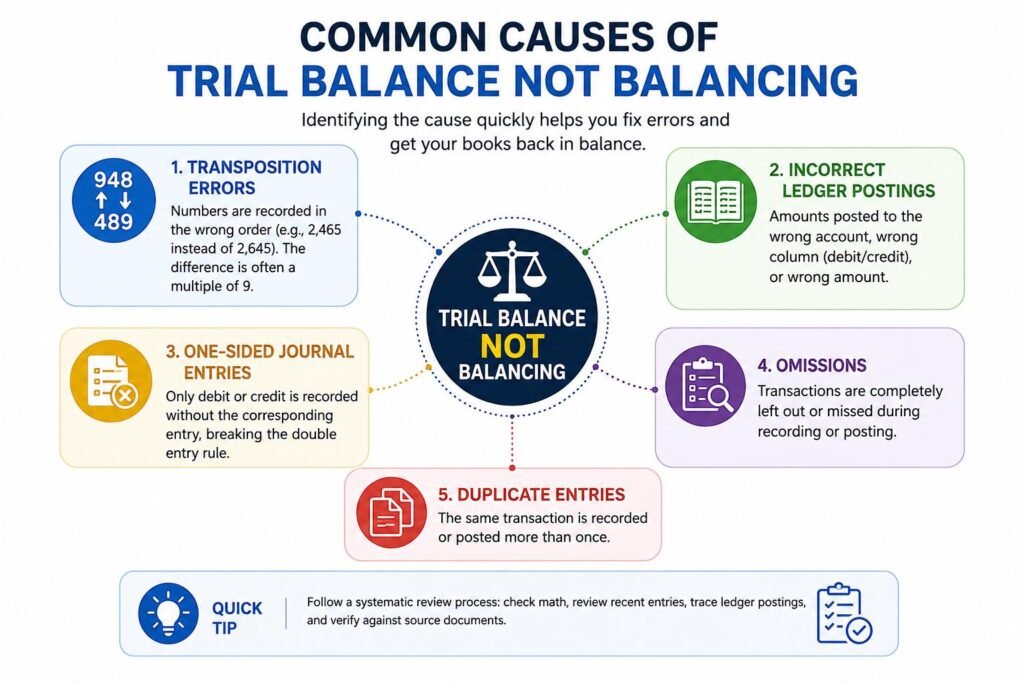
A transposition error is a type of mistake that happens when numbers within a total are put in the wrong order. For example recording ₦8,451 instead of ₦8,541 changes the value of the transaction but doesn’t affect its structure. Though the difference may be small at first glance it causes the debit and credit to not match up when only one side has the inaccuracy. Also transposition errors are very common cause of trial balance not balancing out because they present in manual data entry, ledger posting, or while working with spreadsheets. Luckily these types of mistakes have a unique math related trait which is very useful to accountants in identifying them fast. The issue with transposed digits is that the difference is almost always a multiple of nine which in turn makes division by nine a good tool to use in the process of error detection. While this does not identify which specific transaction is in error it does give a great place to start which in turn makes the error easier to find and correct.
How to Find Transposition Errors
Finding out transposition errors is a process which requires a systematic review of recent transactions as opposed to at random checking of every ledger account. Start by determining the difference between total debits and credits. If that difference is a multiple of nine care should be taken to look at transactions with similar amounts or that which were entered recently. Go over journal entries against the original source documents like invoices, receipts, bank statements, or payment vouchers. Pay close attention to numbers with repeated digits as they are easy to put in reverse during data entry. Also review manual spreadsheets against the general ledger which will help to identify inconsistencies. Many accounting software includes audit trails which show when a transaction was created or modified which in turn makes it easier to trace out of the ordinary entries. Once the transposed digits are identified correct the affected journal entry or ledger post, run the trial balance again and check that the totals agree.
Detecting Incorrect Ledger Postings
Inaccurate ledger postings happen when journal entries go to the wrong account, are put for the wrong amount, or into the incorrect debit or credit column. Also when the journal entry is perfect the error happens in the posting which in turn causes trial balance issues. For example a debit which should go to Office Supplies Expense may instead be posted as a credit or go into Equipment. Also we see it when an amount is posted twice to an account and not at all to another. What we find is that errors of this nature are best detected by a line by line comparison of journal entries with ledger postings to see that each transaction posted correctly. Also accountants should-reconcile account balances against support documentation and check that account classifications match the company’s chart of accounts. A close look at posting references, account numbers, and transaction descriptions usually will reveal the discrepancy before it grows into a large reporting issue.
Finding One-Sided Journal Entries
A very serious issue in bookkeeping is that of the one sided journal entry which breaks the base principle of double entry accounting. For each transaction there must be at least one debit and one credit of the same value. Should only one side of the transaction be recorded the accounting equation goes right out of balance. One sided entries may result from interrupted data input, software issues, the accidental deletion of a line, or user error in manual bookkeeping. Also they may cause trial balance to differ by the amount of the transaction which makes them relatively easy to spot once recent entries are reviewed. Accountants should look at transaction logs, audit trails, and journal entry reports to see that for each debit there is a credit. At the point a missing entry is identified the correct posting must be made right away, also a trial balance should be run off to see that the books are back in balance.
Other Typical Mistakes that Affect Trial Balance Accuracy.
Although we see that transposition errors, incorrect postings, and posting to the wrong account as the primary causes of an unbalanced trial balance, also many other errors play a role. We have omissions of transactions, accidental duplication of transactions, and postings to the wrong accounting period. Also in manual bookkeeping systems we see that calculation errors in ledgers are not uncommon. Also old errors from the prior accounting period which go uncorrected carry forward and create ongoing issues which in turn affect reports. Also we see that suspense accounts which aren’t resolved before the trial balance is run create more issues during the reconciliation process. By being aware of these also other issues accountants may take a more comprehensive approach to investigation which is to say they do not put all their effort into looking at one type of error and ignore others which also may be very much so in play.
A Guide through the Process of Resolving Trial Balance Errors
Step 1: Note the difference.
Calculate out the exact difference between total debits and total credits. Report that amount which may give clues as to what type of error is present. Also look at recent transactions to determine if the imbalance is similar to a particular journal entry amount or a number which is divisible by 9.
Step 2: Check Math Accuracy.
Recalculate all the debit and credit totals by hand or with the use of spreadsheet formulas. Check that all account balances are present and that no numbers have been put in the wrong column during report preparation.
Step 3: Check your recent journal entries.
Check out the latest accounting entries where we see many errors play out in the present period. Go over each journal entry in detail against the support documentation to determine that the recorded numbers are full and accurate.
Step 4: Review Journal Entries against the General Ledger.
Trace all journal entries in the ledger accounts which they were posted to. Check that each debit and credit is in the right account with the correct amount and balance classification.
Step 5: Look out for duplicate and missing entries.
Review transaction records for omissions and duplicates. Go over transaction numbers, dates, descriptions, and reference numbers to identify which are posted more than once or which are completely missing.
Step 6: Recreate the Trial Balance.
After correction, prepare a new trial balance and check if total debits equal total credits. If differences still present, go through the review process in a methodical way instead of putting in additional changes without support of evidence.
Best Practices to Avoid Trial Balance Errors.
Prevention of trial balance issues is a much better approach than to correct them after the fact. We see that organizations which put in place standard accounting practices, keep extensive records, and do routine reconciliation throughout the account period instead of at month end do very well. Regular bank reconciliations, periodic ledger reviews, duty segregation, and approval processes reduce what we see to be the root cause of inaccuracy. Also it is put forth that accounting software should be programmed to require balanced journal entries which will in turn be reviewed independently before transactions are finalized. Also staff training is key to the issue at hand as employees that have a grasp of double entry accounting are less likely to put forward one sided entries or to make incorrect ledger posts. We also see that frequent internal audits and automated exception reports which flag out of the ordinary transactions before the affect the trial balance and financial statements reporting do in my view greatly improve financial accuracy.
The Role of Accounting Software in Error Detection
Today’s accounting software has seen great improvement in terms of speed and accuracy of identifying trial balance errors. Most systems which are put in place today do away with unbalanced journal entries, they run out exception reports, maintain audit trails, and supply detailed transaction histories which in turn simplifies investigations. Also included in most software are what we may call built in validation rules which check out account codes, transaction dates, and posting requirements before which the entries are accepted. In also in very advanced systems we see that accountants are able to go from the trial balance right into individual ledger accounts and supporting journal entries which in turn greatly reduce investigation time. It is true though that software does not do away with all accounting errors which may come from use of incorrect source data, inappropriate account choice, and a lack of understanding of the accounting principles which in turn produces inaccurate financial reports. Thus no matter how good the technology is human review is still very much a requirement.
Conclusion
A trial balance that doesn’t balance out should never be put aside as it indicates that the accounting records require more looked into before financial statements are prepared. Also it is great that most differences can be sorted out quickly by using a methodical problem solving approach instead of a hit or miss. We start with basic math checks, we look at transposition errors, we go over ledger posts, we look at one sided journal entries and we trace transactions back to their support documentation which allows us to find the cause of the imbalance very efficiently. By use of a mix of investigative techniques with strong internal control, regular reconciliations and properly put together accounting software organizations are able to keep their financial records accurate and avoid large scale reporting issues. As a student of accounting which is just starting out or a professional that is dealing with large scale finance systems, mastering these problem solving techniques will improve accuracy, it will raise confidence in financial reports and see you through to the end of the accounting cycle with reliable and balanced books.
Get more well researched information about Trial Balance Not Balancing here.



I like the efforts you have put in this, regards for all the great content.